
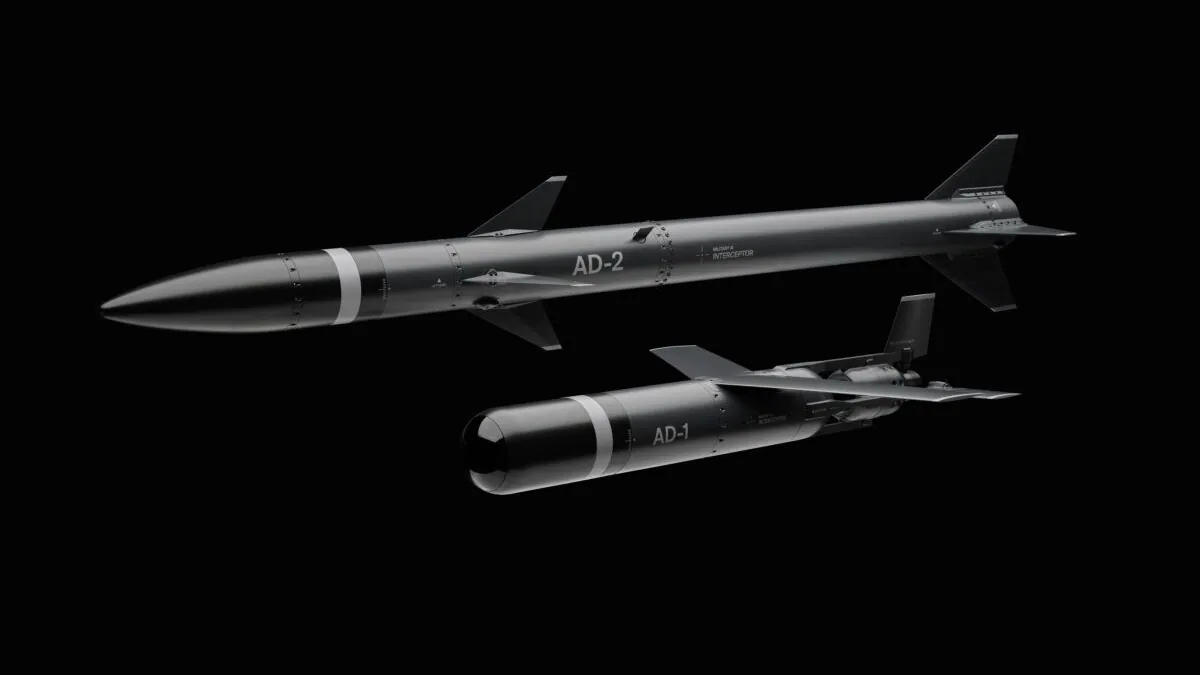
Helsing unveiled an air defense system called Contra in Berlin on Monday, along with two interceptor missiles it says will cost less than €100,000 each. The AD-1 Inferno is jet-powered and built to loiter. The AD-2 Ambush rides a solid rocket motor. Both are aimed at the jet-powered Geran drones Russia now launches at Ukraine by the thousand every month.
Contra is the Munich company’s first air defense system. DroneXL last covered Helsing in August, when Rakuten was brokering a sale of its HX-2 strike drone to Japan’s army, and in July, when it picked West Virginia for an HX-2 factory. Co-founder Gundbert Scherf told reporters on Monday that one customer, which he did not name, has already signed a contract for the Contra command system.
Neither interceptor has finished flight testing. A Helsing representative at the briefing put the earliest deliveries in the second quarter of 2027.
Helsing Prices Both Missiles Under €100,000 and Promises 1,000 a Month
Scherf put the unit price of the AD-1 and the AD-2 below €100,000 apiece and said mass production of the AD-1 means 1,000 a month. Helsing’s comparison, as hartpunkt reported it, puts existing interceptor missiles at €500,000 to €4 million each, shipping in the hundreds or thousands per year.
The saving, by Helsing’s account, comes from an active radar seeker built from commercial off-the-shelf parts. The company says the seeker costs less than a tenth of comparable seekers and, per hartpunkt, is largely the same part in both missiles. It pairs an optical sensor with the radar, and Helsing says the radar is there because Russia times its attacks for darkness and bad weather, when camera seekers go blind. “When we say mass-producible, we mean 1,000 units per month,” Scherf said, according to defence-network.
Both missiles use jet engines and rocket motors Helsing developed in-house, on supply chains the company describes as free of US export restrictions and mostly European. The two missiles get separate supply chains, and both would be built in the decentralized plants Helsing calls Resilience Factories. German defense site hartpunkt reported that output would reach several thousand a month once development ends in the second half of 2027.
The AD-1 Loiters and Re-Attacks While the AD-2 Sprints Past Mach 2
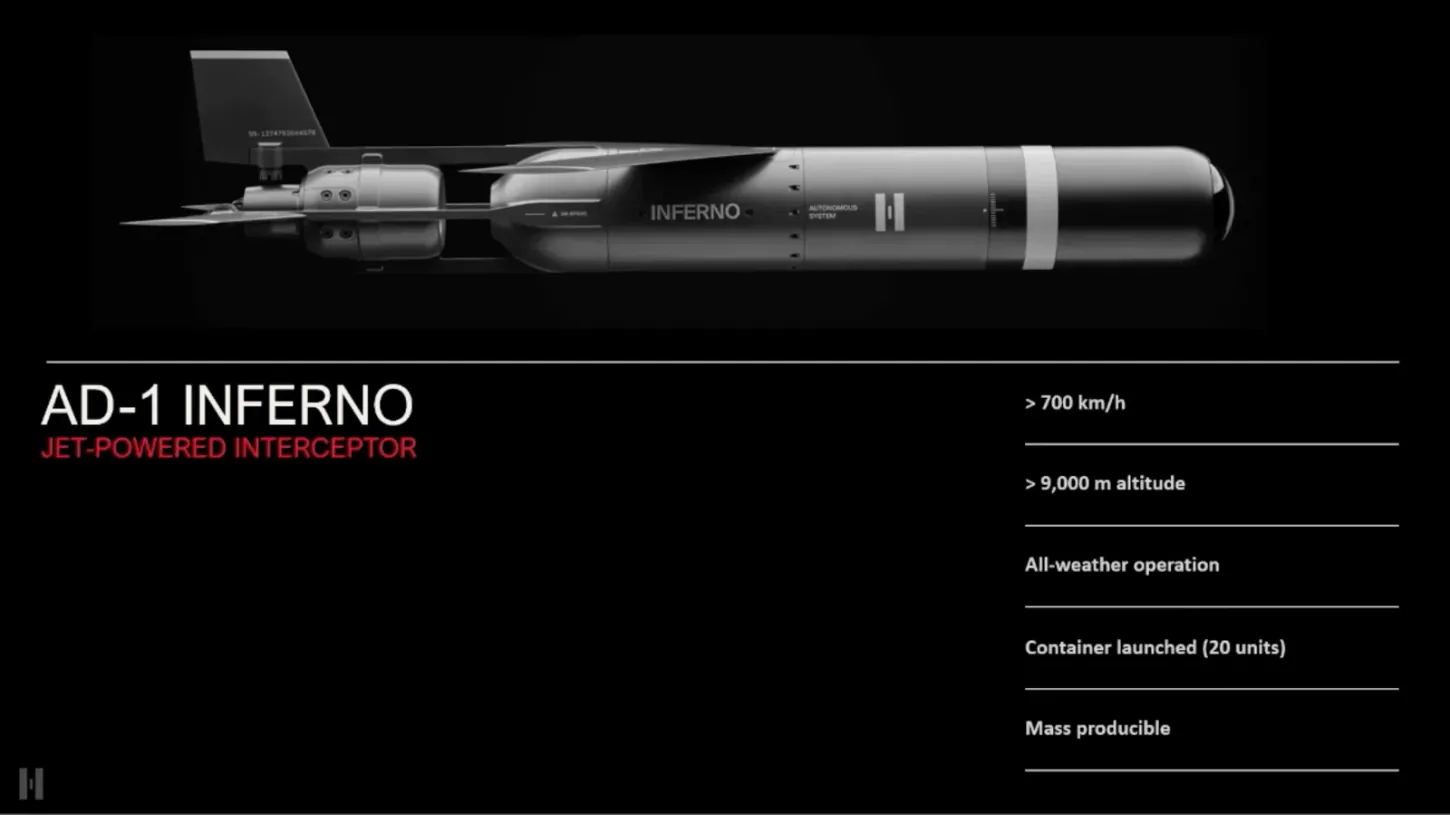
The AD-1 Inferno is a jet-powered interceptor that tops 435 mph (700 km/h). It reaches 12 miles (20 km) and climbs above 29,500 feet (9,000 meters). The AD-2 Ambush passes Mach 2 on a solid rocket motor with the same range and ceiling, built for threats beyond the AD-1’s reach.
Both launch from 20-foot shipping containers, 20 AD-1s or 40 AD-2s per box, moved by truck, rail or ship. Contra’s ground radars guide them mid-course and the onboard seeker takes over for the final approach. The AD-1 can loiter, fly as a swarm and come back for a second pass if it misses, and Helsing’s product page places it between electric interceptor drones and legacy missiles. Niklas Köhler, Helsing’s co-founder and president, told reporters the pair delivers “autonomous fire superiority at altitudes of up to 10 kilometers.”
The target is the drone Ukraine’s intelligence service took apart in May. The GUR teardown DroneXL reported on May 26 put the Geran-4 at 310 mph (500 km/h) and 16,400 feet (5,000 meters), and said Russia built it to outrun Ukraine’s $2,000 interceptor drones. Helsing says Russia now uses 4,000 Geran-4 and Geran-5 jet drones a month, and hartpunkt put their unit cost at €200,000 to €250,000. President Volodymyr Zelenskyy’s own count, which DroneXL cited in its September teardown story, was more than 2,730 jet-powered Shaheds launched in September, with Ukraine stopping 55 percent of them.
Contra Runs on Altra and Has a Customer Before the AD-1 Has Flown
Contra runs on Altra, the command software Helsing uses for its HX-2 strike drone, and the first contract covers that software, not the missiles. The system fuses radar, electro-optical, infrared and acoustic sensors from any vendor, assigns each track to the best weapon and can re-task interceptors in the air.
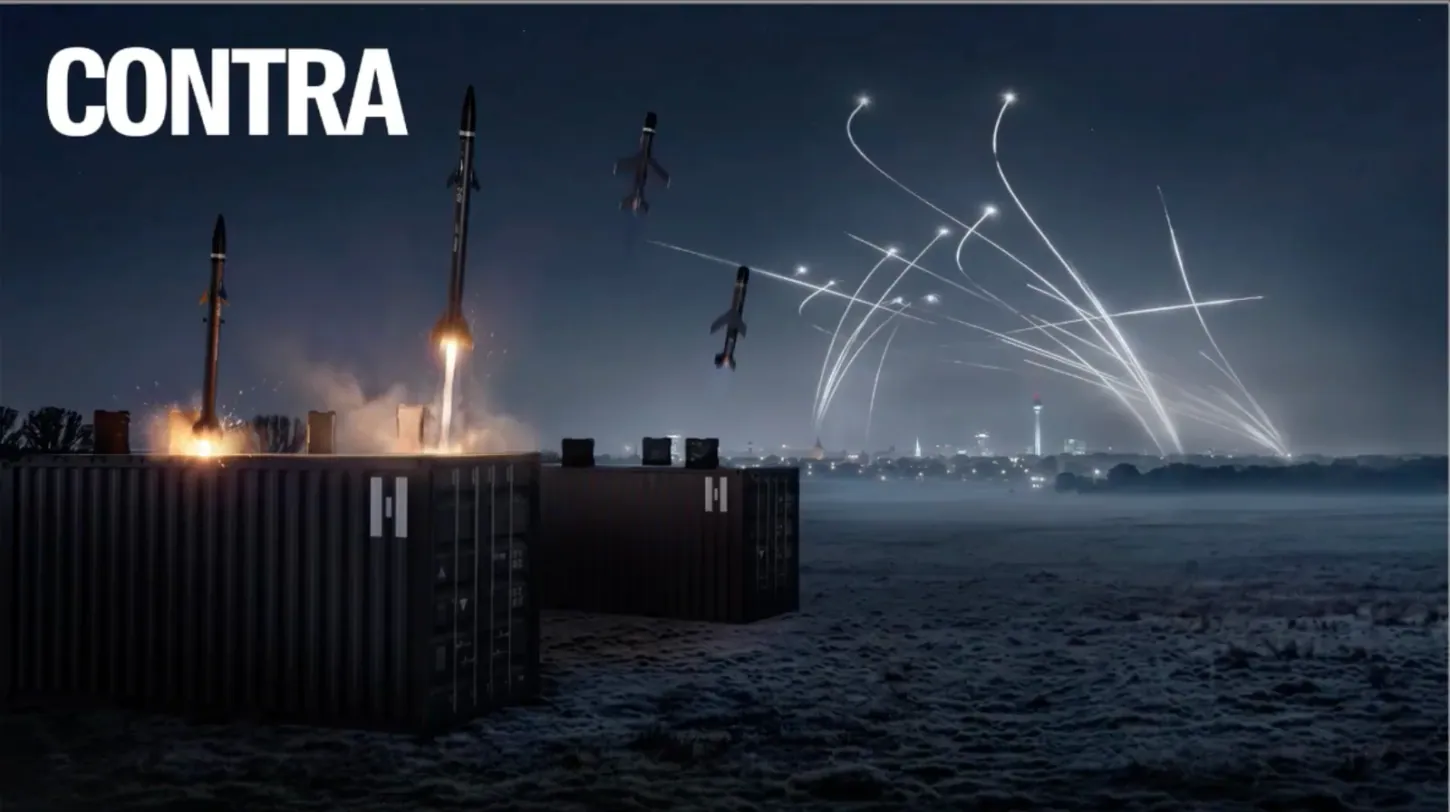
The company says third-party guns, lasers, net launchers and interceptor drones can be plugged in through open interfaces within days, that operators set the rules of engagement, and that the system connects to SitaWare and the German army’s own battle management software. It showed a video of an AD-2 test flight. The AD-1 went from concept to demonstrator in two months, Helsing said, and its first flights are due in the coming weeks.
DroneXL’s Take
The price is a promise and the seeker is the bet. My read is that Helsing has the diagnosis right: GUR said in May that Russia built the Geran-4 to fly away from Ukraine’s $2,000 interceptor drones, and a 435 mph jet with a radar nose is the correct shape of answer. But a radar seeker assembled from catalog parts that sees through fog at a tenth of the usual cost is a claim every missile house would love to make, and what Helsing showed in Berlin was a flight video, not a seeker test. I’ll believe the seeker when a European army publishes a result, and until then Contra is a contract and a concept render. Ukraine is stopping 55 percent of Russia’s jet Shaheds today with the interceptors it has, and Helsing’s earliest delivery is the second quarter of 2027. Russia went from the propeller Geran-2 to the jet Geran-4 and Geran-5 inside a year to beat a $2,000 drone, and I expect it to change the aircraft again before Helsing fills its first container.
Sources: Helsing, defence-network, hartpunkt, dpa, Militarnyi
DroneXL uses automated tools to support research and source retrieval. All reporting and editorial perspectives are by Haye Kesteloo. Read our editorial standards.


