
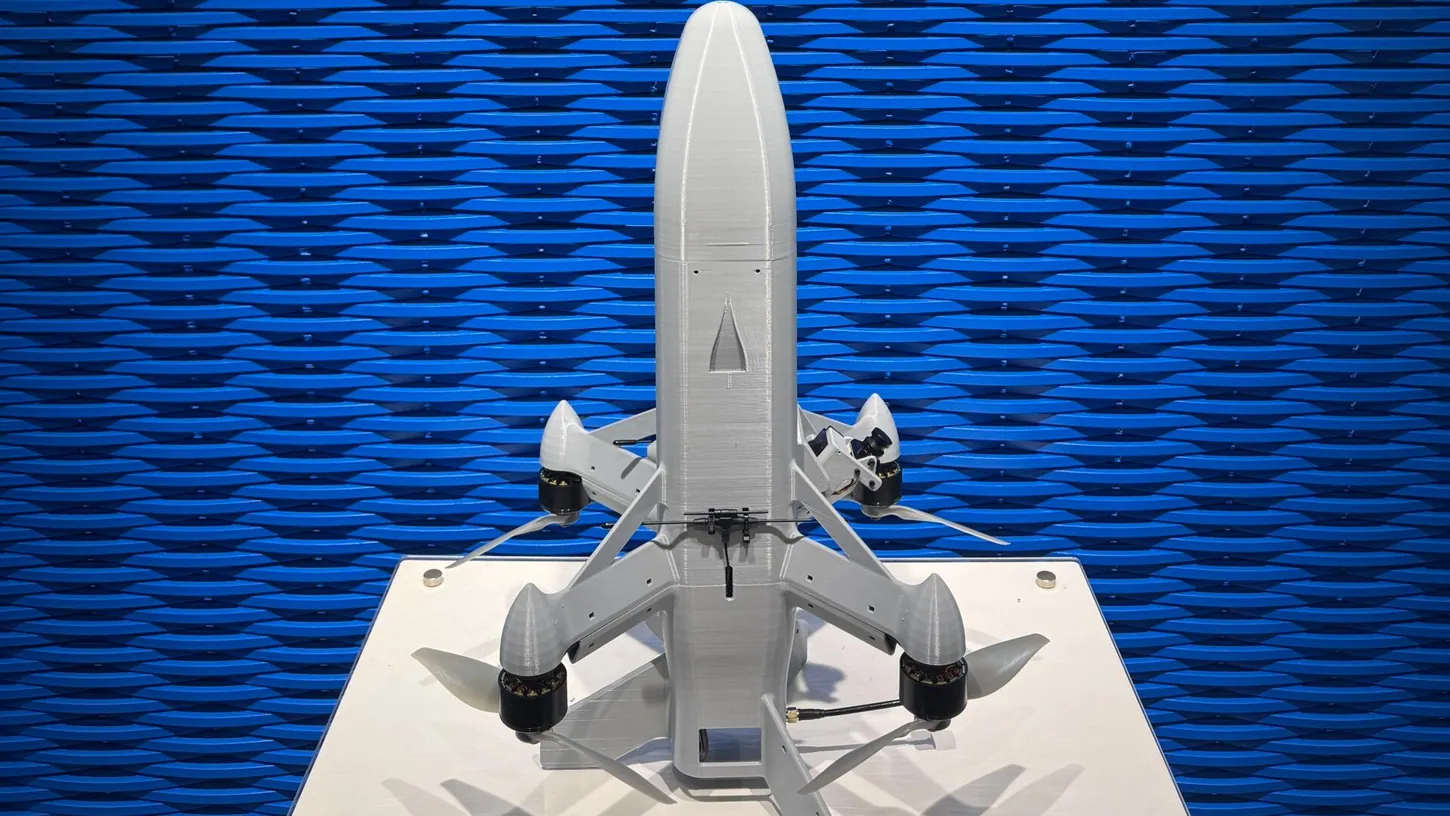
Terra Drone president Toru Tokushige says he would be lying if he claimed not to be scared. On October 21, Russia’s Foreign Ministry singled out his Tokyo company over interceptor drones its Ukrainian subsidiary had delivered to Kyiv’s Defense Ministry. Spokeswoman Maria Zakharova called the delivery a blatantly hostile step and promised Japan a tough response. She also repeated that weapons threatening Russia’s security, and the capacity built in Ukraine to make them, are legitimate targets for its armed forces.
Tokushige answered in a two-part interview with Gendai Business, Kodansha’s business site, published November 3. He is not stopping. Gendai describes his greatest concern as the parts Japan’s drones are built from, and what happens to that supply if a crisis breaks out over Taiwan.
In the remarks Interfax and RIA quoted, Zakharova spoke of Terra Drone’s drones being used in combat on the front line and did not call them interceptors. The press release she cited says they are built to shoot down Russian FPV and reconnaissance drones.
Zakharova Named Terra Drone and Warned of Measures Sensitive for Tokyo
Zakharova cited Terra Drone Corporation’s October 14 press release by name at her October 21 briefing, according to Interfax. The delivery came despite repeated Russian warnings, she said. Tokyo’s argument that the company’s work with Ukraine’s army is a private initiative was, she said, absolutely unconvincing.
She then said “such attacks on Russia will not be left without a tough response,” including measures sensitive for Tokyo in the relevant areas. Neither Interfax nor RIA Novosti quotes her naming one. She said Russia has the resources to respond and closed by saying she thought Tokyo would hear the message.
Moscow made the same threat in April. Terra Drone announced its investment in Kharkiv-based Amazing Drones and the Terra A1 interceptor at the end of March, which we covered in April. On April 6, Zakharova said joint drone plants built with Japan in Ukraine would be legitimate military targets, APA reported. Two days later the ministry summoned Japan’s ambassador in Moscow and called the investment overly hostile and harmful to Russia’s security interests.
Kurin’s KT-1 and KT-2 Hunt FPV Drones, Not Shaheds
The October delivery came from Kurin Technologies, a Kyiv interceptor maker Terra Drone brought into its group in September through its Estonian unit, Terra Defense Europe. Kurin’s KT-1 and KT-2 go after FPV drones, reconnaissance drones and Molniya-type drones flying low over the front, not long-range Shahed-type attackers.
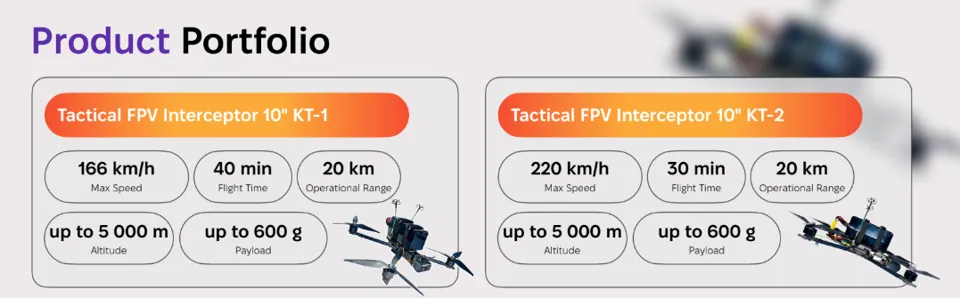
Terra Drone said the deal takes it beyond long-range threats into protecting the front line’s low airspace. Both are 10-inch tactical FPV interceptors. Kurin’s spec sheet puts the KT-1 at 103 mph (166 km/h) with 40 minutes of flight time and the KT-2 at 137 mph (220 km/h) with 30 minutes. Each has a 12-mile (20 km) operational range and a payload of up to 600 g.
According to Terra Drone’s October 14 announcement, Kurin took part in a tender run by Ukraine’s Defense Procurement Agency, the ministry body that has centralized military buying since January 1, and delivered interceptors to the front. The release gives no quantity. Kurin started selling commercially in late April and says it can now build more than 12,000 a year. The 3rd Army Corps already flies them, and its deputy air defense commander, Oleksandr “Jan,” calls them “the best frontline interceptor drones we have used,” as Terra Drone’s Japanese release quotes him.
The same release cites Ukraine’s Defense Ministry figures to show the scale. The ministry says its forces downed more than 350,000 enemy drones between January 1 and September 22. About 31,000 of those were Shahed-type. The rest were cheaper fixed-wing and multirotor drones working the front line. Terra Drone’s Shahed interceptors sit with two other Ukrainian units, Amazing Drones (Terra A1) and WinnyLab (Terra A2), in which it agreed in June to take 50% stakes.
Tokushige Says No Weapon Left Japan
Tokushige told Gendai Business that a Ukrainian company built the drones in Ukraine and delivered them to Ukraine’s Defense Ministry. Nothing was exported from Japan, he said, and the Japanese government was not involved. He suggested Moscow is blurring the two on purpose.
He was surprised, he said, that Russia would go this far against a private startup. He has been to Ukraine 15 times and says the production sites there are dispersed and hidden. Gendai reports that Defense Minister Shinjiro Koizumi said there was no problem as long as Japanese companies follow Japanese law, and pointed out that Russia fights with North Korean missiles and troops in violation of UN resolutions.
Terra Drone’s own response was quieter. On October 21, the day of the briefing, it published a statement signed by Tokushige saying its defense products are interceptors meant for defense, not attack, that it follows Japanese law and the laws of the countries involved, and that it will not touch weapons banned by international treaties. The statement does not mention Russia.
Tokushige Wants 65% of Japan’s Drone Parts Made at Home Before 2028
In the second part, Tokushige said the company’s drones have about 20 main parts each, and only the batteries and flight controllers are made in-house, with the rest bought from foreign suppliers that include Taiwan. A Taiwan crisis that closed the sea lanes would stop production at once, he said.
Rebuilding those parts from scratch inside Japan would take six months to a year, by his estimate. He believes China and North Korea already hold large numbers of cheap one-way attack drones. Without interceptor production in those first months, he said, Japan would be hit by Shahed-type drones and missiles with no way to answer. He put it bluntly: “If things continue like this, Japan will be beaten to a pulp.”
His fix, which he says he is pressing on politicians, is a minimum of 65% domestic content by value. The rule the Defense Ministry plans today only gives bidders extra points for domestic parts, he said, and nobody will pay to localize for that. In peacetime, a mother factory would build tens of thousands of drones a year. About 500 drone schools would be contracted to assemble hundreds of thousands in wartime. He sees the risk window opening after Taiwan’s January 2028 presidential election, which by his count leaves Japan a year and a few months.
That cuts against the pitch the Japan UAS Industrial Development Association made in July, when its executive director urged closer manufacturing ties with Taiwan, pairing Japanese components with Taiwanese capacity. Tokushige wants a supply chain free of China and of Taiwan too.
Japan’s first interceptor buy shows how far the rules reach today. The Acquisition, Technology and Logistics Agency (ATLA) required a Japan-made interceptor in its fast-track program, according to Terra Drone, took 38 proposals and sent four makers into navy testing. Terra Drone’s Terra B1 was the only one to pass, the company said on August 25, and ATLA’s schedule called for a mass-procurement contract in late August and delivery around September. Tokushige told Gendai the company won the order for the Maritime Self-Defense Force.
DroneXL’s Take
My read is that the October statement was aimed at Japanese money, not at Kurin’s output. Zakharova went out of her way to reject Tokyo’s private-initiative defense, and the April threat came within a week of Terra Drone’s first Ukrainian investment. I think Koizumi’s answer, as Gendai reports it, was the right one, and the KT-1 is a strange thing to call an attack on Russia when its job is to stop Russian drones.
The Taiwan warning deserves more attention than the threat, and Tokushige makes the case against his own convenience. He told Gendai that if he only cared about his company’s profit, he would keep quiet and keep assembling with cheap Taiwanese parts, and that a lot of people mistake assembly for domestic production. Terra Drone’s August 25 release on the Terra B1 lists a stronger supply chain for parts, batteries, communications and control equipment as work still ahead. So ATLA can demand a Japan-made interceptor while the ministry’s parts rule only hands out bonus points. Japan should write the 65% floor into the next order, before the risk window Tokushige sees opening in 2028.
Sources: Gendai Business (interview with Toru Tokushige, part 1 and part 2), Interfax, RIA Novosti, The Moscow Times, APA, Terra Drone (October 21, October 14, September 14, August 25, July 15 and June 15 announcements).
DroneXL uses automated tools to support research and source retrieval. All reporting and editorial perspectives are by Haye Kesteloo. Read our editorial standards.


