Munich startup Nomadic has raised $6 million in a Seed round led by Foundamental for drones that land on live high-voltage lines and recharge from them. The company says its 4 kg NOMADs have logged over 20,000 hours on live lines, work at up to 420 kV, and cover about 25 km each.
The release, as issued by Nomadic
Nomadic raises $6M Seed for drones that charge on live power lines and find the grid’s weakest points
A power line is only as strong as its weakest stretch. NOMADs sit on live high-voltage lines, charge from them, and move across the grid to locate the sections most likely to fail.
MUNICH, Germany, 17 November 2026. Nomadic, which builds drones that sit on and charge from live high-voltage power lines, has raised $6 million in a Seed round led by Foundamental, with participation from Verve Ventures, Cyan Ventures, existing investors Outlander VC and Asia2G Capital, and angel investors from the sdw alumni network.
With more than 20,000 hours on live lines, NOMADs are in active operation in the German transmission and distribution grids and have been deployed in Norway and the US. Nomadic was founded in 2024 at UC Berkeley by Andreas Moldskred (CEO) and Lauritz Weil (CTO) and is now based in Munich.
Electricity demand is growing faster than new power lines can be built. The International Energy Agency (IEA) expects annual grid investment to rise by roughly 50% by 2030, from around $400 billion today. Wind and solar parks, data centers and factories wait years for a grid connection. Grid operators are asked to connect more to the lines they already have, while keeping the grid as safe and reliable as it is today.
Modern grid operators already use grid and weather models to decide how much power each line can carry. These models give a good general picture of a line, but they treat it as one uniform asset. In reality, a single 10 km stretch can include splices, older components, and sections with very different weather exposure. Each of these changes what the line can safely carry, and the weakest point sets the limit for the whole line.
Measuring those differences has been hard because the grid is a system that is not made to stop. Putting equipment on a live line usually takes planning, line outages, or heavy machinery. Fixed sensors then stay where they were installed, while the weakest point moves with weather and load.
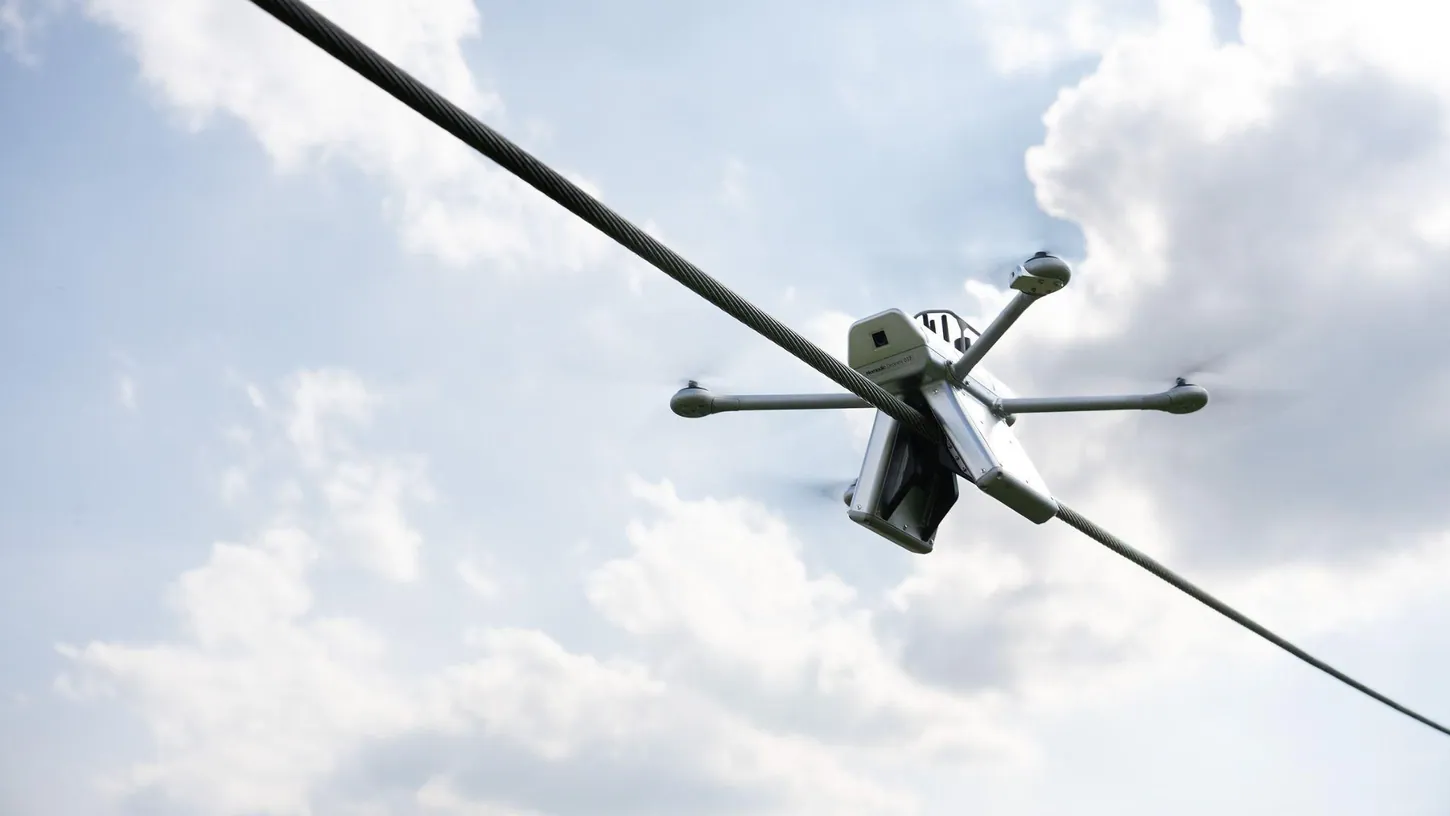
Nomadic’s drones, called NOMADs, are built to work on live lines. Each one weighs about 4 kg, lands on live conductors without a line outage and recharges inductively from the line itself.
Today, measuring conditions on a specific stretch of line often means sending a crew to drive, hike, and climb to reach it. With NOMADs, the operator’s own drone pilots bring them to site and have them on a live line within minutes, without long planning or a line outage. NOMADs are designed to fly between stretches on their own, directed from the operator’s office. That frees crews to focus on maintenance, building new lines and preparing the grid for tougher weather.
One NOMAD covers about 25 km of line, where fixed sensors are typically installed every 1 to 5 km. With a fleet in place, there is always a NOMAD close by, ready to react to events that happen in the power grid.
Nomadic OS combines the measurements from the fleet with weather models, grid models and historic line data, so the model of each line keeps correcting itself. Operators see what is physically happening on their lines in real time and can spot problems as they develop. They can run closer to the real limits without taking on more risk. That makes room for more renewable generation and new industry on the grid they already have, while keeping the system resilient against attacks and instability.
“Grid operators often have a good picture of what happens at each substation. Everything in between, along kilometers of line, has been much harder to see, because installing anything on a live line is very difficult,” said Andreas Moldskred, CEO and co-founder of Nomadic. “NOMADs land on the line, charge from it and move to where they are needed. Nomadic OS turns those measurements into the physical context layer for the power grid.”
A year ago, Nomadic deployed its first prototypes in German distribution grids. Since then, the system has proven that it works at temperatures as low as minus 25 degrees Celsius and on up to 420 kV, the highest voltage level in most European transmission grids. It has shown that it can sustain itself reliably on power from the line.
With the new funding, Nomadic will take remote relocation into production with customers in 2027, expand its fleet with grid operators in Europe and the US, and grow its team in Munich.
“Without data on actual line conditions, grid operators have to plan for the worst case. That can leave valuable capacity unused. Nomadic gives operators the measurements they need to understand what their existing lines can carry and confidently unlock more capacity. Andreas and Lauritz have already proven the technology on live lines, and we’re proud to back them,” said Dustin DeVan, Venture Partner at Foundamental.
“Landing on a line carrying up to 420 kV, in wind and at minus 25 degrees, and then running on power from the magnetic field around it, is a hard robotics problem,” said Lauritz Weil, CTO and co-founder of Nomadic. “We built our own test grid with real conductors and high currents, so every version is tested under real conditions before it reaches a customer’s line. We are looking for more passionate problem solvers to join us on this mission.”
About Nomadic
Nomadic builds drones that land on and charge from live high-voltage power lines. Its software, Nomadic OS, combines measurements from the drones with weather and grid models to show grid operators what is physically happening on their lines in real time. Founded in 2024, Nomadic is based in Munich and works with transmission and distribution system operators.