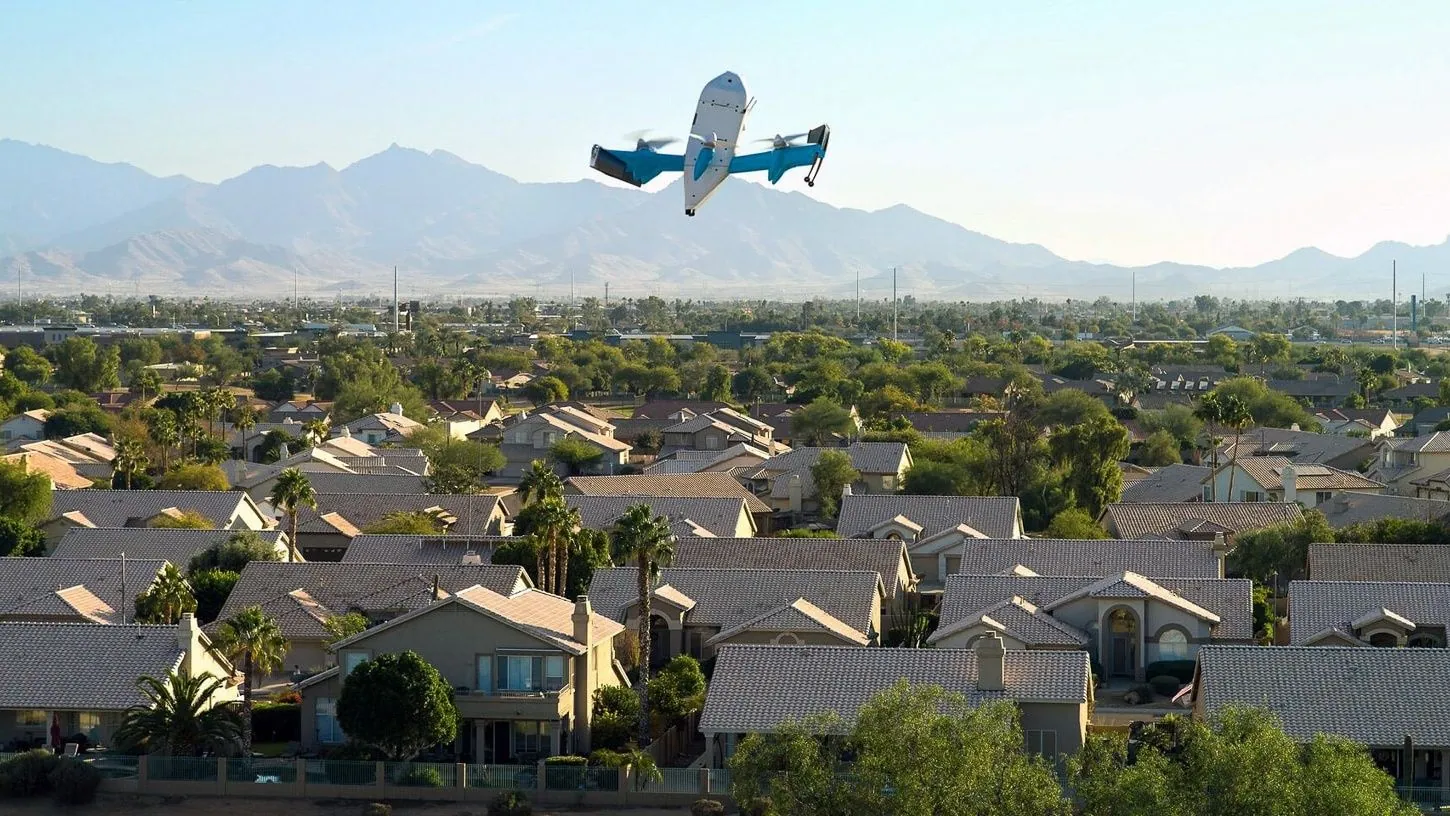
Nampa, Idaho’s planning director has told a resident in writing that the complaint contact Amazon must provide under its Prime Air drone permit is for the city and not for the public, and that Amazon asked the city not to release it and to forward residents’ complaints to that contact instead. Rodney Ashby wrote that on November 4 to Judit Crace, who lives in Cherry Creek Estates, about half a mile (0.8 kilometers) from the hub. The number Ashby passed on as Amazon’s answer for residents was one digit off and reached a telemarketing line, and Amazon sent the correct one the next morning. Crace sent DroneXL the email thread, 10 messages from November 2 to 4, after Monday’s report on the permit’s five conditions, and I have read all of it.
In the same emails, Ashby says he is investigating the noise complaints and that the permit covers the launch site, not the flights. Crace also sent four drone scanner readings that show Amazon’s MK30s between 176 and 195 feet (54 and 60 meters) above their takeoff point. The city’s findings describe a 200-foot minimum, and Amazon told KTVB last week that its drones stay higher than 200 feet over the neighborhood. Height above takeoff is not height above the ground, and the app gives its own accuracy as under 10 meters, so the readings cannot show a flight below 200 feet.
Amazon Asked Nampa Not to Release Its Local Contact, the Director Wrote
Condition 5 of the permit requires Amazon to give Nampa a local contact for drone complaints, reachable within 72 hours. Ashby wrote on November 4 that the wording does not promise residents a contact of their own, and that Amazon asked the city to keep its contact private.
The condition “does not specifically state that they will have a local contact for the public to speak to,” he wrote. “Amazon has asked that the city’s specific contact they provided us not be released to the general public, but that we forward on all concerns and complaints we hear from the public to this contact.”
Ashby added that, after he spoke with that contact, Amazon is “trying to come up with a better way for the public to have communication at a local level.” He mentioned a possible rerouting of the drones’ flight path and wrote that Amazon “provided no assurance of that.”
As I read it, the hearing record fits his reading. When Ashby presented the condition to the Planning and Zoning Commission on May 26, he said it answered the Nampa Airport Commission’s concern about having somebody to contact, according to the city’s recording of the meeting. Sam Bailey, the Amazon manager who applied for the permit, told commissioners that night that police could call a flight monitor at the site directly, and that city staff had his own cell number. On Monday DroneXL wrote that it had not confirmed whether Amazon had given the city a contact. Ashby’s emails say it has.
The First Number Nampa Relayed From Amazon Reached a Medicare Sales Line
Ashby wrote on November 3 that he had asked Amazon how residents could reach it, and he passed along the answer: 1-888-280-4431. Crace wrote that she called and reached an automated pitch for a medical alert device and Medicare Advantage plans. Ashby replied that he got the same result.
“I tried the number as well and found the same thing,” he wrote. The next morning he forwarded Amazon’s correction: “the correct number is 1-888-280-4331, not 4431.”
That is Amazon’s national customer service line, the number in Nampa’s flyer and in DroneXL’s guide for residents. Crace wrote to Ashby that the automated line asked about an order or her account and offered no option for a drone or noise concern. Amazon’s online chat has one, under “Something Else” and then “Amazon Drone Delivery.”
Crace says she used the chat on November 5. A screenshot she sent shows an agent logging her noise complaint, giving her a ticket number and telling her the complaint was going to “our engineering department.” The agent then wrote: “our Prime Air department will contact you regarding this feedback. They should get back to you within 3 - 5 business days.” Five business days from November 5 ended on November 12, or on November 13 if the Veterans Day holiday is not counted. Crace told DroneXL in an email this week that nobody from Amazon has contacted her. DroneXL did not ask Amazon about the ticket.
Ashby Says the Permit Covers the Launch Site, Not the Flights
Ashby wrote on November 3 that he is investigating the noise against what the conditions of approval state. A day later he set out the limit: the city’s authority covers the launch and landing site, he wrote, and the FAA controls the airspace and has approved the flights.
“Because the Conditional Use Permit is for the site, and not the flight, I see no way the City can prevent these flights from occurring, unless they violate any of the conditions of approval, which I do not have any proof that they have done,” he wrote. He added that he is “committed to keep working with Amazon to see if we can find solutions that work better.”
He also described the limits of a staff review. He tries to judge only what a condition states and whether it is clearly being violated, he wrote, “but sometimes these conditions are worded such that they do not give clear ways for staff to measure.” Any decision he makes can be appealed to the City Council.
Ashby visited Cherry Creek Estates on Wednesday, November 4. He wrote that he spent more than an hour in the southwest part of the subdivision, from about 11 a.m. to 12:15 p.m., took video and “did not see a single drone.” A couple of people he spoke with said they had seen the drones mostly on Sunday and had no concerns, he wrote, and he added that he was reporting what they told him without taking a position.
Crace replied that a neighbor had filmed several drones over the subdivision between 12:22 and 12:52 p.m. the day before, and she asked for a second visit, unannounced. On November 3 Ashby had written that hers was the only official written complaint he had received, and he asked whether neighbors could send theirs. In May he told the commission he would want complaints from at least two residents before assessing the noise, according to the recording. DroneXL has not asked the city where the review stands today.
The thread also answers two questions Monday’s article left open. Assistant planner Sheil Krell wrote that hearing notices go by mail to people within 300 feet (91 meters) of a project, with a posting on the property and a notice in the Idaho Press. Cherry Creek Estates is about half a mile away. On noise, Krell pointed to section 6-7-3 of the city code, which Krell described as barring a business from creating excess noise between 11 p.m. and 7 a.m. DroneXL has not read that section. Bailey told the commission in May that the drones fly from about 30 minutes before sunrise to 30 minutes after sunset.
Four Remote ID Readings Put Amazon’s Drones at 176 to 195 Feet Above Takeoff
Crace’s screenshots come from Drone Scanner, a phone app that reads the Remote ID signal a drone broadcasts. Four readings taken on November 10 and 11 show heights of 53.5, 55.0, 57.5 and 59.5 meters, which is 176 to 195 feet, and the app labels each one “Above Take Off.”
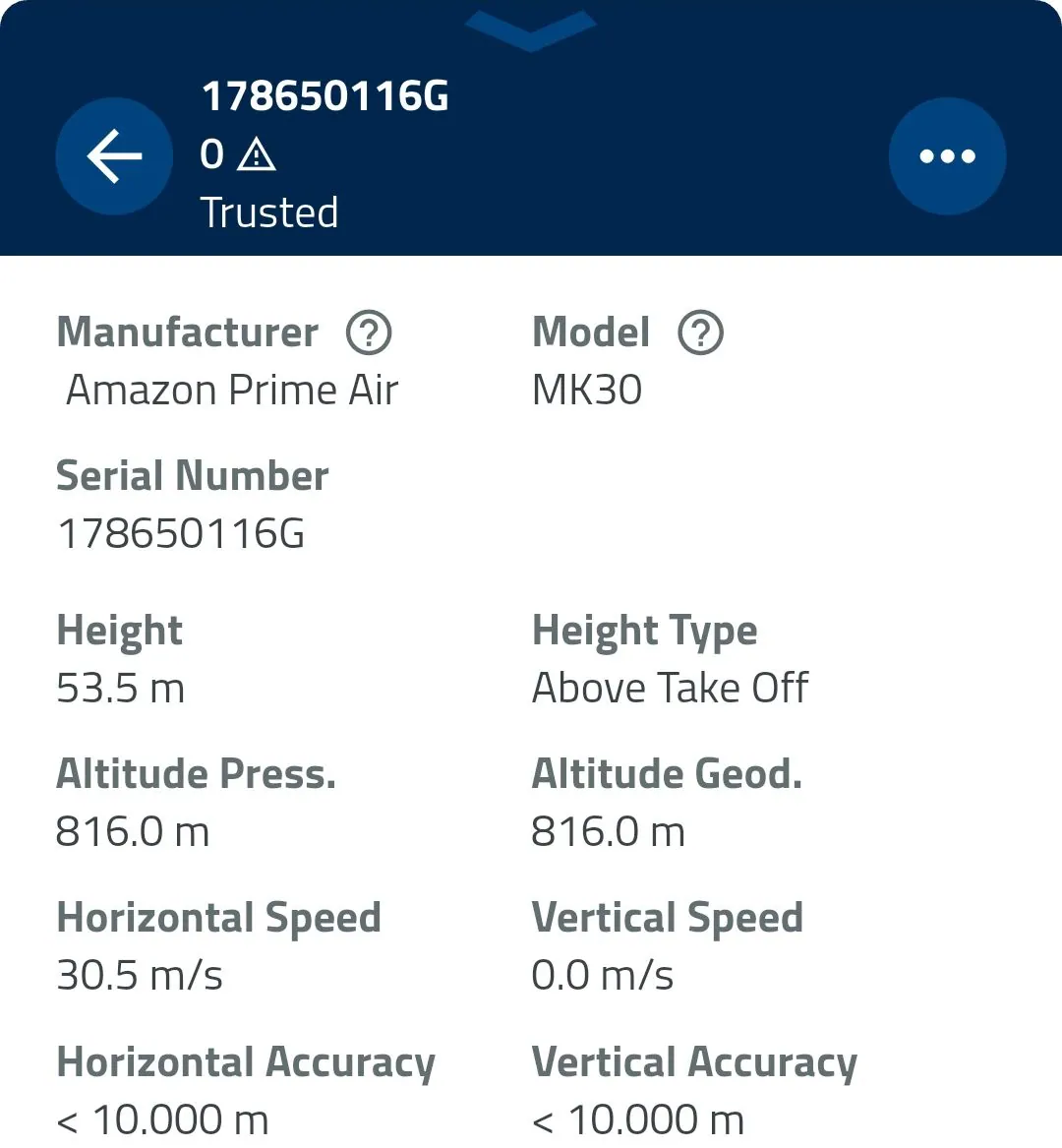
Two of the four screenshots show the fields that identify the aircraft, and both read “Amazon Prime Air” and “MK30.” The three legible speeds run from 28.5 to 30.5 meters per second, or 64 to 68 mph. Bailey told the commission the drones travel at about 70 mph.
Height above takeoff is height above the launch pad, which is not the same as height above the ground under the drone. USGS elevation data put the ground at the fulfillment center lot at about 765 to 768 meters and the ground under the four readings at about 763 to 767 meters. I don’t know exactly where the pad sits on the lot, but on those figures the ground under the drones is no more than about 5 meters (17 feet) lower than the pad. The app also lists its vertical accuracy as under 10 meters (33 feet).
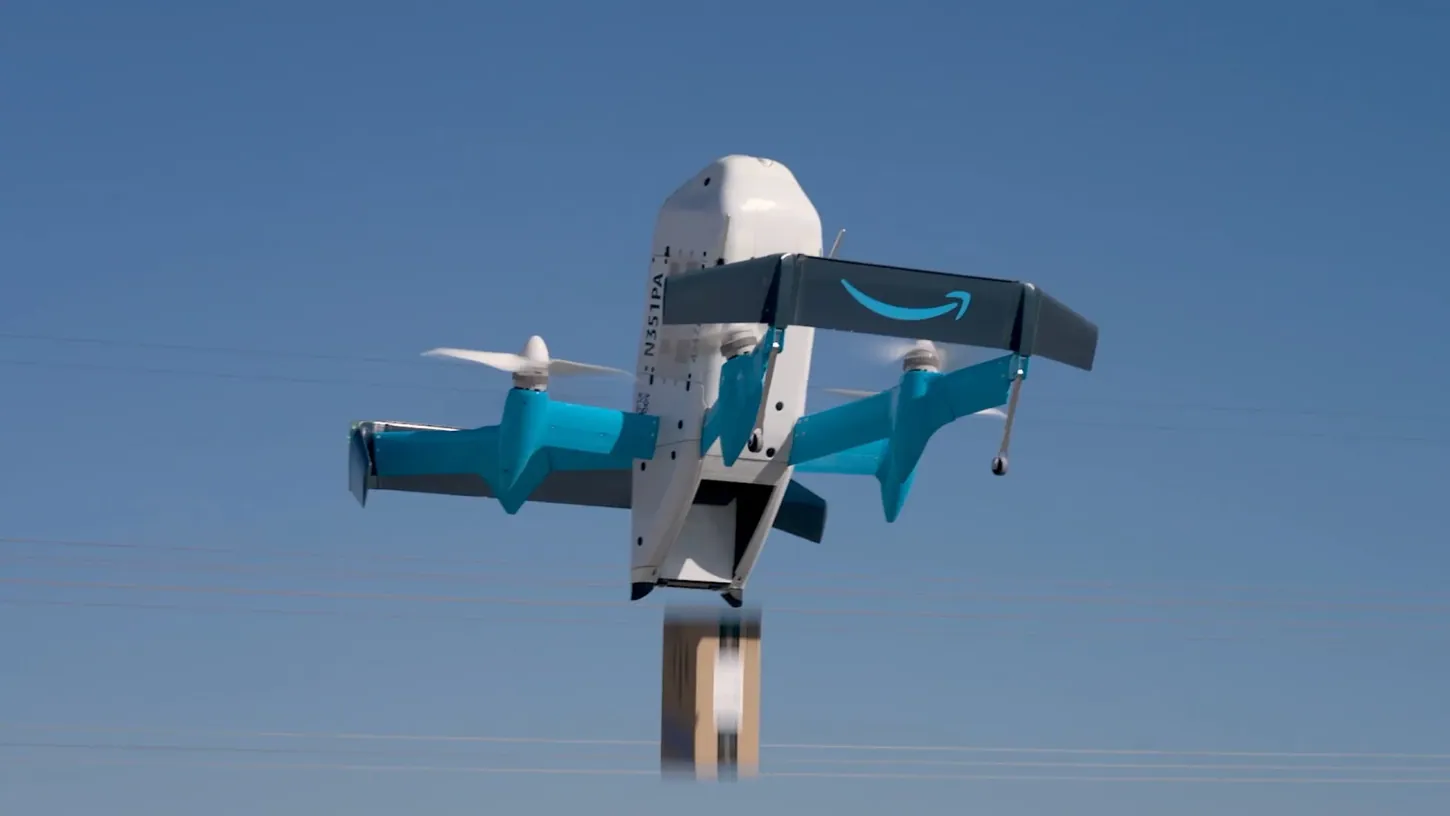
The readings are consistent with drones flying near 200 feet over the subdivision, a little under or a little over. They cannot prove a flight below it, and DroneXL has not measured one. DroneXL does not know what minimum altitude, if any, Amazon’s FAA authorization sets. The 200 feet is a finding in the permit and not a condition. Bailey told the commission the drones would fly out at an average of about 225 feet or more and return between 300 and 400 feet. Crace wrote to the city on November 2 that returning drones appear to fly at about the same height as outbound ones. In Richardson, Texas, Amazon raised its average outbound altitude to 225 feet after complaints, and one resident there still logged 52 overflights in a day.
Amazon Told the Commission Two Other Sites Fly 100 to 300 Times a Day
A commissioner asked Bailey how many customers the Nampa site would reach, and he declined to say. Amazon’s Richardson site makes 200 to 300 flights a day, he said, and a Kansas City, Kansas, area site 100 to 200. He agreed Nampa could see 100 to 300 in ideal weather.
Bailey gave those figures at the May 26 hearing and tied the Nampa one to customer demand as well. Crace says she filmed 16 drones passing in 15 minutes on November 5, and a neighbor counted 39 passes in 48 minutes for KTVB. DroneXL cannot turn counts over one subdivision into a daily total. No condition in the permit caps the number, and the city asked Amazon for flight data only this month.
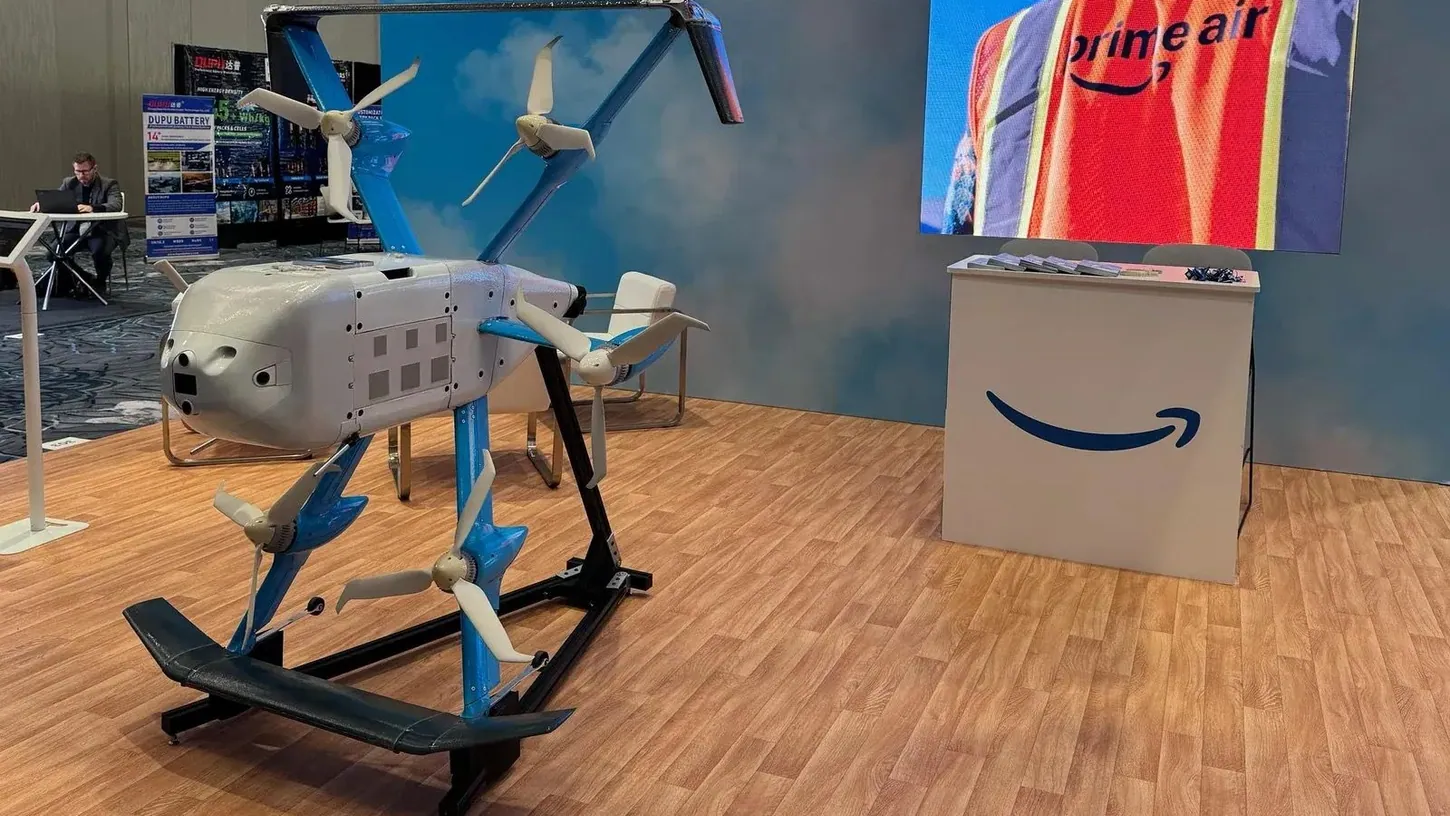
The recording also shows what the commission knew about outside objections. Ashby told commissioners the Nampa Airport Commission had sent a long letter recommending they not approve the permit until Amazon documented how it would handle a list of concerns. His summary of the list included airspace coordination, failsafe systems “such as controlled descent or parachutes,” noise and community impacts, and flight volumes. Ashby told commissioners they had already heard about controlled descent that evening. The 83-pound MK30 carries no parachute.
Ashby told the commission Amazon had given him enough data and confirmation that it would address each of the airport commission’s concerns. Bailey said Amazon had answered the letter in writing and was meeting with the airport in person. DroneXL has not seen the letter or Amazon’s reply. Nampa’s file is on DroneXL’s Amazon Prime Air tracker.
DroneXL’s Take
My reading is that Ashby has condition 5 right. It was written so the city would have someone to call, and it does. The person under the route has an 888 number whose phone menu, by Crace’s account, has no option for a drone. Amazon can ask a city to keep an employee’s name private, and I understand why it would. A company flying 83-pound aircraft over the same roofs every few minutes can still staff a Nampa phone line and publish it.
The director’s emails are more candid than most city correspondence I read. He went out and looked, he reported what he saw even though it cut against the complaint, and he told a resident plainly what he believes the city cannot do. His sentence about conditions that give staff no clear way to measure is the one the next planning commission should read before it votes. On Monday I wrote that the next town should put its numbers in the conditions. It should add a public phone number to that list, and a date by which someone has to answer it.
Sources: City of Nampa Planning and Zoning email thread with Judit Crace (November 2 to 4, 2026), City of Nampa Planning and Zoning meeting recording (May 26, 2026), Drone Scanner screenshots and Amazon customer service chat screenshot provided by Judit Crace, USGS Elevation Point Query Service
DroneXL uses automated tools to support research and source retrieval. All reporting and editorial perspectives are by Haye Kesteloo. Read our editorial standards.