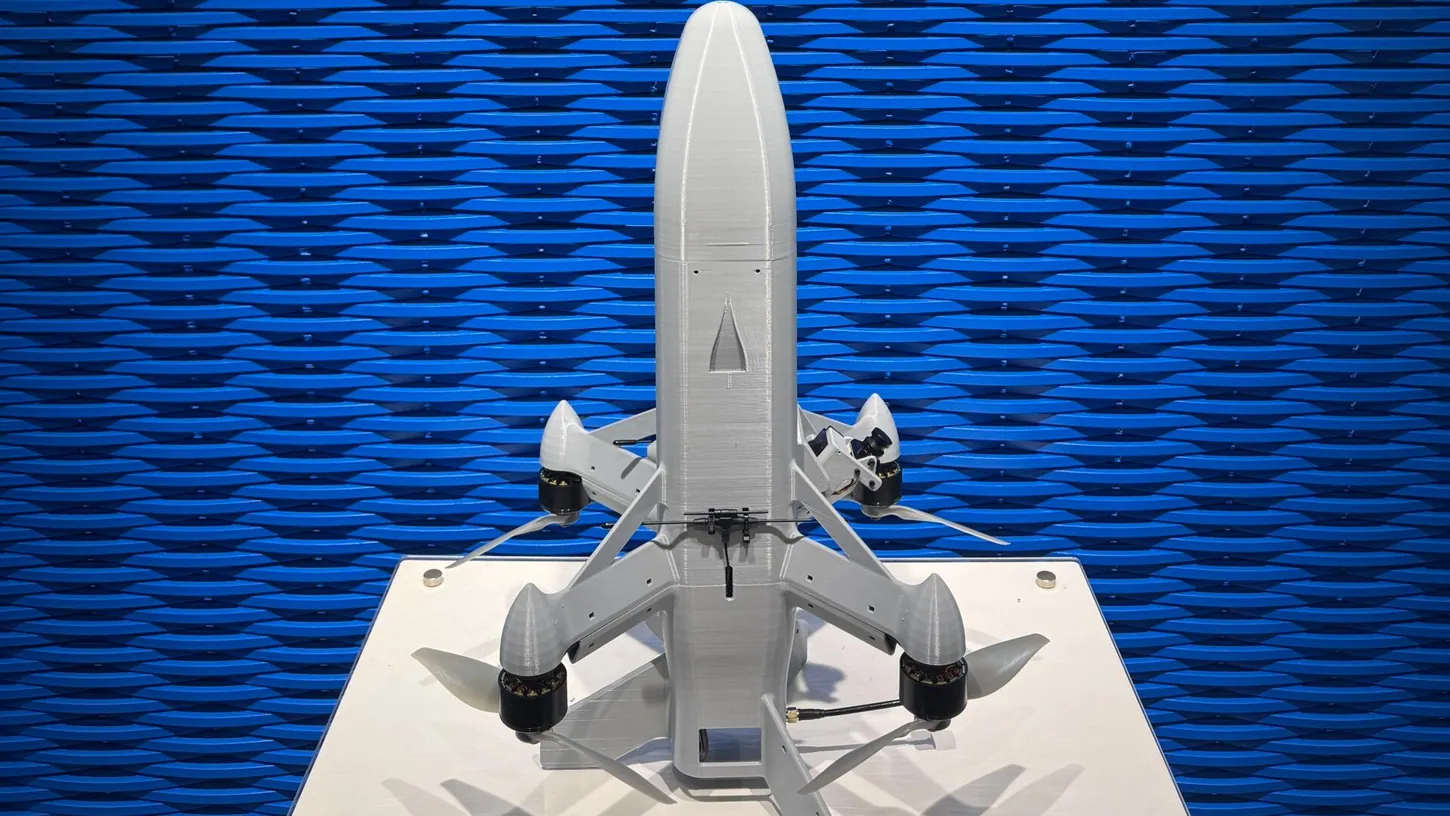
Iran’s Islamic Revolutionary Guard Corps (IRGC) Aerospace Force has put three new miniature drones on display at an exhibition of its work in Mashhad, the IRGC-linked Tasnim News Agency reported Saturday, November 28. One is a quadcopter interceptor for shooting down other drones. The other two are suicide drones built to keep working when GPS is jammed.
The interceptor, called Sayeh (“Shadow”), weighs 2 kilograms (4.4 pounds) and flies for five minutes, according to the specifications Tasnim published. The same list gives it a top speed of 450 to 600 km/h (280 to 373 mph).
Sayeh’s claimed 600 km/h would put a 2 kg combat quad near record speeds
A 2-kilogram quadcopter at 600 km/h (373 mph) would sit just below the purpose-built record drones, and Tasnim’s report carries no flight footage or test data to back it. Quantum Systems announced this week that its Apex Recordhunter averaged 727 km/h (452 mph), a record listed by Drone World Records.
Ukraine’s Sting interceptor, which has been knocking down Shaheds in combat, tops out at 315 km/h (196 mph) according to its builder, Wild Hornets. The IRGC is claiming 1.4 to 1.9 times that for a drone that also carries a 1-kilogram (2.2-pound) payload and a thermal camera. Tasnim gives Sayeh a 10-kilometer (6.2-mile) range and says it can take off from almost any surface, patrol, then attack its target. It can also be launched from a larger aircraft.
Qasedak navigates by camera, not GPS, Tasnim says
The Qasedak (“Dandelion”) weighs 13 kilograms (28.7 pounds). Its listed range is 40 to 50 kilometers (25 to 31 miles). Tasnim says its autopilot and optical target recognition let it reach a target on its own, relying less on an operator link or GPS.
It carries a 3-kilogram (6.6-pound) payload and stays up for about 45 minutes.
Its listed top speed is about 90 km/h (56 mph), which makes it a slow, long-loitering weapon rather than a fast one. In Tasnim’s photos it is a four-rotor drone on a long gray fuselage, and like Sayeh it can be carried aloft and released by a larger drone or aircraft.
That design target, a strike drone that keeps working when GPS and the radio link are jammed, is the same problem Ukrainian and Russian drone makers are racing to solve at the front.
Third drone resembles the US Switchblade 300
The third aircraft has no name in Tasnim’s report, which calls it a miniature suicide drone with a strong resemblance to AeroVironment’s US-made Switchblade 300. Its listed figures are a 2.8-kilogram (6.2-pound) weight, a 20-kilometer (12.4-mile) range, 250 km/h (155 mph) top speed and five minutes of flight.
Like Qasedak, it is described as built for GPS-denied environments, using image-based navigation and target recognition. Tasnim’s photo shows a carbon tube with folding wings and tail fins, the tube-launched layout the Switchblade made familiar.
DroneXL’s Take
Every number in this story is the IRGC’s, and the Sayeh speed is the one I don’t believe. A 2-kilogram quadcopter carrying a thermal camera and a 1-kilogram payload at 600 km/h would fly within about 130 km/h of a purpose-built record drone, and Tasnim’s report shows no flight footage or test data. My read is that the spec sheet is written for an audience, not an engineer. Iran is also in the news this week because the Financial Times reported it is suspected, without confirmation, in the six drones repelled over RAF Lakenheath, and nothing in Mashhad links these drones to that incident. What the display does show is Tehran putting its name on the drone types Ukraine and Russia proved in combat: small interceptors and loitering munitions built to survive jamming.
Source: Tasnim News Agency
DroneXL uses automated tools to support research and source retrieval. All reporting and editorial perspectives are by Haye Kesteloo. Read our editorial standards.
Advertise with DroneXLYour company hereReach 200,000+ drone readers a month with a sponsored article, a banner on your beat, or a partnership.See the options →