Massachusetts’ Counter-UAS Plans For The FIFA World Cup Aren’t Cutting It

Check out the Best Deals on Amazon for DJI Drones today!
Massachusetts is staring down a very modern security headache ahead of the 2026 FIFA World Cup: how do you build a real counter-UAS plan fast enough to protect massive, high-visibility crowds, without turning the entire region into a no-fly panic zone?
The state just landed more than $21 million in federal funding aimed at countering “malicious drone activity,” with money flowing to Boston Police, Massachusetts State Police, and Foxborough Police to support training and equipment.
The most flawed parts of this counter-UAS operation are caused by human-error: coordinated planning across multiple agencies, unclear event footprints, and the legal reality that “detecting a drone” and “interfering with a drone” are not the same thing.

The Money Is Real, and the Clock Is Ticking…
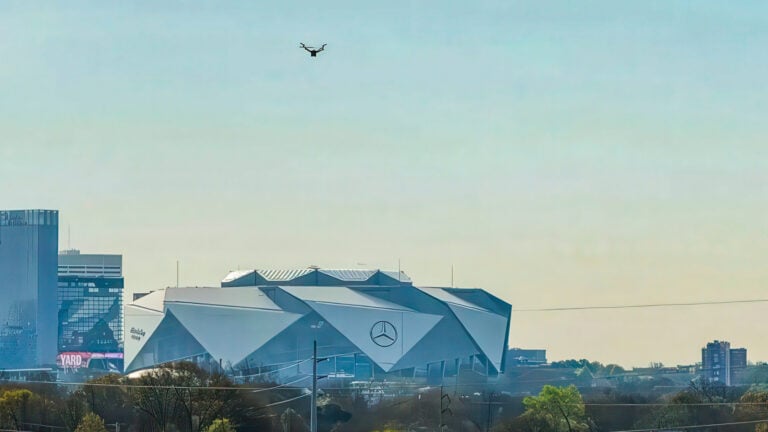
Boston is one of the World Cup host cities, but Massachusetts’ matches are scheduled for Gillette Stadium in Foxborough, which will be branded “Boston Stadium” during the tournament. Seven games are slated to run from June 13 through July 9, 2026, putting a hard deadline on readiness.
Funding splits reported by local outlets put roughly $11 million to Boston Police, around $3.5 million to Foxborough Police, and more than $6.5 million to Massachusetts State Police.
Those dollars trace back to FEMA’s Counter-Unmanned Aircraft Systems (C-UAS) Grant Program, and as of now there are $250 million prioritized for World Cup host states and the National Capital Region in 2026.
“Boston Stadium” is not in Boston, and the FanFest site is still not set
One of the most immediate planning problems is geographic. Gillette Stadium sits roughly 27 miles southwest of Boston, which makes multi-agency coverage and command-and-control (C2) planning more complex, especially when crowds and drone risks are not confined to the stadium footprint.
Then there is the FanFest problem. Massachusetts’ own public safety planning report flagged that the official FIFA FanFest location had not been selected, and that they had not yet confirmed site limits planning, coordination, or preparation.
That is not a small detail for counter-UAS. Detection systems are not magic bubbles. Where you place sensors, how you deal with line-of-sight constraints in an urban environment, and how you build response timelines all depend on knowing where the biggest crowds will be.
The “Unusual Payment Structure” creates friction at the worst possible time
The state report also highlighted a funding mechanics issue that can slow everything down: a reimbursement structure that requires event organizers to front costs before seeking payment.
Even if the grant award is locked in, reimbursement-based spending can create delays in procurement and deployment, especially for systems that require contracting, integration into an operations center, testing, and training cycles. That matters when the calendar is already tight and the first match is in mid-June 2026.
Detection is the Easy Part. Mitigation Comes with Guardrails, and Extensive Training
A lot of the public messaging around counter-UAS security blurs “detection” and “mitigation” together, but FEMA’s rules do not. Just like I tell my students every day – even law enforcement needs to adhere to the federal regulations laid out for drone operations.
Mitigation tools are treated differently than detection and tracking. Reporting around the grant program notes that only law enforcement or correctional agencies are eligible for mitigation funding, and agencies must have personnel trained at, or scheduled to be trained at, the FBI’s National Counter-UAS Training Center (NCUTC), with FEMA verifying registration.

At the same time, Congress has been actively wrestling with counter-drone authorities and frameworks for state and local agencies, including legislation tied to major-event security.
In other words, Massachusetts can buy equipment, but whether and how it can be used in a real incident depends on who is trained, who is authorized, and what operational playbook is approved across local, state, and federal partners.
DroneXL’s Take
If you’re reading that Notice of Funding Opportunities (NOFO) like a drone pilot, the part that should jump off the page is not the dollar amount. It’s the scope of who the federal government is explicitly preparing to touch counter-UAS tools.
When official program language puts law enforcement and correctional agencies together for mitigation authorization and funding, it is signaling a broad posture: counter-drone is being treated as a permanent public-safety capability, not just a one-off World Cup add-on.
That raises a few uncomfortable but necessary questions:
- What does “deemed a threat” look like operationally?
In the real world, drone operators make fast decisions. A legitimate drone flight near a complicated event can look “wrong” to someone watching a screen with limited context. - How consistent will training and escalation procedures be across agencies?
Boston PD, State Police, Foxborough PD, and federal partners all bring different cultures, SOPs, and staffing realities. That’s a recipe for uneven enforcement unless Massachusetts builds a single, crystal-clear playbook. - Why include correctional facility officers at all?
From one angle, it makes sense: prisons worry about contraband drops and perimeter threats. From another angle, it is a notable expansion of who gets brought into the counter-drone ecosystem, especially when “mitigation” can mean disabling or seizing control of an aircraft mid-flight.
None of this is an argument against protecting a World Cup venue. It’s a reminder that the legal scaffolding being built for “special events” tends to stick around for a while.
If you fly anywhere near major venues, do the boring stuff every time: check NOTAMs and TFRs, know where the event footprint actually is that day, and do not assume the stadium is the only sensitive spot. (The surrounding celebrations often matter just as much.)
Massachusetts has the money. The hard part now is building the coordination, the event map, and the rules of engagement so this doesn’t devolve into confusion in a matter of minutes.
Ultimately, the bigger story is that the World Cup is just the excuse to accelerate something that was already coming: state and local agencies building a long-term counter-drone muscle, with “mitigation” authority increasingly moved to the federal government.
Discover more from DroneXL.co
Subscribe to get the latest posts sent to your email.
Check out our Classic Line of T-Shirts, Polos, Hoodies and more in our new store today!

MAKE YOUR VOICE HEARD
Proposed legislation threatens your ability to use drones for fun, work, and safety. The Drone Advocacy Alliance is fighting to ensure your voice is heard in these critical policy discussions.Join us and tell your elected officials to protect your right to fly.

Get your Part 107 Certificate
Pass the Part 107 test and take to the skies with the Pilot Institute. We have helped thousands of people become airplane and commercial drone pilots. Our courses are designed by industry experts to help you pass FAA tests and achieve your dreams.

Copyright © DroneXL.co 2026. All rights reserved. The content, images, and intellectual property on this website are protected by copyright law. Reproduction or distribution of any material without prior written permission from DroneXL.co is strictly prohibited. For permissions and inquiries, please contact us first. DroneXL.co is a proud partner of the Drone Advocacy Alliance. Be sure to check out DroneXL's sister site, EVXL.co, for all the latest news on electric vehicles.
FTC: DroneXL.co is an Amazon Associate and uses affiliate links that can generate income from qualifying purchases. We do not sell, share, rent out, or spam your email.