Skyways Air Transportation plans world’s largest autonomous drone fleet with $37M Air Force backing

Check out the Best Deals on Amazon for DJI Drones today!
The Austin American-Statesman just published an in-depth look at Skyways Air Transportation, the Austin-based startup that wants to build the world’s largest fleet of fully autonomous drones. What caught my attention isn’t the ambition. It’s the math. The company says its V2 drone can deliver cargo between Navy ships for about $1,000 per flight hour. Helicopters doing the same job cost $30,000. That 30x cost reduction is the kind of number that makes procurement officers pay attention.
Here’s what you need to know:
- The company: Skyways Air Transportation, founded by former Google engineer Charles Acknin, builds fully autonomous VTOL cargo drones at its 250,000-square-foot facility in North Austin’s Tech Ridge neighborhood.
- The aircraft: The current V2 carries 30 pounds over 450 miles. The upcoming V3, expected in the second half of 2026, will carry 100 pounds over 1,000 miles.
- The money: Skyways has a $37 million Air Force contract for V3 production, one of the largest ever awarded to an autonomous drone company.
- The source: Austin American-Statesman reporting by Karoline Leonard, published February 6, 2026.
Skyways drones fly themselves without any pilot input
Skyways’ aircraft are fully autonomous in a way that most commercial drones are not. Engineers send coordinates and flight plans directly to the aircraft. There is no joystick, no controller, no remote pilot making real-time decisions. The drones use machine learning and onboard sensors to navigate their routes, similar in concept to self-driving cars but operating in three dimensions.
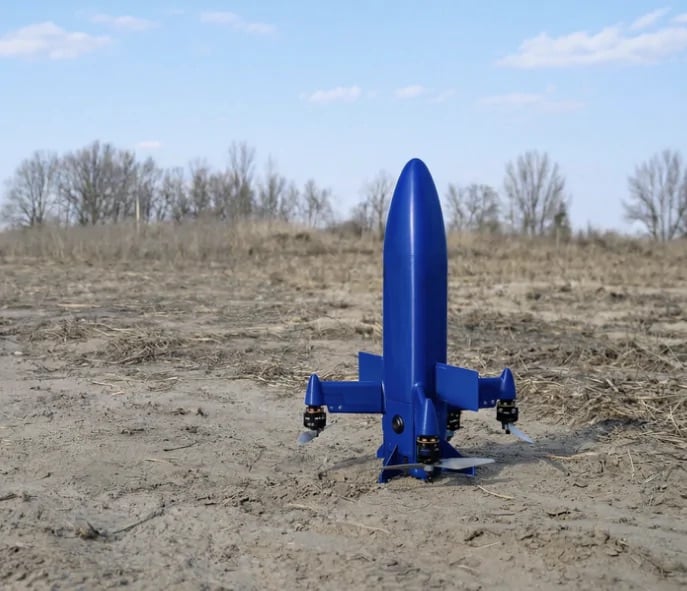
The aircraft don’t look like consumer drones either. They resemble small airplanes, taking off and landing vertically on electric power before switching to jet engines for forward flight. During recent flight tests for customers near Giddings, Texas, about 50 miles east of Austin, the company flew both its deployed V2 and a prototype of its next-generation V3.
“We’re really spending 2026 to build that production capability so that in 2027 we’re ready to hit go,” Acknin told the Austin American-Statesman.
DroneXL readers may remember Skyways from our January 2023 coverage of their Navy drone delivery trials at Naval Air Station Patuxent River in Maryland. During those tests, Skyways demonstrated the ability to deliver cargo over 200 nautical miles to a moving ship. The company has come a long way since then.

Navy logistics costs drop from $30,000 to $100 per flight hour
Skyways’ current primary customers are the U.S. military, specifically the Navy. The use case is straightforward: ships at sea need parts, mail, and small supplies delivered between vessels. Right now, that means flying a helicopter with a full crew for what is often a single wrench or a confidential document.
“When you’re on these ships, sometimes one ship will say they need a piece of mail or a part from another ship, and so an entire flight crew will have to man a helicopter for a small delivery. Those cost about $30,000 of taxpayer money per flight hour,” Acknin said. “But with a small drone like V2, someone can get a confidential piece of paper or a wrench just as quickly without needing a fully-manned crew. And it costs probably a thousand dollars per flight hour. With full fleet deployed, that’d drop to just about a hundred dollars.”
The V2 is already deployed to commercial customers and naval bases overseas. The V3, with its significantly increased payload and range, is expected to enter production in the second half of this year.
Skyways fits into the Pentagon’s broader autonomous drone push
The $37 million Air Force contract for V3 production is not happening in a vacuum. The Pentagon’s fiscal 2026 budget requested $9.4 billion specifically for aerial drones as part of a broader $13.4 billion investment in artificial intelligence and autonomous systems. The Drone Dominance Program, launched under Defense Secretary Pete Hegseth’s July 2025 directive, is spending $1 billion on attack drones alone.
But Skyways occupies a different niche than the small FPV strike drones dominating headlines out of Ukraine. These are large cargo logistics platforms designed for long-range autonomous resupply. In that space, Skyways competes with companies like Reliable Robotics, which landed a $17.4 million Air Force contract for its autonomous Cessna 208B system, and Grid Aero, which emerged from stealth with Air Force backing for its long-range Lifter-Lite cargo drone.
President Trump’s June 2025 executive order, “Unleashing American Drone Dominance,” directed federal agencies to prioritize American-manufactured drones and accelerate domestic production for both military and commercial applications. Skyways, as a fully U.S.-based manufacturer building autonomous aircraft for the military, is precisely the kind of company that policy was designed to benefit.
Skyways plans to double its workforce and expand production in 2026
The company currently employs about 30 people in Central Texas. Acknin told the Austin American-Statesman he plans to double that workforce over the course of 2026. Production will expand at the company’s 250,000-square-foot facility in Tech Ridge, North Austin.
Skyways is also moving its flight test facility closer to Austin, to a site just south of Elgin. The current test site near Giddings covers 750 acres of open land where drones circle most weekdays, logging required test hours before being shipped overseas for Navy use.
Beyond defense, Acknin said Skyways is stepping into commercial applications. But he was clear about the company’s approach: defense comes first, commercial follows, and eventually the technology feeds into a long-term goal of fully autonomous unmanned air transportation for people.
“You can’t just say, ‘Hey, I’m finished building this aircraft. Who wants it?'” Acknin said. “So there needs to be a very clear and deliberate approach to how you enter the market. And for us, it was always clear from day one that this had to start from those defense projects.”
DroneXL’s Take
I’ve been covering autonomous cargo drones for years now, and what stands out about Skyways is the trajectory. When we first reported on their Navy trials in January 2023, they were demonstrating proof of concept. Three years later, they have deployed aircraft overseas, a $37 million Air Force production contract, and a V3 prototype that triples payload capacity and more than doubles range.
That progression from demo to deployment is something most autonomous drone startups never achieve. Look at the Replicator Program’s failures, or the DOGE unit having to seize control of Pentagon drone procurement after years of bureaucratic delays. The Defense Department has burned through billions trying to get autonomous systems to work. Skyways quietly did it with a fraction of that budget.
The $30,000-to-$100 cost reduction for ship-to-ship logistics is the real story here. That’s not a marginal improvement. It’s a structural change in how the Navy moves supplies. If the V3 delivers on its 100-pound, 1,000-mile spec in production, expect Skyways to be in the conversation for contracts well beyond its current scope by mid-2027.
The commercial pivot Acknin mentioned is worth watching too. A platform that can carry 100 pounds autonomously over 1,000 miles without a pilot has obvious applications in remote area resupply, disaster response, and eventually commercial cargo. Acknin’s decision to build credibility through defense contracts first, then move commercial, is the same playbook that worked for companies like SpaceX. It’s also a lot harder to execute than it sounds.
Editorial Note: AI tools were used to assist with research and archive retrieval for this article. All reporting, analysis, and editorial perspectives are by Haye Kesteloo.
Discover more from DroneXL.co
Subscribe to get the latest posts sent to your email.
Check out our Classic Line of T-Shirts, Polos, Hoodies and more in our new store today!

MAKE YOUR VOICE HEARD
Proposed legislation threatens your ability to use drones for fun, work, and safety. The Drone Advocacy Alliance is fighting to ensure your voice is heard in these critical policy discussions.Join us and tell your elected officials to protect your right to fly.

Get your Part 107 Certificate
Pass the Part 107 test and take to the skies with the Pilot Institute. We have helped thousands of people become airplane and commercial drone pilots. Our courses are designed by industry experts to help you pass FAA tests and achieve your dreams.

Copyright © DroneXL.co 2026. All rights reserved. The content, images, and intellectual property on this website are protected by copyright law. Reproduction or distribution of any material without prior written permission from DroneXL.co is strictly prohibited. For permissions and inquiries, please contact us first. DroneXL.co is a proud partner of the Drone Advocacy Alliance. Be sure to check out DroneXL's sister site, EVXL.co, for all the latest news on electric vehicles.
FTC: DroneXL.co is an Amazon Associate and uses affiliate links that can generate income from qualifying purchases. We do not sell, share, rent out, or spam your email.