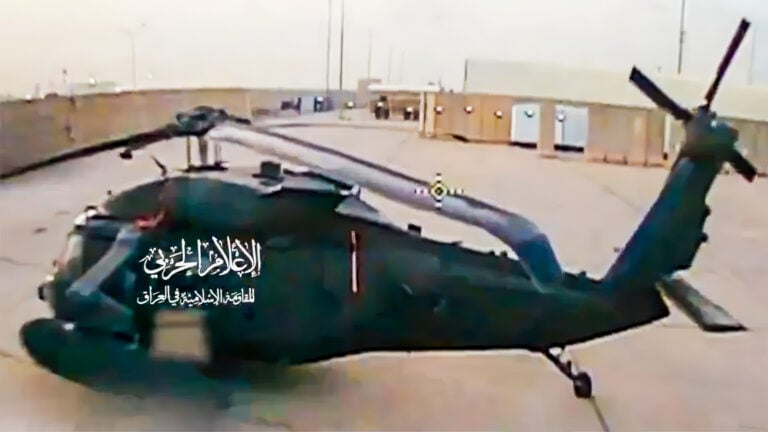
Countering Iran’s Shahed drones: fighter jets, machine guns, and the friendly fire problem Kuwait just exposed

Check out the Best Deals on Amazon for DJI Drones today!
The Kuwait friendly fire shootdown of three U.S. F-15E Strike Eagles early Monday morning just proved, in the worst possible way, why coordinating layered air defenses against cheap Iranian drones is harder than buying the right hardware. Military experts are now advising Gulf states to adopt Ukraine’s counter-Shahed tactics, combining rooftop machine guns, helicopter gunships, and forward-deployed fighter jets into an integrated defense. The problem is that these layers have to talk to each other. In Kuwait, they did not.
- The development: Military analysts are advising Gulf defense forces to use Ukraine’s proven counter-drone playbook against Iran’s Shahed-136 attacks, combining anti-aircraft artillery, jammers, and fighter jet patrols in layered formations.
- The “So What?”: Iran has fired more than 1,000 Shaheds at Gulf targets since Operation Epic Fury began. The massed attacks can overwhelm expensive missile defenses, and the Kuwait friendly fire incident shows that bolting together a multi-layered air defense under fire creates coordination risks that can be deadlier than the drones themselves.
- The source: Reporting by Thomas Harding for The National, published March 2, 2026.
Iran’s Shahed stockpile creates a sustained threat, not a one-wave problem
Iran is understood to have a large stockpile of Shahed drones and the production capacity to build hundreds more every week, according to The National’s sources. That makes the Shahed a long-term threat rather than a one-off barrage that defenders can absorb and move on from. At an estimated $20,000 to $50,000 per unit, with a 2,500-kilometer range and a 36 to 50 kilogram warhead, each Shahed costs a fraction of the interceptor missiles used to destroy it.
The latest figures cited in the report show Iran has fired 541 drones at the UAE, 283 at Kuwait, dozens at Jordan, 12 at Qatar, and nine at Bahrain. Two more were fired at RAF Akrotiri in Cyprus on Monday. One struck the runway, as UK Foreign Secretary Yvette Cooper confirmed. The second was intercepted. We covered the Akrotiri strike in detail earlier today, including the UK’s first confirmed fighter kill of an Iranian drone over Qatar.
The math here is the same cost asymmetry problem we have been tracking for years. A THAAD interception costs $12 million. A Patriot missile costs $1 million. A Shahed costs somewhere around $20,000. Do that math across a thousand drones and the defender loses economically even when they win every engagement. We laid out this exact economic logic in detail when covering the broad Shahed strikes on Bahrain, Kuwait, and Dubai on Saturday.
Ukraine’s playbook: machine guns on rooftops, fighters forward, missiles as last resort
Military experts interviewed by The National are recommending a layered defense model borrowed directly from Ukraine’s counter-Shahed experience. The first layer is anti-aircraft artillery positioned on rooftops, city outskirts, and mounted on pickup trucks. The second layer is helicopter gunships. The third is forward-deployed fighter jets with advanced radar to track incoming drone swarms and shoot them down with cannon or missiles well before they reach populated areas.
The Rheinmetall Skyranger 35 gets a specific mention as a leading system. Its 35mm revolver cannon fires 1,000 rounds per minute with 4,000-meter range and 360-degree coverage using AESA radar. Germany has ordered 600 of them. We first covered the Skyranger series in early 2024 when the smaller 30mm variant entered testing, and Rheinmetall’s CEO told us in September that European governments could order up to 1,500 Skyranger units by 2030. The Gulf conflict may accelerate that timeline.
The German-made Gepard AAA tank, armed with double or quadruple 35mm Oerlikon cannons, is another option already proven in Ukraine. Specialist jamming guns are also mentioned, though The National’s experts note these have limited range and risk interfering with broader electronic warfare systems.
Air power expert Tim Ripley told The National that the key to engaging Shaheds from jets is finding them early enough. “The trick is finding them and engaging them far enough away from your populated city, so the debris doesn’t fall on to it,” Ripley said. Fighter jets like the Rafale, F-16, and UK Typhoon can use their radar to track massed drone attacks from behind, then engage with 27mm cannon or air-to-air missiles.
One cost-effective munition option is the U.S. 70mm Hydra laser-guided missile. About 40 of them can fit on a single F-15 or F-16. The BAE Systems APKWS II variant costs roughly $20,000 per shot, matching the drone’s own price point and breaking the cost asymmetry that makes Patriot intercepts unsustainable.
The UK is bringing Ukrainian expertise to the Gulf
The UK announced on Sunday that it would bring Ukrainian counter-drone specialists to help Gulf partners shoot down Iranian Shaheds. This is significant. Ukraine has absorbed more than 57,000 Shahed-type strikes since February 2022 and has developed the world’s most battle-tested counter-drone doctrine, including $2,500 interceptor drones that hunt Shaheds mid-flight.
The UK’s Project Octopus program, which aims to produce 2,000 interceptor drones per month in partnership with Ukrainian manufacturers, already established the institutional link between British defense planning and Ukrainian combat experience. Now that link is being extended to Gulf allies facing the exact same weapon system. There will be input from Ukraine’s F-16 pilots, who have successfully intercepted Shaheds launched daily at Ukrainian cities.
President Zelensky himself called Ukraine’s Shahed intercept expertise “largely irreplaceable” on March 1 and offered to deploy specialists to the Gulf. As Danish Prime Minister Mette Frederiksen put it last fall: the only expert in the world on anti-drone capabilities right now is Ukraine, because they fight this threat every single day.
The cottage factory problem makes suppression nearly impossible
Even a perfect air defense cannot solve the supply side. Military expert Francis Tusa told The National that a single engineer with the necessary parts could assemble 12 Shaheds in a 10-hour shift. The motor is simple, the navigation system is likely a single circuit board, and the warhead is not complex to produce. Shahed batteries, usually 10 drones each, can be dispersed across Iran and launched from underground car parks, garages, or forest clearings. Finding them before launch is extremely difficult.
We covered this production problem in depth when reporting on Iran’s drone blueprint transfer to Russia in February. The same manufacturing simplicity that made the Shahed a global proliferation risk now makes it nearly impossible to destroy Iran’s production capacity through strikes alone. This is a throughput war, and the defender has to match the attacker’s output with interceptors that cost roughly the same or less.
Kuwait’s friendly fire proves the coordination gap is the real vulnerability
The three F-15E Strike Eagles shot down by Kuwaiti air defenses early Monday morning are the most expensive proof yet that layered air defense is only as good as its coordination. All six aircrew ejected safely and have been recovered in stable condition, according to CENTCOM. But three aircraft worth tens of millions of dollars each were destroyed during active combat that included Iranian missiles, drones, and aircraft. The cause of the incident is still under investigation.
The National’s experts stress that successful defense requires “deconflicting” air defenses with ground positions to avoid exactly this kind of incident. When dozens of Shaheds are inbound, multiple fighter jets are airborne, ground-based missile batteries are active, and rooftop gun crews are engaging targets, the potential for misidentification is enormous. The F-15E does not carry missile warning sensors for infrared-guided threats, meaning the crews may have had no warning before impact.
This is not a new problem. The U.S. military experienced a similar incident in the Red Sea in 2024 when a Navy ship mistakenly fired on an F/A-18 operating from the USS Harry S. Truman. But Monday’s triple shootdown happened on the first full day of sustained Iranian drone attacks against Gulf infrastructure. The speed at which the battlespace became too complex for existing coordination procedures is the real warning.
DroneXL’s Take
I’ve been covering the Shahed threat since Russia started using them against Ukrainian cities in 2022. The Gulf states are now learning in days what Ukraine figured out over years: you can’t missile-defense your way out of a mass drone attack. The economics break. The coordination breaks. And when both break at the same time, you get Kuwait.
What strikes me about The National’s analysis is what it doesn’t say. It talks about Skyranger guns, Gepard tanks, Hydra missiles, and fighter jets, but it barely touches the solution that has actually changed the game in Ukraine: cheap interceptor drones. Ukraine’s Octopus interceptors cost $2,500 and destroy Shaheds at an 80-90% hit rate. They work at night, under jamming, and at low altitude. They don’t create friendly fire risk because they’re expendable and operate in designated lanes. The UK’s decision to bring Ukrainian specialists to the Gulf should include interceptor drone deployment, not just advice on shooting straighter with existing systems.
The Kuwait friendly fire incident is going to dominate headlines, but the deeper story is the coordination failure it reveals. Building a layered air defense from scratch under active attack is fundamentally different from designing one in peacetime. Iran knows this. The Shahed isn’t just a weapon that damages buildings. It’s a weapon that forces defenders into mistakes. Three F-15Es lost in a single night because the defense layers couldn’t tell friend from foe is exactly the kind of cascading failure massed drone attacks are designed to create.
My prediction: within 60 days, at least two Gulf states will sign formal counter-drone technology transfer agreements with Ukraine, modeled on the UK’s Project Octopus. The Shahed threat just became too real for traditional Western defense procurement timelines. The only country with a proven, scalable, cost-effective counter-Shahed playbook is Ukraine, and that playbook starts with interceptor drones, not more expensive missiles.
Editorial Note: AI tools were used to assist with research and archive retrieval for this article. All reporting, analysis, and editorial perspectives are by Haye Kesteloo.
Discover more from DroneXL.co
Subscribe to get the latest posts sent to your email.
Check out our Classic Line of T-Shirts, Polos, Hoodies and more in our new store today!

MAKE YOUR VOICE HEARD
Proposed legislation threatens your ability to use drones for fun, work, and safety. The Drone Advocacy Alliance is fighting to ensure your voice is heard in these critical policy discussions.Join us and tell your elected officials to protect your right to fly.

Get your Part 107 Certificate
Pass the Part 107 test and take to the skies with the Pilot Institute. We have helped thousands of people become airplane and commercial drone pilots. Our courses are designed by industry experts to help you pass FAA tests and achieve your dreams.

Copyright © DroneXL.co 2026. All rights reserved. The content, images, and intellectual property on this website are protected by copyright law. Reproduction or distribution of any material without prior written permission from DroneXL.co is strictly prohibited. For permissions and inquiries, please contact us first. DroneXL.co is a proud partner of the Drone Advocacy Alliance. Be sure to check out DroneXL's sister site, EVXL.co, for all the latest news on electric vehicles.
FTC: DroneXL.co is an Amazon Associate and uses affiliate links that can generate income from qualifying purchases. We do not sell, share, rent out, or spam your email.