

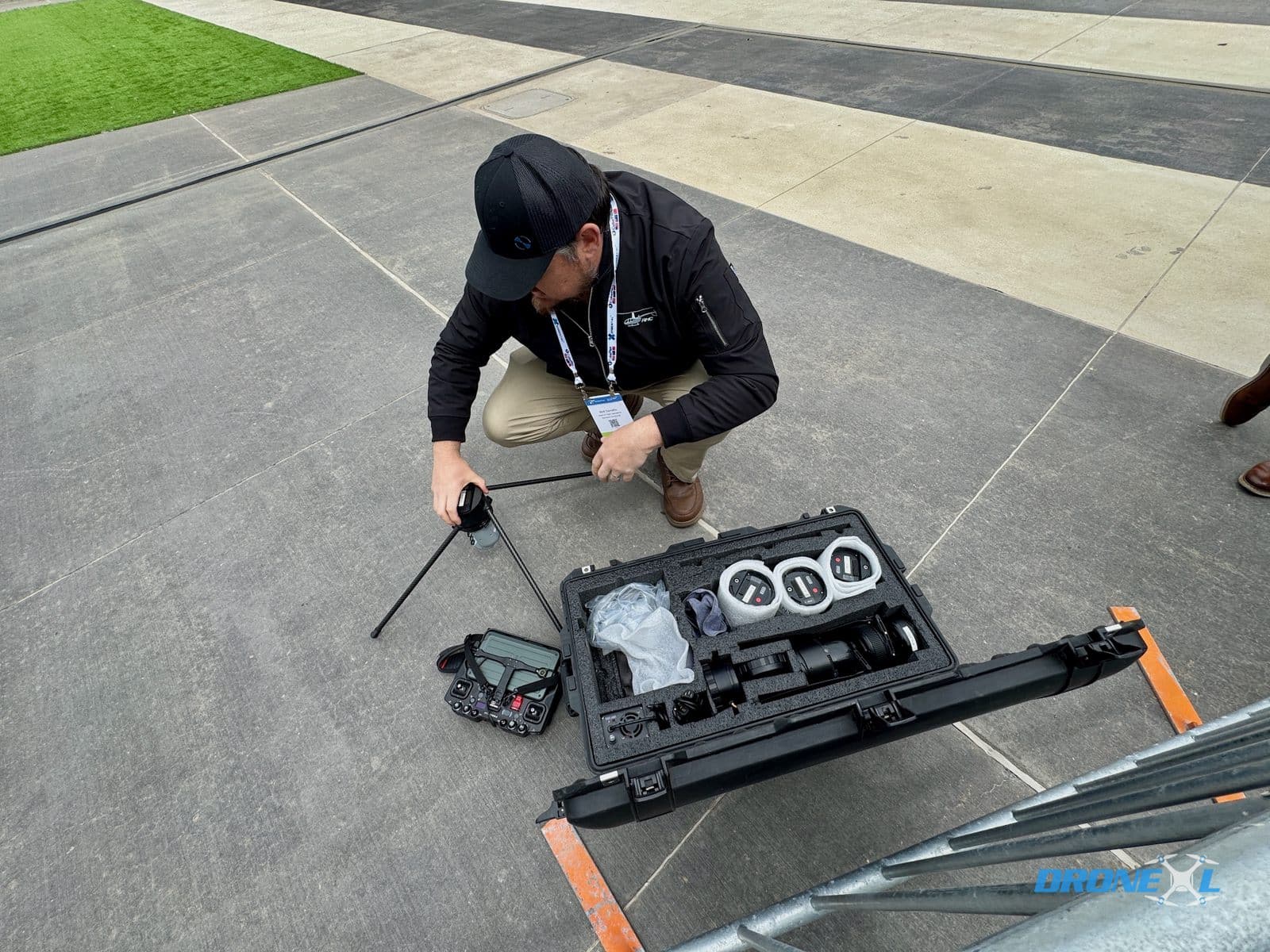
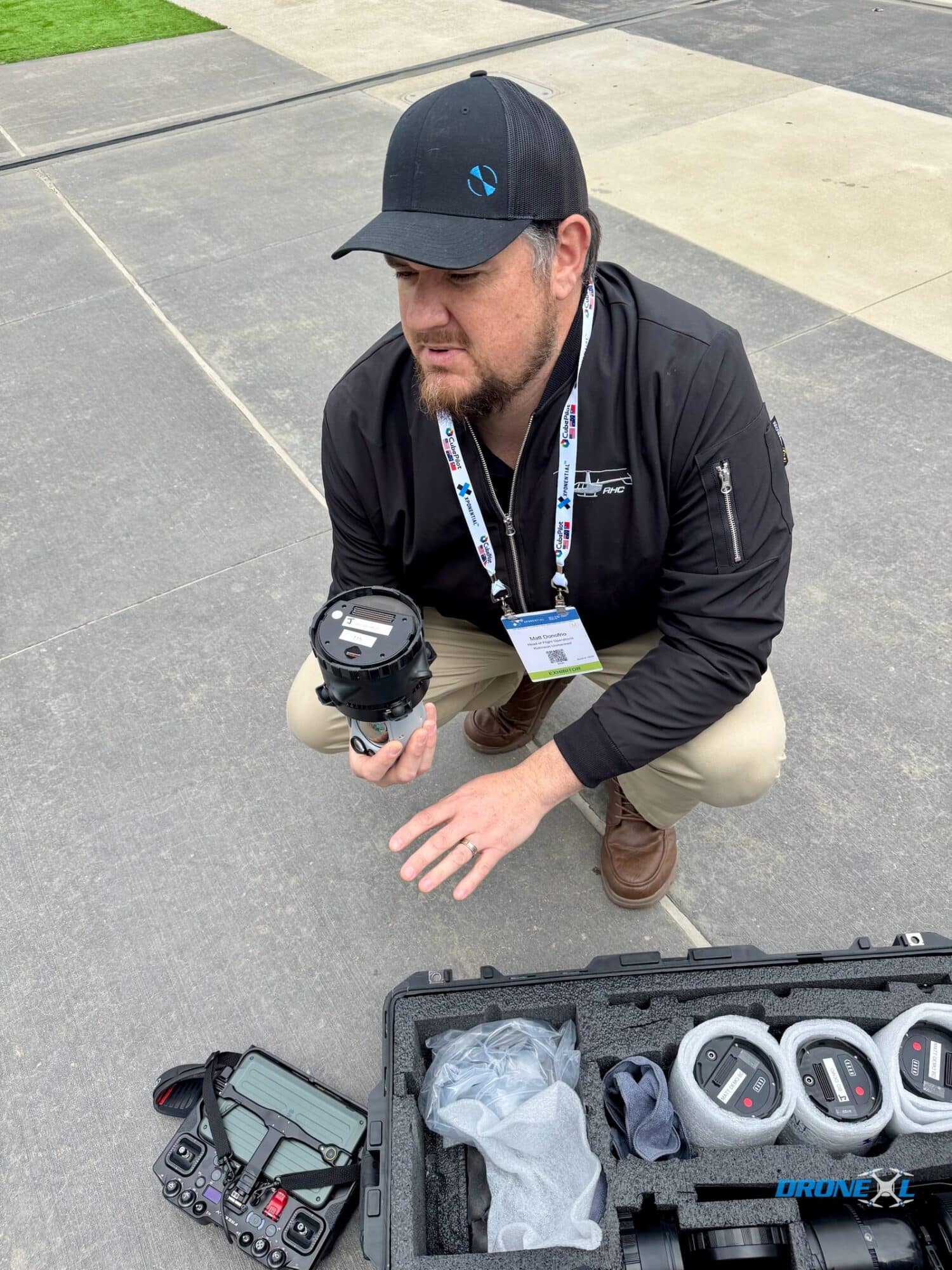
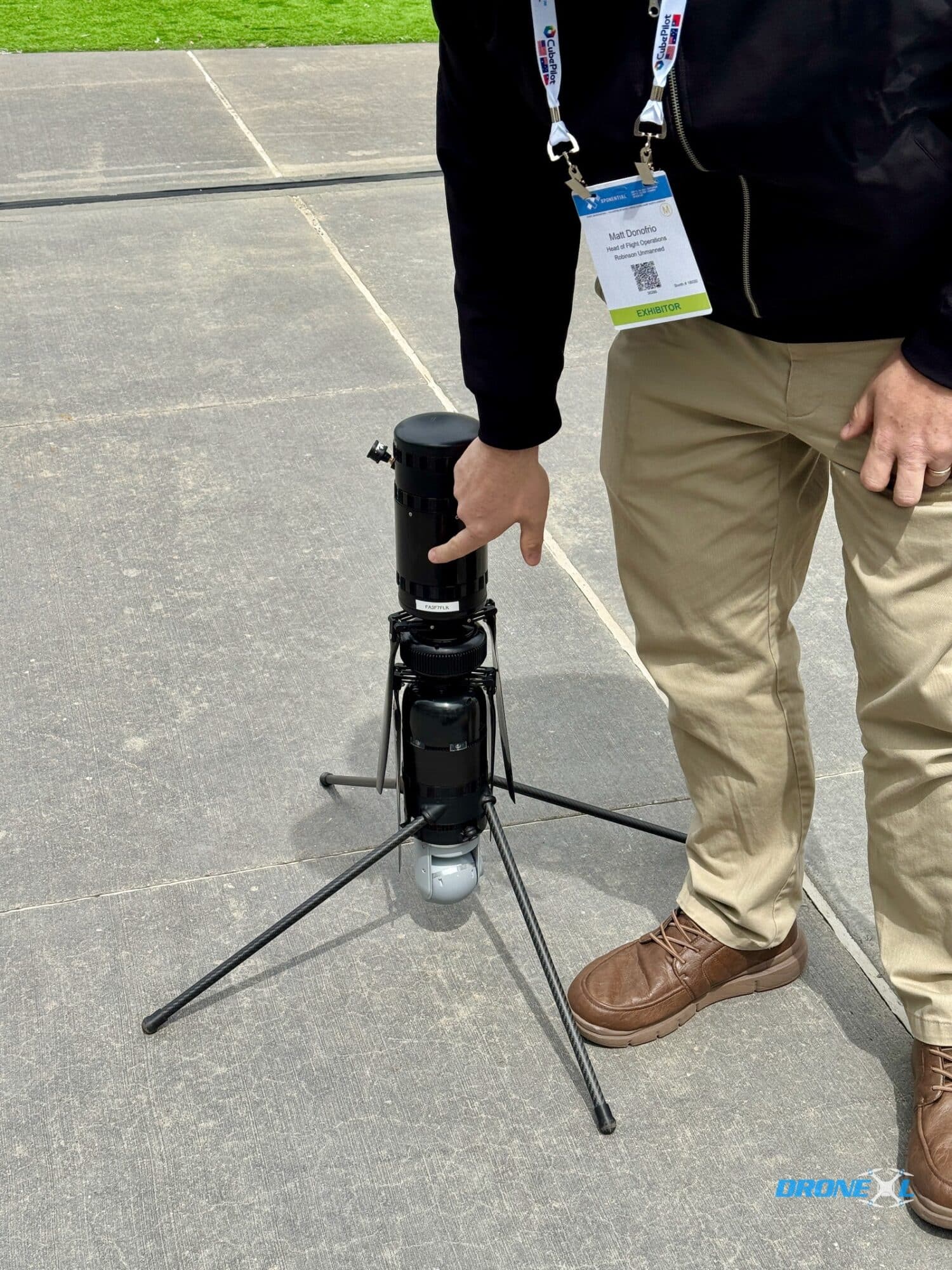
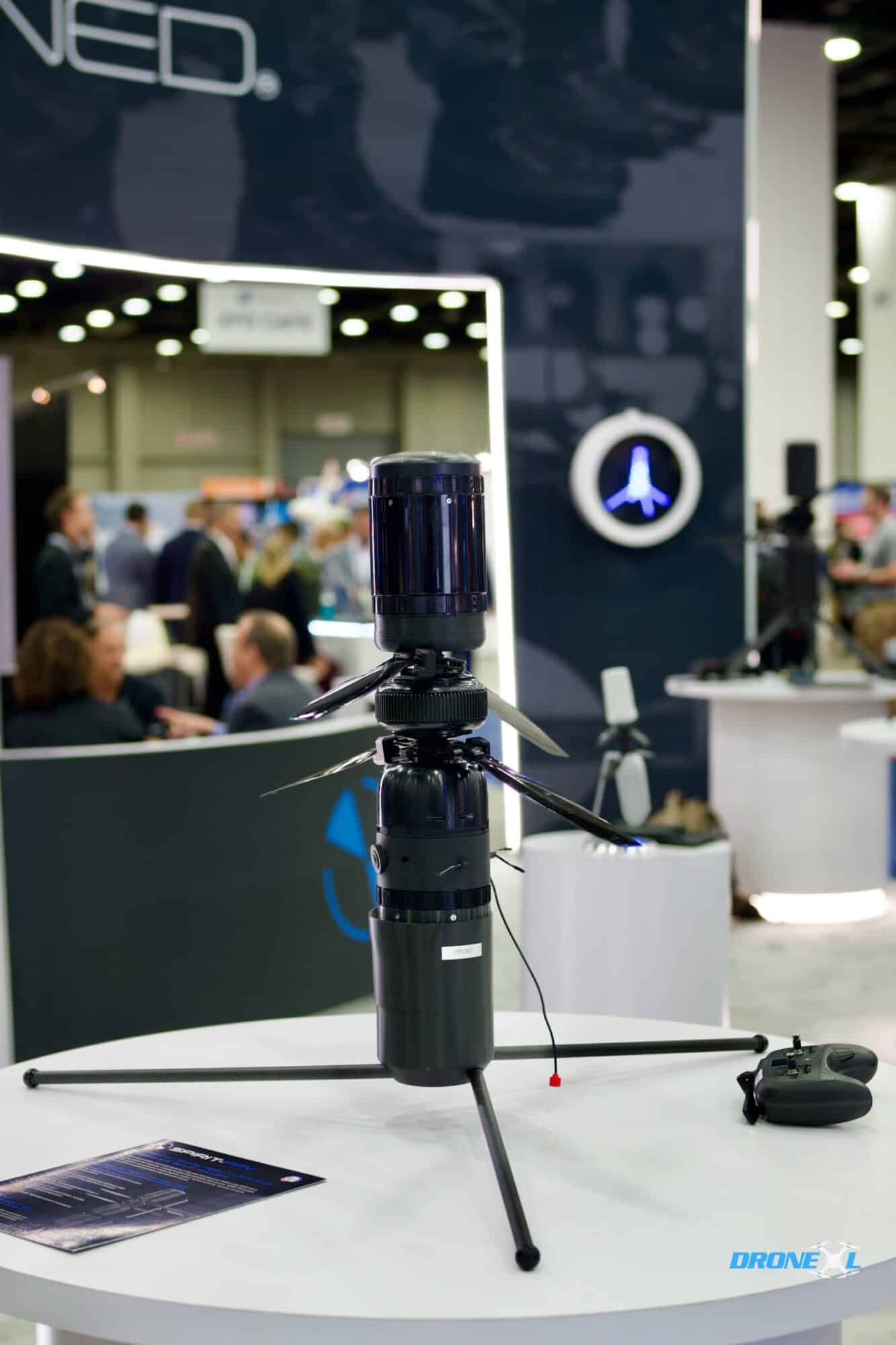
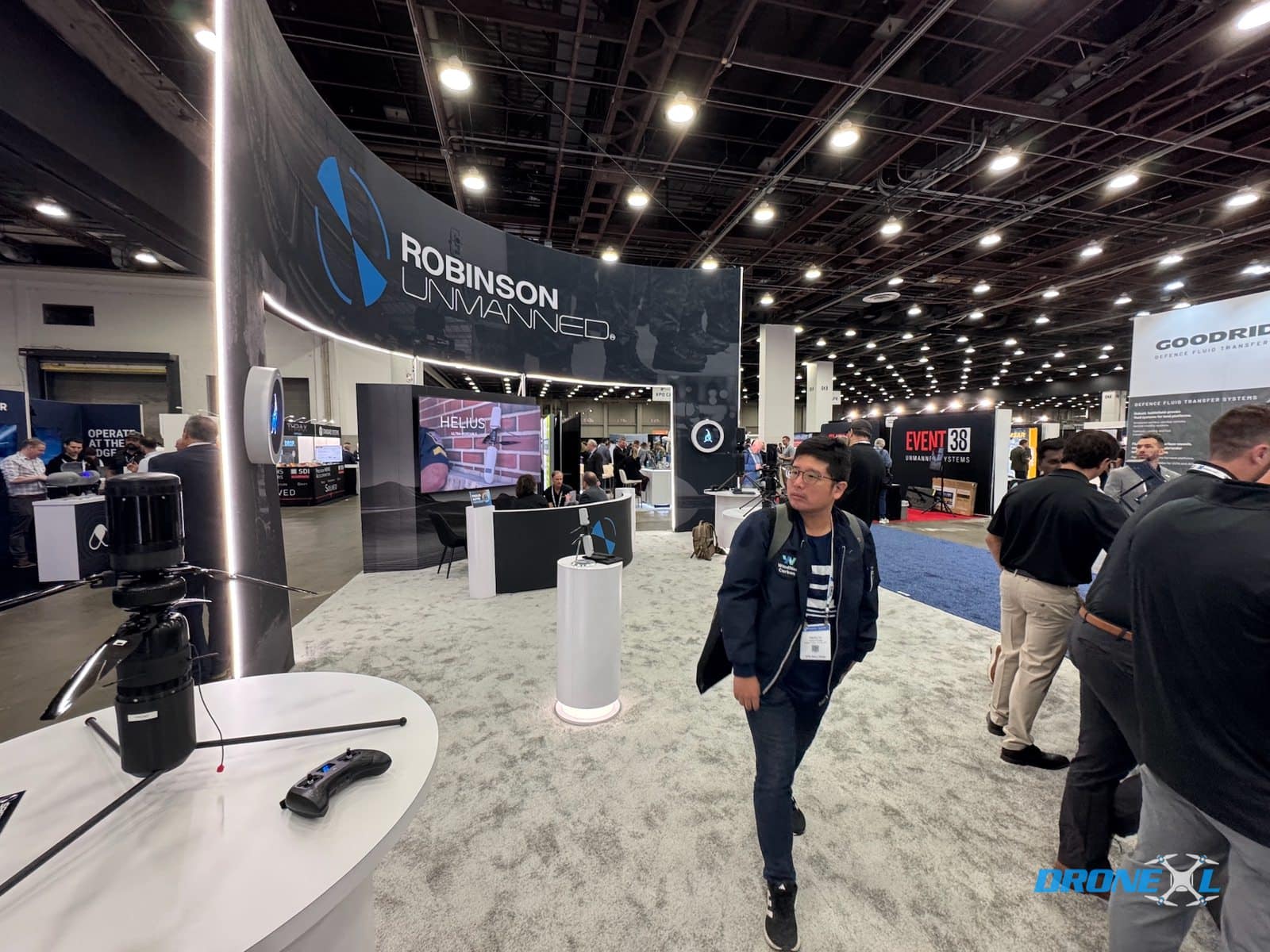
On the outdoor demo pad in front of Huntington Place at XPONENTIAL 2026 Detroit, Robinson Unmanned Head of Flight Operations Matt Donofrio set a black Spirit coaxial drone on its carbon fiber landing legs while a colleague hand-launched the pocket-sized Helius behind him. The demo was the company’s first major US drone-industry trade show appearance since Robinson Helicopter Company formally launched its unmanned division on March 10, 2026 at Verticon in Atlanta.
The most significant piece of news from the demo was not in any press release: Donofrio confirmed that Helius, the 249-gram coaxial pocket drone first publicly shown in March 2025 with promised Q4 2025 deliveries, is still a prototype. Production-ready units, he said, are now coming “mid to late summer.”

The slip is meaningful. When DroneXL first covered the Helius reveal in March 2025, the drone was advertised as available for pre-order at $4,499 with delivery in Q4 2025. The Robinson Helicopter Company dealer network was already taking orders. At XPONENTIAL Detroit on May 12, 2026, those Q4 2025 deliveries have become “mid to late summer” 2026, putting the new realistic timeline at roughly 9 to 12 months behind the originally communicated schedule.
Robinson Unmanned’s First Major US Trade Show Since The March Launch
The XPONENTIAL booth is significant for context. Robinson Helicopter Company, the Torrance, California rotorcraft manufacturer that has built civilian helicopters for more than five decades, formally established Robinson Unmanned on March 10, 2026 as a new business unit dedicated to remotely piloted and autonomous aircraft. The launch integrates Ascent AeroSystems, the Wilmington, Massachusetts coaxial drone maker Robinson acquired in 2024, with two new autonomous variants of Robinson’s flagship helicopters: the R44 Airtruck for heavy-lift cargo and the R66 Turbinetruck using Sikorsky’s Matrix autonomy system.
Paul Fermo, formerly president of Ascent AeroSystems, leads the new Robinson Unmanned business unit. Robinson Helicopter CEO David Smith said at the March launch that the unmanned division “could easily be bigger than all of our heritage businesses combined.” The Detroit booth carried that pivot into its first major drone-specific trade show audience.
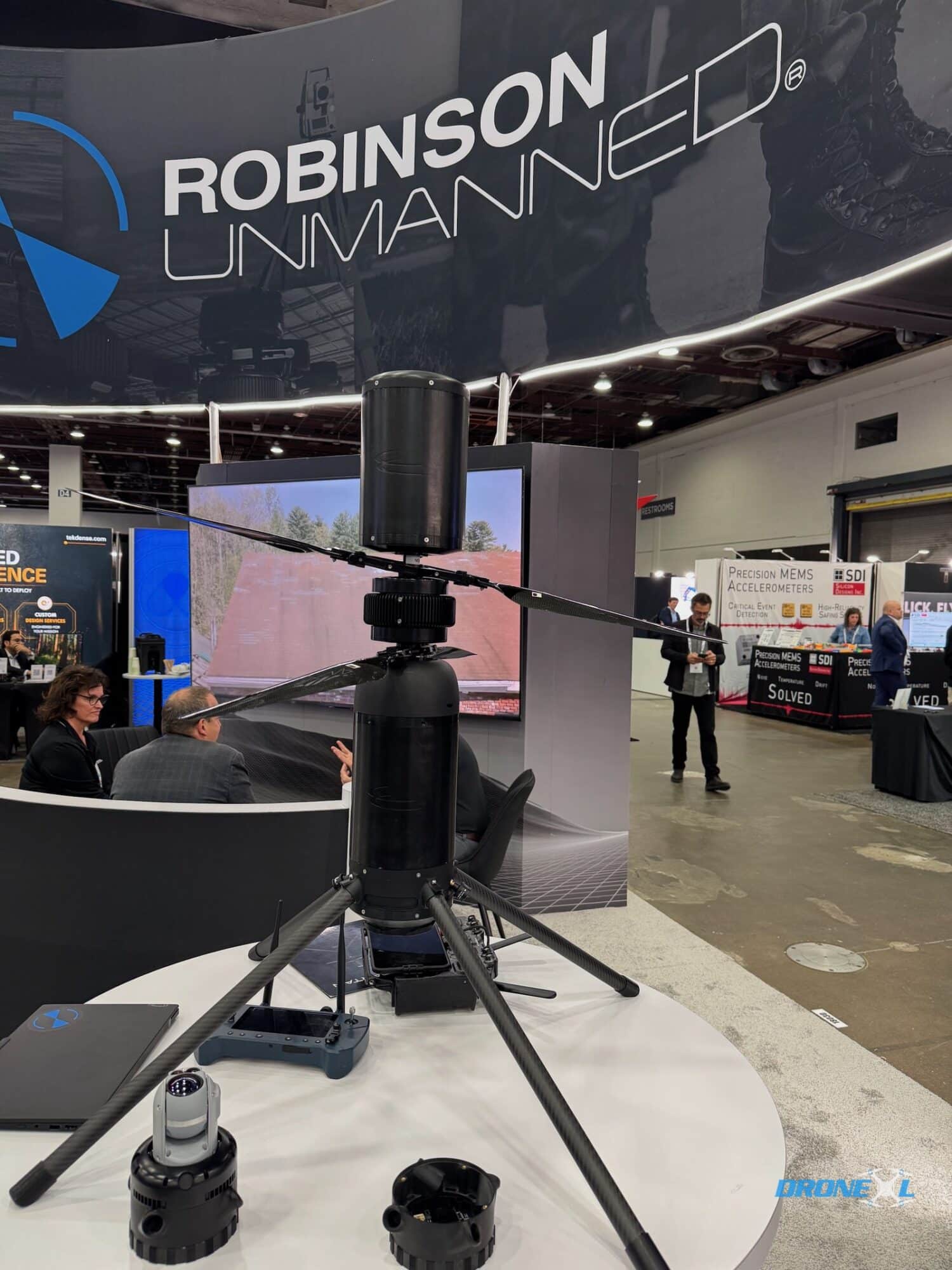
The product lineup on display at Booth 18030 included all three small UAS Group 1 and 2 coaxial drones in the Robinson Unmanned portfolio: Helius (pocket-sized hand-deployable), Spirit (mid-sized modular multi-mission), and Spartan (larger extended-endurance). All three use the same cylindrical coaxial counter-rotating rotor design that has been Ascent’s signature engineering approach since the company’s founding.
Spirit: Two-And-A-Half Minutes From Pelican Case To Airborne
The Spirit demo was the centerpiece. Donofrio assembled the airframe out of its Pelican case in front of attendees, walking through the quarter-turn click-ring modular architecture that joins the aircraft core, primary flight battery, radio module, and GPS/Remote ID module into a flyable platform.
“All of our modules are joined together by a quarter turn click ring,” Donofrio said, demonstrating spring-loaded plungers and visual alignment arrows that confirm each module is locked. “From the time out of the Pelican to up in the air, you can do it in roughly two, two and a half minutes,” he said. “Honestly, it takes longer to get the GPS fixed and for the radio links.”
The Spirit is IP56 rated, an ingress protection specification that allows operation in heavy dust and pressurized water spray from any direction.
Donofrio described his personal operational envelope: “I personally flown it [in] 43 sustained mile an hour winds. Fort Drum this past winter, upstate New York, we were flying in blizzard conditions.” On the other end of the thermal spectrum, he said, “118 degrees Fahrenheit is my record on the hot end.”
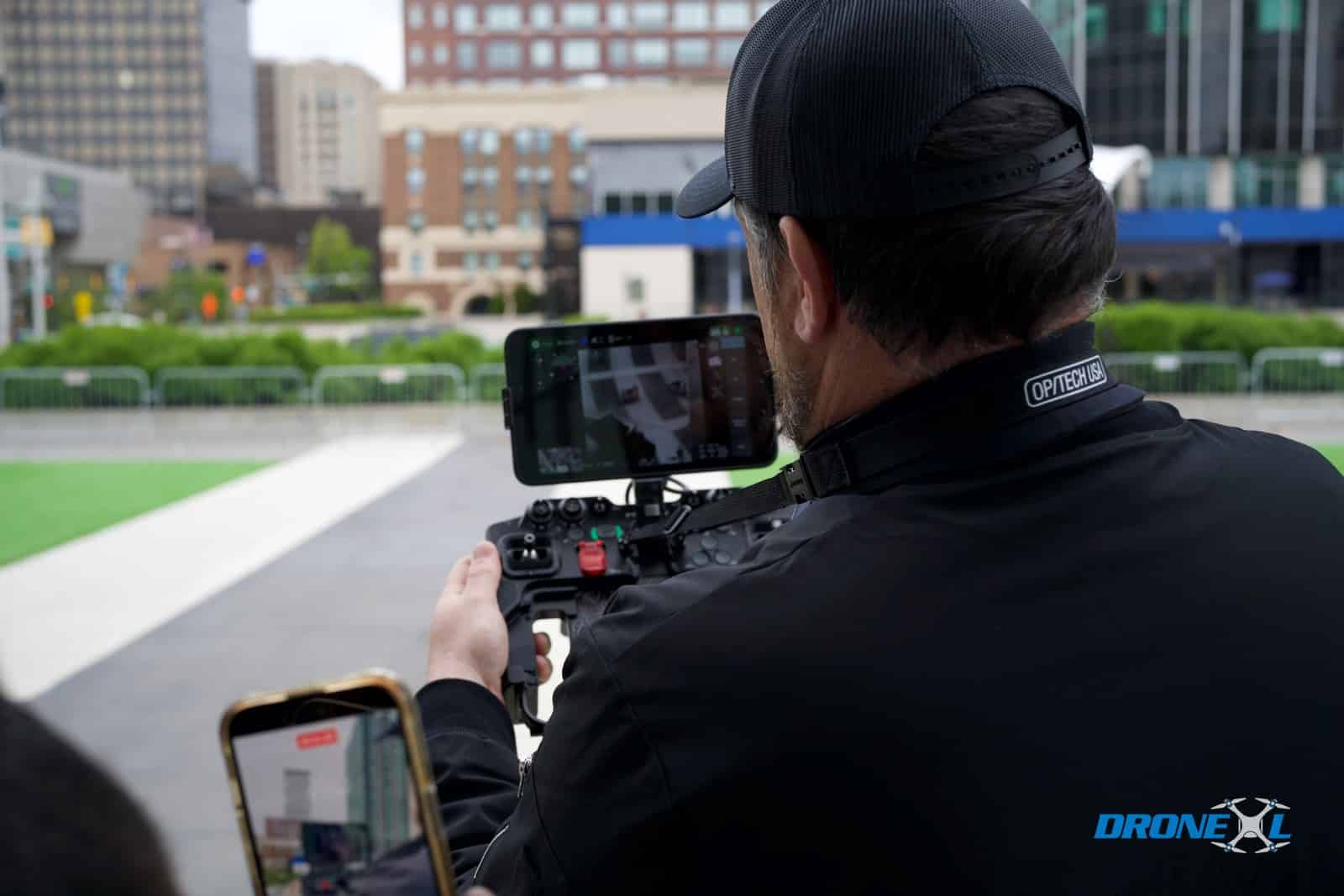
Spirit’s open architecture extends to the payload, radio, and ground control station layers. The XPONENTIAL demo configuration paired a NextVision Raptor EO/IR gimbal camera (with what Donofrio described as 40x optical and 40x digital zoom and built-in AI for object detection, auto-tracking, man-overboard detection, and smoke and fire detection) with a Doodle Labs mesh radio on 2.4 GHz and a Freefly Pilot Pro ground control station, the company’s Blue UAS-aligned GCS offering. Donofrio acknowledged the 2.4 GHz limitation on a contested trade show floor: range was reduced because every booth was running on the same band. Spirit can also operate with Silvus radios and other NDAA-compliant or non-Blue UAS options depending on the customer’s procurement requirements, he said.
Helius: A Different Modularity Philosophy, And A Delayed One
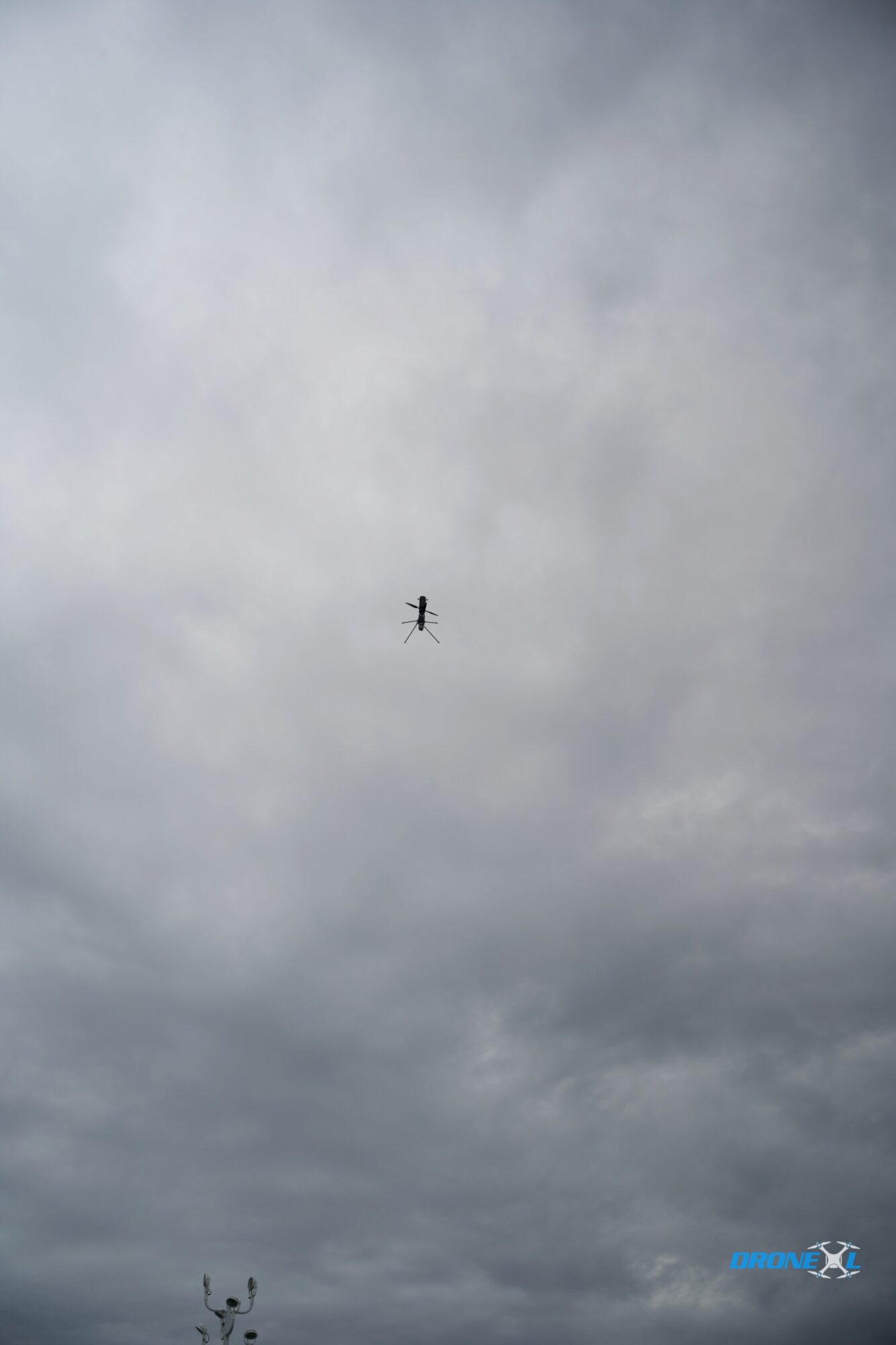
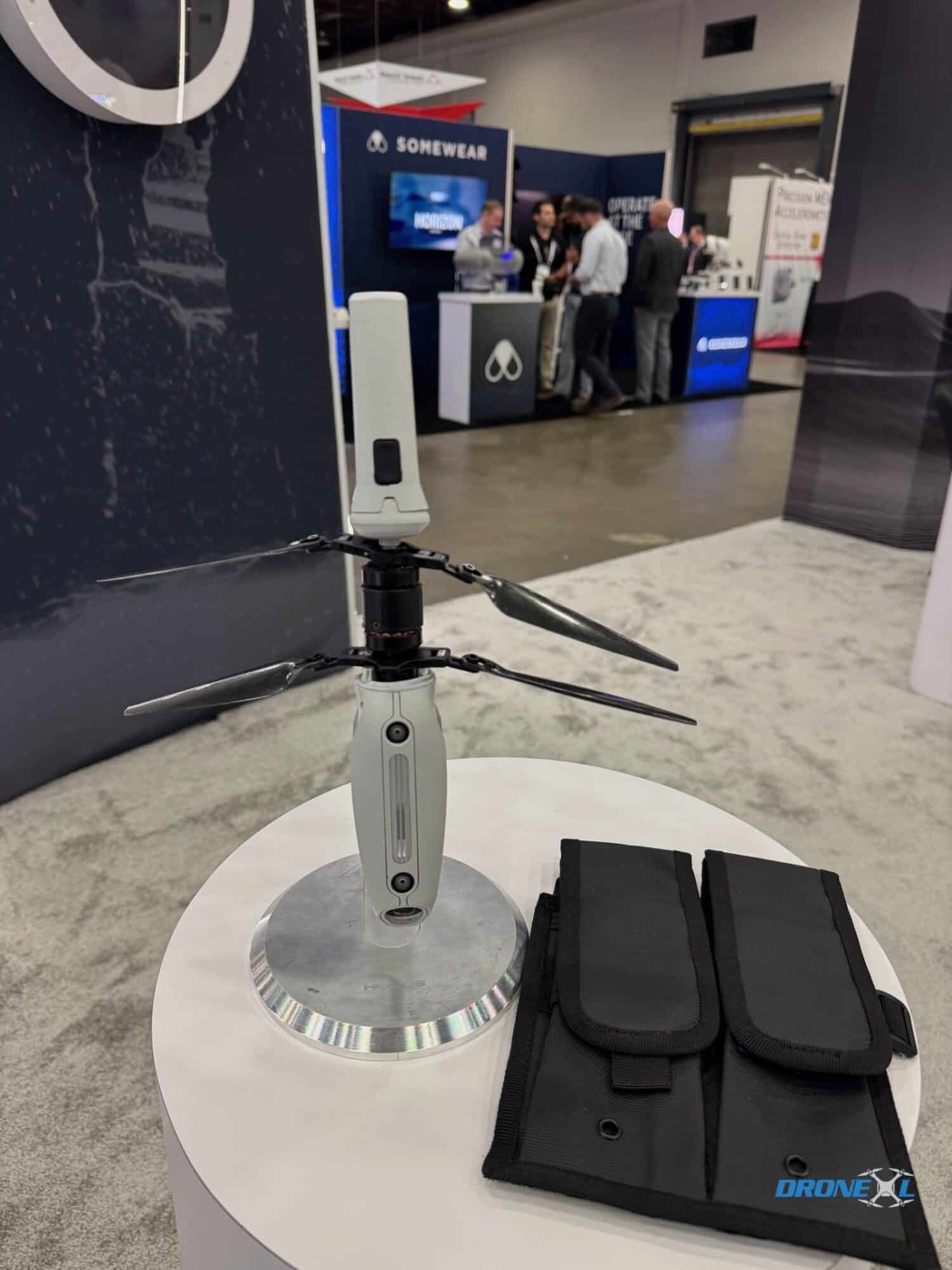
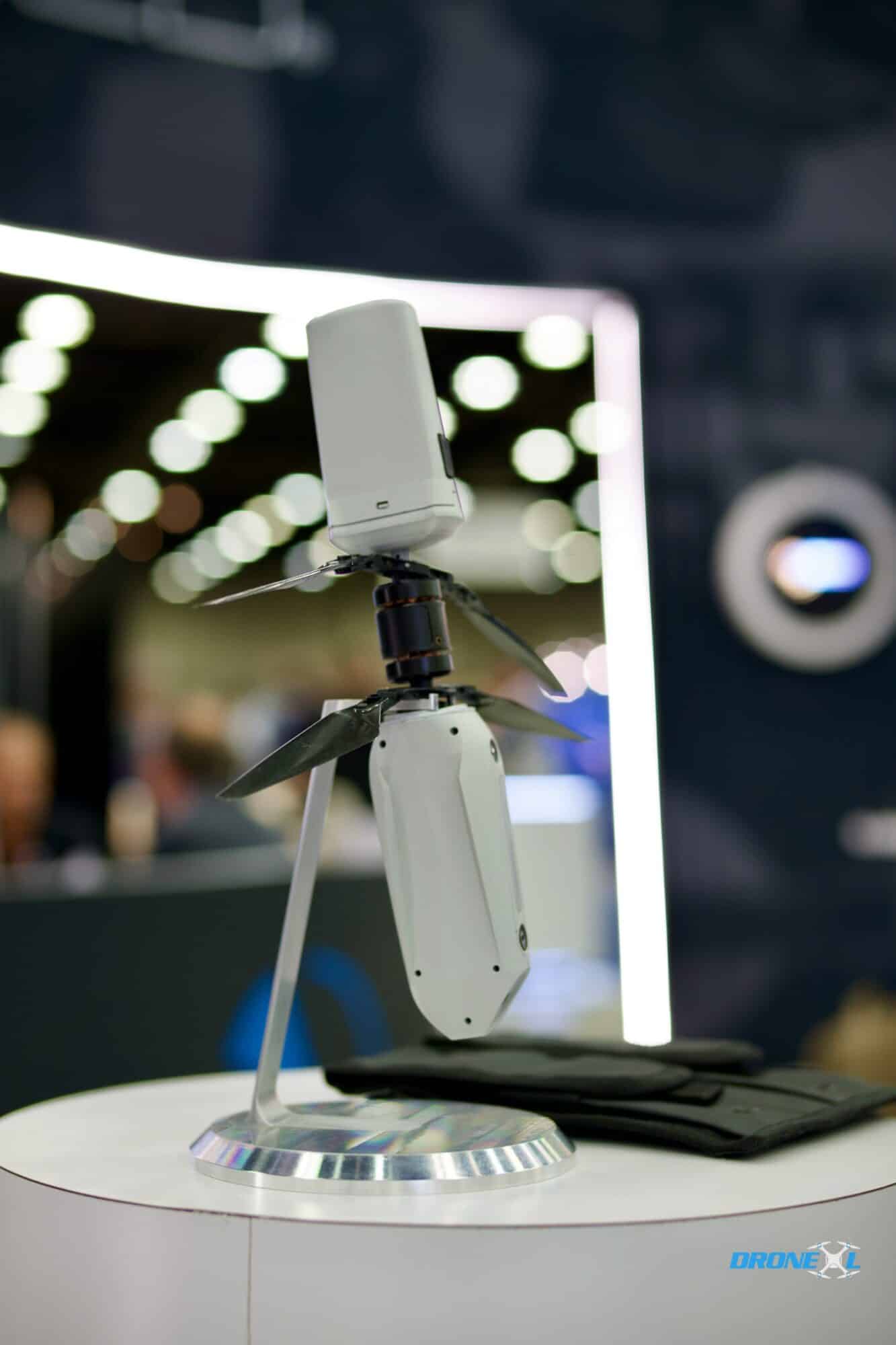
The Helius demo, run by Donofrio’s colleague on the same outdoor pad, illustrated a deliberate product philosophy contrast. Where Spirit is engineered around modular swap-out of every major component, the pocket-sized Helius is purpose-built to be simple. “That one has no modularity except the battery,” Donofrio said as the smaller drone flew. The folding props are intentionally designed as the weak link. In a hard landing, only the props should need replacement, he said, adding that he had crashed prototype Helius units repeatedly during testing and kept flying.

The prototype on display at Detroit was flying over cellular LTE rather than radio link, using a ModalAI VOXL 2 Mini compute module for visual-inertial odometry and obstacle avoidance, and carrying an EO/low-light camera. Donofrio said he has flown the Helius over 40 mph (64 km/h) in testing. The drone is hand-launched and hand-retrieved, and Donofrio described it as “very quiet” in flight.
The production delay is the part of the story most worth noting. When Ascent unveiled Helius in March 2025, the company priced it at $4,499 and committed to Q4 2025 delivery. The original specs in marketing materials cited 4G connectivity, a 4K gimbal camera, 45 mph top speed, 30-minute flight time, and a 249 gram weight that placed it just under the 250 gram regulatory threshold. Robinson Helicopter Company’s dealer network began taking pre-orders that spring. Q4 2025 came and went. At XPONENTIAL Detroit in May 2026, Helius is still labeled a prototype. “The actual production ready ones are coming in mid late summer,” Donofrio said.
The Blue UAS Picture For Spirit Is Strong, And Recently Improved
The defense procurement positioning for the Spirit airframe specifically is the strongest part of Robinson Unmanned’s current commercial pitch. Spirit achieved dual clearance on the Pentagon’s Blue UAS list in September 2025, becoming the first drone listed both as a complete approved system and as a cleared component airframe in the Blue UAS Framework. The component-level listing matters because it allows other US drone manufacturers to build their own specialized aircraft on top of the Spirit airframe with the core platform already pre-approved by the Defense Innovation Unit.
That September 2025 dual clearance also resolved an earlier setback. Spirit was among the drones removed from the Blue UAS list in March 2025, alongside Parrot’s ANAFI USA Gov and Mil models, Inspired Flight’s IF1200A and IF800, Vantage Viper, and others. The removals at the time created sourcing problems for agencies that had standardized on those platforms. Spirit’s return to the Blue UAS list six months later, this time with the added Blue UAS Framework component listing, repositioned the airframe as a foundational building block for the domestic drone industry rather than just one approved end product among many.

DroneXL’s Take
Watching Donofrio assemble a flyable Spirit out of a Pelican case in two and a half minutes is the kind of demo that makes the case for modular open architecture more clearly than any press release. The quarter-turn click rings, the spring plungers, the visual alignment arrows are all small engineering choices that add up to a drone an operator can field without specialized tools and without retraining for each payload swap. That is what Blue UAS Framework component listing actually means in practice.
The Helius story is more complicated. A 9-to-12 month slip from the originally promised Q4 2025 delivery to mid-to-late summer 2026 is not catastrophic by aerospace standards. New aircraft programs slip routinely. But Helius has been marketed as production-ready and available for pre-order at $4,499 since early 2025, and the prototype-versus-production-ready distinction is exactly the kind of detail that matters to public safety agencies and small commercial operators who placed orders on the original timeline. Anyone who pre-ordered a Helius expecting Q4 2025 delivery deserves to know the unit at the Detroit demo pad is still a prototype, not a representative production unit.
The broader Robinson Unmanned story is the one to keep watching. Robinson Helicopter Company spent five decades building one of the most reliable production rotorcraft lines in civil aviation. Turning that high-volume vertically integrated manufacturing capacity toward coaxial drones, and now toward autonomous variants of the R44 and R66 airframes, is a more credible domestic drone manufacturing pitch than most of what gets announced at XPONENTIAL. The question is whether Robinson can apply its assembly-line discipline to the Helius timeline and ship a production unit that matches what dealers and pre-order customers were promised. Mid-to-late summer 2026 is the date to watch. If Helius slips a second time, the credibility narrative around Robinson Unmanned’s “high-volume manufacturing expertise” will be the part of the story that needs revisiting.
Sources: Outdoor demo observed live at XPONENTIAL 2026, Huntington Place, Detroit, May 12, 2026. Robinson Helicopter Company press release announcing Robinson Unmanned, March 10, 2026 (via GlobeNewswire). DroneXL prior coverage of the Robinson-Ascent acquisition (April 2024), Helius product reveal (March 2025), and Spirit Blue UAS dual clearance (September 2025).
Editorial Note: AI tools were used to assist with research and archive retrieval for this article. All reporting, analysis, and editorial perspectives are by Haye Kesteloo.


