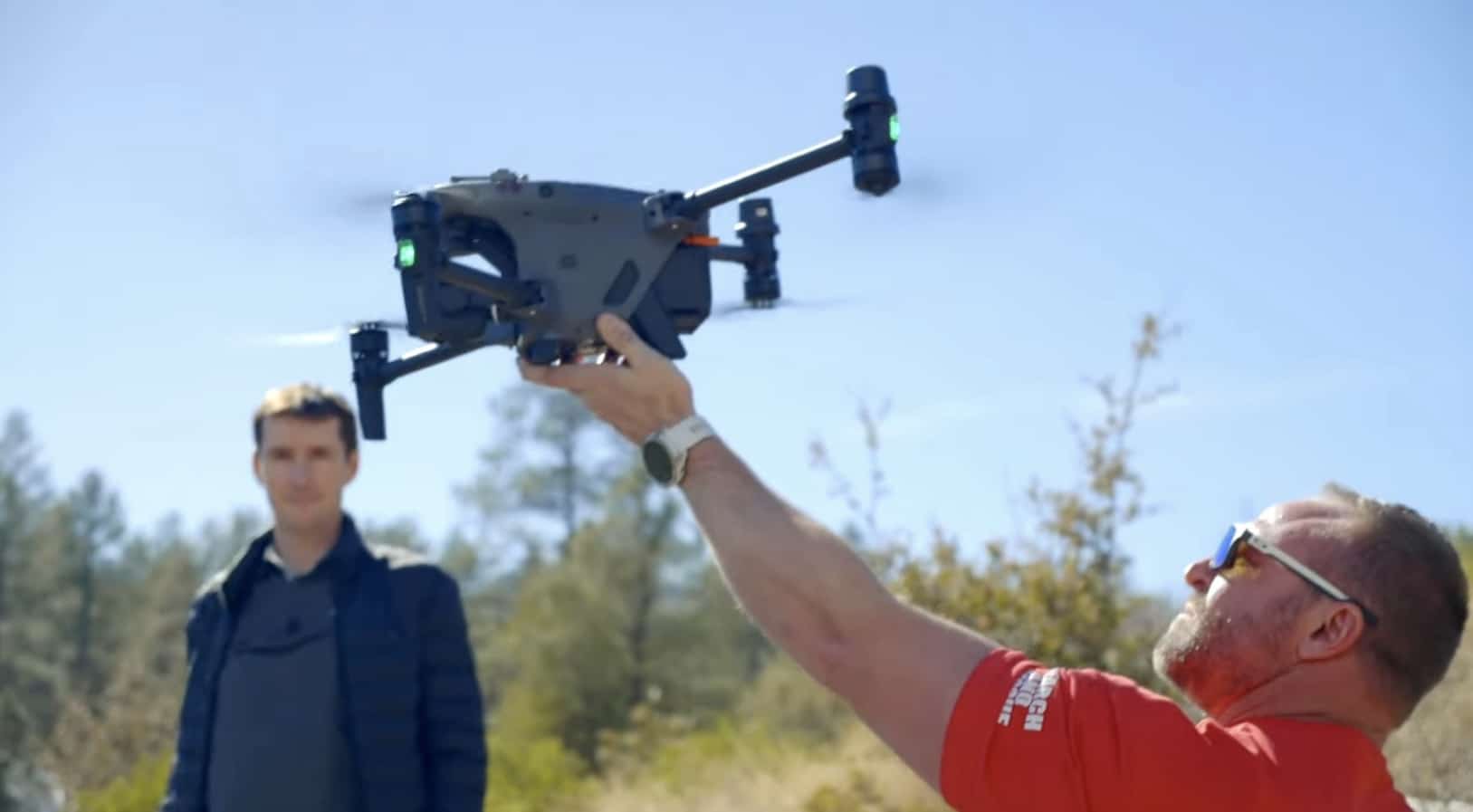
In Yamhill County, Oregon, the police drone stopped being news years ago. The Newberg-Dundee Police Department became the county’s first agency to certify pilots and deploy drones back in 2022, and today it flies a six-aircraft fleet while the Yamhill County Sheriff’s Office operates four more. Between them, the two agencies have quietly built something DroneXL sees more often in big-city programs: a department where the drone is standard equipment, reached for as naturally as a flashlight. The photos accompanying the Newberg Graphic’s reporting show DJI enterprise aircraft doing that daily work, including what I identified as the Matrice 4TD.
The Drone Goes In Before The Officer Does
Building clearing is where the change shows most. A reported burglary or an open door used to mean sending in a K-9 or officers moving room to room. Now a small indoor drone goes first. It can’t open doors, but it clears a house faster than a dog team and it reports back in live video instead of barks.
Deputy PJ Morrissey of the Yamhill County Sheriff’s Office put the case for that in one sentence: “We’d much rather they shoot at a drone than us.” That is the entire argument for interior drones, delivered in nine words by someone who flies them on real calls.
The fleets split the work deliberately. Newberg-Dundee runs a mix of indoor and outdoor models across its six aircraft, and the Sheriff’s Office pairs two indoor drones with two outdoor ones. Different aircraft for different rooms, the same way a patrol rifle and a sidearm serve different distances.
Six of Newberg’s 37 officers hold FAA remote pilot certificates, with recurring in-house training on top. That ratio, roughly one pilot for every six officers, means a certified operator is usually on shift without the department needing a dedicated drone unit.
Thermal At 400 Feet Ends Foot Pursuits
Detective Ariel Siqueiros of Newberg described the outdoor mission that pays off most: “The drone (is) very useful in being able to go up 400 feet in the air, turn on the thermal imaging at night and see someone running.” A fleeing suspect can outrun an officer. Nobody outruns a thermal camera at 400 feet (122 m).
The mission list beyond pursuits reads like a small agency’s whole caseload: missing person searches, crime scene documentation from above, directing responding officers to a suspect’s exact position, and following up on vehicle pursuits. Oregon has had drone guidelines for public agencies since 2013 and a state registry since 2016, which today counts 1,172 public drones registered with 690 active. Yamhill County’s ten aircraft are a small piece of a state that normalized this early.
Both agencies are also watching the next step: automatic-launch drone as first responder programs, and payload missions like delivering life jackets or communication devices to people in trouble. DroneXL has covered that same progression in other small jurisdictions, from Dixon County’s new DJI thermal fleet to Timmins SAR fielding the Matrice 4TD.
Small Budgets Keep Choosing DJI
The hardware choice here follows a pattern DroneXL has documented across county-level America. Agencies that answer to their own budgets, not to federal procurement politics, keep buying DJI. The reasons haven’t changed: more sensors, longer range, mature software with years of field-proven support behind it, and a price a small department can actually absorb, often several aircraft for the cost of one politically approved alternative.
A sheriff’s office with ten aircraft and no dedicated drone unit cannot afford hardware experiments. It buys what works, replaces what breaks, and trains on what its neighboring agencies already fly. That conservatism, multiplied across thousands of county agencies, is the market force no committee hearing has managed to move.
Washington keeps debating bans, the FCC keeps moving on Covered List authorizations, and none of it has changed what shows up in evidence photos from county sheriff’s offices. London’s Metropolitan Police made the same call for the same reasons. Until an alternative matches the capability per dollar, the purchase orders will keep telling this story.
DroneXL’s Take
No ribbon cutting, no controversy, no six-figure procurement fight. Just two small Oregon agencies that started flying in 2022 and four years later treat the drone the way they treat the sidearm: standard equipment you carry every shift and hope not to need.
That sidearm comparison is worth sitting with. An officer doesn’t draw a pistol most days, and most days nobody goes missing in Yamhill County either. But the day someone does, the difference between a tool that’s already in the trunk and a tool that needs a mutual aid request is measured in exactly the minutes that decide those calls. Normalization, not capability, is what four years of flying actually bought this county.
And the quiet DJI detail matters more than any ban headline. County agencies spending their own money keep arriving at the same answer, year after year, purchase after purchase. Policy debates happen in Washington. Procurement happens in places like Newberg, and procurement is the more honest vote.
The next chapter is already named: both agencies are looking at automatic-launch DFR. Whether a county of this size can fund a docked system is an open question, and it’s the right one to watch. The towns that normalized the drone in the trunk are the same towns that will normalize the drone on the roof.
Sources: Newberg Graphic, Oregon Department of Aviation registry figures as cited by Newberg Graphic
DroneXL uses automated tools to support research and source retrieval. All reporting and editorial perspectives are by Rafael Suárez.