
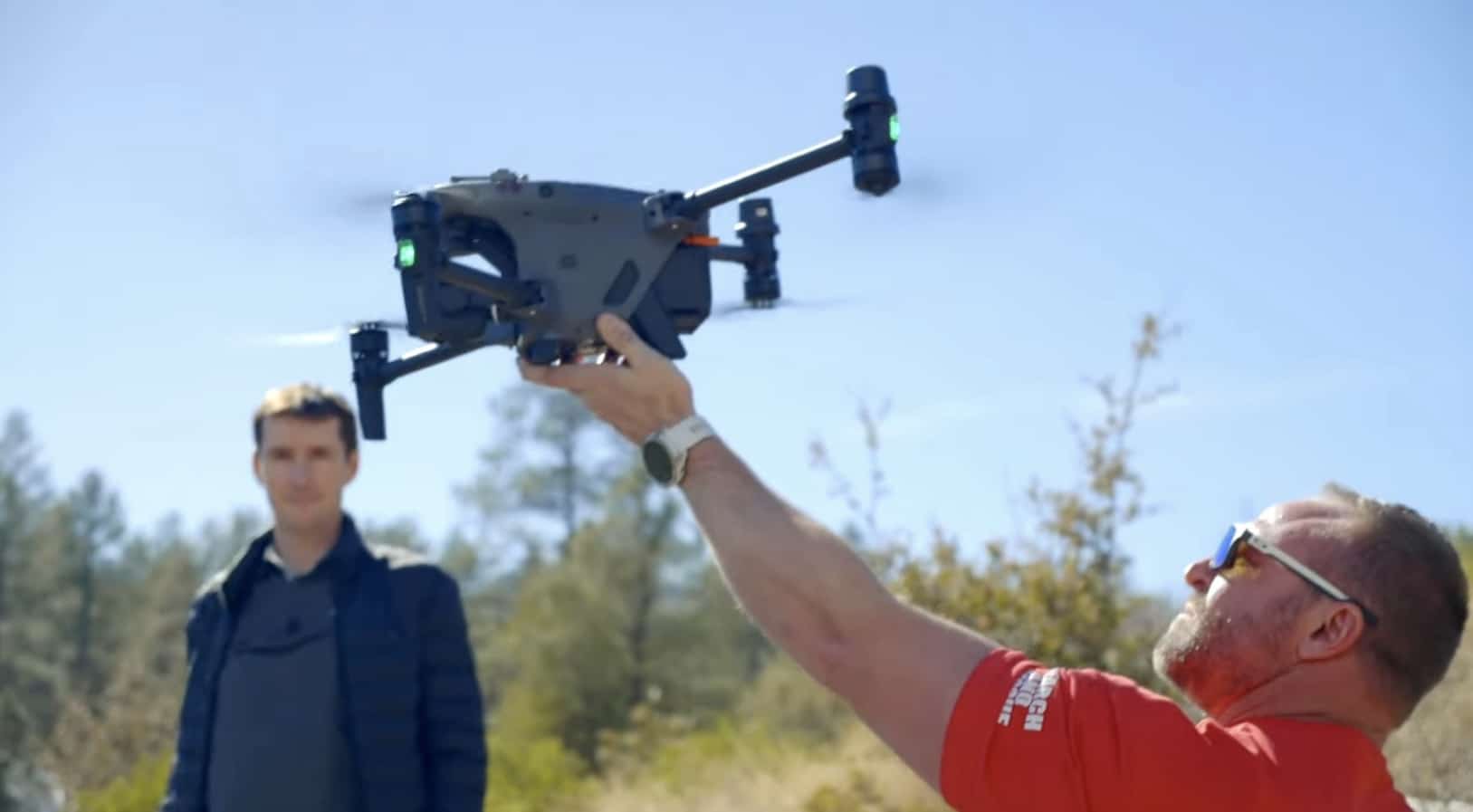
The drone kit one Ocean County Sheriff’s Office deputy carries in his vehicle costs $29,427.99. It is built around a DJI Matrice 300 RTK carrying a thermal camera. Section 232 tariffs now tax imported drones with integrated thermal imagers at 100%, and a pending Federal Communications Commission proposal would bar foreign thermal drones from import and sale. Chief Warrant Officer Kevin Fennessy, who runs the New Jersey office’s drone program, itemized the kit for NPR in a report published October 12.
It is the same Matrice 300 and Restube setup DroneXL covered in July, when an Ocean County pilot dropped a rescue tube to swimmers caught in a Surf City rip current. NPR priced a comparable American-made drone at about twice DJI’s Matrice 400. The FCC proposal would not apply to imports for federal government use. County sheriffs get no such carve-out.
Ocean County Pays for Its Drones From Forfeiture Money and Its Operating Budget
Fennessy’s list runs $13,699 for the Matrice 300 RTK, $1,400 for two batteries, $11,499 for the thermal camera, $1,600 for the controller, $1,099 for a payload release and $130.99 for the Restube. The office funds its fleet from asset forfeiture proceeds and its municipal operating budget.
NPR counts that fleet at 25 drones. As of October 13, the sheriff’s own drone unit page lists 16 aircraft and 13 FAA-licensed pilots, the figures DroneXL reported in July. Fennessy calls the gear a huge investment that is well worth it, especially in summer, when Ocean County’s population nearly doubles and the office watches big crowds from the air. About three years ago he flew a small camera drone through a shot-out window of a house where, by his account, a murder suspect had fired at officers 41 times. The drone found the man dead in a back bedroom. “No one’s hurt. Everyone’s safe,” Fennessy told NPR.

A Comparable American Drone Costs Twice as Much, and Police Say More
NPR compared two drones with similar features. The DJI Matrice 400 retails for about $10,500, and Inspired Flight’s American-made IF800 TOMCAT was listed at a retailer for $21,000. Fennessy, who says he has flown almost all the American models and likes them, puts their cost at about three times DJI’s.
Jon Beal, head of the Law Enforcement Drone Association, gives a wider range. He told NPR that DJI sells a drone with a high-resolution thermal camera for under $10,000, while American drones usually run $20,000 to $50,000 with worse flight time, thermal imaging and zoom. LEDA estimates that about 6,000 U.S. law enforcement agencies now fly drones and that 80% to 90% of them fly DJI. Weber County Search and Rescue’s Kyle Nordfors put the American premium at three to eight times in The Hill this month.
Beal also says moving the supply chain home is harder than it sounds. “Even the American companies are using Chinese batteries,” he told NPR.

Florida Already Showed Who Pays for a Forced Switch
NPR reports that agencies in Florida, Texas, Mississippi and Tennessee ended drone programs, or plans for one, after state bans on foreign drones. In 2023, DroneXL reported Florida’s Orange County sheriff was replacing 16 DJI drones with 18 Skydio aircraft, with $25 million in grants toward replacing more than 500.
That 2023 reporting found most of the replacement cost would still fall on taxpayers. Beal says some departments in the ban states were left scrambling when their budgets couldn’t cover the American alternatives. Federal and state grants for American-made drones exist, NPR notes, but agencies compete for them.
Sheriffs Asked the FCC for the Carve-Out It Proposed for Federal Users
The National Sheriffs’ Association, which represents more than 3,000 sheriffs, asked the FCC in Docket 26-189 to confirm that American drones can do the work before restricting drones that meet its military-grade definition, and to exempt state, local, tribal and territorial law enforcement until the domestic market can supply them.
Its filing asks the agency to “confirm the adequacy of the domestic market” for public safety drones. The definition comes from the FCC’s July 21 notice, which names thermal imaging among seven “military-grade” capabilities alongside lidar and aerosol spraying, and exempts imports for federal government use. DJI’s lawyers attacked that federal carve-out in their own comments.
Comments closed September 2, the day I filed DroneXL’s own comments in the docket. As of October 13, the Federal Register shows no order from the bureaus, which can issue one without a Commission vote. The tariffs are already in force: the Section 232 proclamation has taxed thermal drones at 100% since September 3, with lower rates for other drones and allied imports.
The administration’s case is security. The December 2025 national security determination, issued by an executive-branch interagency body and published by the FCC, treats foreign-made drones as an unacceptable risk. DJI denies sharing user data with the Chinese government, points to an independent security assessment it commissioned, and denies the forced-labor allegations behind Customs and Border Protection’s 2024 hold on some of its imports. Beal told NPR he has seen no hard evidence that China uses the drones to spy on the communities flying them. The FCC told NPR the American drone industry is “booming with new investment.” DroneXL found in September that the FCC’s own $5 billion tally counted pledges alongside money raised.
DroneXL’s Take
Washington wants local police off DJI, and I’d say it is handing them the bill. The tariff adds a duty equal to a thermal drone’s declared import value. The FCC proposal would end those imports outside federal use, and replacement money comes from competitive grants a sheriff may never win.
If Ocean County has to replace its fleet with American aircraft, I expect forfeiture proceeds and the county operating budget to cover a federal policy goal. Fennessy expects the same: “The taxpayers of Ocean County are going to absorb that.”
Birdstop founder Keith Miao told NPR the restrictions give American manufacturers an opportunity to build out drone manufacturing, and a domestic supply chain for public safety hardware is worth having. My view is that the country should pay for it the way Florida at least tried to, with grant money on the table, and not by sending the difference to a county budget.
The sheriffs asked for something modest: proof that American drones can do the job, or permission to keep buying until they can. I think the bureaus owe them one or the other before any order takes effect.
Sources: NPR, National Sheriffs’ Association comments in PS Docket 26-189, National Security Determination, Ocean County Sheriff’s Office, DJI.
DroneXL uses automated tools to support research and source retrieval. All reporting and editorial perspectives are by Haye Kesteloo. Read our editorial standards.


