Amazon Prime Air is running its first drone delivery operation outside the United States from a fulfillment center in Darlington, England, and the entire international expansion now hangs on one date: the Civil Aviation Authority trial permission expires at the end of 2026. What the British regulator decides in December will shape where Amazon’s drones fly next in Europe. DroneXL has tracked this program since the first Darlington parcels flew in the spring, and the story has grown more complicated since.
Darlington Runs On A Trial Permission With Hard Caps
The UK operation is a tightly bounded experiment, not an open commercial service. The CAA authorized flights on a trial basis through the end of 2026, capped at 10 flights per hour and 100 deliveries per day on weekdays, from a single 465,000 square foot fulfillment center in Darlington, County Durham.

Packages top out at 5 pounds (2.2 kg) inside a 7.5 mile (12 km) radius. Flights run in daylight and fair weather only. Amazon has long said the 5 pound limit covers roughly 85 percent of the items it ships, which is the same argument it makes for the US markets.
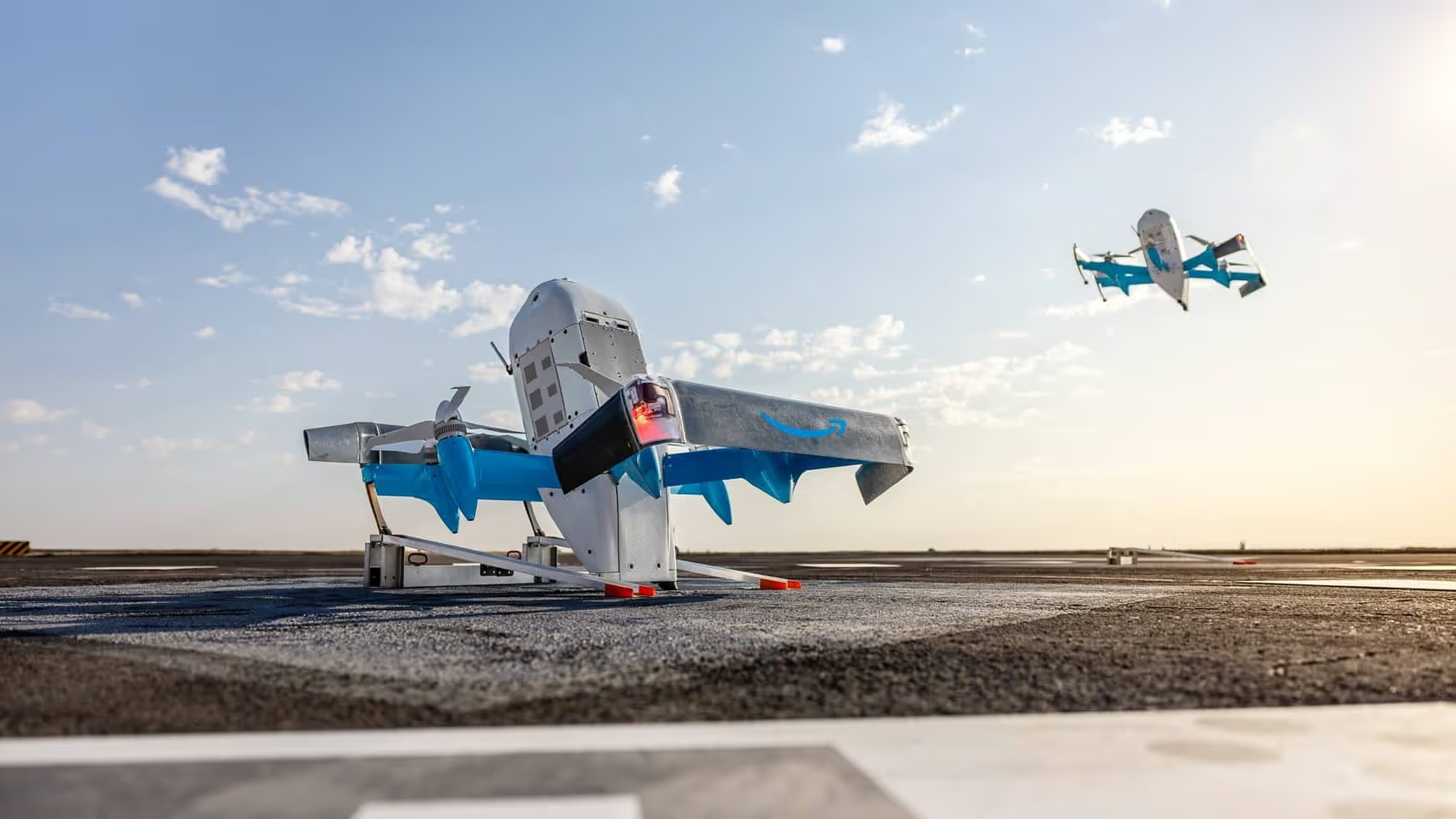
The aircraft is the MK30, the electric drone that tilts its wings to transition from vertical takeoff into forward flight. As DroneXL noted when Darlington launched in May, the airspace permission has to be renewed, which means the CAA holds a lever no US regulator currently pulls this hard.

The Crash Record Crossed The Atlantic First
The MK30’s safety history followed the aircraft to England before the marketing did. On October 1, 2025, two MK30s struck the boom of the same active construction crane in Tolleson, Arizona, within minutes of each other. One collision ejected a battery that caught fire on impact. The FAA and NTSB both opened investigations.
Six weeks later, an MK30 clipped an internet cable in Waco, Texas, 13 days after commercial service launched there, and drew a second FAA probe. DroneXL examined the MK30’s crash problem in April when Amazon showed the aircraft at XPONENTIAL Europe.
Then it happened on British soil. In July, an MK30 crash-landed in a Darlington garden, an incident sUAS News described as exposing a gap in the CAA’s contingency planning. Two drones into one crane is a sensor story. A drone in a garden during a supervised trial is a regulator’s story, and the regulator in question is the one holding the renewal pen.
UK Rules Run Tighter Than The US Playbook
Compare the two rulebooks and the difference is night and day. In the United States, Amazon holds Part 135 authority, flies beyond visual line of sight, and has expanded into new metro areas on its own schedule, with FAA investigations arriving after incidents rather than caps arriving before them.

The CAA flipped that order. One town, a daily ceiling, daylight hours, weather minimums, and a permission that dies in December unless renewed. British regulators built the fence first and are watching how the aircraft behaves inside it.
That answers a question American observers keep asking backwards. The UK framework is not softer than the US one. It is stricter at the entry gate and more discretionary at the renewal gate, which gives the CAA something the FAA rarely uses: a scheduled moment to say no.
Manna Flies The Other Way Across The Atlantic
While Amazon pushes east, Europe’s most experienced delivery operator is flying west. Manna, the Irish company that spent seven years building its model in Irish towns like Oranmore and Balbriggan, put its home operations on a strategic pause, citing the lack of a clear national drone framework in Ireland. It then raised $50 million and announced a US operations and manufacturing center in Tulsa, Oklahoma, with plans for up to 40 American bases.
Read those two flight paths together. The American giant crosses to Europe for a regulator that offers a structured, renewable trial. The European veteran crosses to America for scale that its home government never framed rules to support. Each company left the environment the other one is entering.
The open questions in Darlington are the ones Amazon has not answered publicly: what the per-delivery cost structure looks like, how many UK hubs would follow a successful renewal, and which European country gets the next fulfillment center on the map.
DroneXL’s Take
I’ll be direct: the MK30 is a very large aircraft delivering very small packages, and that mismatch is the thread running through every incident on its record. A drone this size does not brush past a crane or a cable. It hits them, and in Tolleson the result was a battery burning in a parking lot. When I watch delivery footage of the MK30 coming down low over a customer’s lawn, my honest reaction is that it makes me a little nervous, and I fly drones for a living.
The December renewal is the first time a major regulator gets to grade Amazon’s delivery program with a hard deadline attached. The CAA saw the American incident record before it signed the trial. Now it has a Darlington garden on its own docket. Whether the renewal arrives clean, arrives with new conditions, or does not arrive at all is an open question, not a prediction, and it is the single most consequential drone delivery decision on the calendar this year.
Expansion itself is the healthy part of this story. Companies that ship, crash, fix, and ship again are how this industry grows up, and Amazon keeps flying and keeps fixing. The version of this program that earns Europe is the one that lands its lessons faster than its aircraft.
Sources: TechBuzz, TechTimes, sUAS News, CNBC, Silicon Republic, TechCrunch
DroneXL uses automated tools to support research and source retrieval. All reporting and editorial perspectives are by Rafael Suárez.