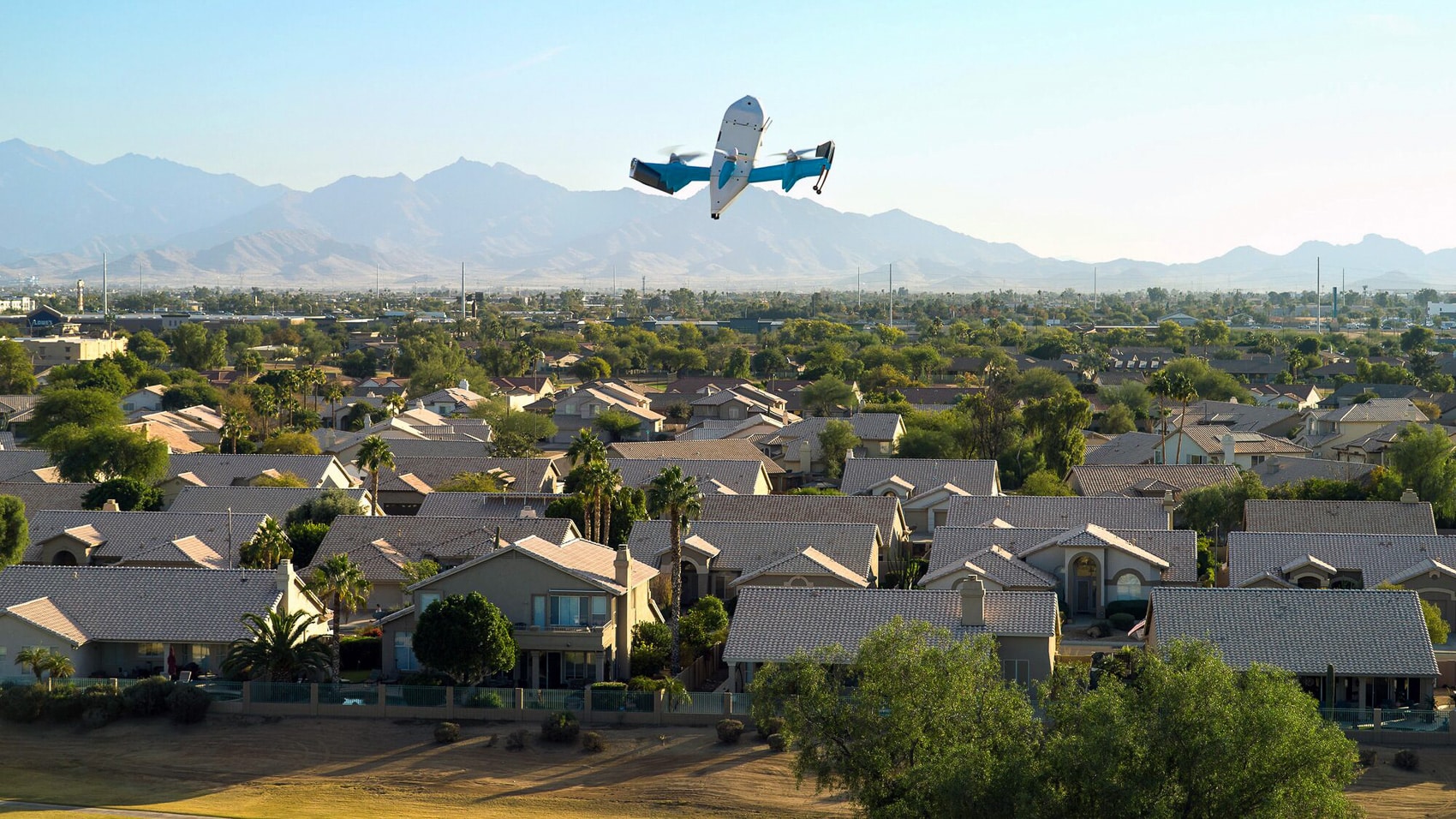
If Amazon picks a warehouse near you for Prime Air, your town gets no vote on whether its MK30 drones fly over your house. The Federal Aviation Administration controls the airspace, and on July 28 it signed a national environmental finding that lets most new drone delivery hubs skip the local comment period towns used to get. Amazon says it will reach nearly 500 US cities and towns by the end of 2026.
Residents are finding that out one town at a time. In Richardson, Texas, one woman counted 52 Amazon drones over her home on what she called a slow day. In Westborough, Massachusetts, hundreds of people filled a hotel ballroom on September 23, and I was in that room when Amazon told them it plans to launch anyway. The only local vote left in Westborough is on the launch pad, and under Massachusetts law the Planning Board may not be able to say no to that either.
That leaves a short list of things a concerned resident can do. None of them stops a drone. Several of them change how Amazon flies.
The FAA Controls the Sky, and a Federal Court Has Kept Towns Out of It
Cities cannot ban drone flights or regulate aircraft noise, because the FAA controls the airspace and the operator’s certificate. In 2017 a federal judge in Massachusetts struck down Newton’s attempt to regulate drones over private property as preempted by federal law.
That case, Singer v. City of Newton, is why city attorneys advise caution. The court threw out Newton’s local registration requirement and its ban on flights below 400 feet (122 meters) over private property without permission. Madison Heights, Michigan now tells residents on its drone delivery page that it is federally prohibited from banning flights or regulating aircraft noise. Richardson’s FAQ says the same about altitude, and its council dropped a rezoning threat in April on legal advice, as DroneXL reported when the New York Times visited the city.
The federal comment window is mostly gone too. Until this summer, each new market triggered its own environmental assessment with a public comment period of about 30 days. The FAA’s national programmatic assessment, signed July 28, lets a hub that stays under 1,150 deliveries a day, and sits at least 600 feet (183 meters) from homes, be approved in an internal FAA check with no public comment at all. A coalition of state attorneys general objected to the draft. The deadline for anyone with standing to challenge the finding in a federal appeals court is September 26, tomorrow, and that is a job for a state or city attorney, not a resident.
Towns Control the Launch Pad, and Often Not Even That
A town’s real authority starts at the ground: site plans, building permits and zoning for the hub itself. Amazon’s pads typically sit in existing warehouse parking lots, which can trigger little local review. Amazon’s Tareq Wafaie told Westborough that about 80% of its proposed hubs were approved administratively.
Westborough is the test case. Its Planning Board resumes site-plan review of Amazon’s pads and trailers at 64 Otis Street on October 6, and residents on local Facebook groups are urging it to reject them. If Westborough’s zoning allows the use by right, Massachusetts case law limits that option. In Prudential Insurance Co. v. Board of Appeals of Westwood (1986), the Appeals Court held that when a use is allowed by right and the bylaw’s criteria are met, a board cannot deny site-plan approval and is limited to imposing reasonable conditions. Those conditions can still matter: hours for ground operations, lighting, screening and noise at the site itself.
Some states have already settled the question in the operators’ favor. Florida Statute 330.41(3)(c) bars cities and counties from withholding a permit or passing an ordinance that stops a drone delivery service because of where its drone port sits. Local governments there may still enforce the setback and landscaping rules that apply to other uses in the same zone. Massachusetts goes the other way on one point: Wafaie said Amazon still needs a MassDOT Aeronautics inspection and registration of the Westborough landing area, a state approval it does not have yet.
The strongest local move so far is a pause. Castle Rock and Parker, Colorado adopted emergency moratoriums on July 21 on new drone delivery hubs, six months in Castle Rock and nine in Parker. A moratorium buys a town time to write zoning rules for hubs before an application arrives, which DroneXL’s guide to how drone delivery approval works calls the most effective thing a town can do.
Decibels Don’t Measure What Neighbors Actually Hear
Amazon spokesperson Jack Stelzner told KWTX the MK30 sounds like a window fan on low at altitude. The FAA’s own Baton Rouge filing puts the delivery hover at 92.1 decibels SEL from 25 feet, and no decibel figure captures pitch, which is what residents keep describing.
The distinction is measurable. NASA Langley researchers Andrew Christian and Randolph Cabell played recordings of small drones and road vehicles to 38 listeners in a 2017 study and found the drones more annoying at the same loudness. PetaPixel reported the extra annoyance as roughly equivalent to a car driving twice as close. The FAA’s national finding measures noise the way it measures airports, as an annual day-night average, which counts energy and not annoyance. A house under a departure corridor can sit below the federal threshold and still hear a drone every few minutes.
Pitch comes from the propellers, and other companies have designed around it. Zipline’s early aircraft used unevenly spaced propeller blades that spread the blade-passage tone across more frequencies, and Zipline says a software update this month cut 19 seconds of peak noise from each P2 flight. NASA measured Joby Aviation’s air taxi at 45.2 dBA from 1,640 feet (500 meters) in 2022. Amazon has not stated the MK30’s dominant frequency. Pitch is one of the 15 questions DroneXL sent every delivery operator this month, and Amazon has not answered it.
The MK30’s Record Includes a Crane, a Cable and a Building
The MK30 weighs 83.2 pounds (37.7 kilograms) at takeoff, cruises at up to 73 mph (117 km/h) and carries no parachute. Amazon relies on six propellers, redundant systems and an automatic contingent landing. Nobody has been hurt in any MK30 incident on the record.
Two MK30s struck the same construction crane in Tolleson, Arizona, minutes apart on October 1, 2025. Wafaie told Westborough the drones missed that crane type and detect it now. Another hit a residential internet cable in Waco in November, and in February one struck an apartment building in Richardson. This month, MK30s made precautionary landings beside a Baton Rouge boulevard and on a Waco lawn.
What a Concerned Resident Can Still Do
Start with the pad, before it is approved: check whether your town’s zoning already covers a drone hub, go to the planning board hearing, and ask for conditions a board can legally impose, like ground-operation hours, lighting and where on the lot the pads sit.
A town that writes hub rules before an application arrives has far more room than one reacting to it.
File complaints with dates and times, and keep filing. Complaints have moved Amazon before: after Richardson residents complained in January, Amazon raised average outbound altitude to 225 feet (69 meters) and moved some routes over commercial land. Amazon told the Times it has adjusted operations in response to feedback, TechSpot noted, without saying how many routes it changed. Every channel is in the box below.
- Call: 1-888-280-4331, and say it's about drone delivery
- Chat: open Amazon's customer service page, click "Something Else," then "Amazon Drone Delivery"
- Online: Prime Air · About Amazon Drone Delivery · Drone Delivery FAQs · Consent for Drone Delivery
- FAA: noise complaints · safety hotline
Keep a log. Stephanie Puri’s count of 52 overflights in Richardson reached the New York Times because she wrote it down. A Garland, Texas group, Quiet Skies TX, publishes incident-log templates and asks residents to record date, time, altitude and duration.
Call your state legislators. State law shapes what a town can do with the ground, as Florida’s statute and Massachusetts’ landing-area registration show, and the two are pulling in opposite directions.
Declining drone delivery at checkout is a personal choice, not a shield. Wafaie told Westborough plainly that there is no opting out of drones flying over your property. Amazon’s own terms for customers are on its Consent for Drone Delivery page.
And when one comes down, report it. DroneXL’s Drone Delivery Tracker logs every hub and incident on the public record, and the Waco landing reached it because a resident posted photos.
DroneXL’s Take
I’m pro drone delivery, and residents deserve it straight: the fight over the sky was lost before Amazon arrived, because the airspace was never a town’s to control. What’s left is the ground and the record, and residents should use both. Show up before the pad is approved, and make Amazon answer on the record.
What frustrates me is that Amazon holds most of the fixes, and from what I’ve seen it uses them only under pressure. It raised altitude in Richardson after residents complained. It could publish its routes and tell a town what pitch the MK30 makes before the first flight. It could fly a lighter aircraft: Zipline carries 8 pounds on a 55-pound P2 with a parachute and delivers from 300 feet. Amazon carries 5 on an 83-pound MK30 without one and descends to 13 feet over the yard.
My worry is what happens if Amazon keeps arriving the way it arrived in Westborough: no public meeting planned for the other towns in the service area and no commitment on hours. Castle Rock and Parker already froze hubs. A moratorium grounds a defibrillator drone as surely as a toothpaste run, and the operators doing it right will pay for Amazon’s approach.
Sources: FAA Final Programmatic Environmental Assessment (July 28, 2026), Singer v. City of Newton, court opinion (D. Mass. 2017), Prudential v. Board of Appeals of Westwood, Florida Statute 330.41, NASA Technical Reports Server, TechSpot, The New York Times, City of Madison Heights, City of Pleasant Ridge, City of Richardson
Update, September 25, 2026: An earlier version of this article listed [email protected], an address two Michigan cities publish for residents. An automated reply Amazon sent DroneXL says that inbox is no longer monitored. The box now lists the phone and chat channels Amazon gave in that reply.
DroneXL uses automated tools to support research and source retrieval. All reporting and editorial perspectives are by Haye Kesteloo. Read our editorial standards.