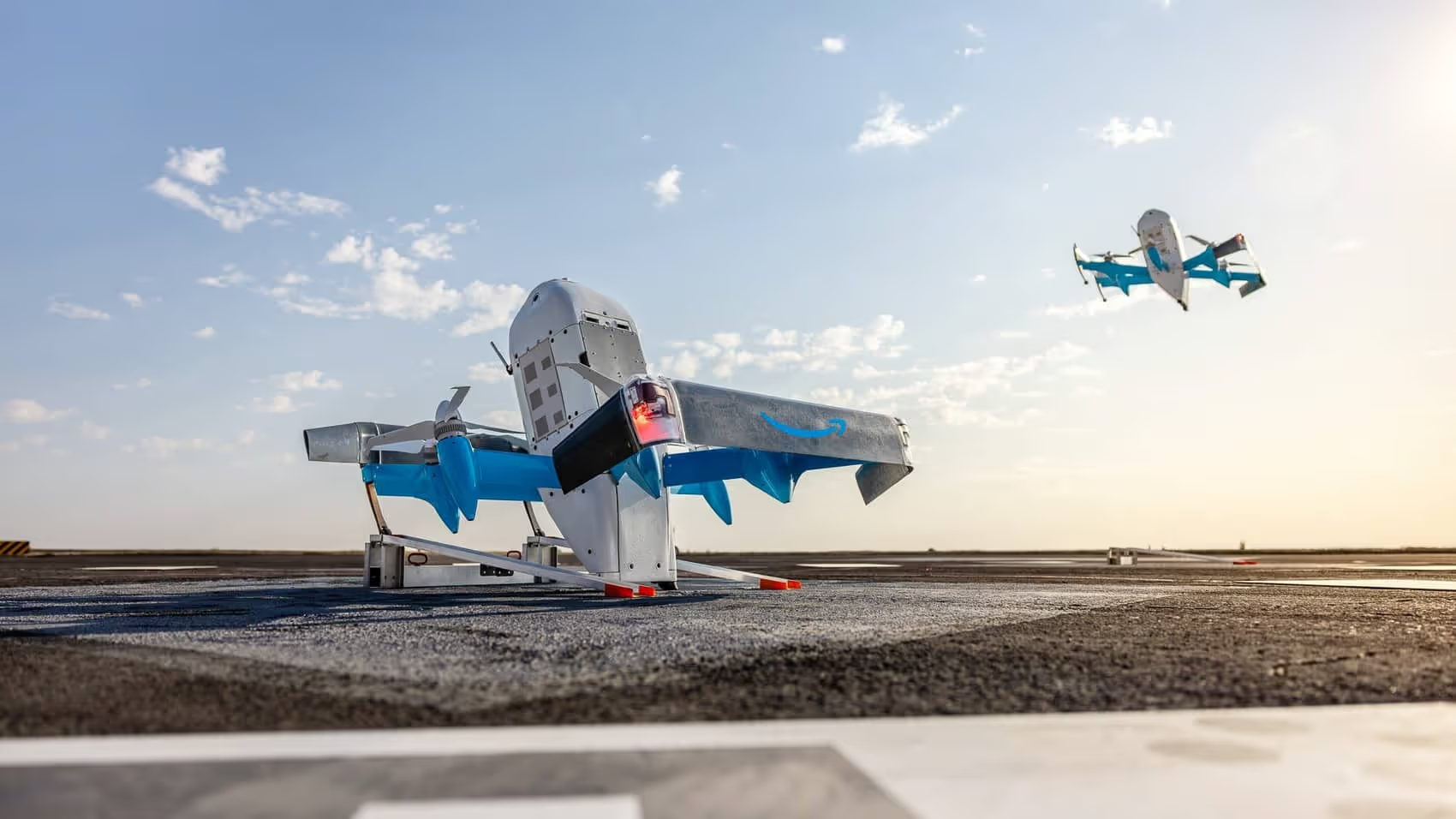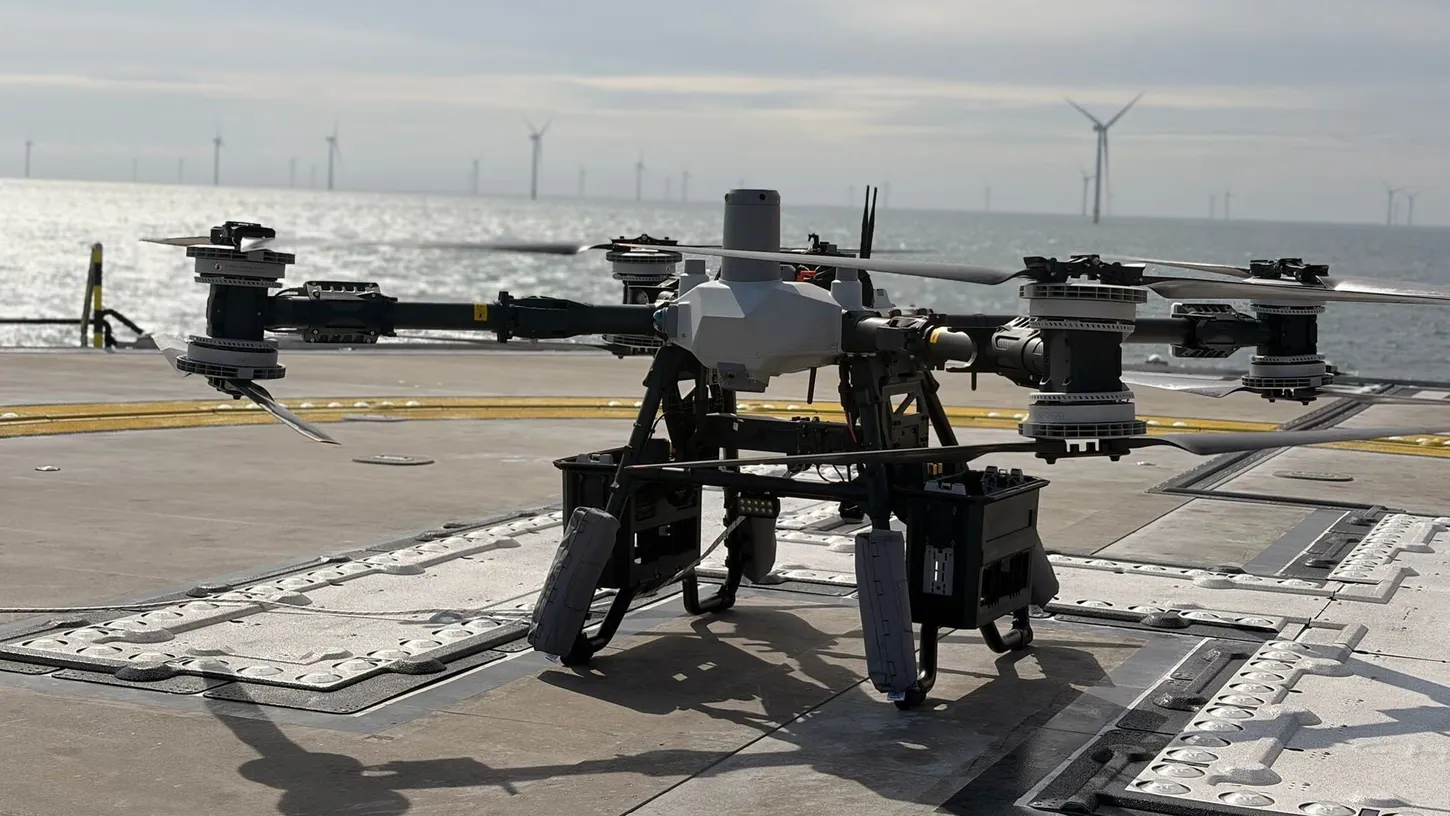

Amazon has applied to the UK’s Civil Aviation Authority for permission to fly Prime Air drones across the whole of Darlington, County Durham, after more than 500 flights and deliveries out of its fulfillment center there. Prime Air vice president David Carbon said the company expects permission very soon, and that the target beyond Darlington is the rest of the United Kingdom.
DroneXL has followed this operation since Amazon picked the site, through the commercial launch in the spring and the crash that put a British accident investigator on the aircraft in July. This is the first time Amazon has asked the regulator to widen the box instead of flying inside it.
Five hundred flights and deliveries since February works out to roughly three a weekday. Amazon’s permission already allows a hundred deliveries a day.
Amazon Is Flying A Small Fraction Of The Deliveries It Already Won
The CAA capped Darlington at 10 flights per hour and 100 deliveries per weekday when it authorized the trial. Amazon reports more than 500 flights and deliveries since February. Across 160 weekdays, that permission allowed 16,000. Amazon flew about three percent of them.
Use the later start date and the picture barely improves. DroneXL reported the first UK parcel deliveries in Darlington in May, after test flights that began in January, which leaves 92 weekdays and 9,200 permitted deliveries. Five hundred is under six percent of that.
Airspace is not what holds this service back, and a bigger map will not change it. The binding limits sit on the ground. A customer needs a garden, yard or driveway with a clear drop zone, and the MK30 flies only in daylight and fair weather under the current permission.
What Amazon actually asked for is the part nobody has published. The BBC reported the geography, a town-wide footprint replacing the 7.5-mile (12 km) radius. Neither Amazon nor the CAA has said whether the application also lifts the 10-flights-per-hour rate or the 100-delivery daily cap, and those are the numbers that decide whether Darlington becomes a service or a larger demonstration. Darlington Borough Council already cut that flight rate from 21 per hour to 10 in December 2025, so the caps have moved before.

The Delivery Promise Has Slipped From 30 Minutes To Two Hours
Tees Valley Combined Authority announced the Darlington project in January 2025 promising 30-minute deliveries. Amazon’s own site feature in August described 60 minutes or less. The wire coverage of this week’s application puts the standard at two hours, with a best single delivery of 39 minutes.
Three numbers for the same service inside 20 months, each slower than the last. DroneXL reported the two-hour window when Darlington went live and flagged the 60-minute claim when Amazon published its site tour last month. The wire copy has now settled back on the figure the launch coverage used.
Carbon has said Amazon’s US markets average 36 minutes per delivery. Darlington’s best day on record is 39. The British operation’s high-water mark is slower than an ordinary American afternoon.
The Shoebox Is A Tighter Limit Than The Five Pounds
Carbon put the share of Amazon orders eligible for drone delivery at about 68 percent, according to PA Media. Amazon has long said the five-pound (2.2 kg) weight limit on its own covers roughly 85 percent of what it ships. The gap between those two figures is the large shoebox.

That corrects how drone delivery usually gets described. Weight is the limit everyone quotes, because weight is the limit the aircraft imposes. Volume costs Amazon 17 points of its own catalog before a single household is considered.
The household number is narrower again, and it has not appeared in Amazon’s UK announcements. The drop-zone requirement rules out flats and anyone whose only parking is on the street. In a town of 107,000 people, the eligible-address count is the real ceiling, and Amazon publishes it for neither Darlington nor its American markets.
Carbon Called The Incident Rate Low Against A Denominator Of 500
Carbon acknowledged there had been some incidents and said the share was “not a percentage that is high at all.” The denominator is 500 flights. One MK30 came down in a garden at Beaumont Hill on July 29, and the Air Accidents Investigation Branch opened an accident investigation.
One accident in 500 flights is one in 500. Aviation does not file that under low. I’d want the full incident list before accepting the characterization, and Carbon used the plural without itemizing it: the July crash is the only Darlington event on the public record.

Amazon’s account of that crash puts the cause outside the aircraft, blaming contact with an object extending above the roof of a moving vehicle, after which the drone came down as designed. The MK30 reached England with a history. Two of them struck the boom of the same construction crane in Tolleson, Arizona in October 2025, and one ejected a battery that burned on impact. Seven weeks later an MK30 clipped an internet cable in Waco, Texas and drew a second FAA probe.
The CAA Holds A December Date The FAA Never Gave Itself
Amazon’s Darlington permission expires on December 31, which hands the British regulator a scheduled moment to renew it or refuse. American regulators have no equivalent date for Prime Air. The FAA opens investigations after incidents. The CAA set the caps before the first flight.
The contrast keeps widening. Amazon says it will offer drone delivery in nearly 500 US cities and towns by the end of 2026, a sixfold jump from 11 sites across seven states, and no American regulator has a calendar entry to approve or deny it. Part 108, the rule meant to make routine BVLOS operations ordinary, still has not published. DroneXL covered the TSA’s closed-door security roundtables on it this month; the final rule, RIN 2120-AL82, reached the White House regulatory office on July 10 and was still listed as pending review in early September.
So the permissive regulator lets Amazon multiply its footprint by six with no scheduled review, while the restrictive one gets asked for more room and still holds the lever.
DroneXL’s Take
Amazon is asking for a bigger box before filling the one it has. Roughly three flights a weekday against a permission for a hundred deliveries is not a company constrained by geography. It is a company constrained by eligible addresses, weather, daylight, and whatever the fleet and the ground crew can actually turn around in a day. Redrawing the boundary fixes none of that.
I’ve covered Prime Air since the MK27 days, and the pattern repeats. The announcement is always about reach. The operating numbers, when they surface, are always small. Nearly 500 American cities is the same move performed with a compass: draw a 175-square-mile (453 sq km) circle around a warehouse and count the municipalities inside it.
The fair point on Amazon’s side is that a 7.5-mile radius struck from a fulfillment center at Symmetry Park is an arbitrary shape. It leaves streets inside Darlington outside the service while taking in farmland beyond it, so asking for a clean municipal boundary is reasonable. I’d grant it. It is also nowhere near the most important thing on the CAA’s desk.
That thing is December 31. The renewal decides whether Prime Air has a European future, and it arrives with an open AAIB accident file attached. As DroneXL argued last month, the CAA built the fence first and gave itself a date to inspect it. Watch what the regulator does with the caps, not the map. A renewal that keeps the 100-a-day ceiling means the CAA reached the same arithmetic and decided Amazon does not need more room. Caps lifted alongside a town-wide footprint means the trial passed, and the next application will be for a second British town.
DroneXL’s drone delivery tracker keeps the running record of every US Prime Air site and incident.
Sources: BBC News, PA Media, About Amazon, Tees Valley Combined Authority
DroneXL uses automated tools to support research and source retrieval. All reporting and editorial perspectives are by Haye Kesteloo. Read our editorial standards.