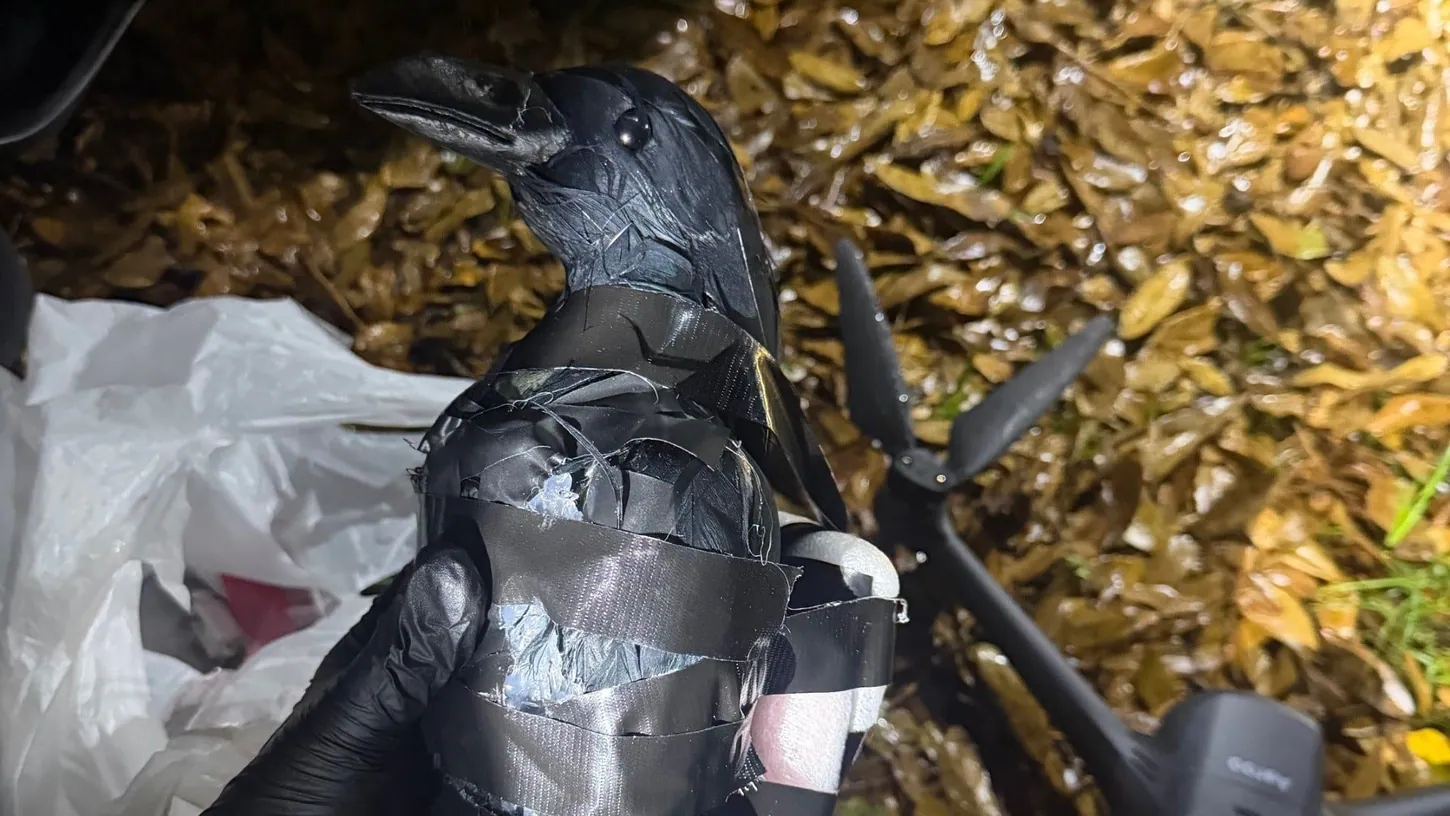
A Grant Parish deputy drove back to a spot on Hooper Road to check on a car that had been sitting in the middle of the road, and found a drone on the ground with $31,000 worth of methamphetamine strapped to it. The men who launched it were gone, leading other deputies across four Louisiana parishes at high speed.
Nobody was flying the drone by then. As the battery drained it did what nearly every modern drone is built to do when power runs low, according to the Rapides Parish Journal’s account of the arrests: it flew back to the point it lifted off from, which was the patch of roadside the deputy had just returned to.
Leroy Rocha, 35, and Javier Hernandez, 31, both of Corpus Christi, Texas, were arrested when the pursuit ended. By KALB’s running tally, the two arrests brought this year’s total to 26 for smuggling contraband into the federal prison complex at Pollock, whose penitentiary went on the FAA’s restricted list in 2018.
Deputies Found the Drone Where the Car Had Been Parked
A Grant Parish deputy spotted a vehicle stopped in the middle of Hooper Road over the weekend and turned around to check on it. The vehicle sped off. The chase that followed ran through Grant, Rapides, Winn and Natchitoches parishes before it ended with two men in custody.
A second deputy went back to the parking spot while the pursuit was still running, and that is where the drone came down. The Grant Parish Sheriff’s Office determined the pair had been trying to fly the meth into the prison, as KALB reported.
Rocha faces charges including criminal conspiracy and possession of methamphetamine with intent to distribute. Hernandez faces taking contraband into a penal institution, along with fentanyl and flight-from-an-officer counts. Both men are affiliated with the prison gang Tango Blast, according to the Rapides Parish Journal, and both are presumed innocent unless convicted.
The Drone’s Low Battery Sent It Back to the Launch Point
Return-to-home is a failsafe, not a feature you trigger on purpose. A drone records a home point at takeoff, measures battery against the distance back, and flies itself there once the margin disappears. That is what happened on Hooper Road, and it is why the meth was still attached.
The behavior is not obscure. DroneXL published an explainer on how return-to-home works in June, covering when the aircraft picks its own altitude and when it follows a preset. Smugglers flying at night over a prison perimeter are working against defaults the manufacturer shipped on purpose.
These two left the aircraft airborne with a live payload and drove away. The drone filed the report for them.
Grant Parish Has Booked 26 Smuggling Arrests This Year
The count is the story. KALB reported the third, fourth and fifth arrests of 2026 in January, the ninth and tenth in March, and number 26 this past weekend. A 27th followed the next day, that one involving meth hidden inside bracelets rather than flown over a fence.
Not every attempt uses an aircraft, but enough do that a rural sheriff’s office has become a proving ground for an air-delivery problem it never budgeted for. DroneXL has tracked the same pattern nationally, through contraband drops that turned prison perimeters into delivery routes and heavy-lift aircraft used against federal facilities.
Pollock Has Been Restricted Airspace Since 2018
The prison complex sits under airspace the FAA closed to drones years ago. The Bureau of Prisons became the first Justice Department component to obtain flight restrictions from the FAA in 2018, and USP Pollock made that original list of 20 facilities, each protected up to 400 feet (122 meters).
Pollock also appears in the largest federal drone smuggling case brought so far. A June indictment in Georgia charged twelve people with dropping contraband into ten federal prisons at least 38 times, FCI Pollock among them. Prosecutors built that case on a BOP detection system that logged each aircraft’s make, model, identification number, launch site and flight path, which DroneXL covered in June.
Neither KALB’s report nor the Rapides Parish Journal account names the drone recovered in Grant Parish. Make, model and Remote ID serial are the fields a detection system captures and a prosecutor uses, and their absence from the public account points to an aircraft identified on the ground rather than in the air. Not detection. A traffic stop.
DroneXL’s Take
Eight years after USP Pollock went on the FAA’s restricted list, that line on the chart has not stopped one of the 26 arrests this parish logged in nine months. Georgia’s case worked because the Bureau of Prisons had hardware listening at the fence line.
This one worked because a deputy was curious about a parked car. I will concede the strongest point against the pro-drone position, because it is real: the payloads have escalated from tobacco to saw blades meant to cut inmates out of a federal prison. Prisons need authority to deal with that, and I have argued they should be able to bring these aircraft down without a permission slip.
My read is that the fix is equipment and training at the fence line, not more airspace drawn on a map. The FAA’s proposed fixed-site framework, docket FAA-2026-4558, would let facility operators nationwide petition for standing no-fly zones, and comments closed August 5. Pollock already had a restriction and still counted 26 arrests. Tennessee asked for $1.7 million in prison drone detection because detection is the part that produces evidence.
The more useful development took effect July 1. The SAFER SKIES rule names correctional facilities outright and lets a sheriff’s office certify to detect and track drones after a free online course that runs about an hour. Knocking one down is the harder tier, requiring resident training at the FBI’s national schoolhouse, which had certified 61 officers across roughly 46 agencies when the rule published. DroneXL reported that about 1,500 agencies are expected to reach the detection tier inside two years.
Watch whether 46 becomes 1,500, and whether rural sheriff’s offices are in that count or whether it stops at departments with grant writers on staff. Sheriff Steven McCain says his deputies will keep making these arrests: “We’re not going to stop.” They should not have to depend on a suspect’s battery management.
Sources: KALB, Rapides Parish Journal, U.S. Attorney’s Office for the Middle District of Georgia, Federal Bureau of Prisons
DroneXL uses automated tools to support research and source retrieval. All reporting and editorial perspectives are by Haye Kesteloo. Read our editorial standards.