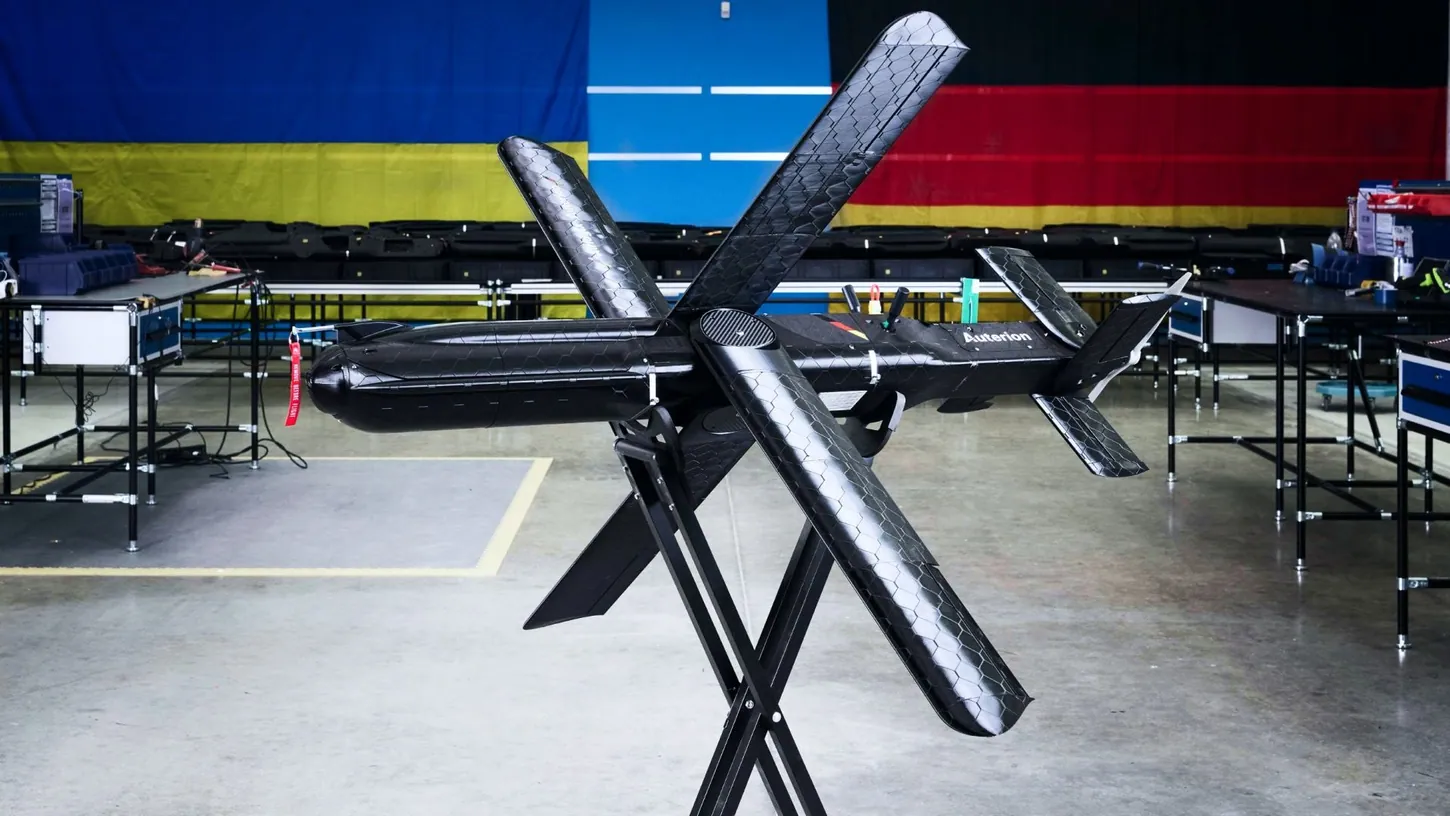
German Chancellor Friedrich Merz arrived in Kyiv by train on October 4 with a support package worth more than €1.3 billion ($1.46 billion), and the headline item is money to mass-produce interceptor drones against Russia’s jet-powered Shaheds. About €1 billion ($1.13 billion) is military aid: the interceptor production financing, long-range strike weapons, combat drones and satellite equipment. Another €350 million ($394 million) goes to generators, substations and grid repairs before winter.
Merz came with Economy Minister Katherina Reiche and executives from Siemens Energy, Hensoldt, Diehl Defence and Quantum Systems, a day after Russia’s foreign ministry told foreign diplomats to leave the capital. Four air-raid alerts sounded over Kyiv that morning. President Volodymyr Zelensky said the two countries signed 15 agreements worth more than €8.5 billion ($9.57 billion) in total, including a separate agreement on joint counter-drone work.
Zelensky also gave the figure Berlin is betting against. Of Ukraine’s interceptor drones, he said, the Bars has shown the best results so far, and it downs up to 30% of its targets.

Quantum Systems Gets The Interceptor Contract And A Successful Test
The interceptor money runs through Quantum Systems. Ukraine’s Ministry of Defense signed an agreement with the Munich company on testing and procuring interceptors for jet-powered drones, and Zelensky told the joint press conference that a new German-Ukrainian interceptor, the SPYS, had just passed its test.
German officials told Euronews thousands of interceptors will reach Ukrainian forces in the coming months.
The SPYS comes from WIY Drones, the Ukrainian interceptor maker Quantum Systems bought into in March when Berlin funded 15,000 Strila interceptors for the National Guard. WIY says the SPYS tops out at 373 mph (600 km/h), carries a 300 g payload, and is being tuned to meet a diving Shahed head-on in its final approach. The first 50 went to the military for combat evaluation in July. Quantum Systems has been chasing that speed since its Apex test aircraft hit 699 km/h in June.
Merz said the recent technical progress means the new interceptors can go into serial production quickly. “This will quickly and noticeably strengthen Ukraine’s air defense,” he said. Quantum also signed a memorandum with Fire Point, the Ukrainian maker of the FP-1 long-range drone, on unmanned systems and countering advanced aerial threats. The same business forum produced a Diehl memorandum on thousands of IRIS-T missiles and a Hensoldt agreement on surveillance radars.
Russia’s Jet Shaheds Are Arriving Faster Than Ukraine Can Catch Them
Russia used more than 1,900 attack drones against Ukraine in the week before Merz’s visit, and more than 800 of them were jet-powered, according to Zelensky. Ukraine’s propeller-driven interceptors were built for a Shahed cruising near 115 mph (185 km/h). A jet Geran runs at roughly twice that.
Ukrainian intelligence said in May that the Geran-4 was designed specifically to beat Ukraine’s $2,000 interceptors. An RFE/RL teardown last week found the Geran-4 runs on a $25,000 Chinese hobby turbojet and that Russia builds about 3,000 a month. Zelensky said on September 22 that Russia plans to spend $12 billion next year on jet-powered drones and loitering munitions alone, and that Ukraine was intercepting about 55% of the jet-powered Shaheds at the time. The SBU released video of the first confirmed jet Shahed kill by an interceptor on September 19, two weeks before Merz landed.
Zelensky said Ukraine expects the first results from small missiles designed for jet drones in the second half of October. Earlier in the day he and Merz walked through the National Academy of Sciences building in central Kyiv, where a Russian drone killed two people and injured seven on September 28. While they spoke with rescuers, an alert sounded and emergency service chief Andrii Danyk showed Merz Russian drones moving across the map in real time. A Russian drone hit Kyiv’s Northern Bridge again the same day.
DroneXL’s Take
Germany is doing the right thing in the right order, and I still want the hit rate on the next press release, not the unit count. Berlin is buying production capacity for a weapon Russia has already engineered around once: the Geran-4 exists because the $2,000 interceptors worked too well against the propeller Shaheds, and the 30% Zelensky gave for his best jet-killer is the bill for that. Ukraine’s cheap interceptors earned this money: the $2,000 Sting has been trading for $50,000 Shaheds on camera since spring, so the concept is proven. The target moved. Serial production of a 600 km/h airframe fixes the speed gap only if the guidance closes the head-on intercept WIY says it is still refining, and Zelensky’s own date for the next data point is the second half of October, when the small missiles report in. Americans should watch this one too: Quantum Systems is the German firm that In-Q-Tel walked into Washington, and the Pentagon has been shopping for Ukrainian interceptors since the Patriot math broke in March. Whatever Kyiv’s 30% becomes by winter is the number the US will be buying.
Sources: Kyiv Independent, Zelensky and Merz joint press conference, Euromaidan Press, Reuters via Business Day, Euronews, UA.News, NV
DroneXL uses automated tools to support research and source retrieval. All reporting and editorial perspectives are by Haye Kesteloo. Read our editorial standards.