
China’s military takes an average of four months to study a new drone tactic from the Russia-Ukraine war and a year or more to train on it, according to a Center for Strategic and International Studies (CSIS) analysis of more than 90 Chinese-language military and industry sources. Lilly Min-Chen Lee and Kateryna Bondar published the analysis on October 7, and CSIS promoted it on X on Sunday. The sources run from July 2022 to August 2026 across 45 outlets, including the Central Military Commission’s own newspaper and the peer-reviewed journals of China’s missile, shipbuilding and aviation conglomerates.
Chinese analysts call 2024 “year one of world drone war,” the authors write, and treat the fighting as a living textbook. Chinese analysts flagged Russia’s fiber-optic FPV drones six days after they first appeared at the front, and a Chinese unit was training on them 410 days later. The People’s Liberation Army (PLA) runs the effort. Beijing’s official position, restated in its 2023 drone export controls, opposes the military use of civilian drones. The PLA’s own procurement website carries a military unit’s tender for DJI docks and Matrice airframes.
Fiber-Optic FPVs Took China 6 Days to Notice and 410 to Train On
CSIS tracked five techniques of the drone war through three milestones: first battlefield use, first Chinese analysis, and first PLA training or hardware. Fiber-optic FPV drones appeared at the front on March 2, 2024, drew a Chinese analysis six days later, and entered PLA training on April 16, 2025.
The pattern holds across the other four techniques in the paper’s Figure 1. Ukraine’s Operation Spider’s Web hit Russian bomber bases on June 1, 2025, and the first Chinese analysis followed one day later. By October 2025, 136 days after the raid, a PLA brigade ran an exercise defending against a drone attack team of more than 20 operators, using detection gear that locates drones by their radio emissions and matches them against a catalog of more than 800 commercial models. The Chinese foreign ministry’s magazine put Russian losses in the raid at 11 strategic bombers and identified its novelty as the launch from inside Russia, at close range. DroneXL reported on June 4, 2025 that the strikes reached airbases from Irkutsk to Murmansk.
Ukraine’s drone-unit organization got a Chinese analysis within two days in June 2024 and institutional evidence 338 days later. Sea drones took longer to reach the training ground. The first Ukrainian naval drone appeared in September 2022, a Chinese analysis followed in 43 days, and the first PLA training evidence came 1,054 days later, in August 2025. Interceptor FPVs are the outlier: first seen in February 2024, they waited 528 days for a Chinese analysis and the first PLA hardware evidence is dated October 4, 2026, three days before the paper came out.
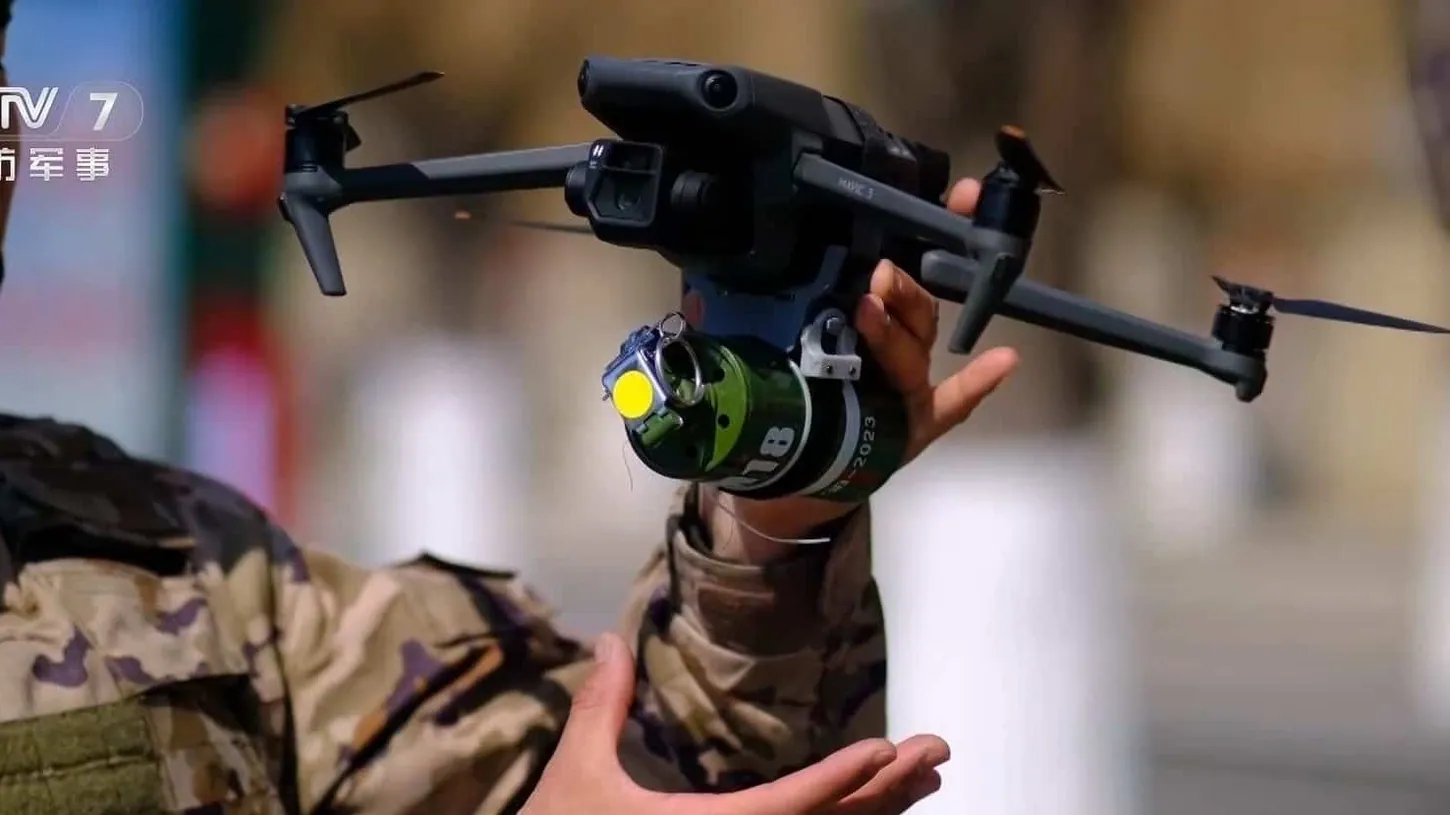
The April 2025 training milestone for fiber-optic drones was a China Central Television (CCTV) broadcast showing a People’s Armed Police unit in Yunnan training with FPV drones and researching fiber-optic models. The PLA Daily had flagged the shift to fiber in May 2024, within weeks of its operational debut. DroneXL had already reported in April 2024 on images of a People’s Armed Police Heilongjiang Corps unit training with DJI Mavic 3 drones fitted with release mechanisms for grenades. CSIS says Chinese outlets framed PLA training footage of strikes and evasion released in 2024, down to the capture nets and jamming guns, as drawn from Russia-Ukraine battlefield experience.
PLA Daily Prices a Strike Drone at Less Than 1% of a Fighter
The PLA Daily is the Central Military Commission’s newspaper. In March 2025 it stated as settled fact that a single reconnaissance-strike drone costs less than 1% of a modern fighter while achieving more than 90% of its battlefield coverage. CSIS calls the figures rough. The paper printed them without qualification.
A Chinese naval academy analyst described the more than one million small drones Ukraine and Russia bought in 2024 as two drones over every front-line soldier’s head. For Chinese planners, CSIS writes, mass is the economic structure of drone war rather than a wartime improvisation.
Speed is the second offensive lesson. China’s National Defense University credits Russian forces with striking a detected target within three to five minutes, and a PLA unit survey attributes that to Russia’s reconnaissance-strike complex, with Orlan-10 reconnaissance drones cueing Kub and Lancet loitering munitions. CSIS says the copying target is the connection between the drones and the artillery and command networks, not any one aircraft.
The defensive side of the analysis runs deepest, because Chinese analysts read Ukraine’s sea drones and airfield raids as previews of attacks on China. A team from the Naval University of Engineering, writing in the journal of the state shipbuilder’s underwater-warfare institute, counted more than 10 large Russian naval vessels damaged by Ukrainian sea drones. A Global Times analysis of Ukraine’s interceptor drones concluded that “the cost of procuring one man-portable air-defense missile buys several hundred air-defense FPV drones.” Chinese state radio has catalogued Russia’s protective fixes, from strategic bombers pulled back some 3,700 miles (6,000 kilometers) to the Chukotka Peninsula to retractable nets developed from the improvised cages on tanks in Ukraine.
Those defensive studies moved into hardware faster than anything else in the corpus. Counter-drone systems from CETC, NORINCO and CASIC dominated Chinese coverage of the November 2024 Zhuhai air show, where DroneXL covered the Jiu Tian drone mothership. In August 2025 the PLA Daily reported a missile-boat drill with an “enemy unmanned boats closing” inject, 35 months after the first Ukrainian sea drone washed ashore near Sevastopol. In late July 2026 CCTV aired an army drone crew putting a missile into a fast boat at sea, and in August the army flew armed KVD002 drones against sea drone targets.
China’s Own Analysts Say Swarms Produced “All Thunder and Little Rain”
Chinese military writing also records what the war did not settle. In October 2024, China National Defense News asked why swarm warfare had produced “all thunder and little rain.” Both sides committed huge numbers of drones, the paper wrote, and a swarm mode of operations never appeared on the battlefield.
The paper listed flight control, communications, onboard intelligence, energy and payload as the obstacles.
CSIS reads that as China buying what the war proved and experimenting on what it left open. The PLA runs its own swarm trials to supply the data the war did not, and one of them was the 200-drone swarm demonstration DroneXL covered in January.
The industrial lessons are the ones China least needs to learn. China’s youth press was explaining as early as November 2023 that Russia overcame its early drone disadvantage through the scale of its defense industry, and that a drone war is won by the side that builds more. A People’s Daily Online report put China’s share of global fiber and cable shipments at 60% for 2025, which is the raw material fiber-optic drones fly on. A 2022 study by the state rocket academy, a satellite launch center and a PLA unit traced how Ukrainian firing units depended on Starlink and concluded that China must build its own low-orbit constellation.
The authors name one limit. A military built on centralized approval cannot create decentralized improvisation by command, and Chinese analysts themselves acknowledge that many theoretical lessons have yet to become mature combat guidance. For the United States, CSIS writes, the same journals, training footage and procurement activity open a window into PLA priorities before they appear in doctrine.
DroneXL’s Take
The DJI tender is the line in this report I expect to travel, and it should be read exactly as CSIS wrote it: one unit’s tender, not a purchase, and no unit, date or document named. That is a contradiction in Chinese policy, and it is also what every army on earth does with the best commercial drone it can buy. Ukraine has flown Mavics with improvised bombs, and US Army soldiers dropped live grenades from a Skydio in 2025 tests.
I expect the tender to show up in the Pentagon’s defense of its Chinese military company label, which DJI is still appealing after a federal court upheld the designation in September 2025 while rejecting most of the government’s allegations. It will not change my view that the label and the FCC ban hurt American operators more than they hurt DJI. The lesson China drew from Ukraine is that the side that builds more drones wins, and China already builds more drones and 60% of the world’s fiber. A tender for off-the-shelf DJI hardware is evidence of that lead, and taking the same hardware away from American farmers and fire departments does nothing to close it. Building does.
Source: CSIS, “Learning Without Bleeding: China’s Lessons from the Russia-Ukraine Drone War”
DroneXL uses automated tools to support research and source retrieval. All reporting and editorial perspectives are by Haye Kesteloo. Read our editorial standards.


