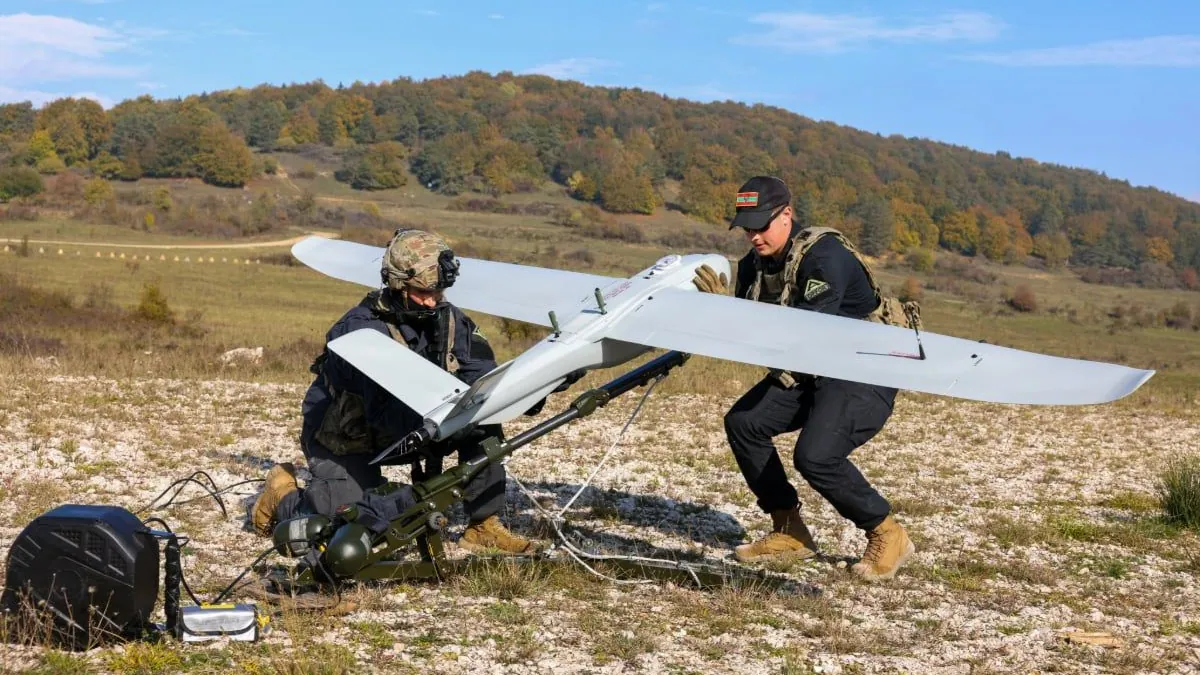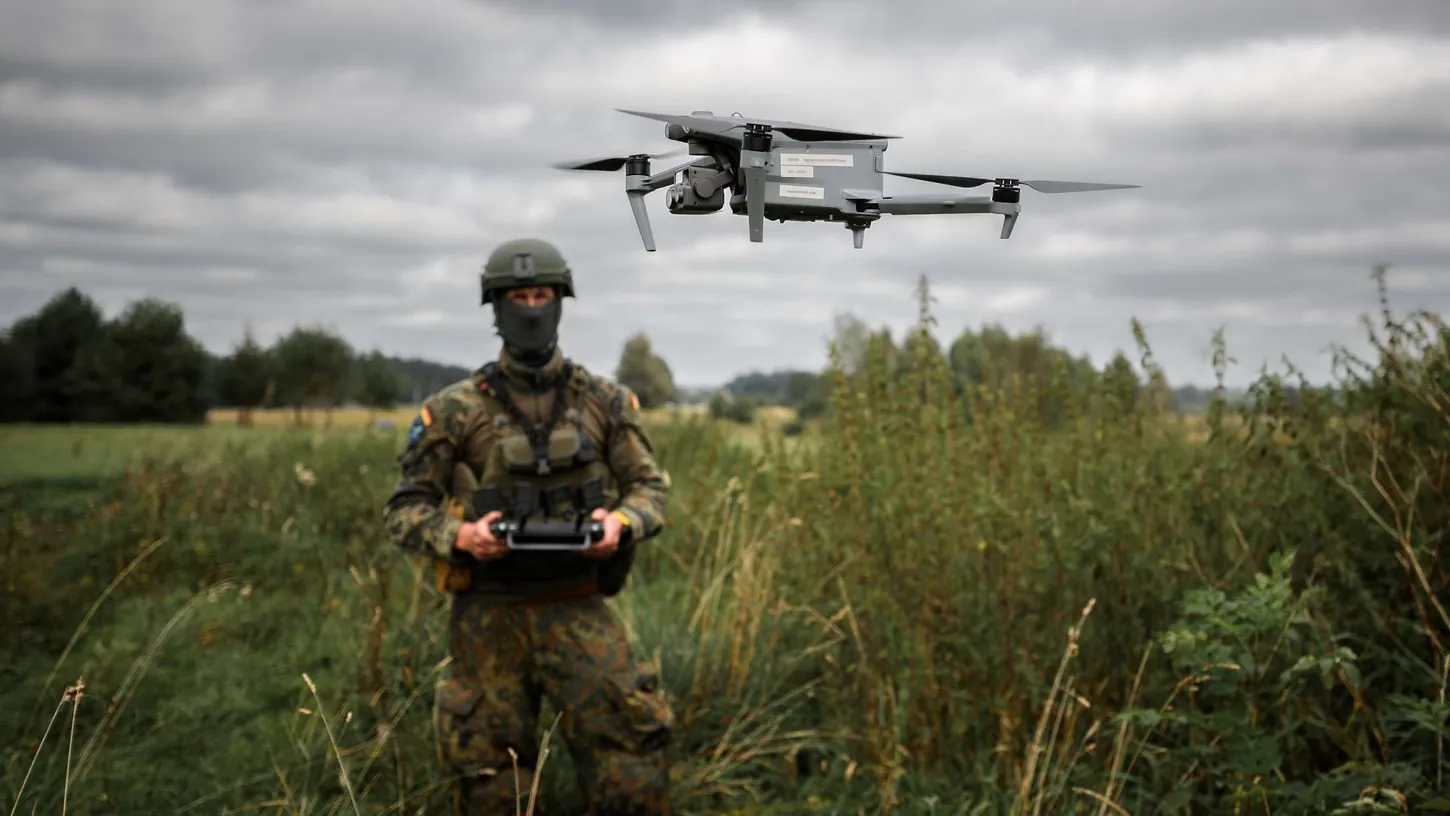
Germany’s army will stand up its first drone regiment in 2027: up to 600 soldiers flying reconnaissance and strike drones and intercepting enemy ones, with a reach Defense Minister Boris Pistorius puts at 500 kilometers (311 miles). He announced it October 1 at the Bergen training area in Lower Saxony, standing next to the prototypes the army is testing there.
The regiment goes to the 10th Panzer Division, headquartered in Veitshöchheim in Bavaria. About 100 miles (160 kilometers) east, at Grafenwoehr, the US Army activated a drone battalion of roughly 600 paratroopers in January to learn the same lessons from Ukraine. That battalion lost its drone mission in September and went back to airborne infantry work.
Pistorius Gives the Regiment Reconnaissance, Strike, Ground Robots and Jammers
The regiment is an independent formation for unmanned systems, Pistorius said at a press conference after touring the tests. It bundles aerial reconnaissance and strike drones, unmanned ground vehicles and the interception of enemy drones, from close range out to long range. It also gets its own electronic warfare company.
The regiment starts in 2027 with an initial capability and roughly 300 soldiers, growing to a target strength of about 600, according to Augen geradeaus, the German defense blog that recorded the briefing. The Bundeswehr’s own account names no garrison and no budget. If the model works, Pistorius said, the other divisions get one too.
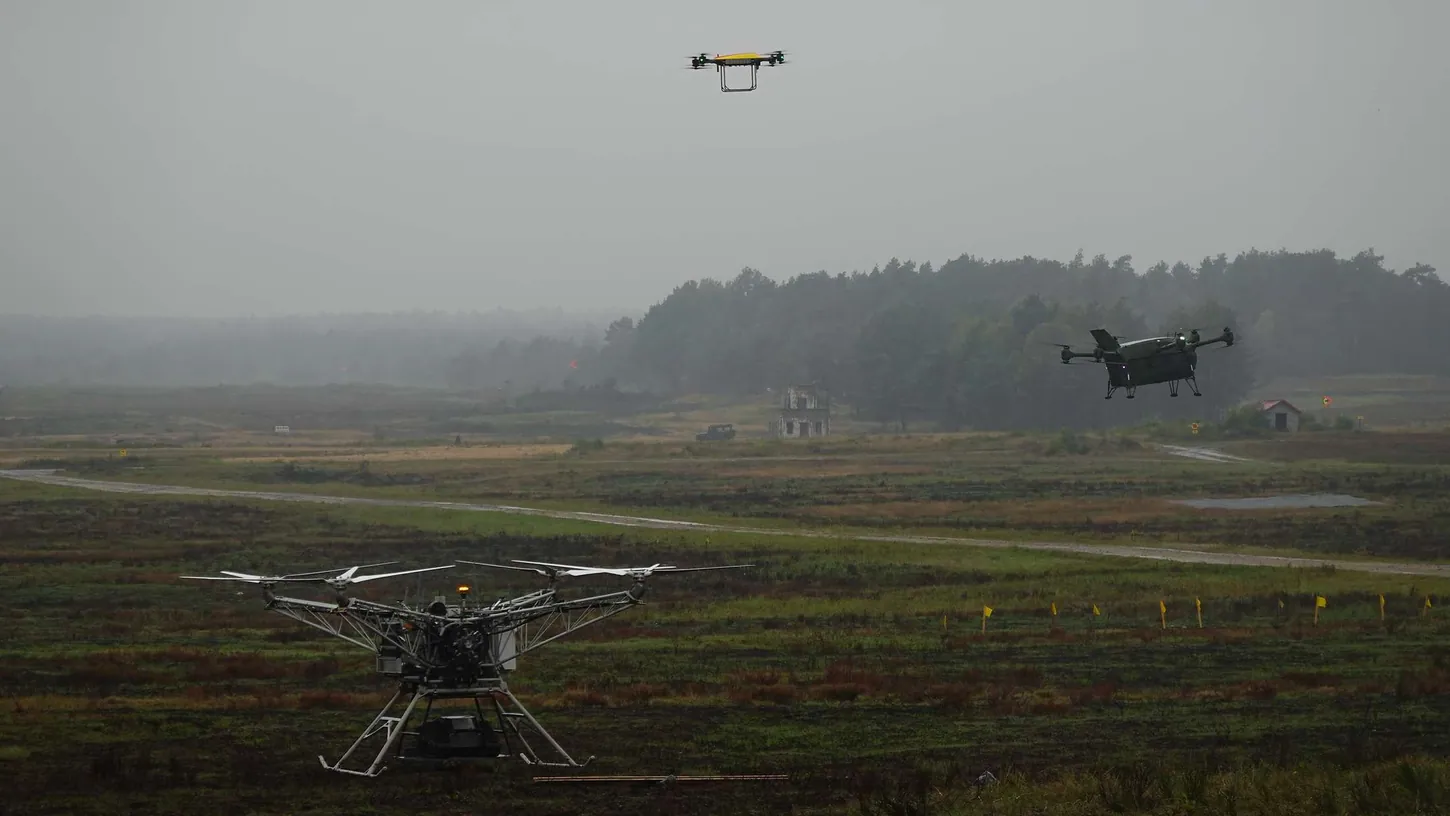
The regiment is not the army’s whole drone plan. Army chief Lt. Gen. Christian Freuding said three branches, among them the light infantry and the tank force, start building unmanned systems into their own units around the turn of the year, and the regiment adds a second track on top. “I believe this will let us gain a lot more speed in unmanned combat,” he said.
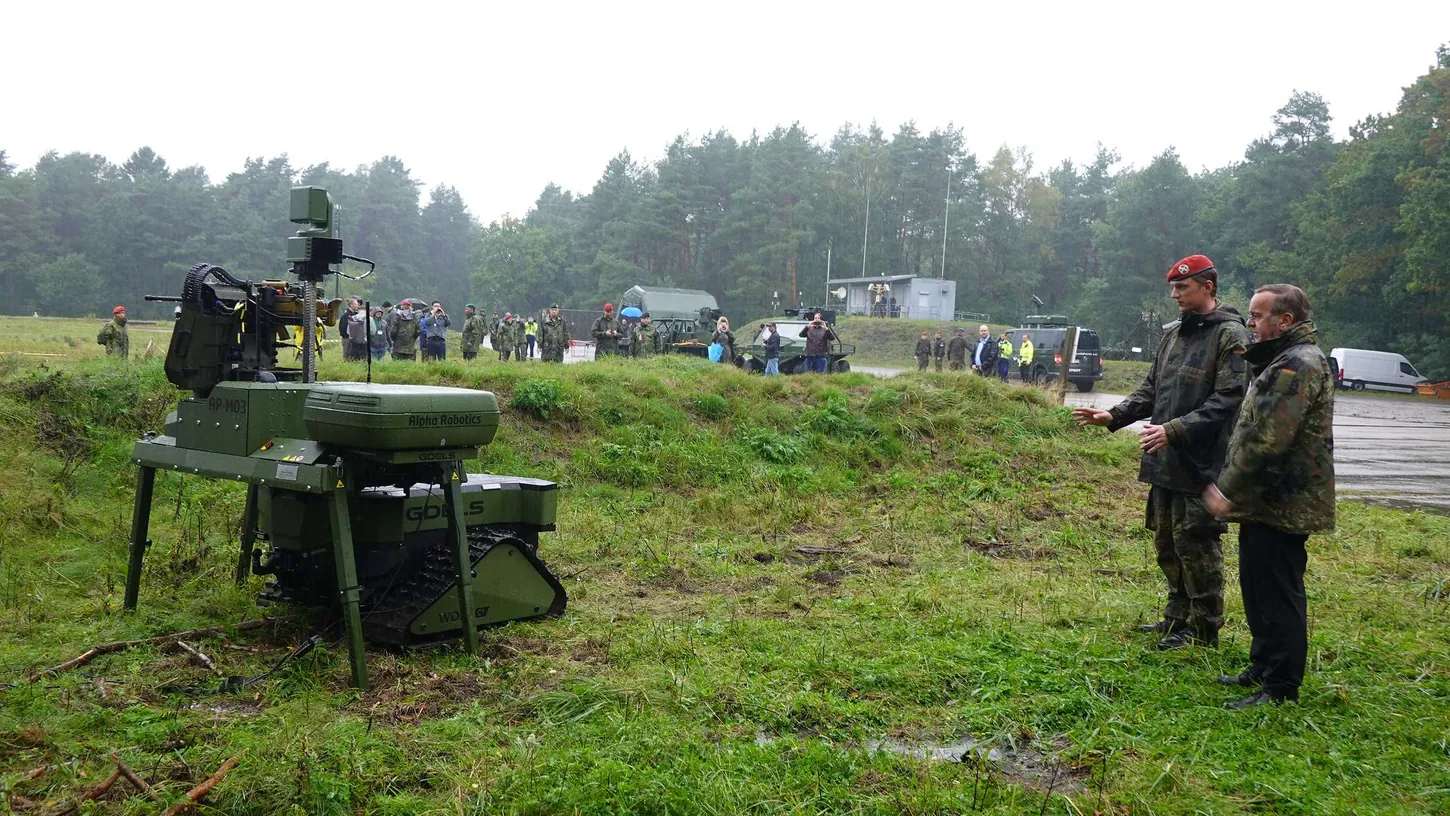
The setting was the Experimentalserie Land, a 10-day field trial where troops, not engineers, put more than 40 prototypes through tactical scenarios on Bergen’s range 20. Pistorius watched a tracked ground robot carrying a remote weapon station, and he tied the whole exercise to Ukraine: innovation cycles decide success or failure on that battlefield, he said, and the strategic partnership with Kyiv lets Germany test and adopt what Ukrainian troops learn.
The Strike Drones Arrive in 2027, the Same Year as the Regiment
The regiment’s strike hardware is already on order. In February, the Bundestag’s budget committee approved about 269 million euros each for Helsing and Stark Defence to deliver loitering munitions, a deal DroneXL covered when lawmakers capped it at 1 billion euros per company, with the first rounds shipping in 2027.
Those first deliveries go to the 45th Armored Brigade in Lithuania, Germany’s forward-deployed NATO brigade. That brigade belongs to the 10th Panzer Division, the same division that now gets the drone regiment, which puts the army’s loitering munitions and the unit built to fly them under one headquarters.
The record behind that order is mixed. Stark’s Virtus failed all four of its strike attempts in a Bundeswehr test last October, and the government awarded the contract anyway a few days later. A regiment with 300 soldiers is a way to find out, in German hands and on German ranges, whether the rounds now work.
The US Army Ended a Same-Size Drone Unit 100 Miles Away
The 3rd Battalion, 504th Parachute Infantry Regiment of the 173rd Airborne Brigade was the US Army’s only drone assault battalion, built to turn Ukraine’s drone war into doctrine. Acting Army Chief Gen. Christopher LaNeve sent it back to airborne infantry duty once Saber Junction 26 ended. That was September 13.
DroneXL reported the phase-out in August. Three senators and a House member wrote to Army leaders on September 1 that eliminating the battalion hurts the Army’s ability to learn from Ukrainian soldiers. The battalion owes the Army a findings report, and no successor unit has been announced.
The Army in Europe keeps training with drones. Saber Junction put 1,900 autonomous systems on the field at Hohenfels, and Brig. Gen. Terry Tillis, who commands the 7th Army Training Command, told reporters on September 17 that his command rewrites its drone training doctrine every 60 days, Stars and Stripes reported. German and American units in Germany have trained Ukrainian troops since 2022, and Ukrainian drone operators regularly assess both armies’ platforms and tactics.
DroneXL’s Take
Germany just did the thing the US Army undid: it gave drones a home with a commander and a headcount of its own. Ukraine built a separate Unmanned Systems Forces branch, Russia answered with dedicated drone formations like Rubikon, and the lesson both armies learned under fire is that drone skill lives in units that do nothing else. A platoon of quadcopters inside an infantry company gets borrowed for guard duty. A regiment with its own jammers and its own budget fights for its mission.
Freuding is also doing what the US Army says it wants, which is drones inside every combat unit. The difference is that Germany runs both tracks and the US Army kept one. On the evidence of the last six months, the Bundeswehr is the army that studied Hohenfels, where Ukrainian operators beat a US brigade this spring and the opposing force threw 1,900 drones at the 173rd, and acted on it.
I’d hold the applause until the end of 2027. German drone procurement has a habit of announcing before it delivers, and this regiment currently has no garrison, and its 500-kilometer requirement is one neither ordered munition meets on paper (Helsing and Stark both market theirs at about 100 kilometers). The number to check next December is 300 trained soldiers. The number to check in Washington is whether the 173rd’s Saber Junction findings produced a single new drone unit, or a binder.
Sources: Bundeswehr, Stars and Stripes, ZDF, Augen geradeaus.
DroneXL uses automated tools to support research and source retrieval. All reporting and editorial perspectives are by Haye Kesteloo. Read our editorial standards.