
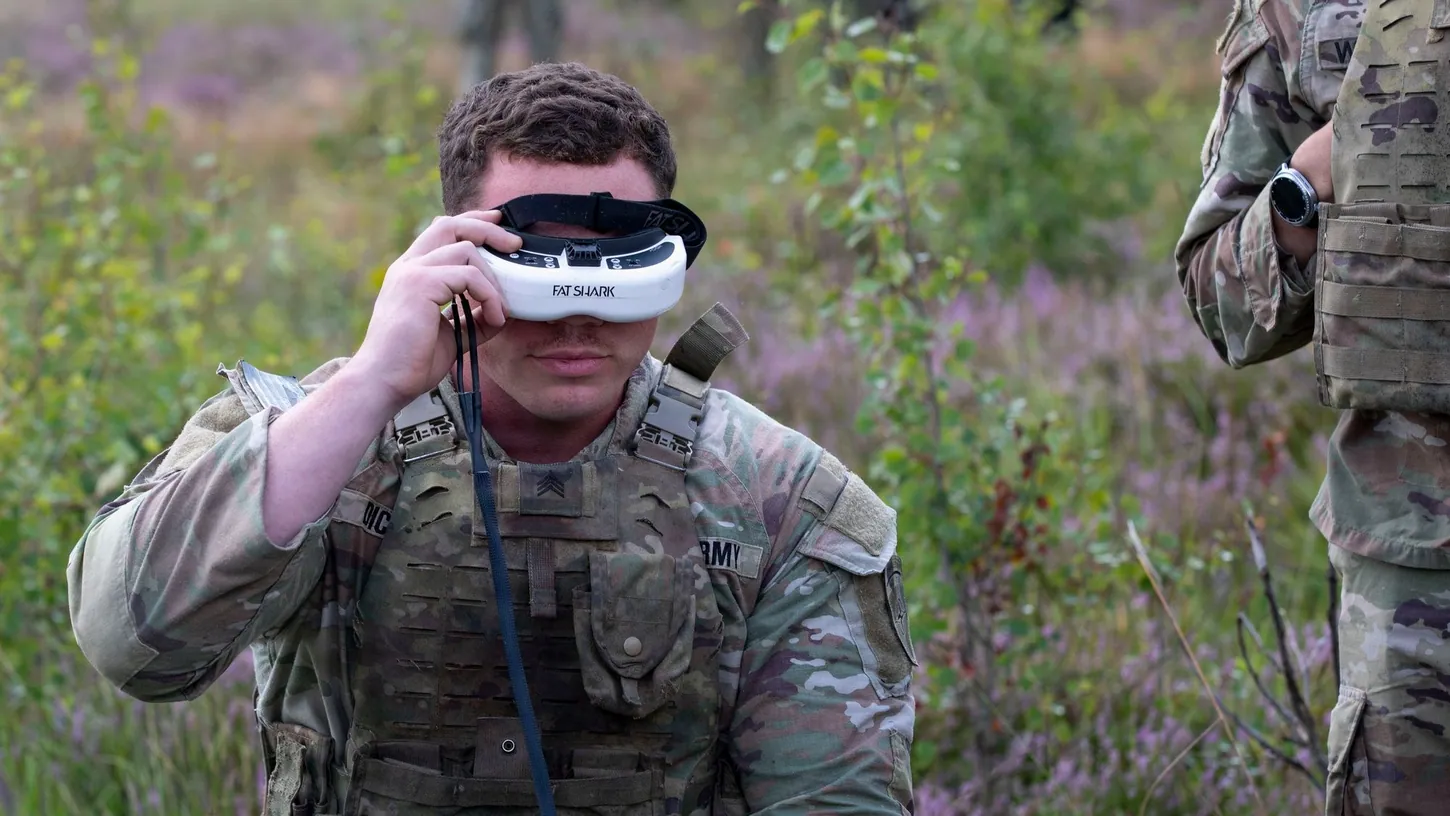
NATO should field tens of thousands of cheap air, land and sea drones along its borders so that Russia faces what amounts to 32 Ukraines, two retired heavyweights argued in The Hill on Monday. Harlan Ullman, principal author of the shock-and-awe doctrine, and Field Marshal Lord David Richards, Britain’s former chief of the defense staff, call drones the only option that can hold the alliance together as Washington shifts its forces toward homeland defense and Taiwan.
They hang the plan on NATO’s top commander. US Air Force Gen. Alexus Grynkewich laid out a theory of victory in Poland to “blunt, block and break” a Russian attack, the authors write, in a speech they say has not been released. SHAPE, the NATO command Grynkewich runs, has the full transcript and video posted on its website.
Ullman and Richards Want Drones to Fill the Gap US Troops Leave
The op-ed in The Hill proposes stationing unmanned systems across Europe, from the UK, Norway and Finland in the north to the Baltic states, Greece, Turkey and Romania. The authors say the drones would cut demand for US troops in Europe and absorb any redeployment to Asia.
They call the plan a variant of the Porcupine Strategy they first pitched in a Telegraph column in March 2025: make any first assault so costly it would become unacceptable. “Imagine how Russia would fare against 32 Ukraines,” they write, crediting Ukraine’s drone war with holding a far larger Russian army to a standstill for nearly five years.
The authors concede that “unmanned” oversells the idea, since people still have to maintain, repair and launch every system.
Grynkewich’s Transcript Pairs Cheap Drones With High-End Strike
Grynkewich spoke at the Warsaw Security Forum on October 12, and SHAPE’s transcript runs the sequence block, blunt, break. Land forces block the first assault. Autonomous systems and sensors help blunt any follow-on push. Breaking the attack takes precision munitions layered with an “overpowering mass of affordable and scalable systems.”
That is a high-low mix, and Grynkewich used those words when asked about a two-front war. Affordable mass is one part of the theory that would look different without Ukraine’s large numbers of short- and long-range drones, he said, and NATO is still learning from Ukrainian partners. Nothing in the transcript treats drones as a replacement for troops. Asked whether American soldiers would be in the ground force, he called it ultimately a political decision, then pointed to US troops already on the Eastern Flank and said no one should question the US commitment to the alliance.
The authors’ quote also swaps the first two steps. Grynkewich said block, blunt and break, in that order, three times in the speech. An unnamed NATO spokesman called the theory “consistent with and grounded upon” the alliance’s defense plans, according to Grosswald. The detailed plans stay classified.
The Pentagon’s Europe Troop Cut Recommendation Is Due November 6
The Pentagon is weighing a cut of 25,000 or more of the roughly 80,000 US troops in Europe, possibly 40,000, NBC News reported in September. Defense Secretary Pete Hegseth is expected to receive a final recommendation on November 6, Anadolu Agency reported, before any proposal goes to President Trump.
Germany, Italy and Spain, which host some of the largest US deployments, are among the countries likely to lose troops. The Army canceled a planned armored brigade rotation to Poland this spring, and a Pentagon spokesman called the 5,000-troop surge that followed a temporary delay of the plan to cut Europe’s brigade combat teams from four to three, Military Times reported.
The US Army’s own drone unit in Europe is gone too. The 173rd Airborne Brigade’s drone assault battalion at Grafenwoehr went back to airborne infantry work on September 13, less than three weeks before Germany announced a 600-soldier drone regiment of its own.
DroneXL’s Take
Ullman and Richards are right that Europe needs cheap mass, and fast. I don’t like how they’re selling it. Pitching drones as a way to need fewer American troops makes them a consolation prize for Europe. Ukraine’s drone war runs on trained operators and a domestic industry that keeps redesigning what they fly, and Europe would have to build and pay for both.
Grynkewich’s version is more honest about it. He wants cheap drones on top of the high-end force, not in place of it, and he credits Ukraine for teaching NATO how to do it. The op-ed calls the lessons of Ukraine largely unique to that war in one paragraph and tells NATO to become 32 Ukraines in another, and those two claims don’t fit together.
The test comes after November 6. If the Pentagon pulls 25,000 troops and Europe answers with drone orders but no new operators, the alliance ends up with fewer soldiers and more hardware, which is the opposite of what Grynkewich described in Warsaw.
Sources: The Hill, SHAPE, Anadolu Agency, Military Times.
DroneXL uses automated tools to support research and source retrieval. All reporting and editorial perspectives are by Haye Kesteloo. Read our editorial standards.


