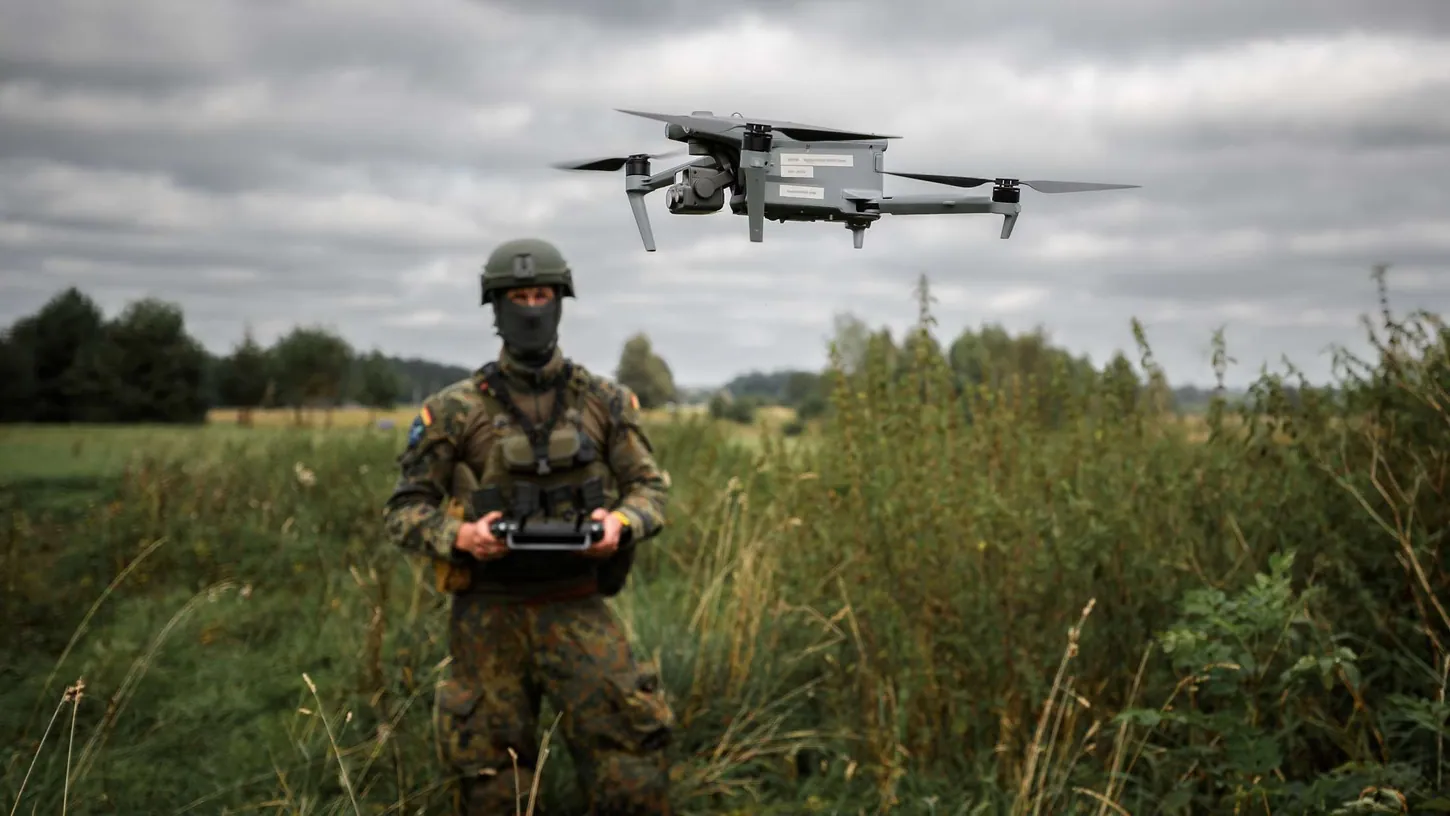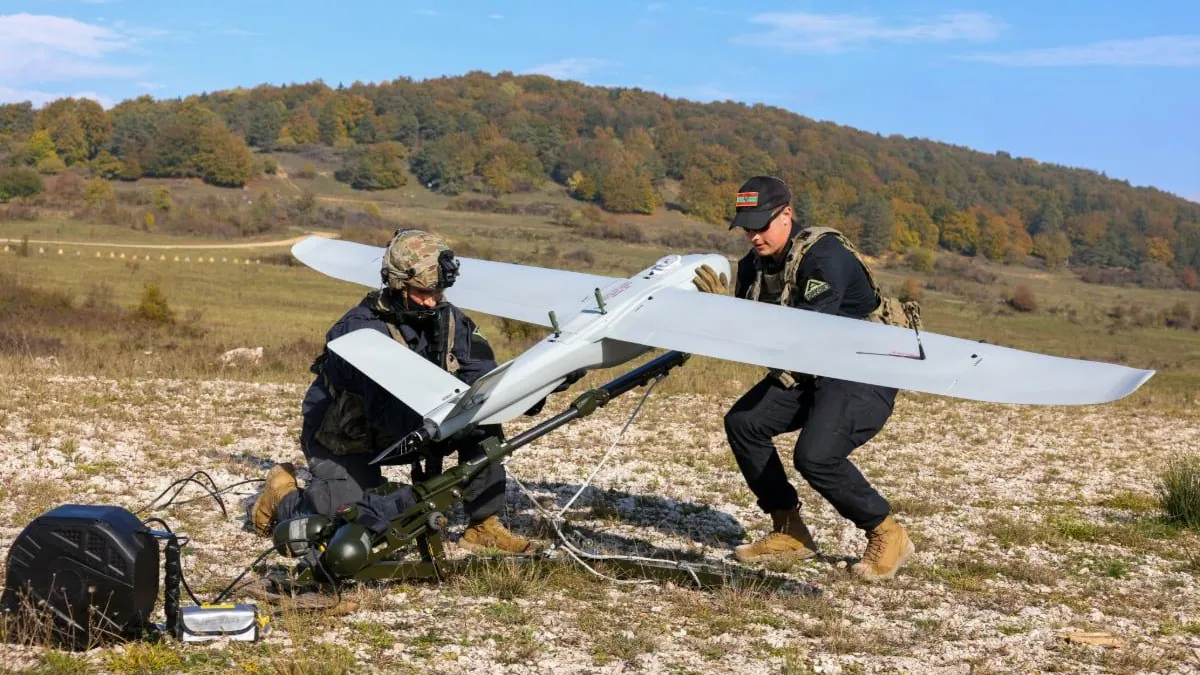
US Army soldiers of the 1st Battalion, 4th Infantry Regiment launched a Stork LR reconnaissance drone at the Hohenfels Training Area in Germany during exercise Combined Resolve 27-01 last week. The Army published eight photos of the fixed-wing aircraft on Saturday, taken on October 15 and 16, showing the troops assembling it and firing it off a pneumatic catapult into the Bavarian sky.
The Stork is built by U&C UAS, a Czech company founded by the owners of Ukrainian drone maker DeViRo. It descends from the Leleka, the recon drone that has flown for Ukrainian artillery since before the 2022 invasion. U&C announced a contract to supply ISR drones to US Army units in Europe on May 18, and the Hohenfels photos are the only Army imagery of the aircraft on DVIDS, the Pentagon’s media hub.
The 1st Battalion, 4th Infantry is not a line unit. It is the resident opposing force at Hohenfels, the unit that plays the enemy for every brigade that rotates through. This spring, a Ukrainian-reinforced opposing force on the same ground beat a US armored brigade with drones, and in August the Army ordered its only drone assault battalion back to regular infantry work.
The Stork Reached the Enemy Force Five Months After the Contract
U&C UAS signed its US Army contract in May 2026 through ATP Gov, a US government contractor, to supply reconnaissance drones for scouting and base protection in Europe. The company disclosed no value, quantity or delivery date. The Army picked the Stork after trials in exercises simulating high-intensity combat.
“Our products held up in trials during exercises, against other solutions on the market,” production director Pavel Bulant told Forbes Česko in May, in a quote translated from Czech. Chief commercial officer David Jirman told Army Technology the Army valued the aircraft’s long-endurance surveillance and real-time data.
Two sets of photos exist on DVIDS. Spc. Kaleb Lampkin of the Joint Multinational Readiness Center shot the first, which carries an October 15 timestamp under captions that say October 16, and Sgt. Addison Shinn of V Corps shot the second on October 16. Shinn’s captions name the operators: Spc. Alexander Walker, an infantryman, and Pfc. Mathew Munoz, an M1 tank crewman who prepared the takeoff site. Defence Blog first reported the sighting on Monday.
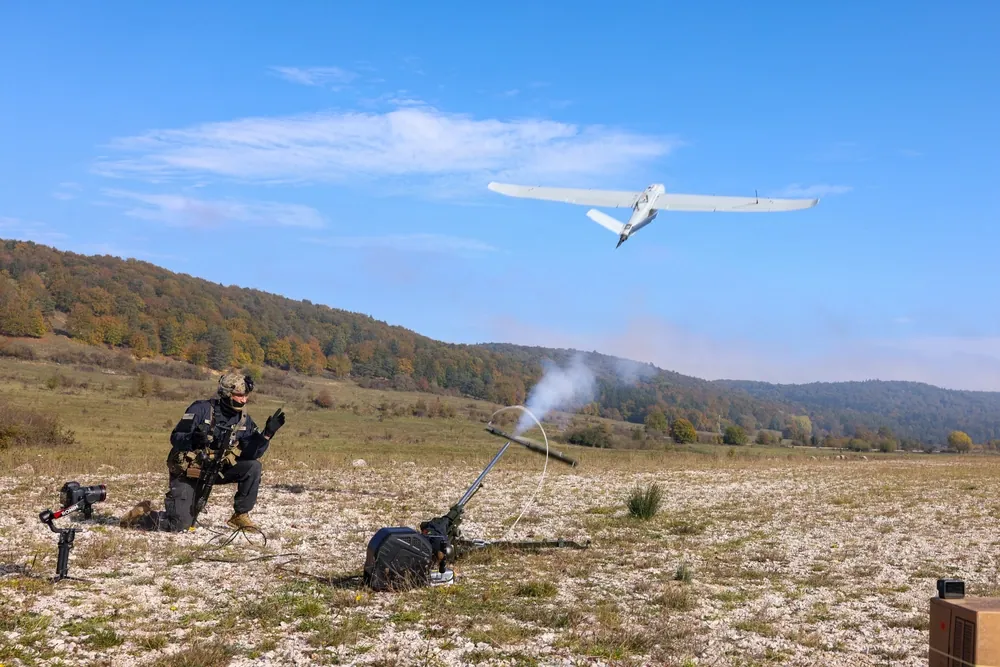
That unit has been the Army’s drone-heavy enemy all year. At Saber Junction 26 in August, the same battalion turned 1,900 autonomous systems on the 173rd Airborne Brigade. The Stork gives it a five-hour reconnaissance aircraft on top of the quadcopters.
Stork Is the Leleka, Built in Kolín at About 300 Drones a Month
DeViRo’s co-owners founded U&C UAS in the Czech Republic in July 2022 and started serial production in Kolín, east of Prague, in 2024. The plant turns out up to 300 Stork and Mace drones a month, per Forbes Česko, and booked more than 150 million euros in revenue last year.
DeViRo has built drones in Ukraine since 2014, according to Militarnyi. DroneXL covered its Leleka-100 in March 2022, when one was credited with spotting a Russian Buk launcher for Ukrainian artillery, and the Mace at Eurosatory 2024, where it was presented under the UAC name the Army captions still use. Former EU commissioner Štefan Füle holds a 10% stake in the Czech company, which expects to double its revenue this year, according to Forbes Česko.
U&C’s spec sheet puts the Stork LR at 31 pounds (14 kg) takeoff weight, up to five and a half hours in the air, an 84-mile (135 km) tactical range and a 14,800-foot (4,500 m) ceiling at a cruise of 42 mph (19 m/s). It carries a jam-resistant satellite receiver and falls back to inertial navigation when jamming or spoofing overwhelms it, and one Stork can relay for another over a mesh link. Bulant told Forbes that hundreds of Storks are flying in Ukraine right now.
That record made U&C a Russian talking point in April. Russia’s defense ministry published addresses of what it called Ukrainian and joint drone enterprises in Europe on April 15, and Dmitry Medvedev called it a list of potential targets. The list named DeViRo and the Czech firm PBS Group, not U&C, Seznam Zprávy reported, and Bulant told the outlet the threat applied to his company too. The Czech foreign ministry summoned the Russian ambassador the next day.
Raybird and Magura Boats Make It Three Ukrainian Designs in Army Hands This Fall
The Stork is the third Ukrainian design to show up with US Army units since September. The Army awarded Skyeton Inc. a $10.64 million firm-fixed-price contract for Raybird reconnaissance drones on September 18, due December 15. Magura-type drone boats launched aerial drones at Bayonet Quest 26 in Michigan this month.
Skyeton says the Raybird has logged more than 350,000 combat hours in Ukraine, Kyiv Independent reported. The company is building a Raybird factory in Fayetteville, North Carolina, next door to Fort Bragg. The MV7 boats, built by Ukrainian manufacturer UFORCE, launched aerial drones from a platform on the bow during the 7th Infantry Division’s exercise, which ran from September 26 to October 6, according to Defence Blog. The division has not said how many boats took part or what they carried.
DroneXL’s Take
The Army is learning Ukraine’s drone war through its enemy force before its line units. The brigade that lost to Ukrainian operators at Hohenfels this spring went home without a Stork, and the 173rd’s drone battalion is back to airborne infantry. The only Storks the Army has put on DVIDS belong to the battalion whose job is to make American soldiers miserable. I don’t think that’s an accident. The opposing force is where the Army keeps what it learned from Kyiv, and a brigade rotating through Bavaria will meet the Leleka as a threat long before it gets one as equipment. The contract does say base protection and ISR for units in Europe, so line units may be flying Storks that nobody has photographed yet, and U&C has not said how many it sold. Until a photo shows a US brigade launching one for its own side, the Ukrainian drone lesson at Hohenfels is still something done to American troops, not by them.
Sources: Defence Blog, DVIDS, Forbes Česko, Seznam Zprávy, Army Technology, Kyiv Independent, U&C UAS.
DroneXL uses automated tools to support research and source retrieval. All reporting and editorial perspectives are by Haye Kesteloo. Read our editorial standards.