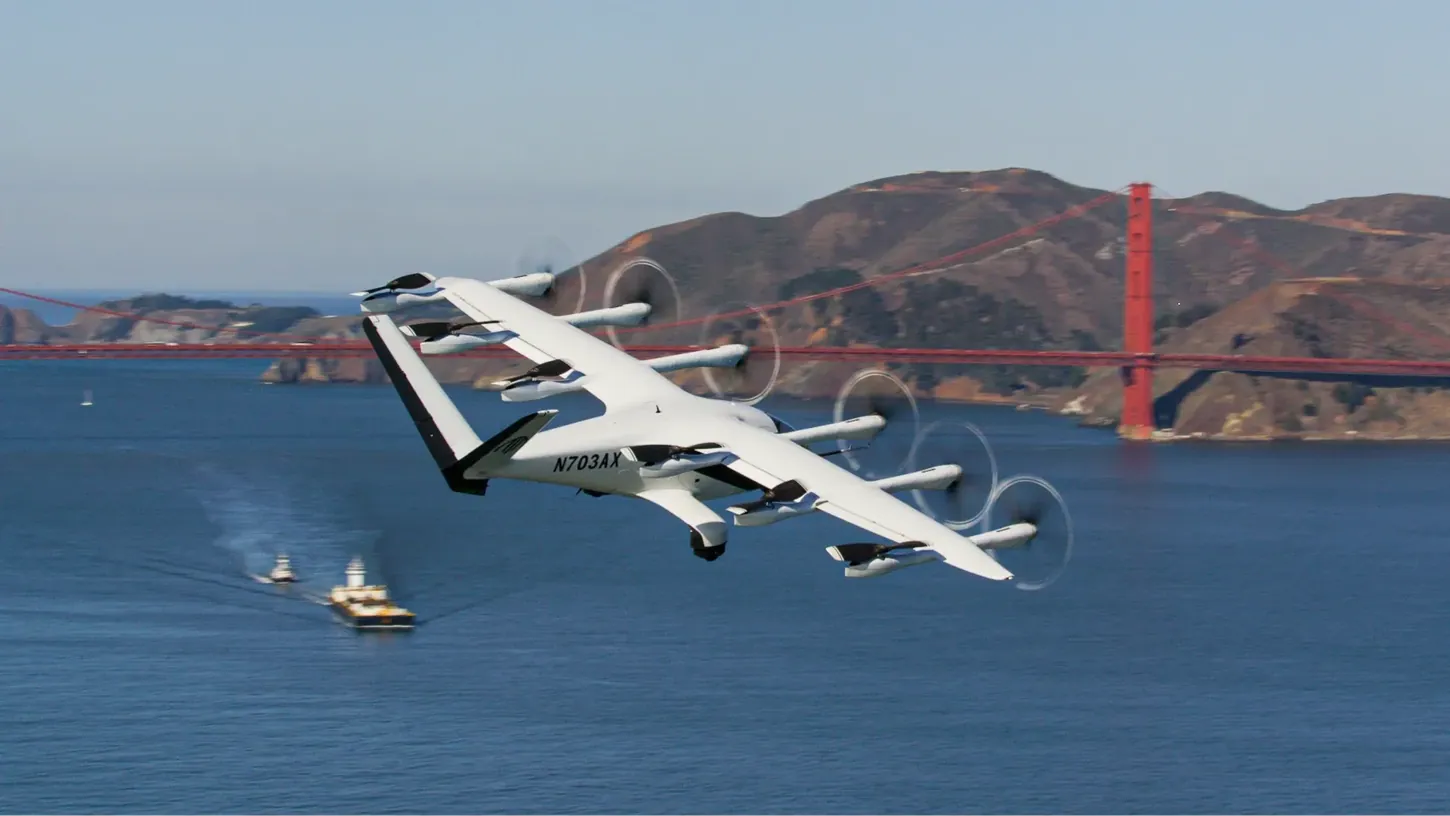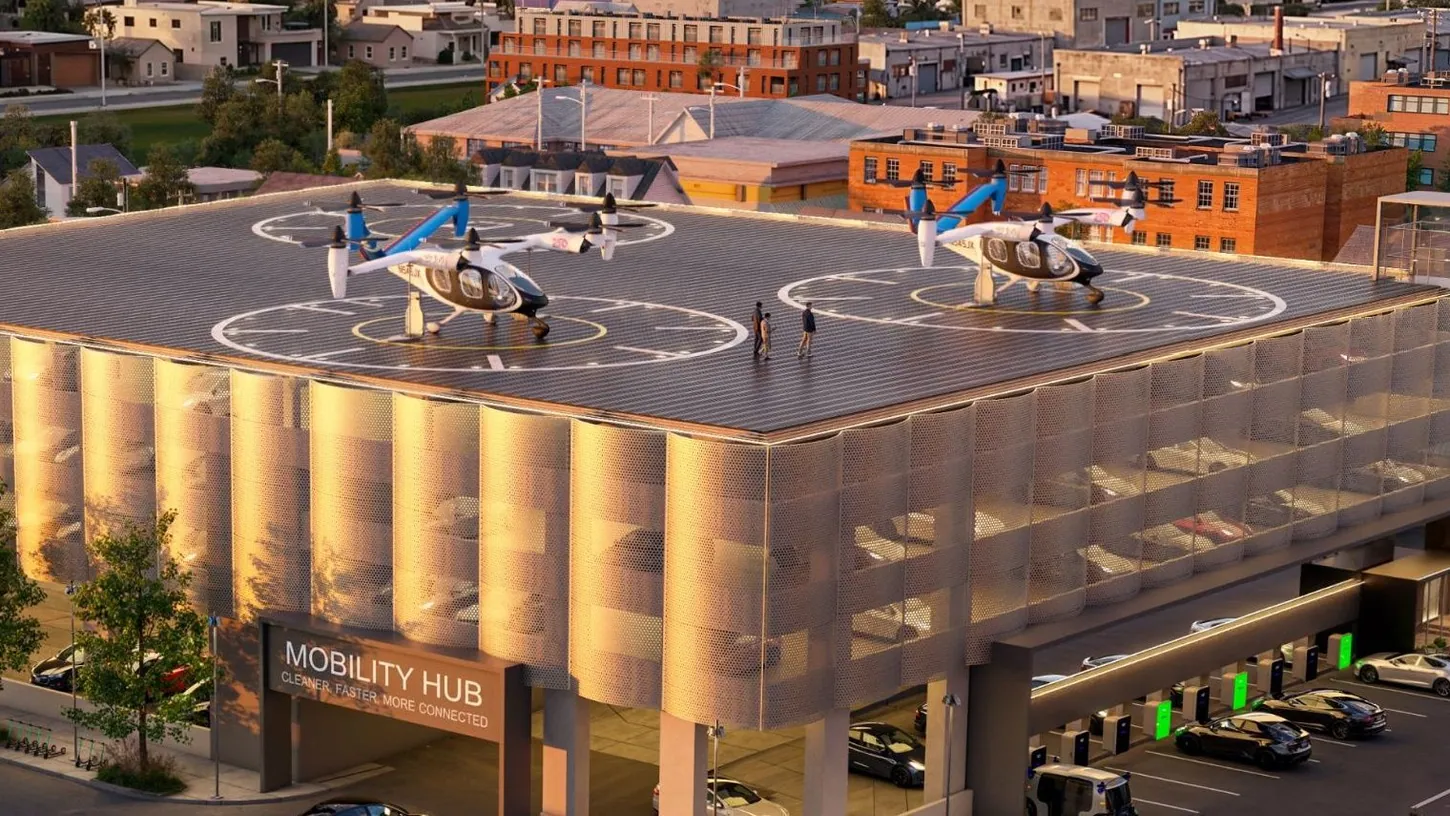
The FAA posted a draft advisory circular on October 22 that merges its heliport design standard and its interim vertiport guidance into one document, AC 150/5390-4, Vertical Flight Aircraft Infrastructure Design. Once final, it cancels AC 150/5390-2D, Heliport Design, and Engineering Brief 105A, the interim brief that air taxi pads such as the Orlando International vertistop were designed to. Comments are due January 11, 2027, and the FAA says final standards follow in summer 2027.
The 140-page draft drops the aircraft limits EB 105A applied and widens the touchdown area to 10 feet (3 m) beyond the aircraft’s propellers. For powered-lift aircraft, it sets the approach surface at 15:1 or shallower, about half the climb of a helicopter’s 8:1. The same section says the FAA does not evaluate slopes shallower than 8:1 for obstructions.
The Draft Drops EB 105A’s Aircraft Limits and Grows the Landing Pad
EB 105A covered only aircraft with three or more battery-powered propulsors, a pilot on board, a maximum takeoff weight of 12,500 pounds (5,670 kg) and a span of 50 feet (15.2 m) or less. The draft lifts those limits and applies one set of formulas to helicopters and powered-lift aircraft.
The draft circular sets the minimum touchdown and liftoff area (TLOF) at the aircraft’s rotor diameter plus 10 feet (3 m), where rotor diameter is the smallest circle around all the lift-producing propellers. The final approach and takeoff area (FATO) is at least 1.5 times the aircraft’s overall controlling dimension and must sit 0.34 times that dimension beyond the TLOF on every side. The safety area adds 0.28 times the dimension, never less than 20 feet (6.1 m). For a 50-foot aircraft whose propellers set its outer edge, EB 105A called for a 50-foot TLOF, a 100-foot FATO and a 125-foot safety area. Under the draft the separation rule, not the 1.5 multiplier, sets the FATO, and the numbers become 60, 94 and 134 feet.
The FAA’s letter to industry says the pad sizes come from research on where aircraft actually touch down. When we covered Wisk’s test vertiport at Hollister in August, the city’s filing dated this circular to 2027, and the FAA’s own release now holds to that year. The draft also retires the Transport heliport category while keeping separate rules for hospital heliports, and on airports it recommends a marked aiming point instead of a dedicated helipad where there are no more than 10 piloted VFR vertical flight operations a day.
The Downwash Zone Gets Fixed Dimensions for Aircraft Up to 7,000 Pounds
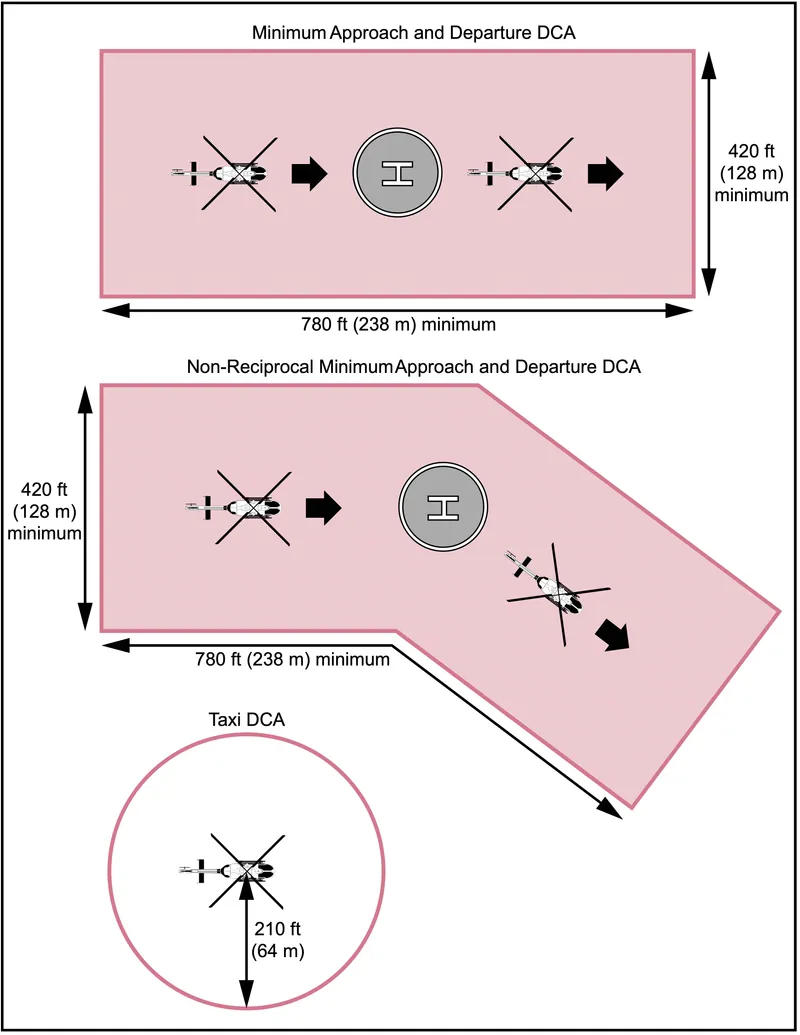
The draft keeps EB 105A’s 34.5 mph (55.5 km/h) outwash threshold and, for aircraft of 7,000 pounds (3,175 kg) or less, sizes the caution area at a minimum of 420 by 780 feet (128 by 238 meters), centered on the pad under each approach and departure path.
EB 105A described the downwash/outwash caution area without fixing its size. It pointed to FAA Technical Center surveys still collecting data, noted velocities well above the threshold 126 feet (38.5 m) from the pad for some designs, and told developers of heavier aircraft to work out the size with the FAA. The draft adds a 210-foot (64 m) radius around the aircraft wherever it taxis, says the area can extend past the property line, and names keeping bystanders out as the primary mitigation. AC 150/5390-2D had no such area, so helicopter pads pick it up as well. The draft gives no dimensions for aircraft heavier than 7,000 pounds.
Charging and Pilotless Aircraft Get Placeholders, Not Standards
The charging chapter has two standards. Aircraft battery storage stays out of the landing, safety and approach areas, and chargers must meet building, fire and NFPA codes. The FAA writes that consensus has not been reached on charging classes or connector standards, and that guidance for hydrogen will come later.
A separate standard keeps charging equipment out of the heliport protection zone, which runs 280 feet (85 m) out under each approach path. Everything else in the chapter, from raised pads against flooding to collision barriers, is recommended practice.
Pilotless aircraft get one page. The autonomy appendix says the FAA will write infrastructure standards for aircraft without a pilot on board after further research, and tells sponsors expecting one to contact their FAA Airports District Office and Flight Standards District Office. Autonomous cargo flights are part of the eVTOL Integration Pilot Program, which the FAA says will feed future revisions. Administrator Bryan Bedford said in the FAA’s announcement that “the next generation of aircraft is here.”
Powered-Lift Approaches Get 15:1 Surfaces the FAA Will Not Evaluate
The FAA checks obstructions only against the 8:1 heliport surface in Part 77, its airspace obstruction rule. The draft says shallower slopes, including the 15:1 surface it sets for powered lift, are not evaluated by the agency and are not considered when it charts new objects.
EB 105A required 8:1 approach paths. The draft keeps 8:1 as the maximum for helicopters and lets the sponsor pick a flatter slope, naming 15:1 and 20:1, because powered-lift aircraft, and aircraft that cannot hover out of ground effect on a given day, may fly shallower approaches. It recommends 15:1 or 20:1 to serve a wider mix of aircraft and asks sponsors to record the shallower slope in the FAA’s airport data system.
The approach surface runs 4,000 feet (1,219 m) from the pad. At that distance an 8:1 surface sits 500 feet (152 m) above pad elevation and a 15:1 surface about 267 feet (81 m). A tower reaching 300 feet above the pad there clears the helicopter surface and penetrates the powered-lift one, and the FAA’s obstruction review covers only the first. That review applies only to public-use heliports and those with an instrument approach procedure, so a private-use rooftop pad gets no Part 77 protection at either slope. The draft’s advice is to route approach paths over freeways, railroads, lakes and rivers where possible.
DroneXL’s Take
I’d rather have pad sizes built on landing research than on the preproduction assumptions behind EB 105A, even if a 50-foot air taxi ends up with a slightly bigger footprint. Commenters should push on the approach surface before January 11. An advisory circular can’t change what Part 77 evaluates, so closing the 15:1 gap takes a separate Part 77 rulemaking.
Until Part 77 changes, a rooftop vertiport’s 15:1 approach path is protected by local zoning or by nothing. Florida’s vertiport law kept local zoning in charge of siting, and Atoms and Joby said they will initially focus on Florida, New York and Texas for the vertiport network they announced in August. Whoever builds those pads should read the 15:1 paragraph before signing a rooftop lease, because the FAA won’t treat a new tower that breaks only that surface as a hazard.
Sources: Federal Aviation Administration, Draft AC 150/5390-4, FAA Industry Letter (October 22, 2026), Engineering Brief 105A, AC 150/5390-2D, Joby Aviation.
DroneXL uses automated tools to support research and source retrieval. All reporting and editorial perspectives are by Haye Kesteloo. Read our editorial standards.