The Federal Communications Commission (FCC) will vote on November 19 on two orders that would rewrite spectrum rules for drones, drone-detection radar and in-flight internet. Chairman Brendan Carr announced the items on October 28, in a release that bills them as final rules for “American Drone Dominance.” The draft text goes online on October 29, the same day the commission votes on opening the 800 MHz Cellular band to drones.
The first order covers three bands. It would let drones carry control data at 450 MHz, in spectrum now limited to voice calls from high-flying private planes. It would let ground radars track drones at 24.45 to 24.65 GHz and loosen power rules in the 800 MHz air-ground band that carries in-flight Wi-Fi. The second order opens all of 28.35 to 28.6 GHz to low-Earth orbit satellite terminals on moving vehicles, drones included.
The FCC proposed the three changes in the first order on January 13, 2025, a week before President Trump’s second inauguration, when Jessica Rosenworcel chaired the agency and Carr voted for it as a commissioner. In two of those three bands, the agency’s own proposal names a single company as the only licensee.
Echodyne Asked the FCC for Drone-Detection Radar Rules in 2018
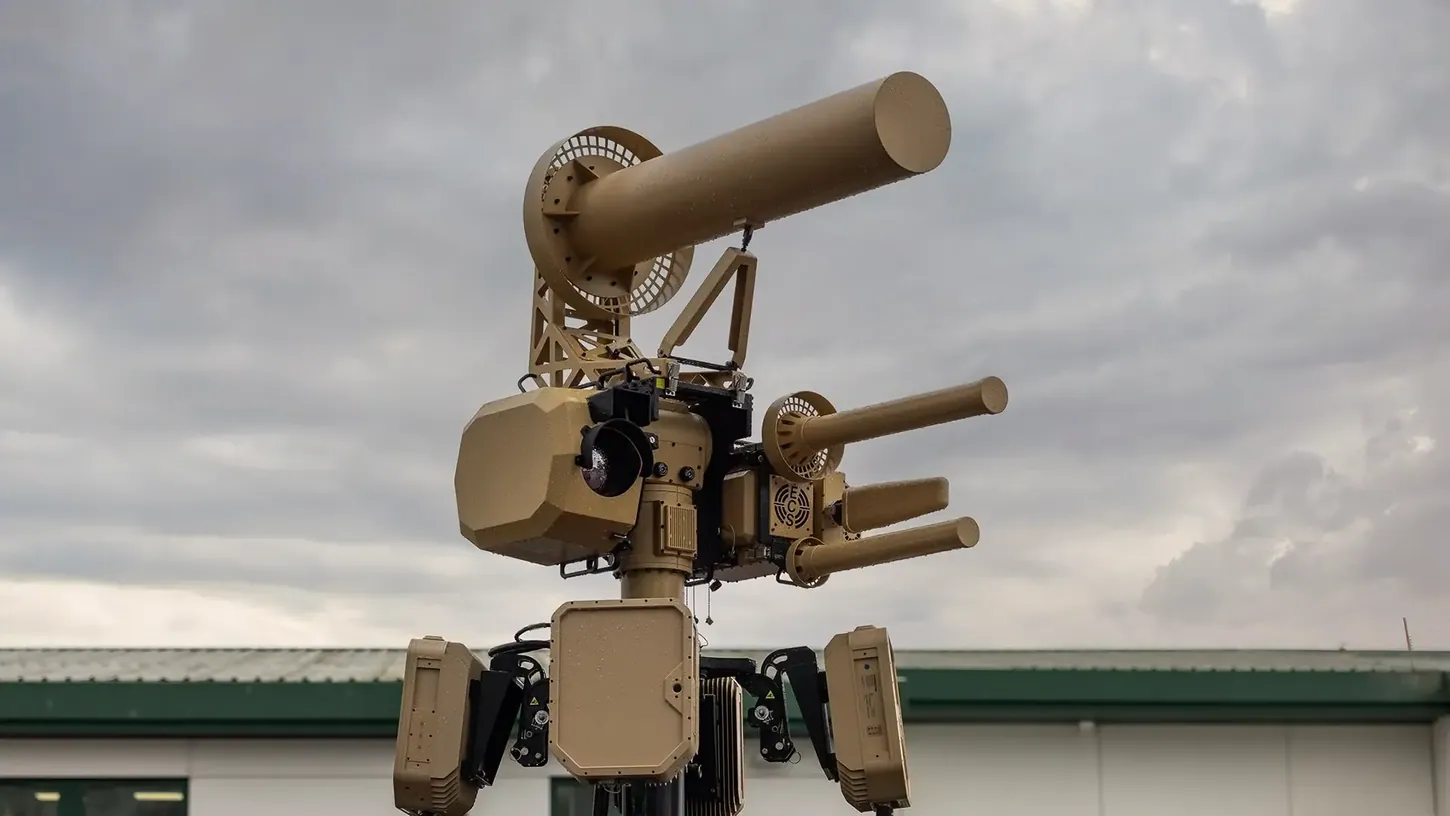
The 24 GHz rule answers a petition Echodyne filed on October 24, 2018, adding federal and non-federal secondary radiolocation to the 200 MHz between 24.45 and 24.65 GHz, so ground radars can detect drones near airports, borders, prisons, stadiums and critical infrastructure without disturbing the band’s primary users.
Those primary users are aircraft radionavigation systems, including detect-and-avoid radar, and inter-satellite links. Until now drone-detection radar has run in the band on waivers. The FCC’s Wireless Telecommunications Bureau granted Echodyne a site-by-site waiver in June 2019 and extended it by five years in June 2024, the same day it granted one to MatrixSpace. The January 2025 proposal noted two comments on Echodyne’s petition, from Black Sage Technologies and In-Q-Tel, and both supported it. Echodyne’s radar already sits inside a $490 million Air Force counter-drone program.
Radiolocation means detection, with no navigation use of the data. A rule that lets a radar see a drone gives no one the power to jam it or bring it down. That authority comes from federal law, which now extends it to the mitigation-certified local agencies DroneXL covered in September.
Gogo Has Been the Only 800 MHz Air-Ground Licensee Since 2013
The first single-licensee band carries in-flight internet. The 2025 proposal would rewrite power rules for 849 to 851 and 894 to 896 MHz, four megahertz Gogo Business Aviation has held alone since 2013, and measure transmitter power by average instead of peak, as Gogo petitioned in July 2022.
The FCC auctioned the band in 2006, and Gogo won three of its four megahertz, then took over the fourth when it bought LiveTV in 2013. Gogo asked for a waiver to use average power in May 2021, and the FCC’s Mobility Division granted it on June 21, 2022. The Association of Public-Safety Communications Officials (APCO) asked the FCC to reconsider that grant a month later. The FCC already switched PCS and AWS to average power in 2008 and the Cellular band in 2017, each with the same 13 dB cap on power spikes the 2025 proposal sets for Gogo’s band. Carr’s release says the final rules keep protections for public safety communications.
AURA Would Turn Its 450 MHz Licenses Into One Nationwide License
The 450 MHz change acts on a February 2021 petition from AURA Network Systems and A2G Communications. The FCC calls AURA the band’s only incumbent licensee. The 2025 proposal covers 650 kilohertz at 454 and 459 MHz and would convert AURA’s licenses into one nationwide control-link license with no auction.
In the FCC’s words, the current site-based rules effectively prohibit “wide-area, low-altitude service.” Carr’s release repeats that passage from paragraph 6 of the January 2025 proposal, WT Docket 24-629, nearly word for word. The proposal adds a primary aeronautical allocation for control and non-payload communications (CNPC), the link that flies the aircraft rather than the camera feed. AURA filed its petition as a condition of a 2021 waiver that already let it offer some drone services from its 53 sites. The conversion is voluntary, and the proposed eligibility test describes the band’s only incumbent: nationwide coverage at 25,000 feet (7,620 meters) from sites placed so that nobody else can build a regional service. The FCC says the leftover spectrum between those sites cannot reasonably go to anyone else without harmful interference.
The FCC paired that with build-out conditions. If the licensee keeps high-altitude coverage, it must serve 400 feet (122 meters) over 17.5% of each of the country’s regional license areas within four years and 35% within eight. If it drops high-altitude service, the targets double to 35% and 70%. Missing the first benchmark cuts the 15-year license term to 13 years, and missing the final one in any region terminates the license automatically. The FCC tentatively concluded the conversion would not create undue enrichment for the incumbent, because building drone service takes heavy investment against uncertain demand, and asked whether a windfall payment should apply anyway.
DroneXL’s Take
I want all three rules passed. Echodyne has waited eight years for a permanent version of a rule it has run on by waiver since 2019, and a licensed control link that reaches 400 feet is something the 450 MHz rules have never allowed without a waiver.
The airspace sovereignty branding adds nothing to a proposal Carr already voted for as a commissioner. Finishing it as chairman is good government. Read the 400-foot benchmark first when the draft posts on Thursday. Under the 2025 proposal, the only company holding licenses in the band gets a nationwide license without bidding against anyone. The 400-foot coverage targets and the termination penalty behind them are what make AURA build a drone network on it. If the draft weakens them, the FCC is handing one company a nationwide license with the drone part made optional. I’d want the commissioners to explain that before they vote on November 19.
Sources: FCC news release, October 28, 2026, FCC Notice of Proposed Rulemaking FCC 25-7, WT Docket 24-629, FCC November 2026 Open Meeting
DroneXL uses automated tools to support research and source retrieval. All reporting and editorial perspectives are by Haye Kesteloo. Read our editorial standards.