
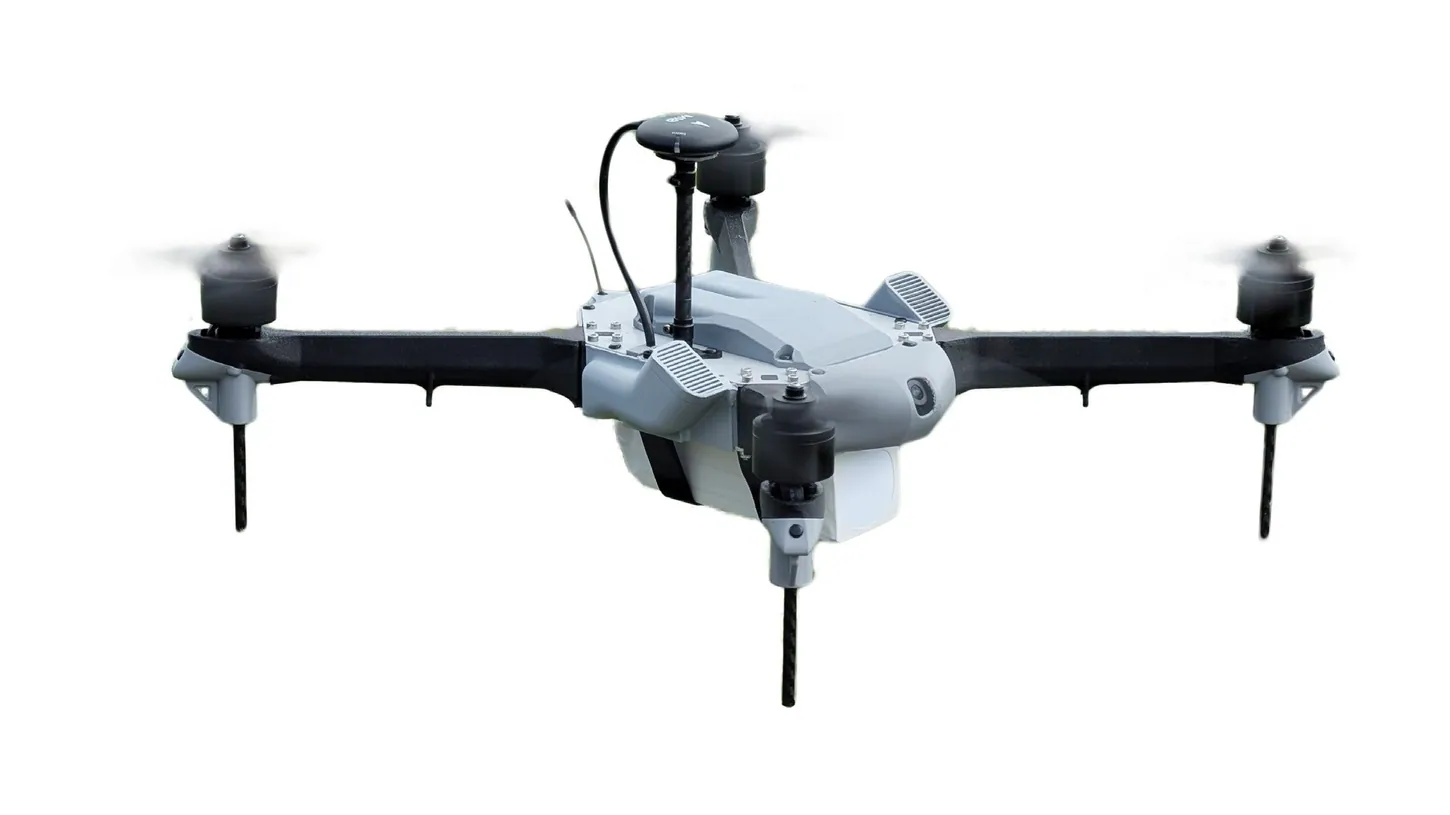
The European Space Agency signed a contract on Tuesday with Rift Dynamics, the drone maker in Sandnes, Norway, to keep low-cost, expendable drones navigating for 10 minutes while satellite navigation is jammed or spoofed, then recover cleanly once the signal returns. Comrod is the subcontractor, and the system will go through jamming and spoofing trials in the Arctic.
Rift is the company Ondas Holdings invested in last year, taking exclusive U.S. distribution of its Wåsp drone through the Ondas subsidiary American Robotics. The contract was one of three ESA signed with Norwegian companies at Spaceport Norway in Oslo under its Navigation Innovation and Support Programme (NAVISP), with Norwegian Space Agency money behind the call.
ESA did not say what any of the three contracts are worth, or which aircraft Rift’s navigation system is meant to fly on.
ESA Gives No Method or Schedule for Rift’s 10-Minute GNSS-Denied Target
Beyond the Arctic trials and the 10-minute target, ESA’s announcement gives no test schedule and does not describe the navigation method Rift will use. Comrod, a Norwegian maker of tactical antennas and masts, is the only partner ESA names on the project.
A drone that loses GPS falls back on whatever else it carries, typically inertial sensors and cameras, and those position estimates drift the longer the outage lasts. Orqa drones running KEF Robotics navigation software completed two missions under GPS jamming in front of Army Green Berets in Alabama in August.
The only aircraft on Rift’s website is the Wåsp FPV+, which the company describes as a cross between an armed FPV drone and an AI-capable surveillance drone. Rift and Ondas say it is built to meet EASA C2 class requirements. Ondas placed an initial order for 500 Wåsp systems on October 2, 2025. On October 13 it brought in Nammo to supply warhead payloads for an armed version aimed at the U.S. defense market. Neither release mentions GNSS or jamming.
Testnor Will Turn Jammertest’s Recorded Jamming Into a Test Library
Tromsø-based Testnor, which coordinates Norway’s annual Jammertest exercise, will use its NAVISP contract to build a Signal Data Library of real jamming recordings and RF playbacks, starting with Jammertest data, which ESA says is conceived as a market-ready service for companies testing navigation hardware.
For drone makers that is the more immediately useful of the three contracts. Jammertest is an open-air event on Andøya, and a recorded library lets a team replay those conditions on a bench instead of waiting a year for the next one. The third contract went to Norse Navigation in Trondheim for ship positioning sensors that use Galileo’s OSNMA signal authentication and detect jamming and spoofing on merchant vessels.
Norway Puts a Week Without Satellite Positioning at NOK 3.4 Billion
The Norwegian Space Agency funded the call. Its satellite navigation advisor cites a government analysis putting a seven-day loss of satellite positioning at NOK 3.4 billion (EUR 320 million), plus a Norwegian Defence Research Establishment report on total defense, as the reasons resilience is a national priority.
That advisor, Kristian Svartveit, made the case when ESA announced the contracts. “Strengthening PNT resilience is a priority for Norway,” he said.
NAVISP was created in 2016 as an optional ESA program, supported by 20 states, to fund positioning, navigation and timing work that backs up or complements satellite navigation. Its remit covers European and Canadian industry, and the program is designed to carry part of the commercial R&D risk.
DroneXL’s Take
I’m glad to see a civil space program paying for jam-resistant navigation on cheap drones, because jamming is no longer something only soldiers deal with. Military GPS jamming tied to White Sands was running the night a medevac crew flew into a New Mexico mountain, and Norway’s government prices a week without satellite positioning in the billions of kroner. Navigation that survives a jammer is dual-use by nature, and the delivery and inspection drones DroneXL readers fly will need it as much as a military quad does.
ESA should still publish the contract values and say which aircraft Rift’s system is for. NAVISP exists to carry commercial R&D risk with public money, and the public should know where that money lands. If the work does end up in the Wåsp, it would reach a drone that American Robotics distributes in the U.S. Ondas reports third-quarter results on November 12, the first scheduled chance for the company to say so.
Source: ESA, “ESA and Norway pen projects for resilient satellite navigation,” October 28, 2026, ESA on X, Ondas Holdings press releases
DroneXL uses automated tools to support research and source retrieval. All reporting and editorial perspectives are by Haye Kesteloo. Read our editorial standards.


