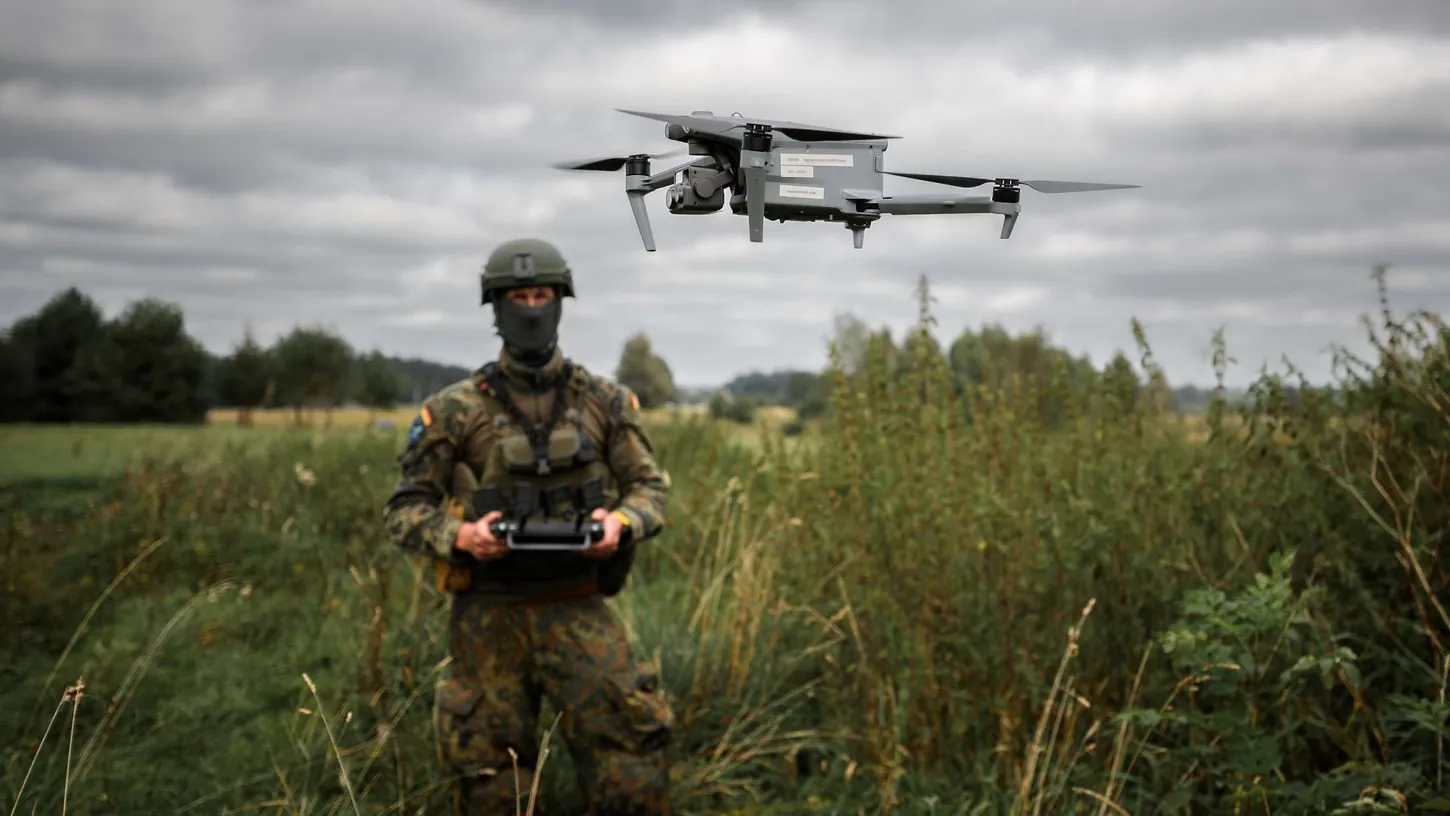
Orqa drones flew a reconnaissance mission and a payload drop at Fort McClellan, Alabama, in late August while GPS and their communications links were both being jammed, according to a joint release from Orqa, Blue Arrow Defense and KEF Robotics. Personnel from the Army’s 1st Special Forces Command and the Alabama National Guard’s 20th Special Forces Group watched.
The drone maker is Croatian. The navigation software comes from Pittsburgh, and the fleet software was written in Kyiv.
Jamming takes away the satellite fix that tells a drone where it is and the radio link a pilot uses to tell it where to go. The payload drop used several drones at once, and both missions were completed.

KEF’s Tailwind Gave The Drones Their Position From Onboard Cameras
With GPS jammed, the drones took their position from KEF Robotics’ Tailwind software. Tailwind works out where the aircraft is from its onboard cameras and hands the autopilot latitude, longitude, altitude and velocity in the same form a GPS receiver would, so the flight controller keeps flying as usual.
KEF rates its map-free mode at under 2 percent drift at 100 mph (161 km/h), according to its product page, and a second mode matches what the camera sees against a map for longer, higher flights. Limitless Aeronautics, a U.S. maker of drone payload attachments, built the release mechanisms used in the drop.
“GPS jamming and spoofing are operational realities,” said Fraser Kitchell, KEF’s chief executive. DroneXL first wrote about his Pittsburgh company in 2022, when the Army’s Applications Laboratory gave KEF $1.5 million to develop vision-based autonomous flight, and again in 2024 when its work reached from Pittsburgh to Kyiv.
Blue Arrow’s Kyiv-Built Autonomy Is Moving Onto Orqa’s Flight Board
RII is the Blue Arrow software that coordinated the multi-drone payload run. It breaks a mission into smaller sub-missions each aircraft can finish on its own, so one operator can command several drones. Blue Arrow launched RII on April 2, with Ukrainian defense units as its first planned users.

Blue Arrow grew out of KEF’s partnership with Kyiv’s Sensorama Lab and launched in January 2025, with headquarters in the U.S. and its engineering in Ukraine. Before Blue Arrow launched, the Sensorama and KEF team took first place and $50,000 at a NATO-Ukraine automated guidance hackathon in Kraków in June 2024, the Defense Innovation Unit reported.
When Blue Arrow joined Orqa’s Developer Program, its system was a prototype that needed extra hardware bolted onto the drone. It will now be offered as a package with Orqa drones built around the company’s Auto Pilot Board, or APB, which puts an STM32 H7 flight controller and an NXP i.MX8M Plus processor for AI and video on one board, Orqa’s developer documentation shows. One board instead of two saves weight and power, and it is simpler to build by the thousand.
Blue Arrow CEO Sergii Tereshchenko said Ukraine has shown that “no single company can address every requirement of modern drone warfare.” Olga Pogoda, KEF’s chief operating officer and one of Blue Arrow’s co-founders, sent me the release.
Orqa Brings Ukraine-Tested Drones And Its Own Supply Chain To The Partnership
Orqa, based in Osijek, Croatia, has had its drones in use in Ukraine since 2022 and now supplies FPV systems and components to more than 50 countries, the release says. It designs and builds its own electronics, which the release credits for ending its reliance on Chinese suppliers.
In December 2024 the Pentagon stopped using Orqa drones after the Defense Innovation Unit found radio modules assembled in China inside them, Forbes reported. CEO Srđan Kovačević told Forbes the chips were Taiwanese and European and that Orqa now makes the modules itself.
The release calls the Alabama event a “Watchtower” drone competition. The Army’s record of Fort McClellan that week is 1st Special Forces Command’s first Best Drone Team Competition, run August 24 to 28 with 15 teams.
Orqa expanded its Croatian plant last year to a stated capacity of 280,000 drones a year, and in June it signed a 150 million CAD deal to build in Canada. Kovačević pitched the Alabama work as modular by design, adding capability “without locking the customer into a single proprietary system.”
DroneXL’s Take
Ukraine is writing the requirements for everyone else’s drones, and this is what that looks like when it reaches the U.S. Army. RII was built for Ukrainian units first, and KEF took its navigation software to Ukraine for its first field tests in February 2025, Blue Arrow told AIN.
The modular approach Kovačević described is how that knowledge gets to American operators. The Army buys the best navigation and the best fleet control without marrying one vendor, and the people who learned the problem under Russian jamming get to sell the answer.
DroneXL has argued for years that drones should be judged against security standards every manufacturer has to meet, not by the flag on the box. By its CEO’s account, Orqa brought the problem radio in-house after the 2024 halt, which is the right answer to a finding like that. The partners say they will keep working together in Ukraine and the United States and extend the integration to more aircraft and payloads. Watch for the first Orqa drones to ship with the APB and Blue Arrow’s software on board, because RII and Tailwind have already worked through the jamming at Fort McClellan.
Sources: Orqa, Blue Arrow Defense and KEF Robotics joint press release (supplied to DroneXL, not yet published online), U.S. Army, Defense Innovation Unit, Forbes.
DroneXL uses automated tools to support research and source retrieval. All reporting and editorial perspectives are by Haye Kesteloo. Read our editorial standards.