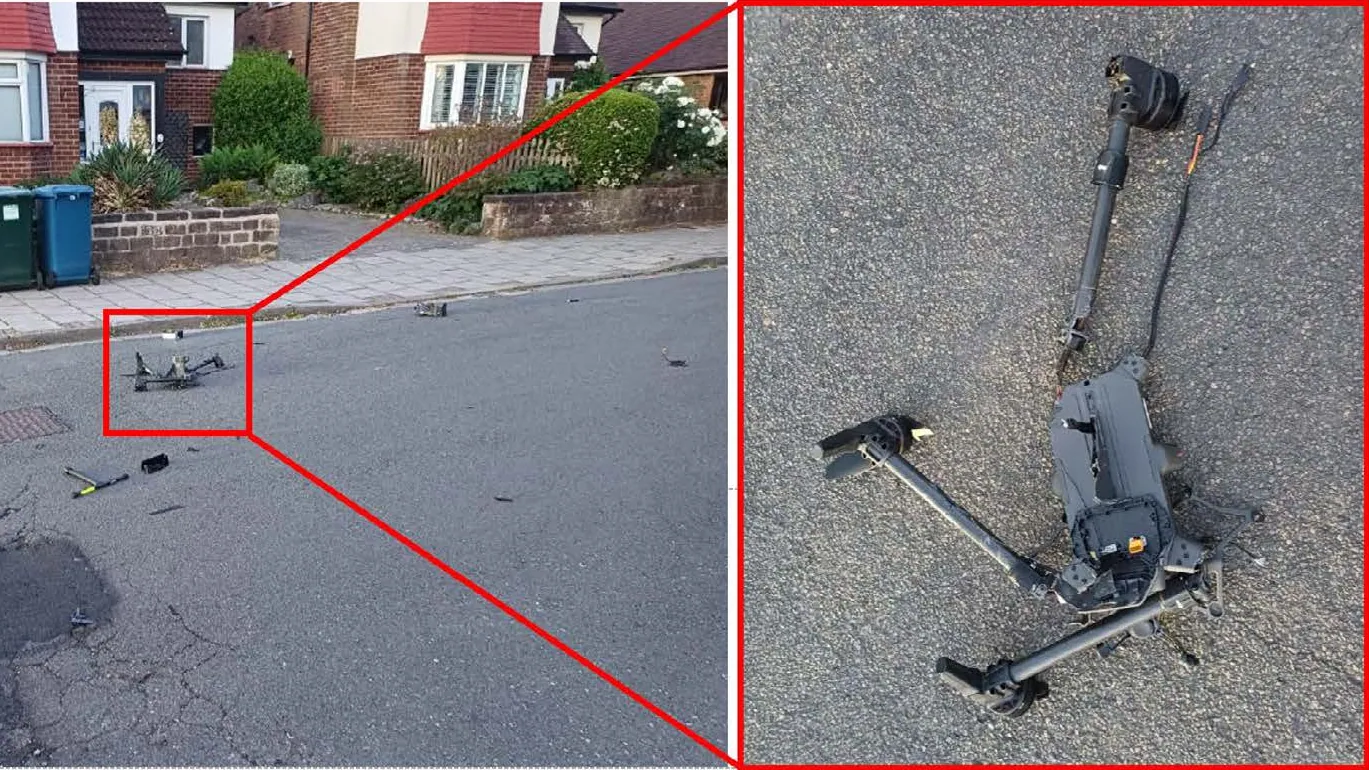
A DJI M300 police drone spun out of control and fell from about 380 feet (115 meters) onto a residential road in West Bridgford, Nottinghamshire, after its rear right motor arm folded in flight. Nobody was hurt. The UK’s Air Accidents Investigation Branch (AAIB) published its report on the June 1, 2026 crash on November 12. It says the 15.9-pound (7.2 kg) aircraft could likely have killed a person if it had hit one.
The pilot had placed the arms in their flight positions at the start of his shift. His force’s pre-flight checklist did not ask him to check them again before takeoff, and the AAIB says it has investigated M300 crashes like this one before.
The M300 Warned Its Pilot Nine Seconds Before It Fell
The M300’s controller told the pilot to land and check the arm sleeves 4 minutes and 4 seconds into the flight, with the drone 1,165 feet (355 meters) away. Nine seconds later it reported a propulsion system error, and the aircraft began to spin and drop.
The AAIB bulletin puts the crash at 03:23 UTC, which is 4:23 a.m. in Nottinghamshire. The pilot reported very few vehicles on nearby roads and no pedestrians in sight. A police team was searching for suspects and had already flown an Autel MAX 4N for 19 minutes. The pilot switched to the M300 after a request to stream live video to what the bulletin calls the “top desk,” because the Autel’s stream had been less reliable.
The first warning stayed on the screen for one to two seconds. The pilot turned the drone back toward his takeoff point, saw the second set of errors, looked up and watched it fall out of sight. The flight log ends at about 250 feet (75 meters), where the drone was descending at 3,740 feet per minute, or about 43 mph (68 km/h). The AAIB says it was likely falling faster than that when it hit the road.
Wreckage was spread over about 66 feet (20 meters), and the batteries were thrown onto the footpath next to the road. The bulletin reports no damage to property. The drone was damaged beyond economic repair.
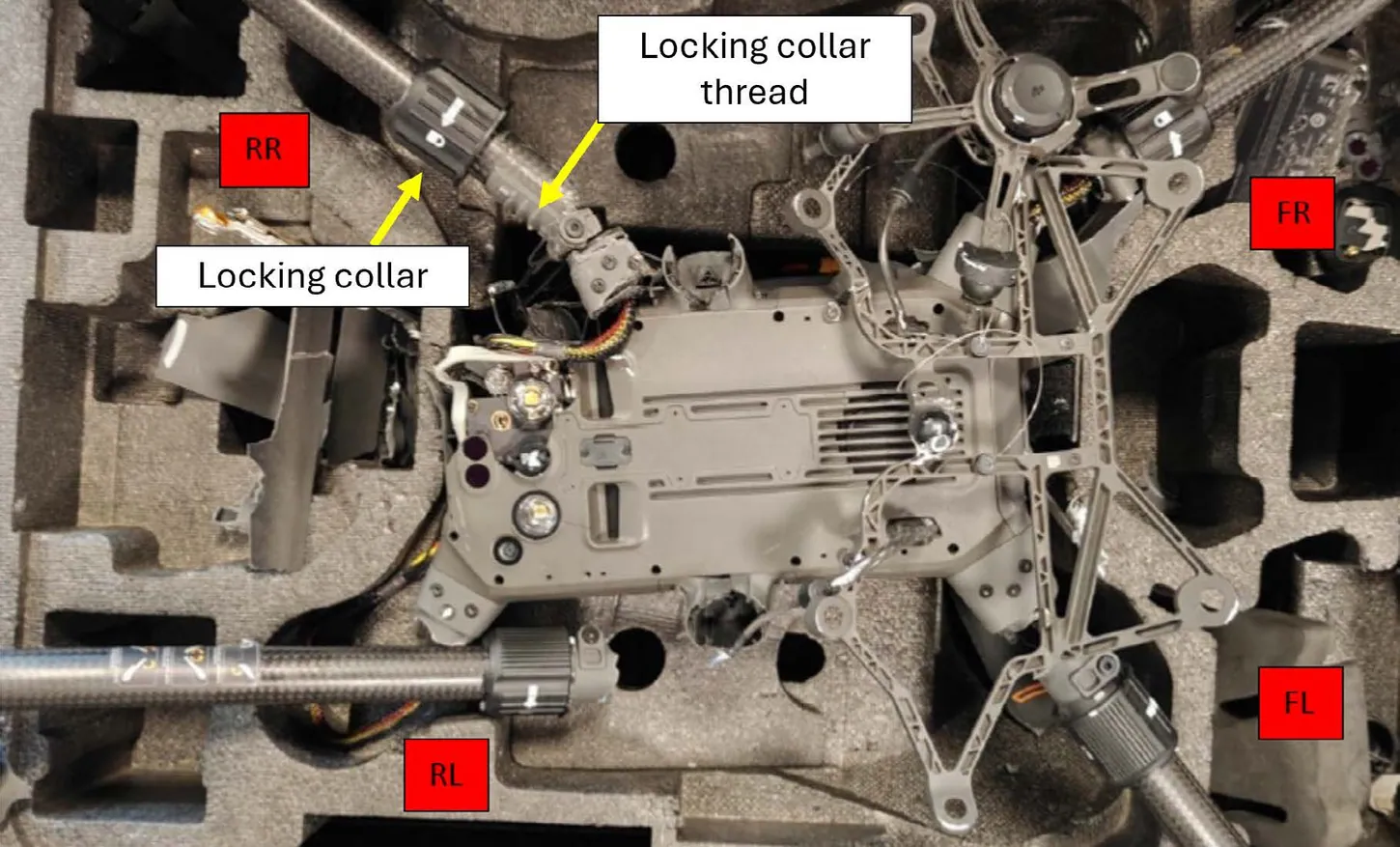
Three of the four locking collars were still engaged when the wreckage was inspected. The rear right collar had come off its thread, and a section of that thread had broken away. DJI analyzed the flight data and the wreckage and concluded that “the accident was caused by the M4 arm not being properly installed.” M4 is the rear right arm.
The Police Checklist Did Not Ask About The Arm Locks
The force’s pre-flight checklist did not include a check that the M300’s motor arms were locked. The 25-year-old pilot had set them at the start of his shift and told the AAIB he did a visual check before takeoff. He had 128 flying hours, 84 of them on the M300.
The bulletin does not name the force. It does record two other lapses. The pilot had not signed off the checklist for this flight or for the Autel flight before it, and his body-worn camera, which should have been recording the pre-flight checks, was not switched on until the drone was in the air. The force then found that its own audits had missed that body-worn cameras were not being switched on until after takeoff. They had checked that in-flight footage existed and had not looked for footage of the checks.
On June 24, 2026 the force issued Safety Notice 1/2026, which found that “critical assembly and safety checks were either missed or not verified.” Its pilots must now confirm before every flight that the marks on each collar and the airframe line up, that the collar clicks when it closes, and that the arm does not move afterward. A second pilot or observer repeats the check when one is available. A collar that does not click, or a worn thread, grounds the aircraft.
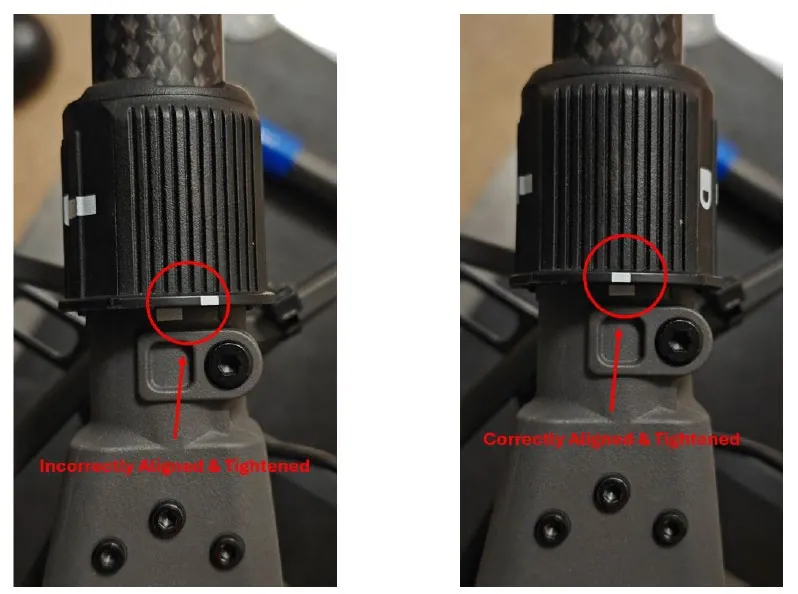
The National Police Chiefs’ Council (NPCC) sent a notice based on that one to every police force flying the M300 and told the National Fire Chiefs Council. It also recommended that every pre-flight check on a folding-arm drone include a visual inspection of the connecting parts, and that body-worn cameras record the checks. The NPCC says it is working toward common operating procedures, and that checklists still differ between forces. An NPCC-led safety board classified the crash as “medium” severity.
Three 2021 M300 Crashes Pointed At The Same Locking Collars
The AAIB cites three earlier M300 investigations in which a loss of control was attributed to motor arms that were not fully secured. All three happened in England in 2021, in Manchester, Gloucestershire and Chester, and the bulletin says several involved the emergency services.
In Old Trafford, Manchester, an M300 searching for a missing person at night on August 3, 2021 crashed after its left rear arm folded back in flight, and DJI saw a high likelihood the collar had not been fully tightened. Two weeks later a search flight in Cam, Gloucestershire dropped on approach, and the AAIB said the damage suggested an unlocked arm without proving it. On November 21, 2021 an M300 in Blacon, Chester fell just after launch when an arm folded.
The M300, which DJI launched in May 2020, has no dedicated sensor on its arm locks. The bulletin says the warning this pilot saw is triggered by excessive vibration. DJI added arm lock detection with the M350 in May 2023, and the AAIB says that system and the one on the M400 stop the aircraft from taking off with an unlocked arm.
Police forces operate more than 800 drones nationally, including more than 30 M300s. In England and Wales, 1,326 remote pilots logged 82,624 flights in the 12 months to May 31, 2026. The AAIB expects occasional lapses to continue as that number grows and points to two possible hardware mitigations, the newer airframes and parachutes for drones that work over towns. DJI released the AP100 parachute for the M400 in July.
DroneXL’s Take
I think the real fix for this is in the hardware, because the checklist fix depends on people. The AAIB published three reports in early 2022 that pointed at these collars, and four years later a UK police force was still flying the M300 with a checklist that did not mention them. The new notice is sensible, but it depends on a pilot doing three extra checks at 4 a.m. while colleagues wait for video, and on this flight the sign-off had been skipped and the camera went on only after takeoff. DJI’s answer on the M350 was a sensor that refuses to take off, and that doesn’t depend on anyone remembering.
In January I wrote about the AAIB’s record-only handling of the Kent Police crash that injured a child. This bulletin is the fuller kind of investigation I wanted then, and it’s blunt about what a 15.9-pound drone does to a person from 380 feet.
American agencies still fly this airframe too. The Ocean County Sheriff’s Office used an M300 for a rip current rescue in July. If you fly one, check the collars before every takeoff.
Sources: AAIB Bulletin 11/2026, AAIB-31806, GOV.UK
DroneXL uses automated tools to support research and source retrieval. All reporting and editorial perspectives are by Haye Kesteloo. Read our editorial standards.