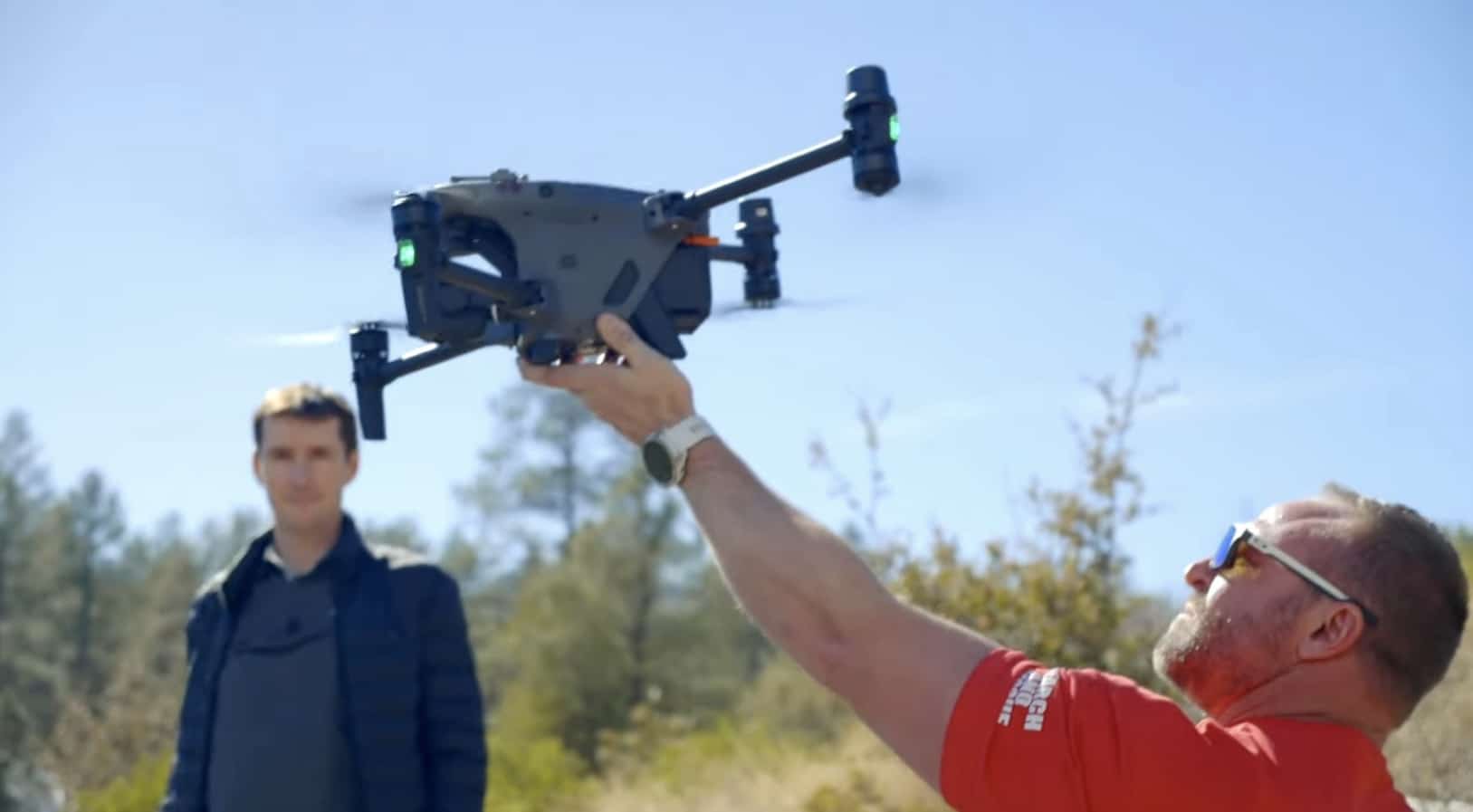
An Ocean County Sheriff’s Office pilot dropped an inflatable rescue tube beside two swimmers caught in a rip current off Long Beach Island on Friday, July 17. The aircraft that carried it was a DJI Matrice 300 RTK, and the sheriff’s office cannot buy a new one.
The call reached dispatch around 6:14 p.m. at Division Avenue Beach in Surf City. Surfers went in first. A volunteer fire company water rescue team put two swimmers into the surf with rescue cans and sent a third out on a rescue board. While that was underway, the sheriff’s officer already stationed on the island launched, flew out past the break, and released a Restube Automatic flotation device. One victim grabbed it and stayed up until Surf City lifeguards reached them. Everyone came out of the water and was evaluated by EMTs.
I have been writing about drone-delivered flotation since I covered Oak Island’s fire department dropping rescue tubes in 2024. This one is worth a second look, because the interesting part is not the drop.
The Reporting Record on This Rescue Is Messier Than the Rescue Was
Local coverage disagreed on when this happened and who flew. WPVI/6abc placed it at about 6:15 p.m. on Friday, July 17, matching the incident date Patch obtained from the Surf City Volunteer Fire Company, though Patch called it a Thursday. Two other outlets ran it as a Wednesday and a Sunday. July 17, 2026 was a Friday.
The pilot attribution slipped too. The sheriff’s office named Officer Cook. At least one trade outlet credited the detective who gave the television interview. Small errors, but they matter when agencies later cite press coverage in grant applications and budget hearings.
One figure deserves a clarification rather than a correction. The broadcast report describes a drone equipped with a Restube and then states that “it” can move up to 45 miles per hour, leaving the antecedent open. DJI publishes the M300 RTK’s top speed at 23 m/s (51 mph) in Sport mode and 17 m/s (38 mph) in Position mode, so neither reading lines up cleanly with the spec sheet. If that number came from the agency and reflects a real loaded cruise figure, it is worth publishing properly, because response-time math is the entire argument for these programs.
Ocean County Staffs the Hours When Lifeguards Are Already Off the Stand
The sheriff’s office does not scramble a drone after a 911 call. It parks pilots on the beach before the call comes. Chief Warrant Officer Kevin Fennessy wrote on LinkedIn that his sUAS team has carried Restubes for more than a year and that during peak water rescue hours the office “strategically position drone pilots throughout the county to reduce response times.” Those hours run 5 p.m. to 8 p.m., after lifeguards leave the stands and while beaches stay full.
The agency’s own statement, quoted by Patch, describes the same pattern: drone operators in place on both the north and south ends of the island. Long Beach Island runs roughly 29 km (18 miles), so two positions put a pilot within a few minutes of most of it.
That is a scheduling decision. It costs overtime rather than capital, and it is the part other coastal agencies can copy tomorrow. New York City runs the same logic at Rockaway Beach, where FDNY pilots drop restubes to swimmers. In January I wrote about the Dutch brigades at Katwijk and Noordwijk adopting DJI aircraft for the same reason, and I grew up on those North Sea beaches watching volunteer lifeguards work them. The gap they are all closing is identical.
NOAA’s guidance explains why flotation is the variable that matters. Swimmers pulled offshore drown from exhaustion, and once they tire they go under without something to hold onto. The U.S. Lifesaving Association estimates rip currents kill more than 100 people a year on American beaches and account for over 80 percent of surf lifeguard rescues.
The Kit Is a Matrice 300, a Talon Drop System, and a 245-Gram Tube
Fennessy identified the airframe as an agency M300 fitted with a Terrestrial Imaging drop system. Terrestrial Imaging’s product for that platform is the DroMight Talon V1, a $1,099 modular release the company says installs in under 30 seconds and also fits the M350 RTK.
The trigger mechanism is the counter-intuitive part. The Talon uses a light sensor pod that sits over the strobe light on the aircraft’s underside, so the pilot fires the release by toggling the strobe on and off from the smart controller. No SDK payload port, no separate transmitter, no extra radio link to lose.
The payload is a Restube Automatic 75, a German-made buoy weighing 245 g that inflates to 75 N of buoyancy, roughly 7.5 kg of lift, when a water-activated trigger punctures a 16-gram CO2 cartridge. Restube specifies a minimum drone payload capacity of 900 g for a device that weighs a quarter of that, and the margin is the point. The M300 carries up to 2.7 kg across three mounts, tolerates 15 m/s (33.5 mph) of wind, and holds an IP45 rating, so it works in the onshore breeze and salt spray that ground lighter aircraft.
Industry pilots flagged exactly that under Fennessy’s post. Arcady Shteynberg of the OMADA Group, who was quoted by CBS News Philadelphia explaining how the same flotation devices inflate during Atlantic City Beach Patrol drone training, commented that “flying on east coast beaches isn’t the easiest task,” citing persistent headwinds and manned traffic. FDNY Robotics’ Michael Leo added that these devices are not the easiest things to deploy down range. Both are describing a job a sub-250-gram drone cannot do.
A Certificate of Authorization Is What Separates This From a Part 107 Flight
Ocean County has been flying since 2016 and now operates 16 aircraft with 13 FAA-licensed remote pilots supporting all 33 municipalities in the county, according to the sheriff’s office. The agency states that it flies under Part 107 guidelines and under an FAA Certificate of Authorization.
That COA matters. Dropping an object is permitted under 14 CFR 107.23(b), which bars allowing an object to be dropped from a small unmanned aircraft in a manner that creates an undue hazard to persons or property. Flying directly over people who are not participating in the operation is a separate question under 107.39, and most Part 107 pilots resolve it with a category-rated aircraft or a waiver. A public agency COA is the path around it. If you are a Part 107 pilot watching this footage and thinking about strapping a rescue tube to your Mavic, the legal ground you are standing on is not the ground Officer Cook was standing on. DroneXL walked through a related version of this problem when a heavy-lift drone carried a stranded man to safety in a maneuver that would be illegal for almost everyone reading it.
The FCC’s July 21 Notice Names Thermal Drones as Military-Grade
On July 21, 2026 the Federal Communications Commission released Public Notice DA 26-758, asking whether it should prohibit the future import and marketing of previously authorized foreign-made drones falling into seven capability categories. Thermal imaging drones are on that list, alongside LiDAR-equipped aircraft, docking stations, aerosol sprayers, swarming systems, defense-article integration, and anything at or above 25 kg (55 pounds). The agency paired it with an extension of Blue UAS and Buy America exemptions through January 1, 2028.
The M300 RTK is the workhorse platform for the Zenmuse H20T, and Ocean County’s own fleet description says many of its aircraft carry thermal cameras. New DJI models have been blocked since the FCC swept all foreign-made drones onto the Covered List in December 2025. This proposal reaches the grandfathered inventory, which is a different and larger thing, and it follows the template the agency set in June when it cut off imports of legacy Huawei-era gear. That prohibition took effect ten days after Federal Register publication. Comments on DA 26-758 close 30 days after it publishes.
DroneXL’s Take
The headline here is not that a drone saved a swimmer. A drone did not save anyone. Surfers went in, rescue swimmers followed with cans, a third responder went out on a board, and lifeguards brought the victim to shore. The drone bought time, and buying time is a real contribution that deserves accurate description rather than inflation. Agencies that oversell what the aircraft did are setting themselves up for the day it does not work.
What Ocean County actually built is a staffing model. Somebody looked at the calendar of drownings, noticed they cluster after the stands empty out, and put licensed pilots on both ends of a barrier island from 5 to 8 p.m. all summer. Any coastal county in America could run that next week with hardware it already owns, and most of them are not.
Then there is the supply chain, which is where this gets uncomfortable. The drop system comes from Terrestrial Imaging, a dealer headquartered in Brick Township, inside Ocean County itself, holding a New Jersey Cooperative Purchasing Alliance contract that lets any public entity in the state buy at bid pricing. The buoy is German. The aircraft is Chinese. Two of those three are secure. The third is the one holding everything else up, and Washington’s position is that a Matrice with a thermal camera is military-grade equipment. Officer Cook’s position was over a rip current at Division Avenue Beach with a rescue tube hanging off the strobe mount.
Read DA 26-758 and file a comment before the window closes. The FCC record has been thin on operators describing concrete harm and thick on generic argument, and the agency has told us repeatedly which one it weighs. A sheriff’s office explaining, in its own words, what it expects to fly at 6 p.m. on Long Beach Island in the summer of 2029 is worth more in that docket than a thousand posts about protectionism. Mine included.
Sources: WPVI/6abc Philadelphia, Patch, Kevin Fennessy via LinkedIn, Ocean County Sheriff’s Office, FCC Public Notice DA 26-758, NOAA, CBS News Philadelphia, Terrestrial Imaging, Restube, DJI.
DroneXL uses automated tools to support research and source retrieval. All reporting and editorial perspectives are by Haye Kesteloo.