
The European Drone Defence Initiative, the rebranded EU “drone wall,” is due to reach initial capacity by the end of December and full operation a year later. Five weeks before that first deadline, a leaked European Defence Agency report on member states’ own plans says only about a third of their counter-drone and very short-range air defense programs are expected to deliver by the end of the decade.
The money is not the shortfall. EU countries are putting €18.9 billion into drone technology between 2024 and 2029, counter-drone investment grew sixfold from 2024 to 2025, and member states have committed more than €7 billion of EU defense loans to drone and counter-drone systems. In July, DroneXL called December the month to see whether the EU initiative shows up next to Poland’s own counter-drone build.
Europe’s Counter-Drone Gap Is Procurement and Authority, Not Funding
The EDA report blames procurement fragmented across national capitals and limited interoperability between the systems they buy. Experts add a legal gap. Some infrastructure operators can detect drones but have no authority to bring them down, and the law is unclear on who may intercept one.
Euronews obtained the EDA’s readiness report in October. It also cites too little testing capacity and industrial surge capacity, and long procurement cycles risk fielding hardware that is outdated on arrival, in a field where drones and jammers change within months.
Geert De Cubber, who leads robotics research at the Belgian Royal Military Academy, told The Parliament Magazine the hard problem is getting the different players with drone detectors to share information while respecting security and privacy rules. The European Commission acknowledged the authority gap in its February 11 action plan on drone and counter-drone security, according to The Parliament Magazine. De Cubber called the idea of intercepting every hostile drone by the end of 2027 “a fantasy.”
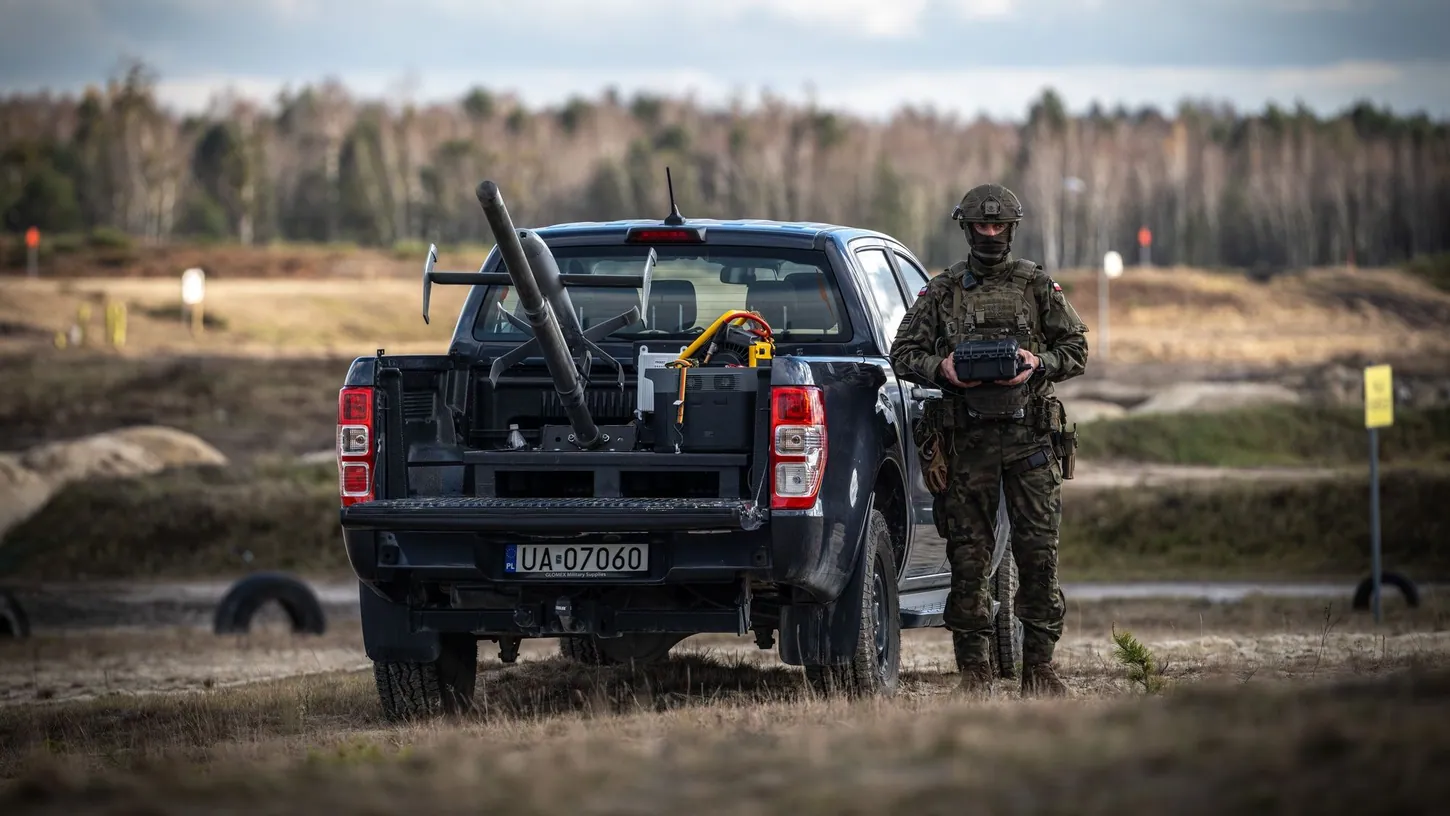
Arthur de Liedekerke of Rasmussen Global said defense procurement offices did not grow with defense budgets, and decades of buying from established manufacturers have made it hard for smaller companies to break in. His prescription, drawn from Ukraine, is “good enough, fast enough, cheap enough, and enough.” The photo above is from a U.S. Army-supported event in Poland in November 2025, where Polish soldiers put a counter-drone system through its paces after a train-the-trainer course. The Army says allies like Poland and Romania are rapidly buying systems battle-tested in Ukraine.
National Drone Defenses Are Racing Ahead of the EU System
Poland’s €3.5 billion SAN program, which DroneXL called Europe’s largest integrated counter-drone system, will field 18 batteries and buys from Norway’s Kongsberg and Denmark’s Weibel Scientific. The EU-level DECODER project brings 28 countries together, with estimated investment needs of €3.5 billion to €5 billion through 2033.
DroneXL covered SAN when Poland signed the contract in January. Its initial operational capability falls before the end of 2026, the same window as the EU initiative.
DECODER covers 26 member states plus Norway and Ukraine; Malta stayed out. The Council named it a European Defence Project of Common Interest in a September 28 implementing decision. Separately, Denmark, Spain, Croatia, Latvia and the Netherlands are buying drone and counter-drone equipment together and setting up shared technology hubs.
The Baltic states are the frontline case. Estonia, Latvia and Lithuania asked Brussels for €500 million in extra drone-defense support, and the Commission turned them down in late October, pointing them to SAFE loans instead. About €21.3 billion of SAFE money is still available, so they can reapply.
Luigi Scazzieri of the EU Institute for Security Studies expects progress on component supply and common technical standards by the end of 2027. Cross-border tracking and joint responses will take longer, he said, and will likely come from a small group of member states with the same threat moving first.
DroneXL’s Take
The EU will be able to say it hit its December milestone. “Initial capacity” for a program that mostly funds national projects is whatever Brussels decides to count. The EDA’s own forecast still has about two-thirds of national counter-drone programs arriving after 2030.
My read is that De Cubber has the most useful point. Europe doesn’t need one wall. It needs a Danish airport operator and the Danish police to see the same drone and agree on who is allowed to take it down. That is a legal and data problem, and no amount of SAFE money fixes it until national governments write the rules.
I’d also push back on the 144-incident figure most of these stories open with. When DroneXL went through the IISS report in July, Danish police had just closed a nine-month investigation without confirming a single drone over Copenhagen Airport. The threat itself is not in doubt: a Russian drone hit an apartment block in Galați, Romania, in May. But a counter-drone network tuned to every helicopter and planet that gets reported as a drone will burn through interceptors Europe is years away from having.
Sources: The Parliament Magazine, Euronews, European Commission, Council Implementing Decision (EU) 2026/2221, ERR News, DVIDS
DroneXL uses automated tools to support research and source retrieval. All reporting and editorial perspectives are by Haye Kesteloo. Read our editorial standards.
Advertise with DroneXLYour company hereReach 200,000+ drone readers a month with a sponsored article, a banner on your beat, or a partnership.See the options →


