
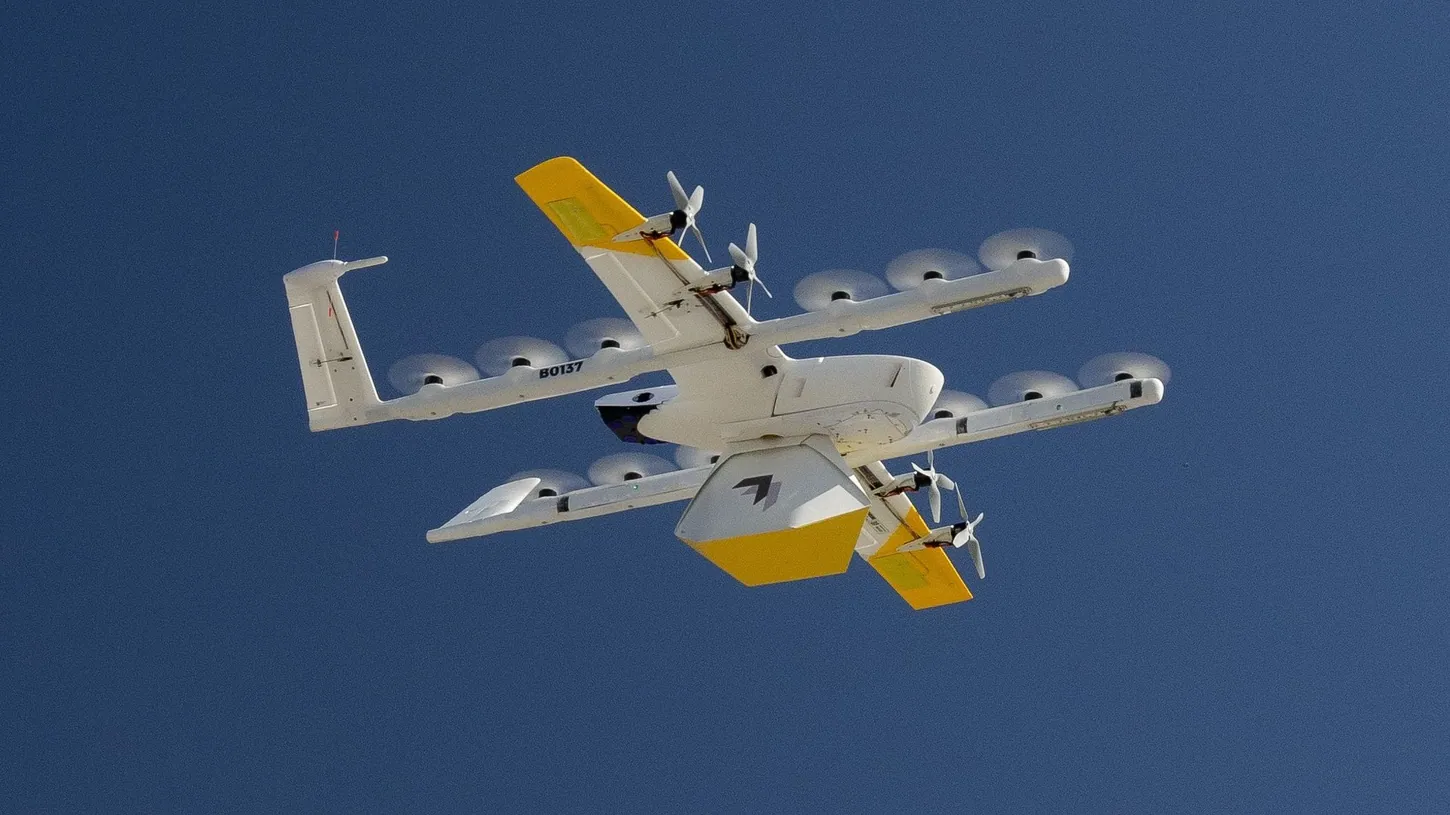
The Federal Aviation Administration (FAA) says helicopter operators should expect few changes to their day-to-day airspace procedures over the next 12 to 24 months, even as drone delivery spreads and the first piloted air taxis get close to service. The agency gave that answer to Vertical magazine for a story published November 25.
Drone operators will keep flying under today’s rules and authorizations in the near term, the FAA said, and early electric air taxi flights will use existing helicopter routes and procedures. Today’s small-drone rule, Part 107, makes the drone yield to every crewed aircraft.
The final Part 108 rule could reverse that for some helicopters. It has been under White House review since July 10, and its final text is not public.
Wing Yields To Every Helicopter It Can Detect
Wing told Vertical its delivery drones take full responsibility for staying clear of crewed aircraft. The company tracks nearby helicopters in part through their ADS-B position broadcasts. Vertical reported that Wing did not specify how it would detect, in real time, a helicopter that is not broadcasting.
“Wing accepts 100% of the maneuvering responsibility,” Dallas Brooks, Wing’s U.S. aviation standards and stakeholder outreach lead, wrote in response to Vertical’s questions. The magazine had asked what happens when an air ambulance or police helicopter enters an active delivery area without notice. Brooks said a Wing drone that detects a helicopter within a few miles tracks it and predicts how close it will pass. If that is inside a preset margin, the drone changes speed and altitude.
Wing flies mostly inside Mode C veils, the rings of 30 nautical miles (35 miles or 56 kilometers) around the busiest airports where most aircraft must carry ADS-B Out. For helicopters that are not broadcasting, Brooks pointed to outreach with local operators and changes to Wing’s own flights. Wing also limits flights near airports and heliports and sometimes pauses deliveries for crewed traffic.
The FAA told Vertical that drone traffic management services can give priority to air ambulance, search-and-rescue, police and firefighting flights. Vertical reported that the agency gave few details on how that works when a helicopter shows up unannounced.
Proposed Part 108 Would Make Some Non-Broadcasting Helicopters Yield
Proposed section 108.195 requires a drone flying beyond visual line of sight (BVLOS) outside a shielded area to yield to aircraft using an airport or heliport, and to aircraft broadcasting ADS-B Out or an approved 978 MHz signal. Other crewed aircraft would have to give way.
The August 2025 proposal has exceptions. Crewed aircraft keep priority in Class B and Class C airspace and over the most densely populated areas, and in those places the drone has to detect and avoid aircraft that are not broadcasting. Everywhere else the proposal requires no such detection. The right-of-way question drew more than half of the roughly 3,100 comments, and the FAA reopened the docket in January to ask again about ADS-B Out, electronic conspicuity and detect-and-avoid. That window closed February 11, and the OIRA review list shows the final rule arrived at the White House on July 10.
The FAA also told Vertical it plans to publish final design standards for vertical flight facilities in 2027, replacing its separate heliport and vertiport guidance. Comments on the draft are due January 11, 2027. In its response to Vertical, the agency did not say what existing heliports would have to change for air taxis.
DroneXL’s Take
Wing’s promise and the FAA’s proposal have the same hole in them. Both work when the helicopter is broadcasting. Outside the busiest airspace and the densest neighborhoods, the proposal would not make the drone look for one that isn’t. In January a surveying drone over a hospital helipad in Lehi, Utah, held up a LifeFlight helicopter that was waiting to move a critically ill child.
I’m for routine BVLOS and I want Part 108 signed. I don’t want it signed with a clause that hands a drone priority over an aircraft it has no means of seeing. The National Business Aviation Association asked for universal electronic conspicuity instead, and that’s the better fix. If you fly a helicopter without ADS-B Out near a delivery area, I wouldn’t wait for the final rule to equip.
Sources: Vertical, Federal Register, Part 108 proposed rule, OIRA review list
DroneXL uses automated tools to support research and source retrieval. All reporting and editorial perspectives are by Haye Kesteloo. Read our editorial standards.
Advertise with DroneXLYour company hereReach 200,000+ drone readers a month with a sponsored article, a banner on your beat, or a partnership.See the options →


