

An Idaho paramotor pilot told a Boise television station that an Amazon Prime Air delivery drone passed over the top of his wing while he was about 30 feet (9 meters) off the ground and about to land. Mike Cunningham, a former commercial pilot, described the encounter in an Idaho News 6 report on Amazon’s drones in Canyon County, published November 18. Amazon told the station its drones can detect and avoid other aircraft on their own, including paragliders that carry no transponder. The report gives no date or place for the encounter and no distance between the drone and the wing.
Amazon has flown MK30 drones from its Nampa fulfillment center since October 30. The city’s permit findings, which DroneXL read in full this week, describe an Amazon no-fly zone around Nampa Municipal Airport and a detect-and-avoid system for aircraft, helicopters and hot air balloons. The decision letter and findings don’t mention paragliders or ultralights. Amazon’s current FAA exemption does. It tells Amazon to avoid known ultralight areas, and it requires a report to the FAA within 24 hours when a drone comes within 100 feet (30 meters) vertically and 500 feet (152 meters) horizontally of a manned aircraft.
The Pilot Says the Drone Crossed Over Him on Short Final
Cunningham told Idaho News 6 reporter Keith Burrell that he was on short final, about 30 feet up, when the drone “went right over the top of my paramotor wing.” He said a drone hitting the wing would put a pilot into a spin he could not recover from.
The Idaho News 6 report does not say how high the 83-pound (38-kilogram) drone was, or how Cunningham identified it as Amazon’s. Nampa’s findings describe a 200-foot (61-meter) minimum on the way to a customer, and a descent to 12 or 13 feet (about 4 meters) only at the delivery point. A drone at that 200-foot minimum would have crossed about 170 feet (52 meters) above a pilot who was 30 feet up, and a drone coming down for a delivery would have been much closer. The report doesn’t say which it was, and it doesn’t say whether Cunningham reported the encounter to Amazon or the FAA. Amazon also told the station it works with local aviation groups to identify busy airspace. DroneXL has not interviewed Cunningham and did not ask Amazon about the flight.
A paramotor is a powered paraglider. A single-seat one typically flies as an ultralight under 14 CFR Part 103, which requires no registration and no pilot certificate, so it has no tail number for Amazon to collect. The same part says an ultralight pilot must yield the right-of-way to all aircraft.
Amazon’s exemption puts duties on the drone as well. The FAA reissued it as Exemption No. 18601F in September, and it runs to August 31, 2028. Condition 46 requires Amazon to keep its drones clear of any manned aircraft. Condition 18 says the drone must avoid known areas with increased aviation activity, and it gives ultralight areas as an example. Condition 14 covers a close encounter, which the exemption defines as a manned aircraft less than 100 feet above or below the drone and within 500 feet of it horizontally. Amazon must report one to the FAA’s Flight Standards office within 24 hours, with the closest point of approach, the location and any avoidance maneuver. DroneXL does not know whether the FAA counts an ultralight as a manned aircraft under those conditions, whether Cunningham’s landing field is a known ultralight area, or whether Amazon filed a report.
Amazon Collected Tail Numbers From Caldwell’s Skydiving Operator
Jordon Basurto owns Skydive Skydown at Caldwell’s airport. He told Idaho News 6 that Amazon contacted him before it began flying in the area. Amazon took his planes’ tail numbers, he said, so its drones could track the jump flights and stay miles from the airport and its drop zones.
“It made me feel great that the communication was there,” Basurto said. The permit findings say Amazon’s system receives the ADS-B position signals that other aircraft broadcast and uses them to keep its drones clear. They also say the MK30 does not transmit ADS-B Out and carries a Remote ID transmitter. My read is that a tail number lets Amazon match a jump plane to its ADS-B track, though neither Basurto nor Amazon said so.
Skydive Skydown’s address is on Aviation Way at Caldwell Executive Airport. DroneXL measured about 7.3 miles (11.7 kilometers) from the Amazon hub’s street address to the airport’s published coordinates, which puts it just inside the 7.5-mile (12-kilometer) delivery radius. Nampa’s findings name no Amazon no-fly zone at Caldwell. Basurto’s account is that the drones stay miles from it anyway.
Greg Ashton, who runs Treasure Valley Balloon Rides, took his concerns to Idaho News 6, which reported on November 9 that he moved his launch site after the drones started, has been in contact with Amazon and plans to sit down with the company and the FAA. In Jacksonville, Florida, Amazon showed its drone map at an airport meeting in September, and a pilot there wrote that pilots would not see the drones in ForeFlight.
Amazon’s No-Fly Zone Reaches 1 Nautical Mile From the Runway’s Sides
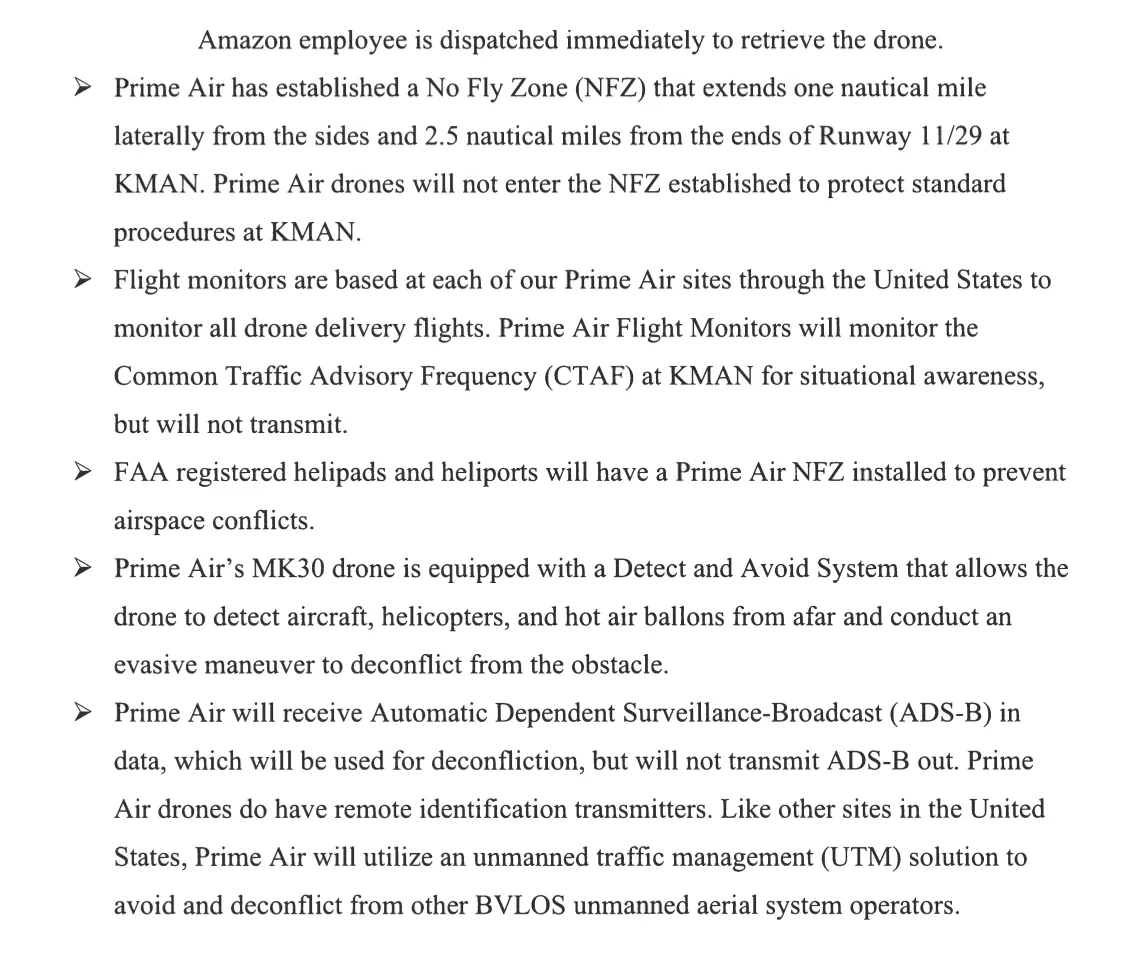
The findings say Prime Air set up a no-fly zone that reaches 1 nautical mile (1.15 miles) out from each side of Runway 11/29 at Nampa Municipal Airport and 2.5 nautical miles (2.9 miles) past each end. Prime Air drones will not enter it, the findings say.
Idaho News 6 reported the same dimensions from documents filed with the city. The runway is 5,000 feet (1,524 meters) long, so the zone is a box about 2.3 miles wide and 6.7 miles long (3.7 by 10.8 kilometers). It covers roughly 15 of the delivery area’s 170 square miles. By DroneXL’s measurement the hub’s street address is about 2 miles (3.2 kilometers) from the runway, a little under a mile outside the zone. That is inside the 3 nautical miles (3.5 miles) at which the FAA exemption bars flights near a public-use runway unless Amazon has mitigations in a collision avoidance plan, which the exemption says should include outreach to the airport.
The findings add that Amazon’s flight monitors listen to the airport’s common traffic frequency and do not transmit on it. FAA-registered helipads and heliports get no-fly zones of their own. Direct coordination “is requested” when flight training or agricultural aircraft fly below 400 feet (122 meters). All of this sits in the findings of fact, and the permit’s five conditions do not repeat it. The Nampa Airport Commission had recommended against approval until Amazon documented how it would handle airspace coordination. Amazon’s Sam Bailey told the Planning and Zoning Commission that the company had answered the letter in writing. The commission called the airport’s concerns valid and concluded that safety measures were in place.
Amazon Told the FAA 7 Meters Is Enough Room Around Crewed Aircraft
Amazon filed its comment on the FAA’s proposed Part 108 rule for beyond-visual-line-of-sight flights on October 6, 2025. It recommends that any required safe distance between a drone and a crewed aircraft, balloons excepted, be no larger than 7 meters (23 feet). Amazon calls that sufficient for safe operations.
The 7 meters is a ceiling Amazon proposed for a definition in the rule. In the same passage of the 80-page comment, Amazon asks the FAA to let operators set safe distances by proving what their aircraft can do. The comment also asks the FAA to require every crewed aircraft below 500 feet (152 meters) to broadcast its position. Amazon wrote that drones should not carry the whole burden of detecting aircraft that are not required to make themselves detectable. It lists places that host hot air balloons and paragliding among those where low-altitude traffic is heavy. DroneXL covered the comment’s weight and noise requests when it counted Amazon’s 52 quarters of drone lobbying.
The comment describes one encounter. On May 8, 2025, it says, an MK30 came into close proximity with a balloon at about 200 feet (61 meters) near one of Amazon’s launch sites, and the drone’s onboard system detected the balloon and maneuvered away. That account is Amazon’s. The comment names no site beyond Class D airspace inside a Mode C veil, and it gives no distance. The MK30 collisions on DroneXL’s record involved a fixed object: two drones struck the same crane in Tolleson, Arizona, on October 1, 2025. A crane is not an aircraft, and no public record ties that accident to the system that tracks aircraft.
Idaho News 6 also reported that Amazon is still looking at changes to its Nampa flight paths after noise complaints. Amazon’s own data put 63 to 79 drones a day near some homes north of the hub. Pilots and residents can reach Amazon at 1-888-280-4331 or through its customer service chat, under “Something Else” and then “Amazon Drone Delivery.” DroneXL’s guide for residents covers the FAA route, and the Nampa hub’s record is on the Amazon Prime Air tracker.
DroneXL’s Take
Amazon’s coordination in Canyon County reaches the pilots it can find, and a paramotor pilot is hard to find. He takes off from a field with no tail number and no transponder, so in my view everything between him and an 83-pound MK30 comes down to the drone’s own sensors. Amazon says those sensors see a paraglider, and I have no evidence that they don’t. The only accounts I have read of the system avoiding an aircraft in service are Amazon’s, though. To me, 7 meters is far too little room around a fabric wing with a person hanging under it, and the MK30 carries no parachute if the two touch. I’d rather see these aircraft fly medicine than shopping orders, because the cargo should be worth the risk to the other people in that airspace. Amazon gave Nampa flight data for individual addresses this month, so I’d expect it to be able to find this flight once it has a date from Cunningham. If the drone came inside 100 feet, the exemption required a report to the FAA within a day, and Amazon should say whether it filed one.
Sources: Idaho News 6, City of Nampa Reasoned Statement, CUP-00407-2026 (May 26, 2026), Amazon Prime Air comment, FAA Docket FAA-2025-1908, FAA Exemption No. 18601F, 14 CFR Part 103
DroneXL uses automated tools to support research and source retrieval. All reporting and editorial perspectives are by Haye Kesteloo. Read our editorial standards.
Advertise with DroneXLYour company hereReach 200,000+ drone readers a month with a sponsored article, a banner on your beat, or a partnership.See the options →


