AAIB’s “Record-Only” Kent Police Drone Crash Investigation Raises Troubling Questions About UK Police Drone Oversight

Check out the Best Deals on Amazon for DJI Drones today!
I’ve spent the morning going through the Air Accident Investigation Branch’s newly released findings on the Kent Police drone crash that injured a child last August, and I’m genuinely troubled by what I’m reading. While the headlines are focused on the basic finding that the officer “didn’t spot” an overhead cable during a “rapid deployment,” the real story here is what the AAIB chose not to investigate and what that tells us about the state of police drone oversight in the UK.
The AAIB has concluded its investigation into the August 2nd, 2025 incident where a Kent Police DJI Matrice 30T struck an overhead cable in Sheerness and crashed into a child, causing serious hand injuries that required treatment at a London hospital. The finding is straightforward: the cable hazard was not identified during rapid deployment. But the investigation itself was anything but thorough. You can read the full BBC report here.
Why a “Record-Only” Investigation for a First-of-its-Kind Incident?
Here’s what bothers me most: the AAIB conducted what they call a “record-only” investigation, based “wholly, or largely” on information provided by the drone’s pilot. Think about that for a moment. A child was seriously injured. This is the first time in UK history that a civilian has been hurt by a police drone. And the aviation safety authority essentially took the pilot’s word for what happened.
The AAIB spokesperson explained their reasoning: “Having reviewed the circumstances and available evidence, we concluded that a full investigation was unlikely to yield new safety findings that would benefit wider aviation safety.”
They added a telling caveat: while details could be obtained from other sources, “the information provided cannot be assured.”
Let me translate that: the AAIB knows there might be more to this story, but they’ve decided not to dig deeper. For a precedent-setting incident that injured a member of the public, that’s a remarkable decision.
The Pattern That Nobody Wants to Talk About
This isn’t the first time DroneXL has written about Kent Police drone operations. Back in 2023, the same department crashed a DJI Mavic 2 Enterprise. Two crashes from the same police force should have warranted closer scrutiny. Instead, we’re getting the investigative equivalent of a shrug.
And the problems run deeper than Kent. In December, sUAS News reported that the National Police Chiefs’ Council admitted that safety records for police drones are scattered across “personal drives” with no single repository. The AAIB revealed that since January 2023, they’ve received 10 notifications involving police-operated Unmanned Aircraft Systems, leading to six safety investigations.
Meanwhile, the Independent Office for Police Conduct has served a misconduct notice on a special inspector involved in the flight. The IOPC has confirmed this is the first time they’ve ever investigated a civilian being injured by a police drone. That investigation remains ongoing, while the AAIB has effectively closed their file.
The “Rapid Deployment” Problem
The phrase “rapid deployment” keeps appearing in reports about this incident, and it deserves scrutiny. Police were responding to an alleged assault in Sheerness around 4 PM on August 2nd. They launched the DJI M30T to search for a suspect. The drone struck an overhead cable in Strode Crescent, fell, and injured a child.
Eyewitness Danny Ashton-Keenan told the BBC he heard a commotion and went outside to find the street closed off by police and ambulances:
“There was an open, empty drone storage box on the pavement on one side of the street. The crashed drone was on the other side with paramedics treating somebody.”
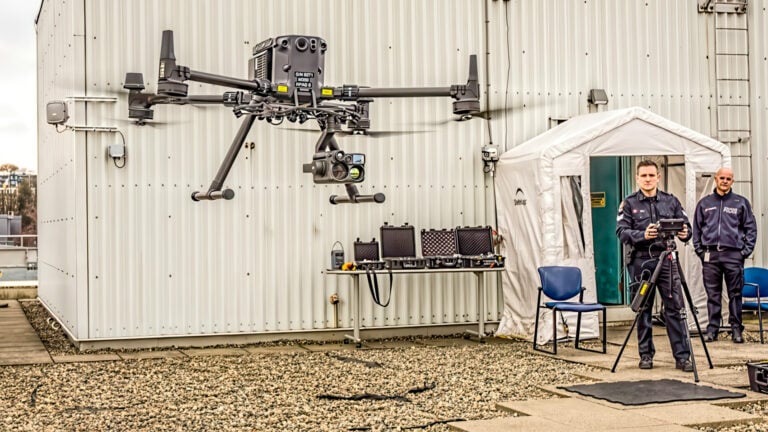
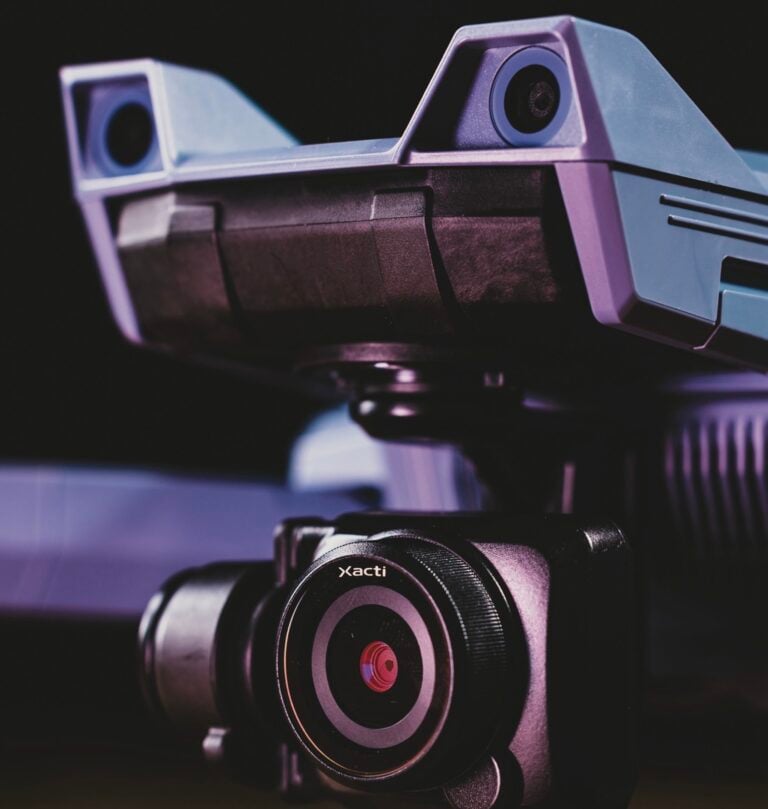
For those unfamiliar with the DJI Matrice 30T, this is not a consumer drone. It’s a 4kg (9lb) enterprise platform equipped with thermal imaging, wide-angle, and 200x zoom cameras. We’ve covered this drone extensively because it’s become the workhorse of search and rescue operations and police departments worldwide. When a 4kg drone drops from the sky, it carries significant kinetic energy. A strike to the hand is serious; a hit to the head or neck could have been far worse.

The central question nobody seems to be asking: does “rapid deployment” justify skipping a proper hazard assessment? Power lines are among the most basic obstacles any drone pilot learns to identify. They’re in every checklist. They’re drilled into training. If a trained police operator launched without identifying an overhead cable in a residential street, that suggests either inadequate training, inadequate pre-flight procedures, or pressure to deploy quickly that overrode safety protocols.
DroneXL’s Take on Drone Crash
I’ve been covering drone incidents for nearly a decade, and this case should have been a watershed moment for UK police drone operations. Instead, we’re watching regulatory bodies treat it as a minor footnote.
The AAIB’s decision to conduct only a “record-only” investigation for the first civilian drone injury in UK police history is, frankly, inadequate. This incident had all the hallmarks of a case that could yield meaningful safety findings: an enterprise-grade drone, a trained law enforcement operator, a built-up residential area, an injured child, and a failure to identify a basic overhead hazard. If that doesn’t warrant a full investigation, what does?
My prediction: this won’t be the last time a UK police drone injures someone. The NPCC’s admission that safety records are scattered across personal drives, combined with the rapid expansion of drone-as-first-responder programs across the country, creates conditions where similar incidents are likely. Between October 2024 and March 2025, UK police drones were deployed over 26,000 times. The question isn’t if another incident will happen, but when.
What troubles me most is the precedent being set. If the first civilian drone injury gets a “record-only” investigation, what message does that send to the hundreds of police departments now integrating drones into their operations? That rapid deployment trumps risk assessment? That injuring a child is an acceptable cost of faster response times?
I genuinely believe in the value of police drones. We’ve documented countless cases where thermal-equipped drones like the M30T have saved lives. But those saves only matter if we maintain public trust, and public trust requires rigorous safety standards and transparent accountability when things go wrong.
Kent Police says they cannot comment due to the ongoing IOPC inquiry. Fair enough. But the AAIB had no such restriction, and they chose the path of least investigation. That’s a choice the entire UK drone industry may come to regret.
What do you think? Should a first-of-its-kind drone crash or drone incident warrant more than a “record-only” investigation? Share your thoughts in the comments.
Editorial Note: This article was researched and drafted with the assistance of AI to ensure technical accuracy and archive retrieval. All insights, industry analysis, and “Deltas” were provided exclusively by Haye Kesteloo and our authors, editors, and Youtube partners to ensure the “Human-First” perspective our readers expect.
Discover more from DroneXL.co
Subscribe to get the latest posts sent to your email.
Check out our Classic Line of T-Shirts, Polos, Hoodies and more in our new store today!

MAKE YOUR VOICE HEARD
Proposed legislation threatens your ability to use drones for fun, work, and safety. The Drone Advocacy Alliance is fighting to ensure your voice is heard in these critical policy discussions.Join us and tell your elected officials to protect your right to fly.

Get your Part 107 Certificate
Pass the Part 107 test and take to the skies with the Pilot Institute. We have helped thousands of people become airplane and commercial drone pilots. Our courses are designed by industry experts to help you pass FAA tests and achieve your dreams.

Copyright © DroneXL.co 2026. All rights reserved. The content, images, and intellectual property on this website are protected by copyright law. Reproduction or distribution of any material without prior written permission from DroneXL.co is strictly prohibited. For permissions and inquiries, please contact us first. DroneXL.co is a proud partner of the Drone Advocacy Alliance. Be sure to check out DroneXL's sister site, EVXL.co, for all the latest news on electric vehicles.
FTC: DroneXL.co is an Amazon Associate and uses affiliate links that can generate income from qualifying purchases. We do not sell, share, rent out, or spam your email.