Amusement Parks Win Counter-Drone Authority. The FAA’s Section 2209 Fight Is Just Starting.

Check out the Best Deals on Amazon for DJI Drones today!
The amusement park industry now has a federal law on its side. The Safer Skies Act — embedded as Sections 8601-8607 of the FY 2026 National Defense Authorization Act — has been signed into law, and the International Association of Amusement Parks and Attractions (IAAPA) is noting what this means specifically for fixed-site attractions.
The law grants state and local law enforcement new authority to detect and mitigate unauthorized drone activity at covered venues, including amusement parks. But IAAPA’s Public Affairs team is already looking past this first step toward the bigger fight: the FAA’s upcoming rulemaking under Section 2209, which will determine whether parks can permanently restrict their airspace.
- The Development: The Safer Skies Act is now law, allowing trained state and local police to partner with fixed-site amusement parks to detect and mitigate unauthorized drone flights that threaten guest safety or disrupt operations.
- The “So What?”: For Part 107 pilots, this means flying near a major theme park — even for otherwise legal commercial work — now carries real legal exposure if local law enforcement deems the flight a credible threat.
- Step Two: The FAA’s Section 2209 rulemaking will decide whether parks can petition for permanent airspace designations, which would make restrictions automatic rather than dependent on law enforcement judgment calls.
- The Source: Amusement Today has the details from IAAPA’s Public Affairs team.
The Safer Skies Act Extends Counter-Drone Authority to Amusement Parks
The Safer Skies Act, now codified in law through the NDAA 2026, authorizes trained state, local, tribal, and territorial law enforcement agencies to detect, track, and in some cases disable drones posing a credible threat at designated covered venues — with amusement parks now explicitly included as fixed-site beneficiaries of this framework alongside stadiums and critical infrastructure.
The law does not give parks carte blanche. Officers must complete federal training and certification before exercising these powers, use only equipment on a federally approved technology list, and operate under DOJ, DHS, and FAA oversight. Every mitigation action requires mandatory reporting. When we covered the NDAA 2026 in December, we noted that the national training and certification program still had to be built out before any of this authority became operational. As of this writing, no public announcement of that program’s launch has been made.
For IAAPA, the law is a win, but a partial one. Counter-drone authority that depends on trained officers being present and responding in real time is useful. Permanent, automatic airspace restrictions are better. That requires the FAA.
Section 2209 Rulemaking Is Where Permanent Protections Get Decided
Section 2209 of the 2016 FAA Extension Act directed the FAA to create a process for restricting drone flights near sensitive facilities. The Trump Administration moved this rule forward in May 2025 alongside the BVLOS rulemaking, but a proposed rule has not yet been published. Once it is, IAAPA plans to submit formal comments.
The association’s position on how the FAA should structure this rule is worth paying attention to. IAAPA is pushing back against attendance thresholds as the primary qualifying criterion — the idea that a venue must hit some minimum crowd size to earn airspace protection. Instead, they want the FAA to weigh factors like:
- Permanence of operations
- Public access and outdoor crowd density
- Operational hazards specific to the venue
- Clearly defined property boundaries
They also want safety buffers that extend to adjacent resort properties, and permanent designations for qualifying venues rather than case-by-case or time-limited approvals. The attendance threshold argument is a real one. A mid-sized regional theme park with roller coasters, fireworks, and thousands of guests on any summer Saturday is a more compelling case for airspace protection than some large but enclosed indoor arena. Headcount alone misses the physical risk picture.
The Trump Administration advanced both the BVLOS and Section 2209 rules to the White House for review in May 2025. The Section 2209 proposed rule is still pending publication. When it drops, IAAPA will not be the only organization filing comments — expect drone industry groups, civil liberties organizations, and commercial operators to weigh in heavily.
Parks Need to Keep Flying Their Own Drones
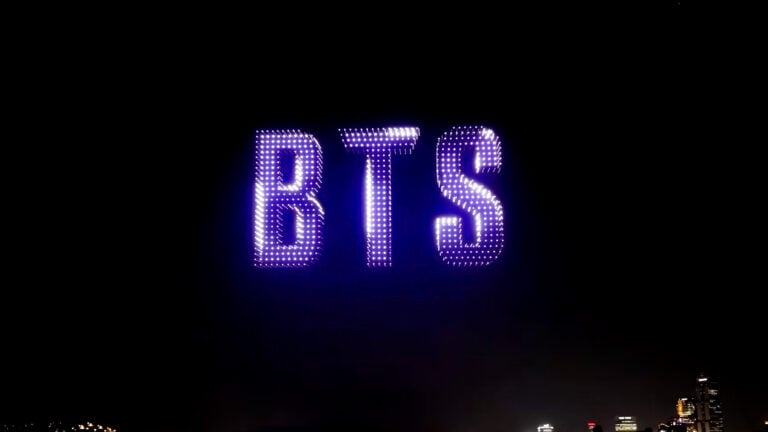
One of IAAPA’s clearest asks is that the FAA’s Section 2209 framework explicitly preserve authorized drone operations by the parks themselves. IAAPA’s concern is that if the airspace restriction language is written broadly enough, it could inadvertently ground a park’s own authorized fleet — the drones used for drone light shows, pyrotechnic coordination, media production, and security monitoring. A rule designed to protect venues shouldn’t create new operational problems for them.
Disney is the obvious example here. Disney is currently deploying some of its most ambitious drone light shows at Disneyland Paris, with drones that float, skim the water, and launch into the sky from the lake surface. Disney World has had drone show programming under development as well. Permanent airspace designations that block unauthorized flights but carve out clearly authorized park operations are the goal. Getting that language right in the rulemaking is what IAAPA’s comment submission will be focused on.
The Broader Context: Stadium Drone Incursions Drove This Legislation
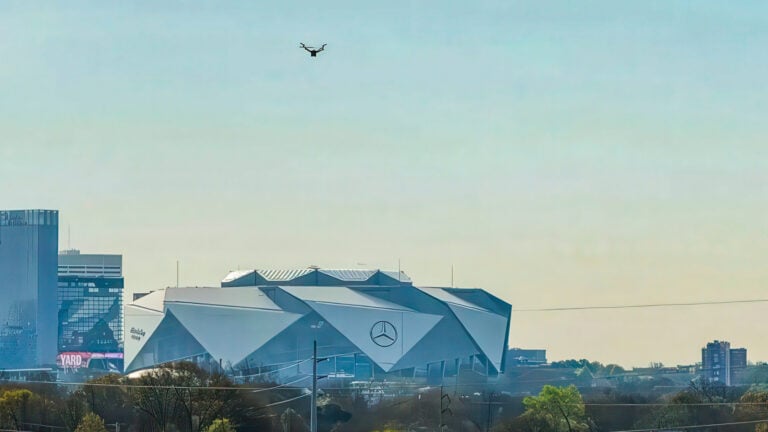
The Safer Skies Act did not come out of nowhere. The NFL reported 2,845 unauthorized drone incursions over stadiums in 2023 alone, and the pressure of hosting the 2026 FIFA World Cup across 11 U.S. cities accelerated the timeline. Senator Tom Cotton warned in late 2025 that U.S. drone defense was in a “severe and growing” crisis, with unauthorized flights over military bases and crowded venues stacking up faster than existing law could address.
Separately, Representative Eric Burlison introduced H.R. 7525 in February 2026 to make the SLTT counter-drone authority permanent, signaling that the Safer Skies Act’s provisions — currently tied to the NDAA framework — may still need additional legislative reinforcement to survive future authorization cycles.
DroneXL’s Take
I’ll be direct about what’s happening here. The Safer Skies Act is the easier half of this problem. Getting trained officers to respond to a drone over a theme park is a workable solution for acute incidents — someone flying a consumer drone over a crowded park because they think it’ll get good footage. The harder question is what happens to the commercial operator who has a legitimate reason to fly near a park boundary for a real estate shoot, infrastructure inspection, or media job, and ends up on the wrong side of a judgment call by an officer who just completed a certification course.
The Section 2209 rulemaking is where the long-term shape of this gets decided. IAAPA’s push for risk-based criteria over attendance thresholds is sensible, and their argument for permanent designations over case-by-case approvals is even more so. But “permanent airspace designation” is a phrase that should make every commercial pilot pay attention. These designations tend to expand in practice even when the written scope is narrow. Washington D.C.’s Special Flight Rules Area is the clearest example: what started as a security buffer around the Capitol and White House has grown in effective scope over two decades through administrative interpretation, not new legislation. Stadium TFRs tell the same story — they now routinely extend hours before and after games in ways the original rules didn’t specify.
Watch for the FAA’s proposed rule. When it publishes, the comment period will be one of the more consequential public input windows for drone operators in recent years. The park industry will be organized and ready to file. Commercial operators and Part 107 pilots should be too. Expect the proposed rule to drop before the end of 2026 — and expect the fight over the criteria to be sharp.
Editorial Note: AI tools were used to assist with research and archive retrieval for this article. All reporting, analysis, and editorial perspectives are by Haye Kesteloo.
Discover more from DroneXL.co
Subscribe to get the latest posts sent to your email.
Check out our Classic Line of T-Shirts, Polos, Hoodies and more in our new store today!

MAKE YOUR VOICE HEARD
Proposed legislation threatens your ability to use drones for fun, work, and safety. The Drone Advocacy Alliance is fighting to ensure your voice is heard in these critical policy discussions.Join us and tell your elected officials to protect your right to fly.

Get your Part 107 Certificate
Pass the Part 107 test and take to the skies with the Pilot Institute. We have helped thousands of people become airplane and commercial drone pilots. Our courses are designed by industry experts to help you pass FAA tests and achieve your dreams.

Copyright © DroneXL.co 2026. All rights reserved. The content, images, and intellectual property on this website are protected by copyright law. Reproduction or distribution of any material without prior written permission from DroneXL.co is strictly prohibited. For permissions and inquiries, please contact us first. DroneXL.co is a proud partner of the Drone Advocacy Alliance. Be sure to check out DroneXL's sister site, EVXL.co, for all the latest news on electric vehicles.
FTC: DroneXL.co is an Amazon Associate and uses affiliate links that can generate income from qualifying purchases. We do not sell, share, rent out, or spam your email.