Ukraine Hits China-Free Drone Milestone — But Mass Production at That Standard Is Years Away

Check out the Best Deals on Amazon for DJI Drones today!
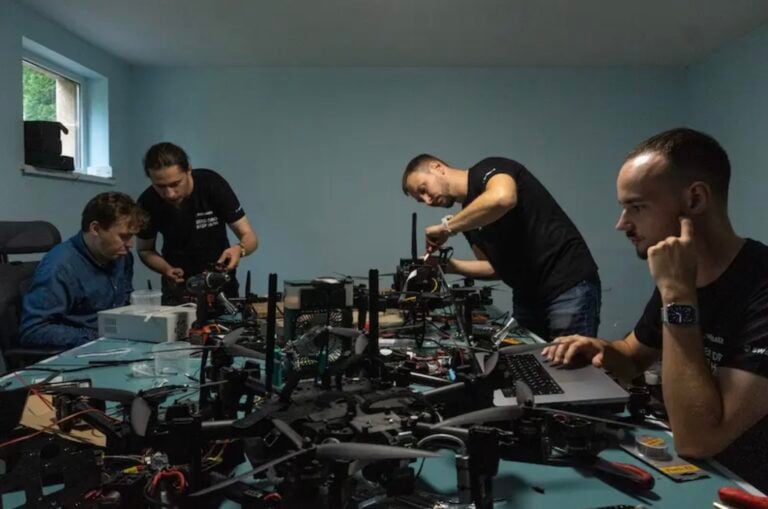
Back in July 2025, Ukrainian officials told us independence from Chinese drone components was “one or two quarters away.” The New York Times is reporting today that Ukraine has hit that target. In a basement workshop somewhere in Ukraine, dozens of workers in headlamps are soldering circuit boards that a year ago the country couldn’t make domestically. That detail alone tells you how fast this industry has moved.
Here’s what happened and what it actually means:
- The Development: Ukraine can now produce drones with zero components imported from China, according to a New York Times report by Maria Varenikova published March 11, 2026. Circuit boards — previously a critical foreign-sourced ingredient in small strike drones — are now manufactured domestically.
- The Battlefield Context: Major Robert “Magyar” Brovdi, commander of Ukraine’s Unmanned Systems Forces, told the Times that drones account for more than 90 percent of Russian battlefield losses. Independent estimates put the figure lower — typically one-third to one-half — though in some engagements the 90% threshold has been reached.
- The Caveat: Mass production of China-free drones isn’t coming soon, because Chinese components remain significantly cheaper. Ukrainian officials acknowledge that many parts made outside China still contain Chinese-sourced materials or raw materials further up the supply chain.
- The Strategic Goal: Kyiv wants to reduce Chinese components as much as possible and preserve the ability to keep producing drones if Chinese supplies are cut off entirely.
Ukraine’s Circuit Board Breakthrough — and the Company Behind It
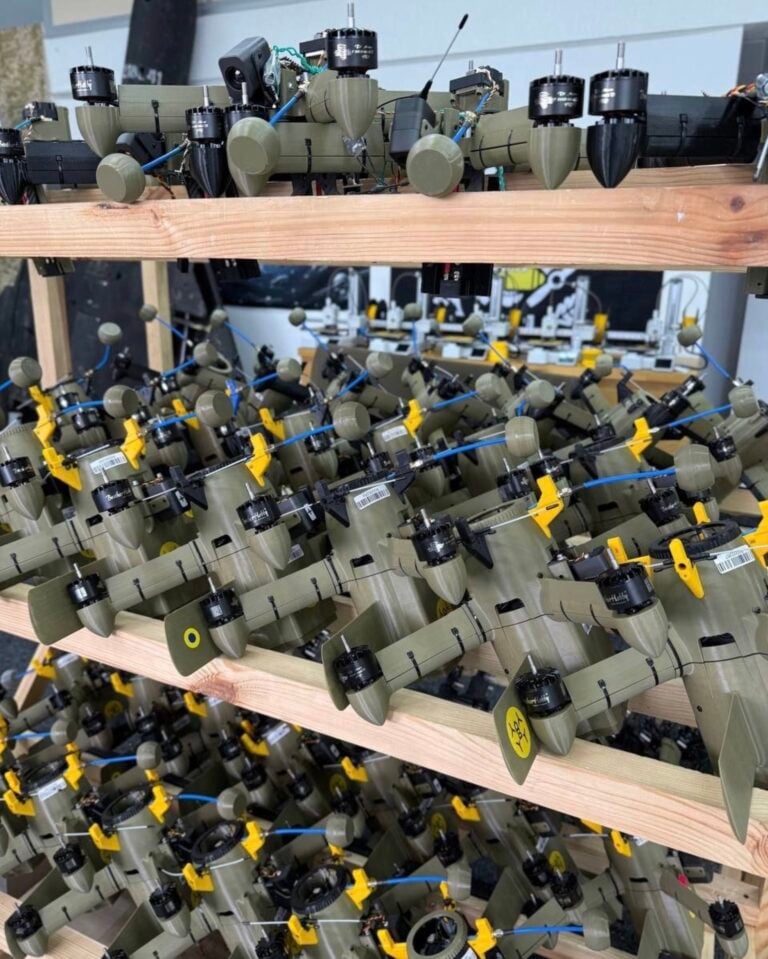
The Times names F-Drones (Ukrainian Defense Drones Tech Corporation) as a central example. The company started in 2023 with an entirely Chinese component supply chain. Within a year it had localized carbon frames and antennas. By 2025 it was manufacturing flight controllers, speed controllers, radio modems, and video transmission systems domestically. Cameras still come from a Ukrainian company sourcing components from Europe. That progression — from 100% Chinese to almost fully domestic in two years — is the concrete story behind the milestone headline.
Circuit boards had been one of the most stubborn foreign dependencies in Ukraine’s drone supply chain. Boards, motors, batteries, and propellers have all been targets of an accelerating domestic production push since late 2024 — and the F-Drones trajectory shows how quickly that push has moved.
We covered Vyriy’s milestone in April 2025, when the company first demonstrated FPV drones built from 100% Ukrainian-sourced components. That achievement was notable at the time, but it was one manufacturer. What the Times is describing now is a broader industrial reality: Ukraine as a country can close the loop.
The motor side of the equation has moved fast too. Motor-G now ships 200,000 drone motors per month, supplying 17% of Ukraine’s domestic market. Add the roughly 10% held by other Ukrainian manufacturers and you have about 27% of motor demand covered domestically. China still dominates the rest, but the direction is clear.
There’s an irony in that Motor-G story worth noting: the company got its initial production knowledge by paying Chinese manufacturers $10,000 for a technology transfer. Ukraine learned the playbook from the very supply chain it’s now trying to replace.
China’s Role as Supplier to Both Sides Accelerated This Outcome
Ukraine didn’t choose to pursue supply chain independence because it sounded strategically elegant. It was forced into it. In December 2024, China began restricting or halting shipments of essential drone components — motors, batteries, flight controllers — to U.S. and European companies. Chinese manufacturers control roughly 80% of global drone component production, according to the Center for Strategic and International Studies.
Meanwhile, China was shipping 328,000 miles of fiber-optic drone cable to Russia while cutting access to Ukraine and its supporters. NATO called China a “decisive enabler” of Russia’s war in July 2025. Beijing’s position has been consistent: it officially maintains export controls on military drones while exploiting dual-use loopholes for components.
The result was predictable. Ukraine faced a choice between accepting strategic vulnerability to a supplier openly tilting toward its enemy, or building domestic capacity at higher cost. It chose the latter. In January 2026, Defense Minister Fedorov announced Ukrainian troops would receive a domestically produced DJI Mavic replacement with comparable camera quality and extended flight range — a signal that the transition had moved from prototype to procurement reality.
The Honest Limits of “China-Free”
The Times is careful here, and so should we be. China’s dominance of global manufacturing is so deep that “China-free” is more a directional goal than a binary status. Raw materials, rare earth metals, and upstream manufacturing inputs often trace back to Chinese sources regardless of where the final component was assembled.
Ukraine is not going to mass-produce China-free drones at scale in the near term. The cost differential is too large. A Chinese motor costs around $70; the Ukrainian equivalent from Motor-G runs about $150. At 9,000 drone deployments per day, those cost gaps matter enormously at scale.
What Ukraine has demonstrated is something narrower but still significant: it can build a complete drone from domestically sourced components when it needs to. Call it supply chain insurance. If Beijing cuts off component exports entirely tomorrow, Ukrainian drone production would not stop.
DroneXL’s Take
I’ve been covering Ukraine’s component dependency problem since before most outlets treated it as a serious issue. The trajectory has been consistent: each time China tightened the screws, Ukraine moved faster on domestic alternatives. The circuit board achievement reported today is the capstone on a supply chain transformation that’s been building for over a year.
The strategic lesson extends well beyond Ukraine. The Netherlands’ €200 million joint production deal and similar NATO partnerships aren’t just about supporting Ukraine — they’re about Western nations getting access to battle-tested drone designs that don’t depend on Chinese supply chains. That’s the export product Ukraine is developing alongside its military capability.
My prediction: within six months, at least one NATO member will formally cite Ukraine’s China-free milestone as evidence supporting domestic drone component manufacturing requirements in defense procurement contracts. The policy language is already shifting. The hardware proof is now there.
Editorial Note: AI tools were used to assist with research and archive retrieval for this article. All reporting, analysis, and editorial perspectives are by Haye Kesteloo.
Discover more from DroneXL.co
Subscribe to get the latest posts sent to your email.
Check out our Classic Line of T-Shirts, Polos, Hoodies and more in our new store today!

MAKE YOUR VOICE HEARD
Proposed legislation threatens your ability to use drones for fun, work, and safety. The Drone Advocacy Alliance is fighting to ensure your voice is heard in these critical policy discussions.Join us and tell your elected officials to protect your right to fly.

Get your Part 107 Certificate
Pass the Part 107 test and take to the skies with the Pilot Institute. We have helped thousands of people become airplane and commercial drone pilots. Our courses are designed by industry experts to help you pass FAA tests and achieve your dreams.

Copyright © DroneXL.co 2026. All rights reserved. The content, images, and intellectual property on this website are protected by copyright law. Reproduction or distribution of any material without prior written permission from DroneXL.co is strictly prohibited. For permissions and inquiries, please contact us first. DroneXL.co is a proud partner of the Drone Advocacy Alliance. Be sure to check out DroneXL's sister site, EVXL.co, for all the latest news on electric vehicles.
FTC: DroneXL.co is an Amazon Associate and uses affiliate links that can generate income from qualifying purchases. We do not sell, share, rent out, or spam your email.