
Ukraine’s Interceptor Elite: Meet the 5 Drones Reshaping Global Air Defense

Check out the Best Deals on Amazon for DJI Drones today!
Ukraine produces at least five distinct interceptor drone models purpose-built to destroy Iranian-designed Shahed and Russian-produced Geran attack drones, and Gulf states are lining up to buy them, according to a detailed breakdown published March 19 by UNITED24 Media. These are 3D-printed, quadmotor UAVs that cost between $1,000 and $3,000 per unit. A single US-made Patriot missile runs $4 million. A Shahed costs an estimated $20,000–$50,000 to produce. The math explains why Jordan, the UAE, Saudi Arabia, Bahrain, and Qatar have all approached Kyiv directly. Speaking in London on March 17, President Volodymyr Zelenskyy said Ukraine currently manufactures 2,000 interceptors per day and can supply at least 1,000 daily to allies once domestic needs are covered.
Five Drones, Five Manufacturers, One Shared Mission
Ukraine’s interceptor sector is a competitive industry, not a single government program. Several companies ship combat-proven hardware at scale, each building a drone designed to launch fast, chase a moving aerial target, and destroy it on impact.
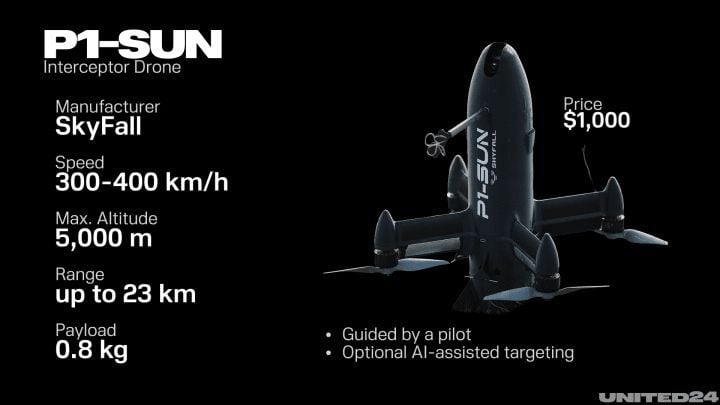
The P1-SUN, built by SkyFall, is the most widely covered. It takes off vertically, reaches a typical cruise speed of 300 km/h with a top estimate of 450 km/h, and operates up to 5 km in altitude. That speed advantage matters against the Shahed-136, which cruises at roughly 185 km/h. The jet-powered Shahed-238 is a different problem: at 550–600 km/h, the P1-SUN’s performance envelope gets tight. The drone costs around $1,000 to produce, carries a modular charge, and flies under pilot control with optional AI-assisted targeting. SkyFall says it can build up to 50,000 units per month and export 5,000–10,000 of those without cutting domestic supply, according to Reuters.
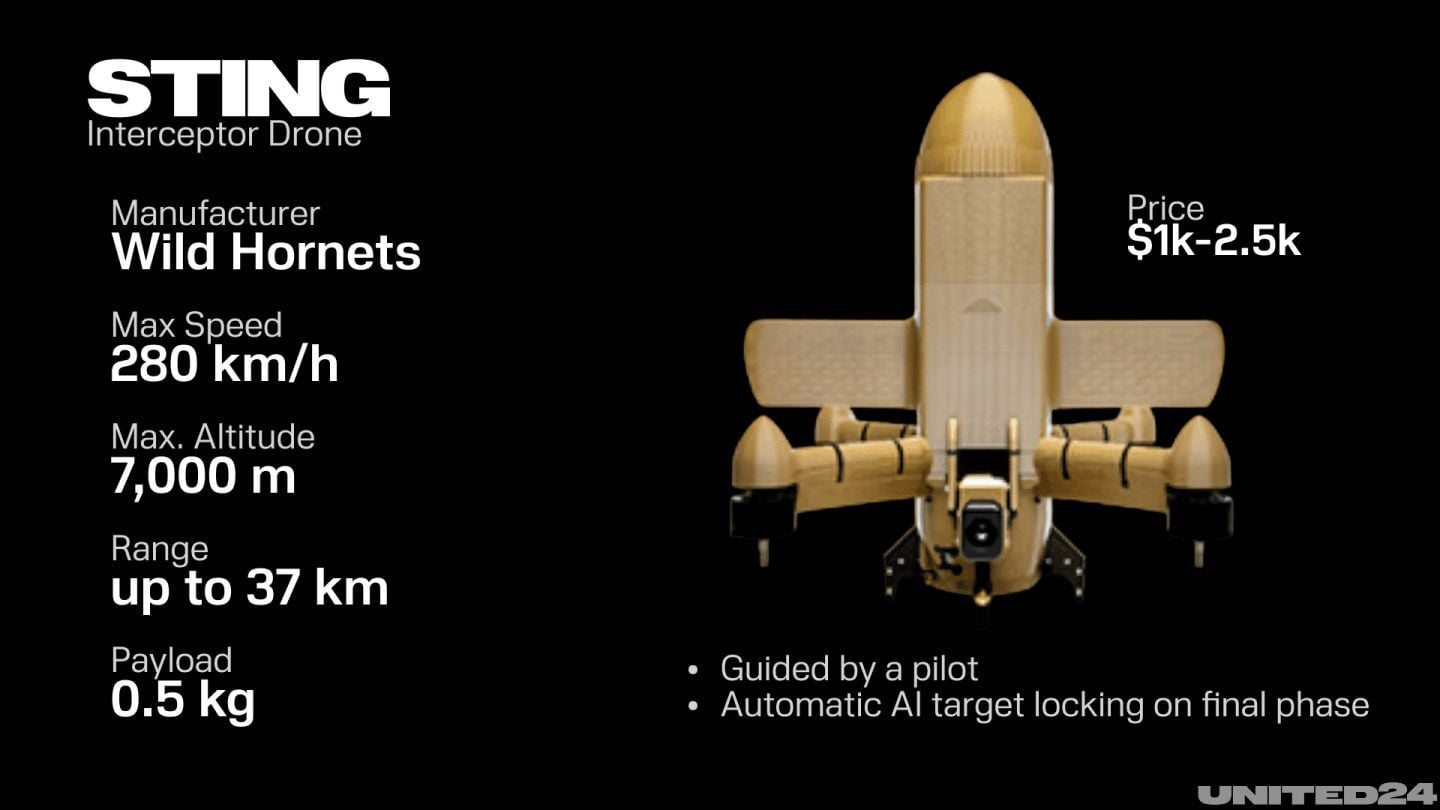
The STING, made by Wild Hornet, looks nearly identical to the P1-SUN: bullet-shaped, four high-thrust motors optimized for forward acceleration rather than hover. It has a proven speed of 280 km/h, a 37 km range, a 7 km altitude ceiling, and 15 minutes of endurance. A daylight camera and a thermal camera let it detect Shahed engine heat at night. It holds a 500-gram warhead, costs $1,000–$2,500, and Wild Hornet says it can ship 10,000 units or more per month. As we reported last week, the STING is the most wanted weapon in the Gulf right now, but Wild Hornet says exports only happen at the Ukrainian government’s call.
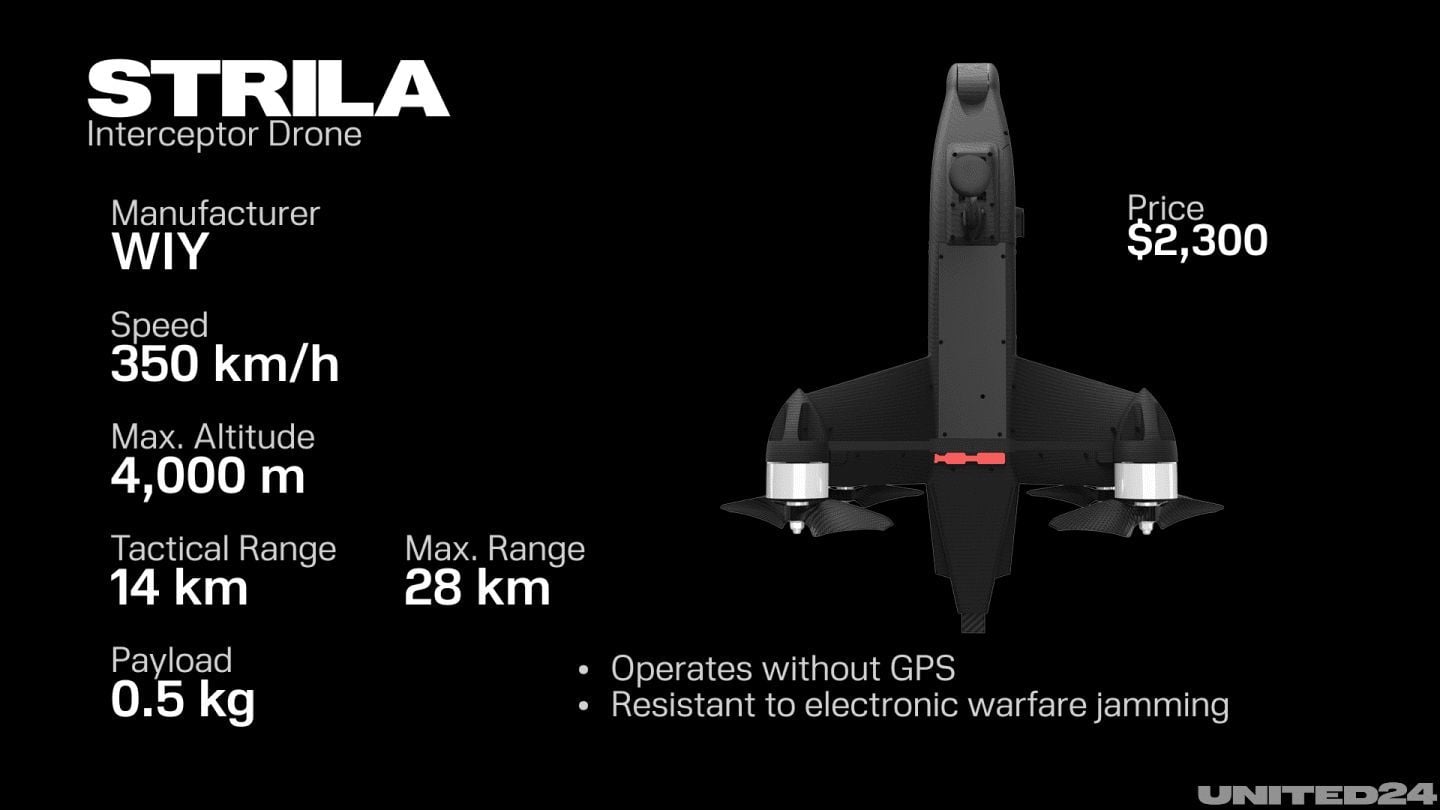
The STRILA, from WIY DRONES, is described by its maker as a “rocket-type air-defence” interceptor. It reaches over 350 km/h in operation and hit 400 km/h during testing. Range runs 14 km in tactical mode and 28 km at maximum. Altitude ceiling is 4 km. Its latest version drops GPS dependency entirely, adding a communication system that resists electronic warfare jamming and lets the operator switch channels mid-flight. WIY DRONES currently produces about 100 units per day under government contract and cut the unit price to roughly $2,300 in January 2026. At 350 km/h, the STRILA, like the STING and Octopus, cannot catch the jet-powered Shahed-238 at all.
The Zerov-8, from The Fourth Law, takes a different design approach. It launches vertically and transitions to horizontal flight mid-air, resembling a small quadrotor aircraft in cruise mode. That gives it a 20 km operational radius and a maximum speed of 326 km/h, slower than the P1-SUN or STING but more efficient over distance. According to the company, its AI-based detection module identifies and tracks Shaheds autonomously, handing off terminal guidance without pilot input. The Zerov-8 carries a 0.5 kg warhead and thermal cameras. The company has not disclosed pricing because the system is still experimental.
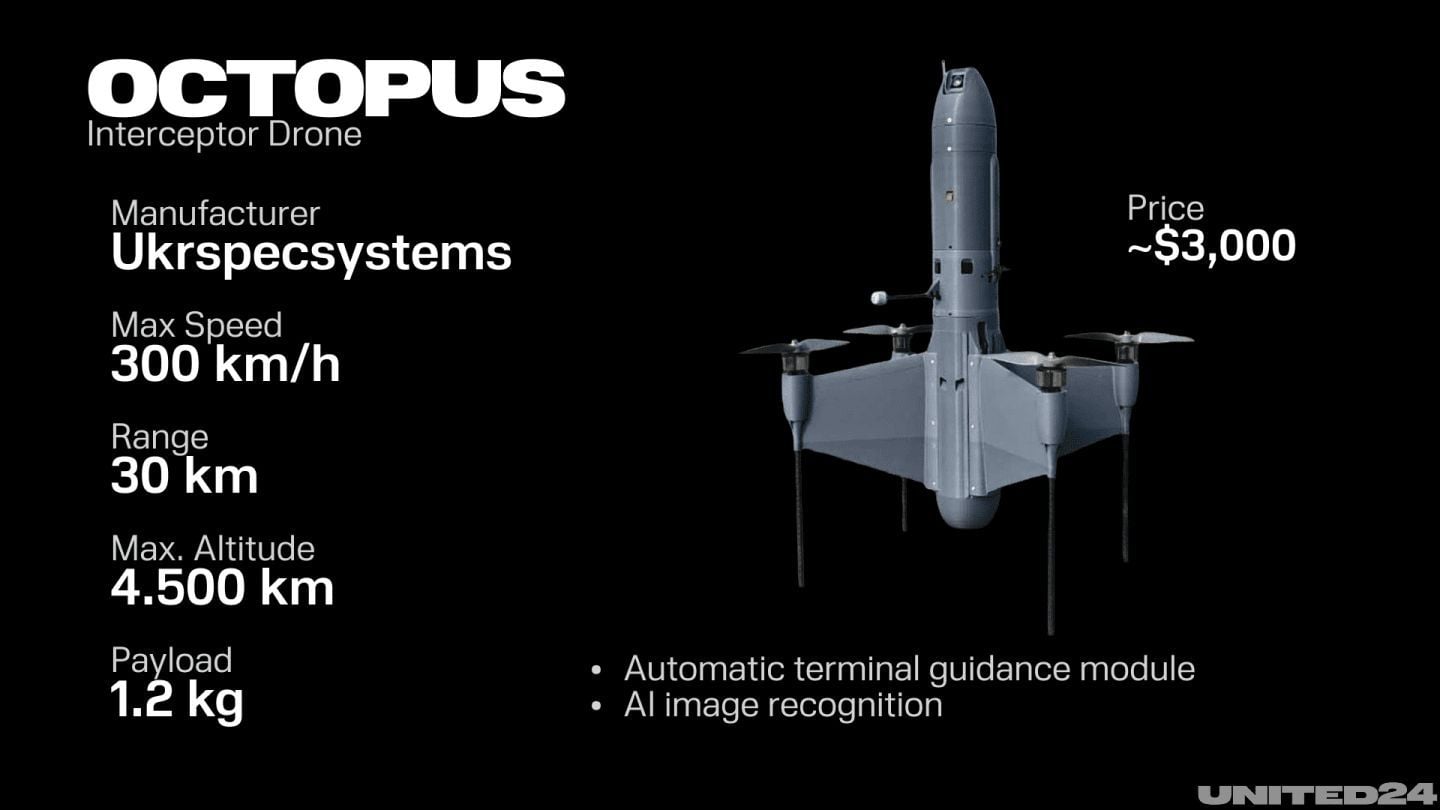
The Octopus, a joint project from Ukrspecsystems and Project OCTOPUS, managed by TAF Drones Industries, tops out at 300 km/h, operates over a 30 km combat radius, reaches 4.5 km in altitude, and carries a 1.2 kg payload with 15 minutes of endurance. Its automatic terminal guidance and AI image recognition let it engage without a pilot in the loop, according to the Royal United Services Institute (RUSI). Ukraine and the UK planned to start joint production of 1,000 Octopus units per month beginning in February 2026, following an announcement by former Defense Minister Denys Shmyhal in January — though neither Kyiv nor London has confirmed that production began on schedule. Zelenskyy first presented the drone in London in late October 2025.
Gulf Demand Is Real, but Deals Remain Unsigned
Ukraine has 201 military experts already deployed across the Gulf region to assist partners with anti-drone defense, with 34 more prepared to deploy. Zelenskyy confirmed on March 14 that Kyiv has also proposed a joint drone production agreement with the United States. We covered that deployment in detail when Ukraine sent its drone warfare experts to Jordan, Saudi Arabia, Qatar, and the UAE earlier this month.
The commercial interest is not hypothetical. Multiple Gulf governments have formally requested interceptor systems. Wild Hornet confirms Middle Eastern clients have expressed interest in the STING. But Wild Hornet is also explicit: the company’s priority is Ukraine’s own air defense, and exports only happen when the government authorizes them. No deal is signed. Zelenskyy added a sharper warning on top of that, saying private companies are attempting to bypass official government channels to procure Ukrainian anti-drone systems and expertise in the region. He did not name specific actors.
The threat side of the equation keeps escalating too. Russia is actively sharing satellite data and upgraded Shahed drone technology with Iran, according to a Wall Street Journal investigation published March 17. That bidirectional hardware pipeline means the drones Ukraine’s interceptors are designed to kill are getting faster and harder to jam.
DroneXL’s Take
I’ve been tracking this sector since Wild Hornet first started shipping STING units at scale, and the pace of manufacturer diversification continues to surprise me. A year ago, Ukraine had one or two names in this space. Now it has five distinct products at various production stages, competing on speed, altitude, range, and price. That’s an industry forming in real time under live-fire pressure.
The speed ceiling problem is the one I keep coming back to. The Shahed-238’s 550–600 km/h puts it out of reach for every system in this article except the P1-SUN, and even the P1-SUN at its upper estimate of 450 km/h only gets close. Close isn’t good enough for a kinetic intercept. We flagged this gap in March when we reported on Ukraine scaling up interceptor production as the Shahed threat outpaced every defense. The threat is moving faster than the interceptor fleet’s top-end capability. Ukrainian manufacturers know this. Expect the next generation of these systems to treat 500 km/h as a design floor, not a ceiling.
The Gulf export story is real demand, but the legal and political machinery hasn’t caught up. Ukraine’s $2,500 interceptors have already been described as America’s most urgent defense import, and Kyiv is pushing a $35–50 billion drone deal back into US talks this week. The government-to-government framework Zelenskyy insists on is the right call. Private procurement channels in a war zone produce accountability disasters. The Gulf states that move fastest through official channels will be the first to get hardware. The ones that try to go around will be waiting.
By the end of 2026, at least one formal government-to-government export agreement for Ukrainian interceptor drones will be signed with a Gulf state. The Octopus UK joint production line, which was supposed to start in February, will be the template that follows.
Photo credit: Ukraine24 Media
DroneXL uses automated tools to support research and source retrieval. All reporting and editorial perspectives are by Haye Kesteloo.
Discover more from DroneXL.co
Subscribe to get the latest posts sent to your email.
Check out our Classic Line of T-Shirts, Polos, Hoodies and more in our new store today!

MAKE YOUR VOICE HEARD
Proposed legislation threatens your ability to use drones for fun, work, and safety. The Drone Advocacy Alliance is fighting to ensure your voice is heard in these critical policy discussions.Join us and tell your elected officials to protect your right to fly.

Get your Part 107 Certificate
Pass the Part 107 test and take to the skies with the Pilot Institute. We have helped thousands of people become airplane and commercial drone pilots. Our courses are designed by industry experts to help you pass FAA tests and achieve your dreams.

Copyright © DroneXL.co 2026. All rights reserved. The content, images, and intellectual property on this website are protected by copyright law. Reproduction or distribution of any material without prior written permission from DroneXL.co is strictly prohibited. For permissions and inquiries, please contact us first. DroneXL.co is a proud partner of the Drone Advocacy Alliance. Be sure to check out DroneXL's sister site, EVXL.co, for all the latest news on electric vehicles.
FTC: DroneXL.co is an Amazon Associate and uses affiliate links that can generate income from qualifying purchases. We do not sell, share, rent out, or spam your email.


