Ukraine’s Drone Industry Arrives in Düsseldorf, and It Has Receipts
Check out the Best Deals on Amazon for DJI Drones today!
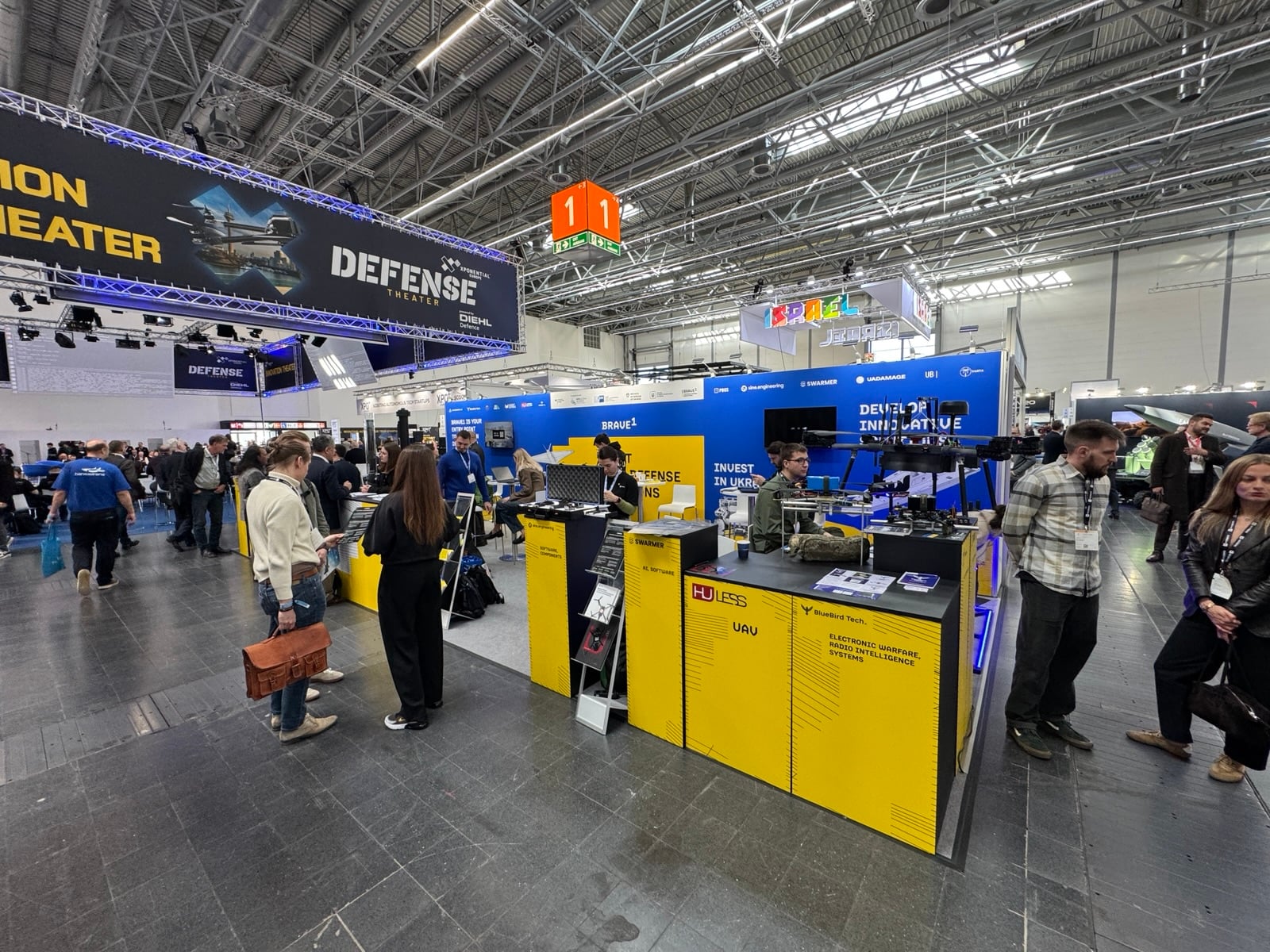
Three years ago, Ukraine had almost no commercial drone manufacturing industry at scale. Today, I was walking the floor at XPONENTIAL Europe 2026 in Düsseldorf — the leading European trade fair for autonomous technologies and robotics, running March 24–26 at Messe Düsseldorf — and Ukrainian companies occupied some of the busiest floor space in the hall. General Cherry, Swarmer, TechEx, Ukrspecsystems, and at least six others under the Brave1 defense tech cluster were present, showing hardware and software already tested against a peer adversary at scale. The contrast with where Ukrainian drone manufacturing stood before February 2022 is hard to overstate — and the people running these booths said exactly that.
A Defense Industry Born in Four Years of War
Multiple company representatives I spoke with volunteered the same observation without prompting: there was no Ukrainian drone industry before Russia’s full-scale invasion. What exists now grew out of battlefield necessity, operating under active Russian strikes, iterating faster than any traditional procurement cycle allows. The companies on the floor in Düsseldorf are not showing concept designs. They are showing products with confirmed combat use.
That’s not marketing language. Swarmer‘s drone swarm coordination software has facilitated more than 100,000 combat missions in Ukraine since April 2024. General Cherry‘s fiber-optic FPV drone from its OPTIX series was the weapon used in what Defence Express described as the first confirmed shootdown of a Russian Ka-52 attack helicopter by a drone in this war, near Pokrovsk on March 20 — a $16 million platform destroyed by a drone costing a fraction of that. Ukraine’s General Staff has not independently confirmed the incident, but the claim has been widely reported and corroborated by video evidence. The company’s Bullet interceptor, sitting on a red pedestal at their Düsseldorf stand, has been officially adopted by Ukraine’s armed forces. According to General Cherry, the Bullet has been used to destroy Russian Shahed drones, including at night. The unit price is approximately $2,100, per the company’s expo display.
The Brave1 Pavilion: Ukraine’s Government-Backed Tech Cluster
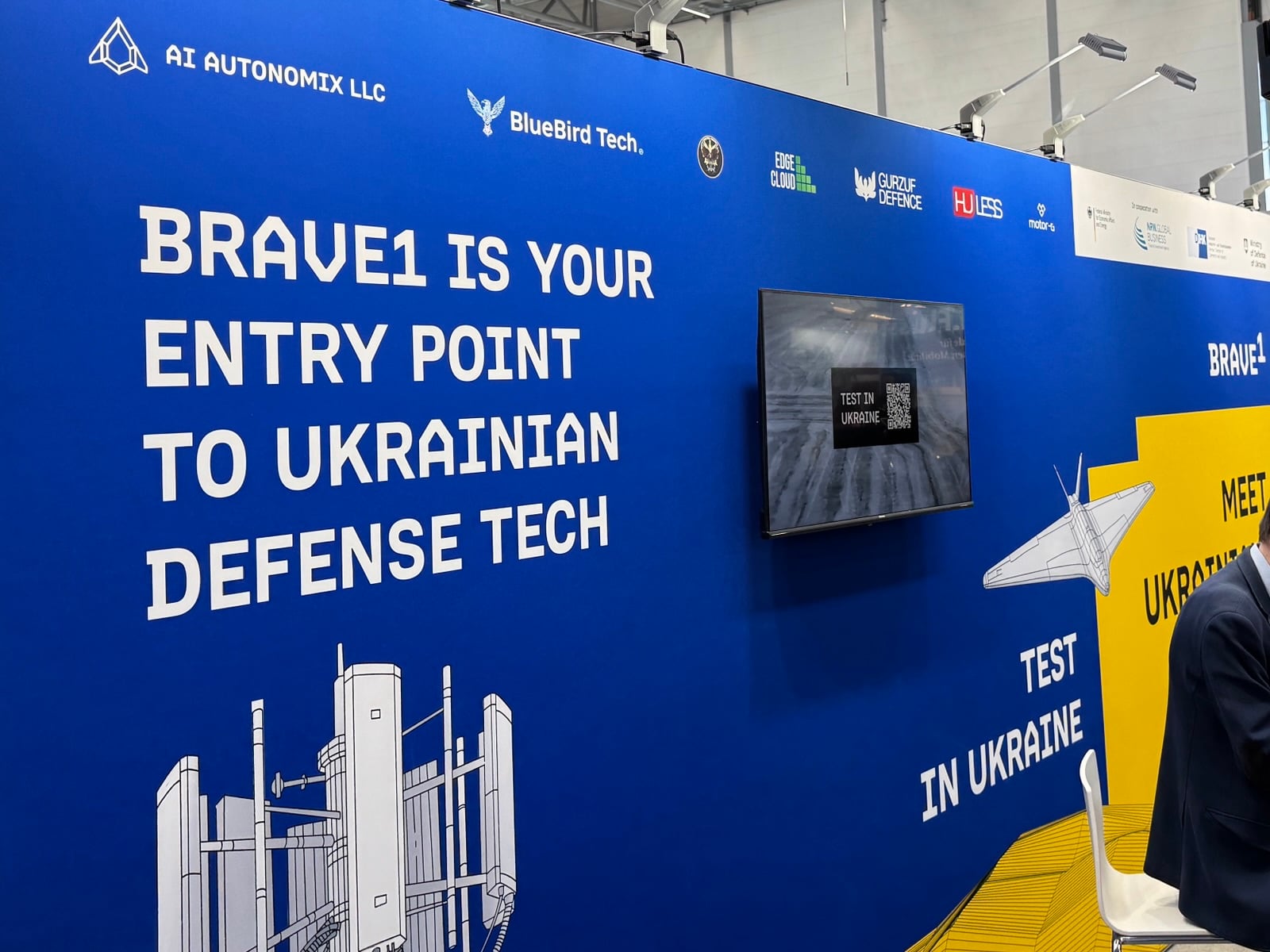
The most visible Ukrainian presence on the floor was the Brave1 pavilion at stand 1C63 — a blue-and-yellow wall bearing the words “Brave1 is your entry point to Ukrainian defense tech.” Brave1 is Ukraine’s government-run defense tech accelerator and procurement marketplace, built specifically to cut through military bureaucracy and get battlefield-tested systems to front-line units fast.
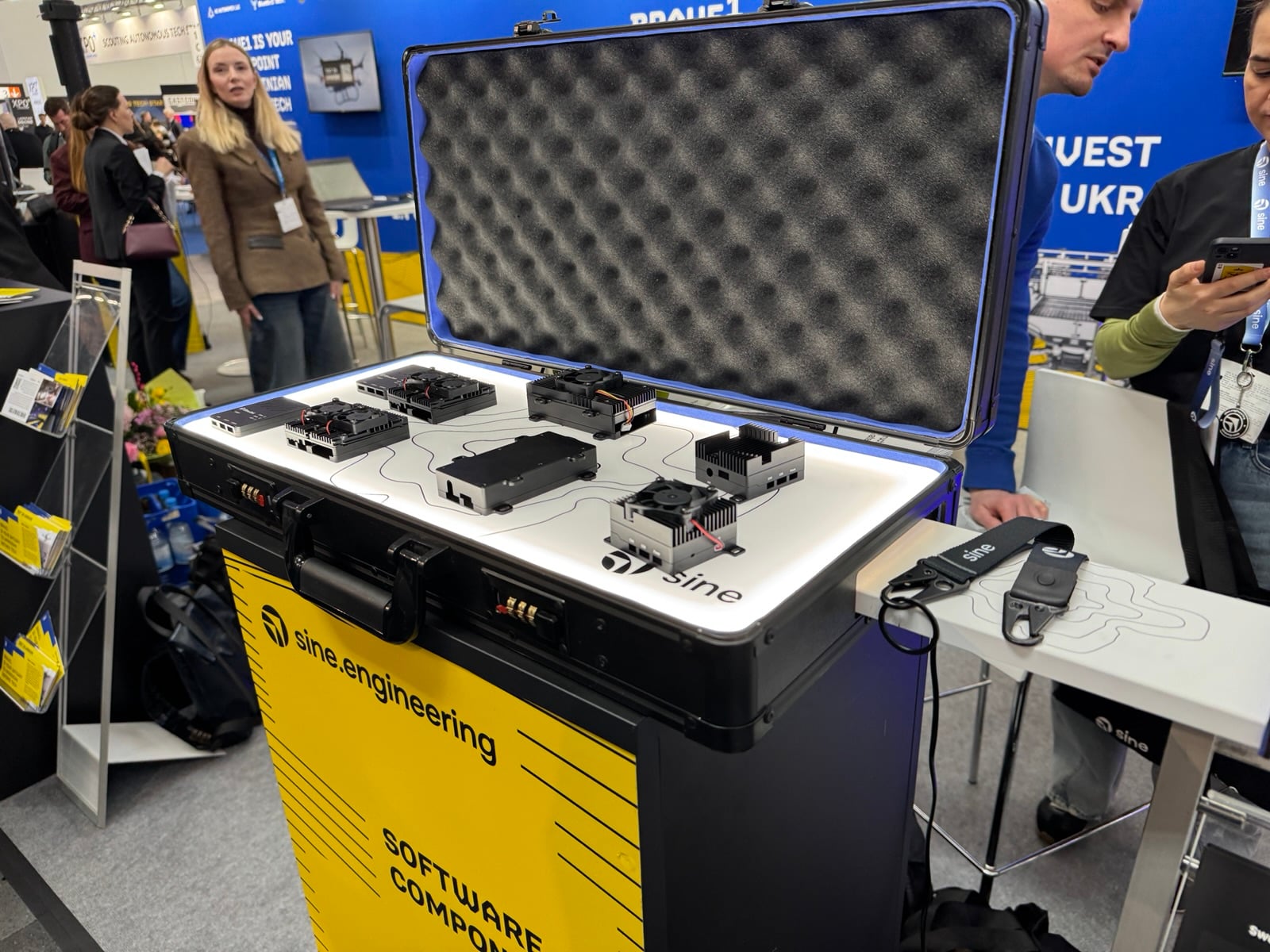
The stand brought nine companies together under one roof: AI Autonomix LLC, BlueBird Tech (electronic warfare and radio intelligence), Edge Cloud (wireless and cellular communications), Twist (AI software), Gurzuf Defence, HuLess (UAV platforms), Swarmer (swarm coordination software), UADamage, and sine.engineering (software and components).
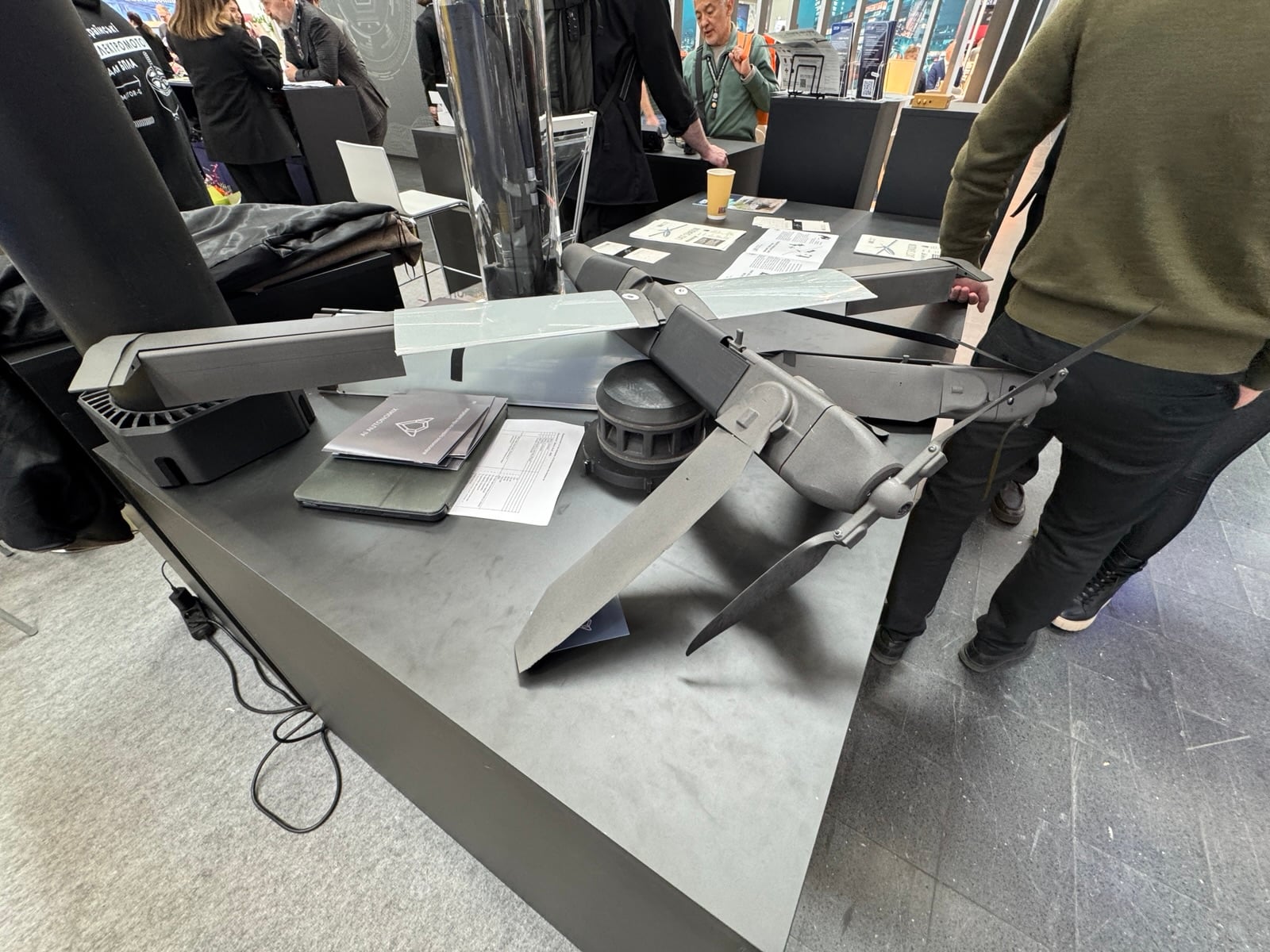
On the table in front of the stand sat a physical Varta FPV interceptor drone — the Dozor system — alongside product literature for the Brave1 Dronehunter Varta. The booth was consistently busy. At no point in the time I spent nearby did it empty out.
Swarmer Goes Public Days Before the Show
Swarmer went public on Nasdaq under the ticker SWMR on March 17 — seven days before XPONENTIAL Europe opened. Shares priced at $5 and closed the first session at $31, a 520% first-day jump, before hitting an intraday high of $65.04 the following day. The offering raised $17.25 million after the underwriter exercised its over-allotment option in full. Per its SEC prospectus, Swarmer’s full-year 2025 revenue was $309,920, down from $329,410 in 2024. Nearly all of that revenue came from a single customer — Smart Machinery Solutions, a Ukrainian LLC — which, per the prospectus, has stopped placing new orders. The company carries a going-concern warning, standard for early-stage companies but notable for one trading at a market capitalization north of $500 million within days of listing. The market is not buying the current financials — it is buying the dataset and the proof of concept.
Swarmer’s software lets a single operator manage 20 or more drones simultaneously across multiple hardware platforms. We first covered Swarmer in October 2025 when the company closed a $17.9 million funding round — then the largest publicly announced investment in a Ukrainian defense tech company since the invasion began — with 82,000 combat missions already logged. The 100,000-mission dataset built since is an asset no Western software startup can replicate in a lab. The company — legally headquartered in Austin, Texas, but operationally rooted in Ukraine, Poland, and Estonia — became the first Ukrainian defense tech firm to list on a major US exchange. Its chairman is Erik Prince, founder of Blackwater, a detail that drew scrutiny in the prospectus and carries real implications if the company pursues contracts with NATO governments: Prince’s documented history with a Chinese security firm employing former PLA personnel is a counterintelligence complication most allied procurement offices will not overlook. Per Brave1 data cited in the prospectus, more than 50 Ukrainian defense-tech startups raised over $105 million combined in 2025. Swarmer’s IPO, the Kyiv Independent reported, is expected to open the path for others.
General Cherry: The Ka-52 Killer in Düsseldorf
General Cherry had the largest and most polished standalone Ukrainian booth on the floor — a full custom-built stand with backlit brand walls, Ukrainian military unit insignia, and a Ukrainian flag in the corner. Their marketing director, Vlad Polikashkin, was there handing out business cards with a Ukrainian +380 number and the address gencherry.com.
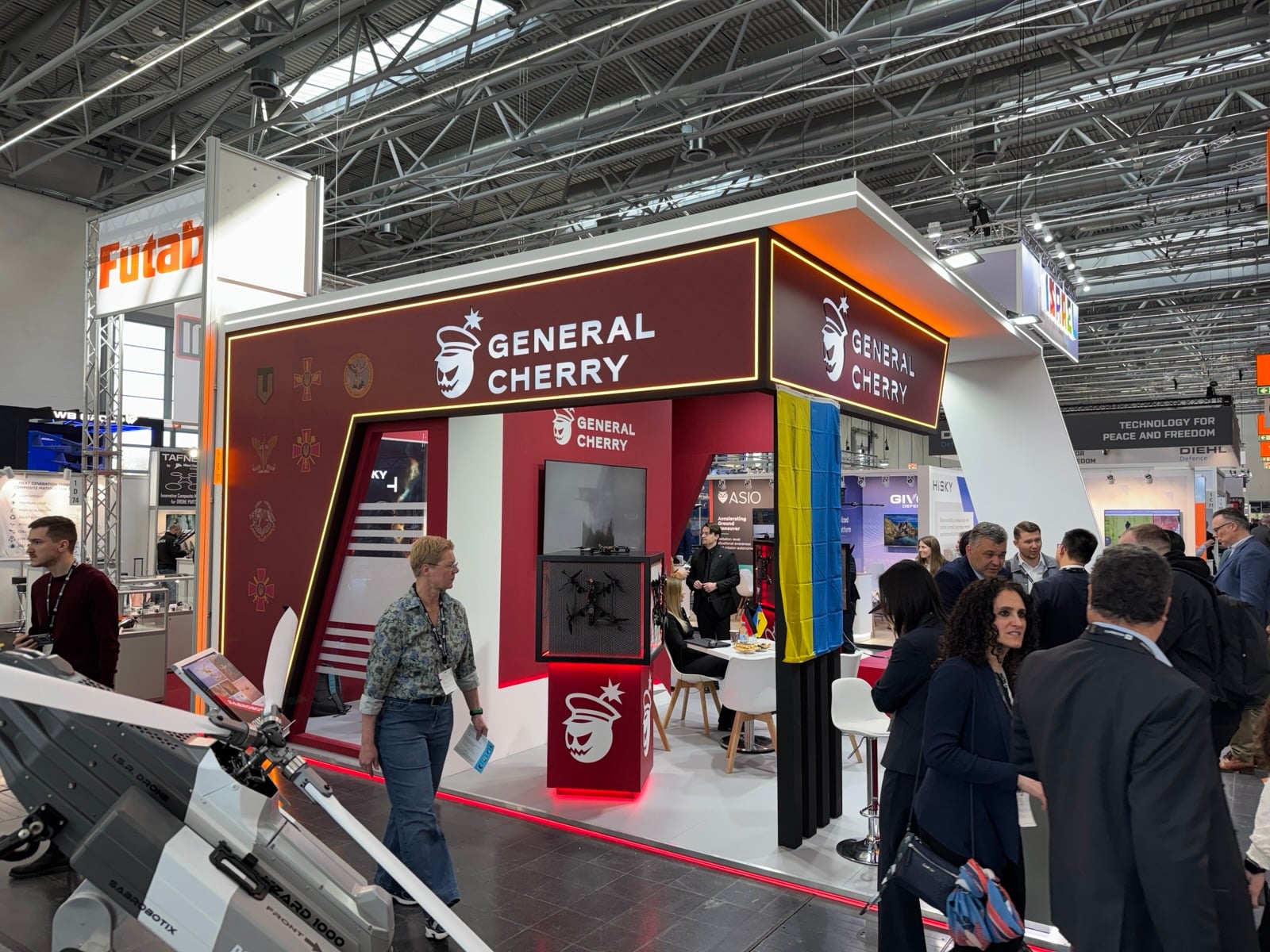
The centerpiece on the display table was the Bullet: a black fixed-wing VTOL hybrid interceptor with four lift rotors and a bullet-shaped fuselage, priced at around $2,100 per unit. The company announced the Bullet in late 2025, and it was subsequently approved for service with Ukraine’s armed forces. In February 2026, the General Cherry AIR interceptor destroyed a rare Russian AI-powered Klin loitering munition, the first confirmed interception of that system. General Cherry now fields a layered interceptor lineup — the AIR SPEED for small fast quadcopters and reconnaissance UAVs, the AIR Pro for larger targets, and the Bullet for long-range Shahed-type threats — which reflects exactly how Ukraine’s counter-drone doctrine has matured: no single system dominates, layered response does.
But the Ka-52 story is what made the biggest impression at the show. On March 20, operators from Ukraine’s 59th Assault Brigade used a General Cherry OPTIX fiber-optic FPV drone to shoot down a Ka-52 in flight near Nadiivka in the Pokrovsk sector — what Defence Express called the first confirmed case of a Ka-52 being destroyed by a drone in this war. The fiber-optic link makes the system immune to radio-frequency jamming, which is why the OPTIX series was certified in December 2025. The helicopter cost $16 million. The drone that brought it down uses a physical cable rather than a radio signal, and according to company representatives at the booth, the mission required a month and a half of tracking Russian aviation routes before the engagement. I stood at General Cherry’s stand the morning after that story dropped. The team knew about it.
TechEx: The Shahed Interceptor From Kyiv
TechEx (techex.com.ua) ran a stand under Ukrainian colors showing two products. The Stalker XO-10 is a fiber-optic FPV with no radio signal emissions, described on the display card as battle-proven and resistant to electronic warfare interference. Specs: teleoperation range 15,000 meters, payload 360 grams or 160 grams depending on configuration, maximum takeoff weight 6.35 kg.
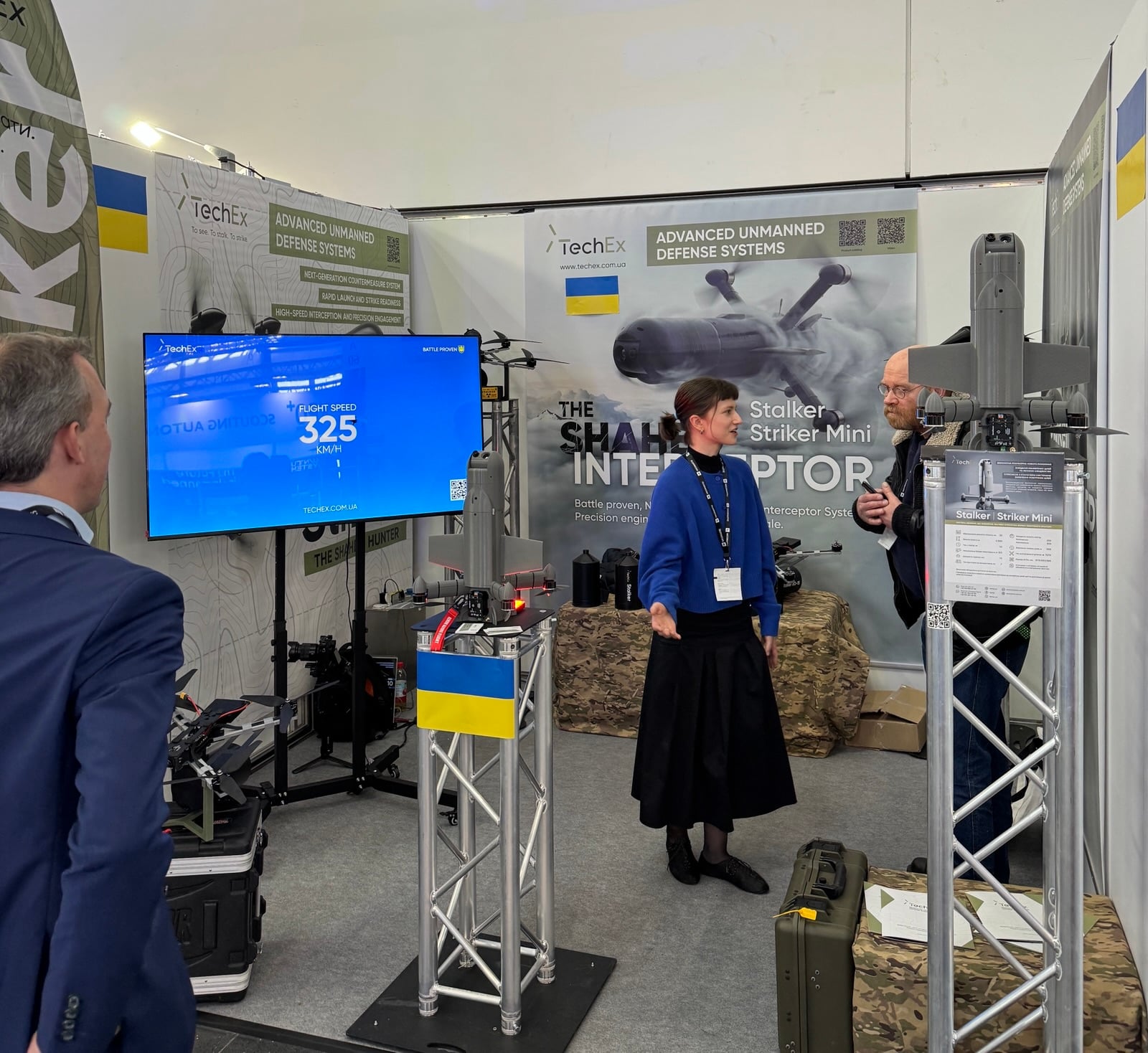
The second product was the Stalker Striker Mini, marketed explicitly as “The Shahed Interceptor.” A screen at the booth looped footage showing the drone in flight with a readout of “FLIGHT SPEED 325 KM/H.” The spec card confirmed: cruise speed 200 km/h, maximum 325 km/h, range 25 km, ceiling 4,000 m, combat payload 0.5 kg, target detection range 500 m, deployment-ready in 7 minutes. TechEx’s banner reads “Battle-proven. NATO-ready. Precision engineered” — though no independent NATO certification process has validated that designation. The Ukrainian-language version of the spec sheet was on the reverse of the same card. These products are built for domestic military use first, export second.
Ukrspecsystems and Motor-G Round Out the Floor
Ukrspecsystems, listed at booth B75 in the printed expo guide, makes the PD-2 VTOL fixed-wing UAV and the Shark reconnaissance drone. The Kyiv-based company opened a production facility in Mildenhall, Suffolk in late February 2026, targeting up to 1,000 drones per month for Ukrainian forces — the first Ukrainian drone manufacturer to establish a UK production line. Managing director Rory Chamberlain told the BBC the location wasn’t a commercial decision: “Ukraine is as vulnerable as ever to attack,” making production on allied soil a practical necessity.
One other company deserves a mention. A stack of minimalist business cards on a black table identified Motor-G (motor-g.com/en, sales@motor-g.com) — a Ukrainian drone motor manufacturer, based on the company’s +38 contact details. No flashy stand. Just a QR code, a phone number, and a sales email. That is the other end of the Ukrainian drone industry showing up in Düsseldorf: not just the finished weapon platforms, but the people building the motors that go inside them.
DroneXL’s Take
I’ve been covering the drone industry for years, and I don’t remember a show floor moment quite like walking through the Ukrainian cluster at XPONENTIAL Europe this week. These aren’t startups pitching a render on a banner. They are companies that built a weapons industry in four years under active bombardment, iterated through hundreds of thousands of real combat missions, and arrived in Germany with polished booths and product sheets in English and Ukrainian. The General Cherry stand had a line. The Brave1 pavilion had a line. Swarmer went public on Nasdaq seven days before the show opened and surged 950% above its IPO price in the first few trading sessions.
What struck me most was what the representatives kept saying unprompted: this industry did not exist before the invasion. Ukraine was not a drone-producing country in January 2022. It is now among the most advanced drone-producing countries on earth, and it got there by having no other option. The decentralized structure — dozens of small companies, rapid iteration, no single point of failure — is a direct product of operating under Russian strikes. That same structure is now appearing at European trade shows and on Nasdaq.
None of this should be taken uncritically. Whether battlefield-iterated products meet NATO procurement standards is an open question, and the gap between a polished expo booth and an actual export contract remains wide. Swarmer’s chairman Erik Prince brings both connections and controversy. Any wartime industry faces the question of what commercial sustainability looks like when the fighting eventually stops. But the trajectory is clear, and the companies I saw in Düsseldorf this week know it. Expect more Ukrainian defense tech listings on Western exchanges within 18 months. Swarmer broke the barrier. The companies at XPONENTIAL Europe are watching what happens next.
DroneXL uses automated tools to support research and source retrieval. All reporting and editorial perspectives are by Haye Kesteloo.
Discover more from DroneXL.co
Subscribe to get the latest posts sent to your email.
Check out our Classic Line of T-Shirts, Polos, Hoodies and more in our new store today!

MAKE YOUR VOICE HEARD
Proposed legislation threatens your ability to use drones for fun, work, and safety. The Drone Advocacy Alliance is fighting to ensure your voice is heard in these critical policy discussions.Join us and tell your elected officials to protect your right to fly.

Get your Part 107 Certificate
Pass the Part 107 test and take to the skies with the Pilot Institute. We have helped thousands of people become airplane and commercial drone pilots. Our courses are designed by industry experts to help you pass FAA tests and achieve your dreams.

Copyright © DroneXL.co 2026. All rights reserved. The content, images, and intellectual property on this website are protected by copyright law. Reproduction or distribution of any material without prior written permission from DroneXL.co is strictly prohibited. For permissions and inquiries, please contact us first. DroneXL.co is a proud partner of the Drone Advocacy Alliance. Be sure to check out DroneXL's sister site, EVXL.co, for all the latest news on electric vehicles.
FTC: DroneXL.co is an Amazon Associate and uses affiliate links that can generate income from qualifying purchases. We do not sell, share, rent out, or spam your email.