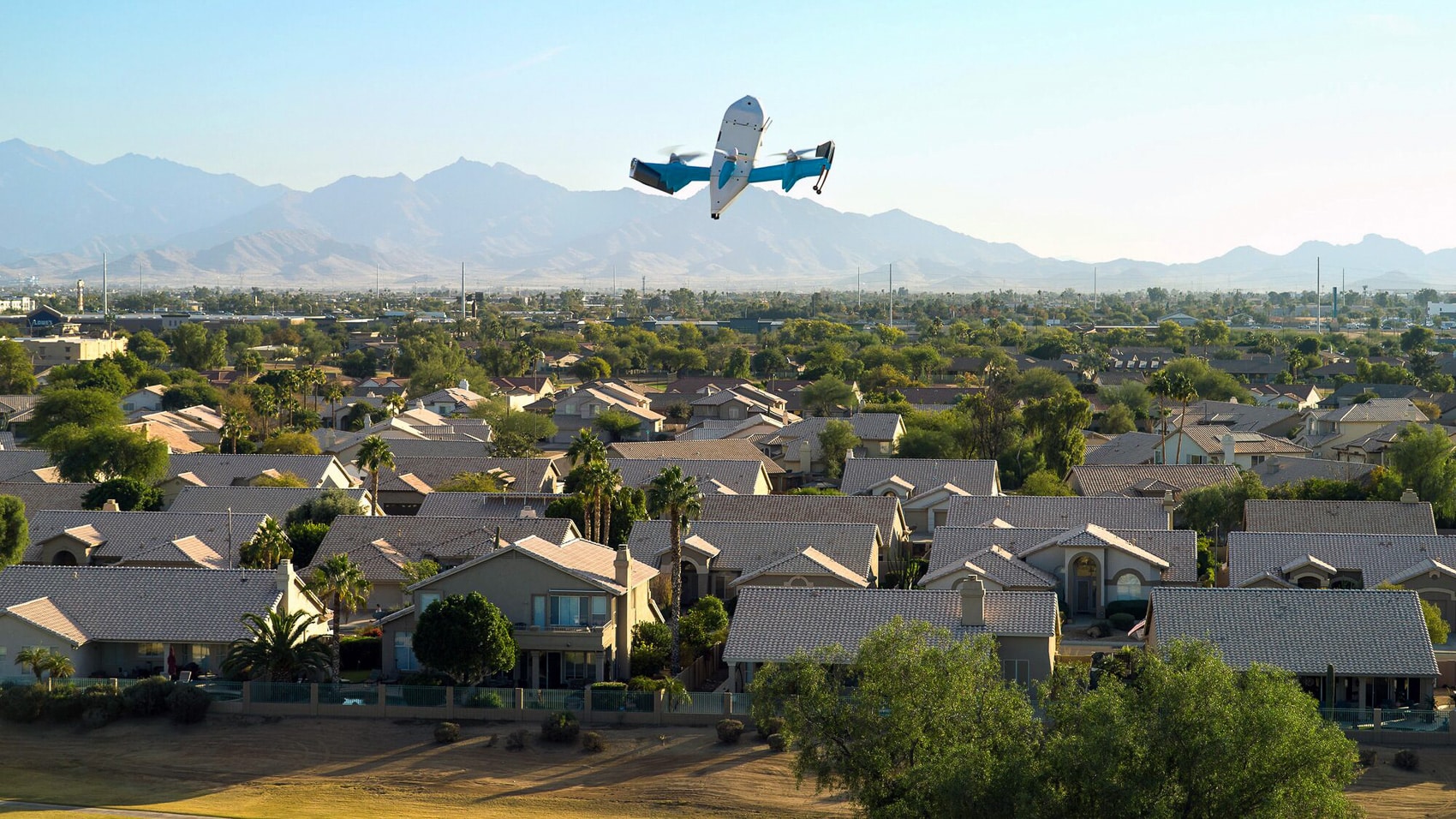
Amazon is laying the groundwork for Prime Air drone delivery in Tallahassee, Florida’s capital. The company is hiring Prime Air Ground Handlers in the city at $27 an hour, has invited drone instructors from Tallahassee State College to an “Amazon Drone Delivery Community Meet and Greet,” and documents filed on Friday, September 18, show a drone storage unit going into the front parking lot of its fulfillment center at Mahan Drive and Interstate 10. Amazon has announced no launch date.
The Tallahassee Democrat reported the hiring and the invitation on September 22. WCTV reported the filing a day later.
The FAA’s public record has nothing on it yet. Its list of drone delivery environmental reviews had no Tallahassee entry on September 23.
Amazon Is Hiring Drone Handlers and Courting Local Pilots Before Any Announcement
Amazon’s Tallahassee job listing pays $27 an hour for ground handlers who move batteries and equipment, watch the airspace for hazards and talk to the community, on shifts of up to 12 hours. An FAA Part 107 remote pilot certificate is preferred, not required. WCTV counts at least three openings.
The invitation reached Tallahassee State College about two weeks before the Democrat’s story, adjunct drone instructor Carl Fuqua told the paper. He and two other instructors responded. Fuqua said some people have mixed feelings about drones over their homes, then pointed to the larger metros where Amazon already flies: “It’s not like we’re the guinea pig for it either.”
An Amazon spokesperson told the Tallahassee Democrat the company is working with local officials and exploring an expansion to Tallahassee customers. “We’re also planning a community event in Tallahassee,” the statement said, with details to come. Amazon has run the same kind of preview elsewhere, as DroneXL documented when it put an MK30 at a Tracy car show and ahead of its Westborough forum tonight. Amazon had not announced a date or venue for the Tallahassee event as of September 23.
The FAA’s Florida Review Covered Six Sites, and Tallahassee Was Not One
The FAA’s Florida environmental assessment, signed June 1, 2026, covers Amazon hubs in Ruskin, Tampa, Orlando, Tamarac, Riviera Beach and Miami. Each gets up to 1,000 MK30 flights a day out to 7.5 miles (12 kilometers), from 6 a.m. to 10:30 p.m. Tallahassee does not appear.
It does not need to. Since July 28, the FAA can check a new hub against its national programmatic assessment inside the agency, with no site document and no comment period, the change DroneXL laid out when Washington cleared the runway for 500 cities. Neither Amazon’s statement nor the FAA’s environmental review page says which path Tallahassee is on.
Ruskin, outside Tampa, is the only Florida hub on the list of 11 operating sites in Amazon’s August 19 expansion announcement, the one that set the goal of nearly 500 cities and towns by the end of 2026. Tallahassee was not among the five named next launches either.
Florida Law Keeps Tallahassee Out of the Flights and Most of the Pad
Florida reserves drone regulation to the state. Under Florida Statute 330.41(3)(b), a city or county may not enact or enforce an ordinance on the operation of an unmanned aircraft, including airspace, altitude and flight paths. Tallahassee cannot write a rule about where Amazon’s drones fly or how high.
The ground gets its own paragraph. Subsection (3)(c) bars a local government from withholding a development permit, business tax receipt or other use approval from a drone delivery service, or banning one, because of where its drone port sits. The city keeps its ordinary setback and landscaping rules and cannot demand extra landscaping as a condition. The statute defines a drone port as a stand-alone building of up to 1,500 square feet (139 square meters) and 36 feet (11 meters) tall in a nonresidential area, so whether that protection covers Amazon’s storage unit depends on plans nobody has published. Local nuisance, voyeurism and property-damage laws still apply to drones under (3)(d).
The drone port rule came from SB 1068, signed on May 25, 2023, after its House twin cleared a subcommittee with Walmart’s DroneUp flights in mind. Massachusetts runs the other way: Amazon’s Westborough pad needs a state aeronautics permit and a local site-plan vote. Among the 35 states DroneXL checked for drop laws, Florida has no general drop rule at all.
DroneXL’s Take
Tallahassee is about to find out what drone delivery looks like when the public gets no formal say. If the FAA clears the hub against its national finding, there is no site review. Florida law keeps the city out of the flight paths entirely and, if the unit counts as a drone port, leaves it setbacks and landscaping on the ground. What’s left is Amazon’s meet and greet, and on this record that event is the only public forum Tallahassee residents get.
I’m fine with the outcome. A 30-minute delivery of cold medicine from a warehouse that already sends out vans every day is exactly the drone use this site has argued for since 2020, and Florida wrote its law so a city council couldn’t zone it out of existence. My problem is with the paperwork gap. Ruskin’s neighbors can open a PDF that says how many flights, how far and what hours. Tallahassee’s can’t.
The Democrat asked the right question: how does a delivery drone work under Tallahassee’s live oak canopy? Amazon owes the answer in public, with a flight radius and route map, before the first MK30 leaves the parking lot. If you live near that warehouse, the meet and greet is where to ask it.
Sources: Tallahassee Democrat, WCTV, Amazon Jobs, FAA Florida Environmental Assessment, FAA NEPA and Drones, Florida Statute 330.41, Amazon.
DroneXL uses automated tools to support research and source retrieval. All reporting and editorial perspectives are by Haye Kesteloo. Read our editorial standards.