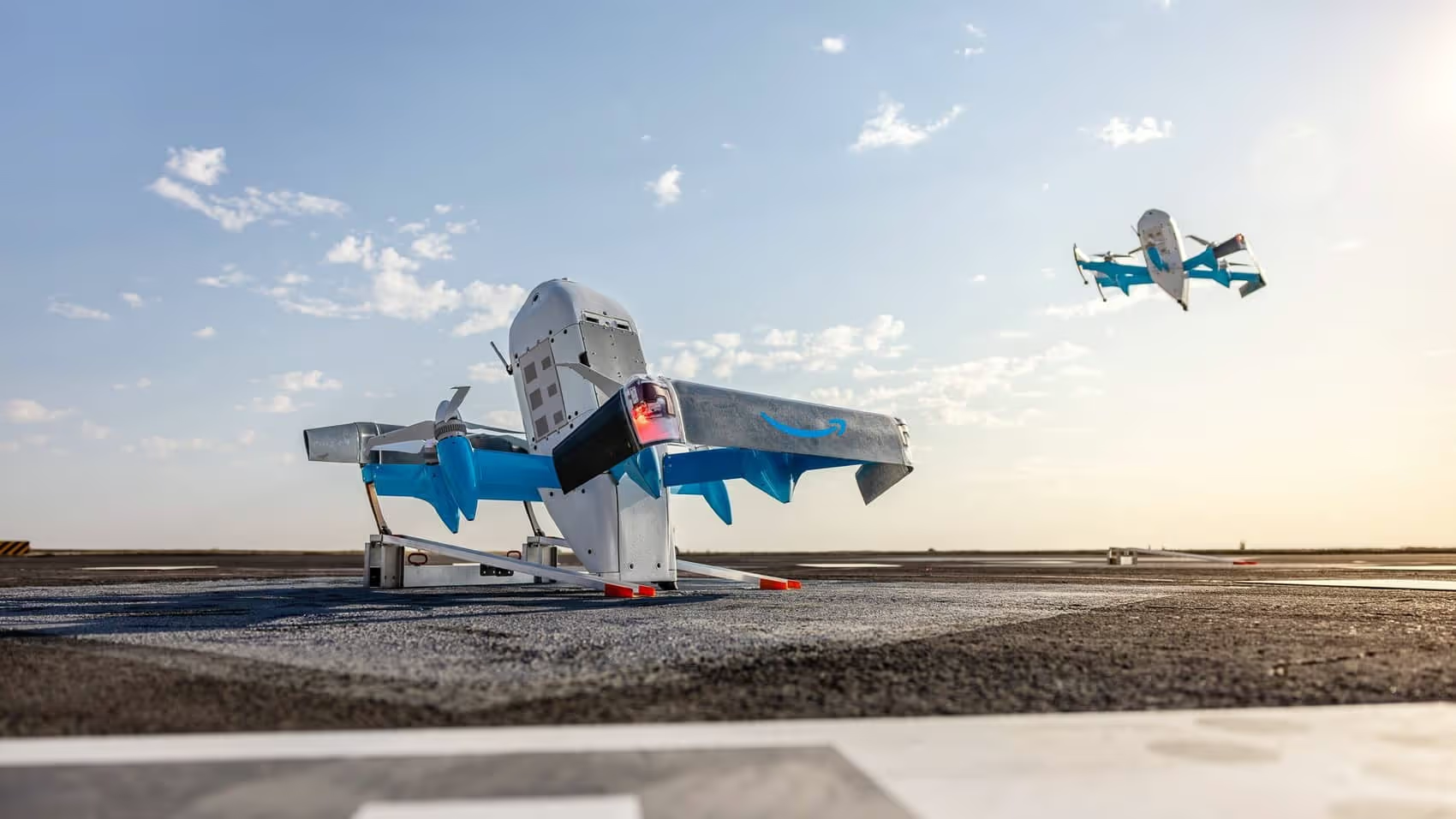
Amazon’s MK30 releases packages from about 13 feet over customers’ yards in Arizona, where dropping an object from an aircraft over a populated area is a misdemeanor, and in Michigan, where a state rule requires a city’s written permission before anything is dropped in flight. Illinois, where Amazon has named Chicago among its next launches, requires a state permit for every drop, filed 14 days ahead and naming the date, time and place.
DroneXL analyzed the aeronautics codes of 35 states this week, every state with a live or announced drone delivery operation among them. Ten regulate the release of objects from aircraft more strictly than the Federal Aviation Administration does. Of the three operators in DroneXL’s delivery tracker, Amazon is the only one whose aircraft lets go of the package in flight; Wing and Zipline lower theirs on tethers.
The argument available to Amazon is that the FAA owns the airspace and a 1920s state statute cannot reach a federally certificated air carrier. DroneXL found no court ruling that tests that argument against a drone delivery drop, and the FAA’s own guidance points both ways.
Federal law treats a delivery drone as an aircraft
Federal law defines an aircraft as any contrivance invented, used, or designed to navigate or fly in the air, and the U.S. Code defines an unmanned aircraft as an aircraft operated without the possibility of direct human intervention. An 83-pound MK30 is an aircraft wherever a statute uses the word.
The definition sits in 49 U.S.C. § 40102, and Congress removed any doubt about drones in 2018 when it wrote § 44801 into the same title. The National Transportation Safety Board had already settled the point in 2014, reversing an administrative law judge who ruled in Huerta v. Pirker that a small drone was not an aircraft.
The federal government enforces that reading when it suits it. Shooting at a drone is prosecuted under 18 U.S.C. § 32, the aircraft sabotage statute, and the FAA said during the New Jersey sightings of December 2024 that a person who fires at one can face FAA civil penalties and criminal charges. A 249-gram quadcopter is an aircraft when someone points a shotgun at it. The states’ aeronautics codes use the same word, and they used it first.
The federal rule on releasing things from that aircraft is short. 14 CFR 91.15 bars a pilot from letting anything be dropped that creates a hazard to persons or property, and then says the section does not prohibit dropping an object if reasonable precautions are taken. That is a standard. No federal permit exists for it. Part 107 carries the same language for small drones, and Amazon flies under Part 135 as an air carrier.
Ten states go further than the FAA on dropping objects
Of the 35 state aeronautics codes DroneXL reviewed, three require a state permit before anything is dropped from an aircraft, six make it a misdemeanor over populated areas with no permit available, and one requires written permission from the local government. Twenty-one have no rule beyond careless-or-reckless operation.
The permit states are Illinois, Minnesota and Oregon. Illinois bars dropping any object from an aircraft without a dropping permit from the Department of Transportation, a Class A misdemeanor under the Aeronautics Act’s penalty section, 620 ILCS 5/79, and IDOT’s rule requires the form 14 days before the scheduled drop, specifying the person, the date, the time, the place and the object. Minnesota requires two written consents, from the commissioner of transportation and from the municipality or property owner where objects may land. Oregon requires a permit from its aviation director under ORS 837.085, a statute that came up this weekend in Amazon’s plans for a Portland hub.
The flat-ban states inherited the 1922 Uniform State Law for Aeronautics almost word for word: a misdemeanor for anyone who, over a thickly inhabited area or a public gathering, drops any object except loose water or loose sand ballast. Arizona grades it a class 1 misdemeanor. North Carolina, Hawaii, Delaware, New Jersey and Missouri carry the same clause. South Carolina carried it too, until a 2012 rewrite of its aeronautics chapter deleted the section. None of the six offers a permit. Either the statute does not reach the aircraft, or the flight violates it.
Michigan is its own case. MCL 750.44 makes it a misdemeanor to drop or release any object that may endanger life or injure property, a harm-qualified test Amazon could argue it meets. The Aeronautics Commission’s rule R 259.308 adds that a pilot shall not permit an object to be dropped from an aircraft in flight except upon written permission of the political subdivision having jurisdiction. The rule sits in the commission’s airport field rules, which gives Amazon an argument that it was written for airport grounds, though its text says aircraft in flight and names no airport.
Three states mirror the federal hazard standard and add nothing Amazon does not already meet: New York, Indiana and Nevada, which rewrote its drop clause around reckless disregard. Wisconsin bans drops and then exempts the delivery of packages or mail by dropping from airplanes when done under federal regulations. Texas, Florida, Georgia, Kansas, Nebraska, Louisiana, Ohio, Idaho, California, Virginia, Utah, Alabama, Montana, Wyoming, Maryland, Arkansas, South Carolina, Washington, Pennsylvania, Tennessee and Connecticut, where Amazon’s North Haven site awaits FAA sign-off, have no general drop rule at all. Connecticut’s careless-or-reckless statute was amended in 2024 to name unmanned aircraft, and Tennessee’s one drone-specific rule bars dropping items into ticketed open-air events.
Amazon’s drop method is the one the statutes describe
Amazon’s MK30 descends to about 13 feet, checks the ground and releases the package into free fall. Wing lowers its package on a tether from a 23-foot hover and Zipline’s Platform 2 winches a droid down from about 330 feet. Only Amazon’s method matches the word the statutes use: drop.
Amazon describes the method the same way, in a federal filing. The flight profile Amazon supplied for the FAA’s Kansas City environmental assessment shows the MK30 cruising at 205 to 250 feet inbound and 325 to 370 feet outbound at 58 knots, descending vertically over the customer’s yard, and releasing the package at 13 feet during a six-second hover. Its how-it-works page gives the same height, and at XPONENTIAL Europe a Prime Air executive told Inside Unmanned Systems the aircraft descends to about three and a half meters and “releases the package, which drops to the ground.” The figures on DroneXL’s aircraft comparison page come from FAA filings: the MK30 weighs 83.2 pounds at takeoff, 78 pounds empty, and carries five. It has no parachute, a design choice Amazon has not explained since September 3.

A customer’s own footage shows the whole sequence. Tamara Hancock, an Arizona Prime Air customer who posts as Teaching Mrs H, filmed an MK30 hovering over her backyard, opening its cargo bay and letting a box fall to the grass. She had ordered a bottle of syrup to see what a drop does to a breakable item, and the video’s title gives her verdict: it didn’t go well.
Whether a package lowered to the ground on a tether and released there is a “drop” under a 1929 statute is a question for a lawyer. Whether a package released from 13 feet is a drop is not. On the statutes’ plain words the exposure is Amazon’s, and the tether is one reason Zipline’s design keeps winning the comparison.
Illinois, Michigan and Arizona put Amazon’s method against live statutes
Amazon delivers in Tolleson, Arizona, where dropping an object over a densely inhabited area is a class 1 misdemeanor, and in Hazel Park and Pontiac, Michigan, where a state rule requires written permission from the city. Its Chicago launch lands in Illinois, which issues per-drop permits with 14 days’ notice.
Illinois is the sharpest conflict because Illinois has a working permit desk. The statute and the rule were written for a banner plane dropping leaflets on a fair: one pilot, one afternoon. A permit that names the time and place of each drop cannot be issued 14 days ahead for a 30-minute delivery to an address nobody knows yet. Either IDOT reads its own statute as not reaching a Part 135 drone, or Amazon flies Chicago without a permit the rule was never written to issue. Amazon’s August 19 announcement lists Chicago among the next five metros.
Michigan is the live one. Amazon flies from Hazel Park and Pontiac under a state rule that, on its face, requires each city’s written permission before an object is dropped. Whether either city was asked is a public-records question, and DroneXL is asking it.
Arizona is the oldest. Amazon began deliveries in Tolleson in 2024, paused after two MK30s struck a crane in October 2025, and resumed. No prosecution under ARS 28-8279 involving a delivery drone appears in any record DroneXL has found, which tells you either that the statute is a dead letter or that nobody has tried. Minnesota, with the strictest text in the country, has no operator yet and therefore no test.

The FAA’s preemption guidance points both ways
The FAA says Congress gave it exclusive authority over aviation safety and airspace efficiency, and that laws aimed at delivery drones are likely preempted under the Airline Deregulation Act. The same 2023 fact sheet says states may regulate how aircraft are used, as opposed to where they fly.
The fact sheet, issued in July 2023, is the closest thing to a federal position. It lists state rules that face field preemption, including mandating geofencing and imposing licensing regimes, and says laws affecting commercial delivery drones are “more likely to be preempted under the Airline Deregulation Act,” which bars states from regulating an air carrier’s routes and services. Amazon holds a Part 135 certificate, so that argument is available to it.
The fact sheet then hands the states their ground. Restrictions on how UAS can be used rather than where they operate within airspace, it says, are more likely to survive, and it repeats that municipalities may generally determine the location of aircraft landing sites through their land use powers. A permit to release cargo over a city is a rule about how, or a rule about airspace, depending on who is reading it. Nobody has asked a judge.
A fact sheet is not law, and the 2015 version said the same things without stopping 44 states from passing drone statutes. The states that adopted the 1922 uniform act wrote it, in its own words, to harmonize as far as possible with federal laws and regulations on the subject of aeronautics. In 1922 that meant nothing, because there were no federal aviation regulations. In 2026 it is the sentence Amazon’s lawyers will read first.
DroneXL’s Take
I am for drone delivery and against a state-by-state patchwork for aircraft that cross county lines in minutes. The FAA should own the airspace. The statutes are real and unrepealed, and the company they describe has let two deadlines pass this month without saying whether its aircraft has a parachute.
The record cuts in Amazon’s favor. Seven incidents in the tracker, no injuries, and statutes written when the aircraft in question was a Curtiss Jenny dropping handbills on a county fair. A legislature in 1923 was not thinking about a hexacopter with detect-and-avoid, and reading its words onto one is a stretch a court might refuse.
But the states are not writing new rules. They are finding old ones, and they are finding them because much of the public record of what Amazon’s aircraft does over a neighborhood sits in the tracker DroneXL built after Amazon let two deadlines pass. A town clerk who cannot get an engineer to a meeting reaches for whatever statute the state gave her. Illinois gave her a permit form.
Chicago is the nearest test, because Illinois has a statute that names the process, a rule that names the deadline and an agency that issues the permit. If Amazon applies, the permit itself becomes a written state position on drone delivery drops, the first DroneXL has found. If Amazon launches without one, IDOT either enforces or explains in writing why it will not. Either answer is news.
The court test will come from somewhere else. The 1922 act did not stop at making the drop a crime. It also made the aircraft owner absolutely liable for injuries to persons or property on the land beneath caused by the dropping or falling of any object therefrom, whether such owner was negligent or not. That clause survives in Delaware, Minnesota and South Carolina, which kept its liability section in the 2012 rewrite that dropped the crime, and Hawaii sharpened it so that a commercial operator is absolutely liable while a private owner is only presumed so. Wisconsin presumes liability for anything that falls from an aircraft and puts the burden of proof on the operator. None of that needs a prosecutor or an attorney general. It needs one homeowner under a 5-pound box released from 13 feet and a lawyer who reads the statute book. Amazon has already put a package into a Richmond, Texas swimming pool. None of those five states is on Amazon’s map yet. A 500-city map is how it gets there.
The only federal ruling on point cuts less cleanly than Amazon would like. In Singer v. City of Newton, decided in September 2017, a Massachusetts federal judge struck down four provisions of a city drone ordinance, but he did it on conflict preemption, finding that the federal government had not claimed exclusive regulatory authority over drones. Field preemption, the argument that leaves no room for any state rule at all, lost. A state permit for releasing cargo over a neighborhood is closer to the land-use power the FAA’s own fact sheet concedes than to the altitude limits Newton lost on. My read is that a challenge to Illinois or Michigan is a coin flip. Amazon has not made the preemption argument in any filing DroneXL has read, and neither its August announcement nor its how-it-works page mentions state or local permission for the release.
Zipline, which answered every safety question on the record, lowers its packages, and the statutes’ word does not describe its method. Neither does it describe Wing’s. Amazon’s fix is a tether or a permit, and both cost less than the test case a plaintiff will eventually bring.
The state-by-state table, with the statute, the tier and a source link for every state checked, lives on the Drone Delivery Tracker; the 15 states with no delivery operation follow in the weekly sweep. DroneXL is putting the permit question to Amazon and to the aviation offices of Illinois, Michigan, Arizona and Minnesota this week. Their answers publish when they arrive.
Sources: Illinois Compiled Statutes 620 ILCS 5/43b and 92 Ill. Adm. Code 14.440; Minnesota Statutes 360.075; Oregon Revised Statutes 837.085; Arizona Revised Statutes 28-8279; North Carolina G.S. 63-18; Hawaii Revised Statutes 263-9; Delaware Code Title 2 § 309; Michigan Compiled Laws 750.44; Connecticut General Statutes 15-72; 74 Pa.C.S. ch. 55; Tennessee Code 42-1-202 and 39-13-903; 620 ILCS 5/79; 14 CFR 107.23; Wisconsin Statutes 114.095; Nevada Revised Statutes 493.100; New York General Business Law § 245; Indiana Code 8-21-4-8; 49 U.S.C. §§ 40102 and 44801; 18 U.S.C. § 32; 14 CFR 91.15; FAA, State and Local Regulation of Unmanned Aircraft Systems Fact Sheet (July 2023); Singer v. City of Newton, No. 17-10071-WGY (D. Mass. Sept. 21, 2017); Delaware Code Title 2 § 307; Hawaii Revised Statutes 263-5; Minnesota Statutes 360.012; Wisconsin Statutes 114.05; Amazon, Prime Air expansion announcement (August 19, 2026); FAA, Environmental Assessment for Amazon Prime Air Package Delivery Operations in Kansas City, MO and Kansas City, KS (May 2026), Figure 2-5; Inside Unmanned Systems; Tamara Hancock (Teaching Mrs H), YouTube.
DroneXL uses automated tools to support research and source retrieval. All reporting and editorial perspectives are by Haye Kesteloo. Read our editorial standards.