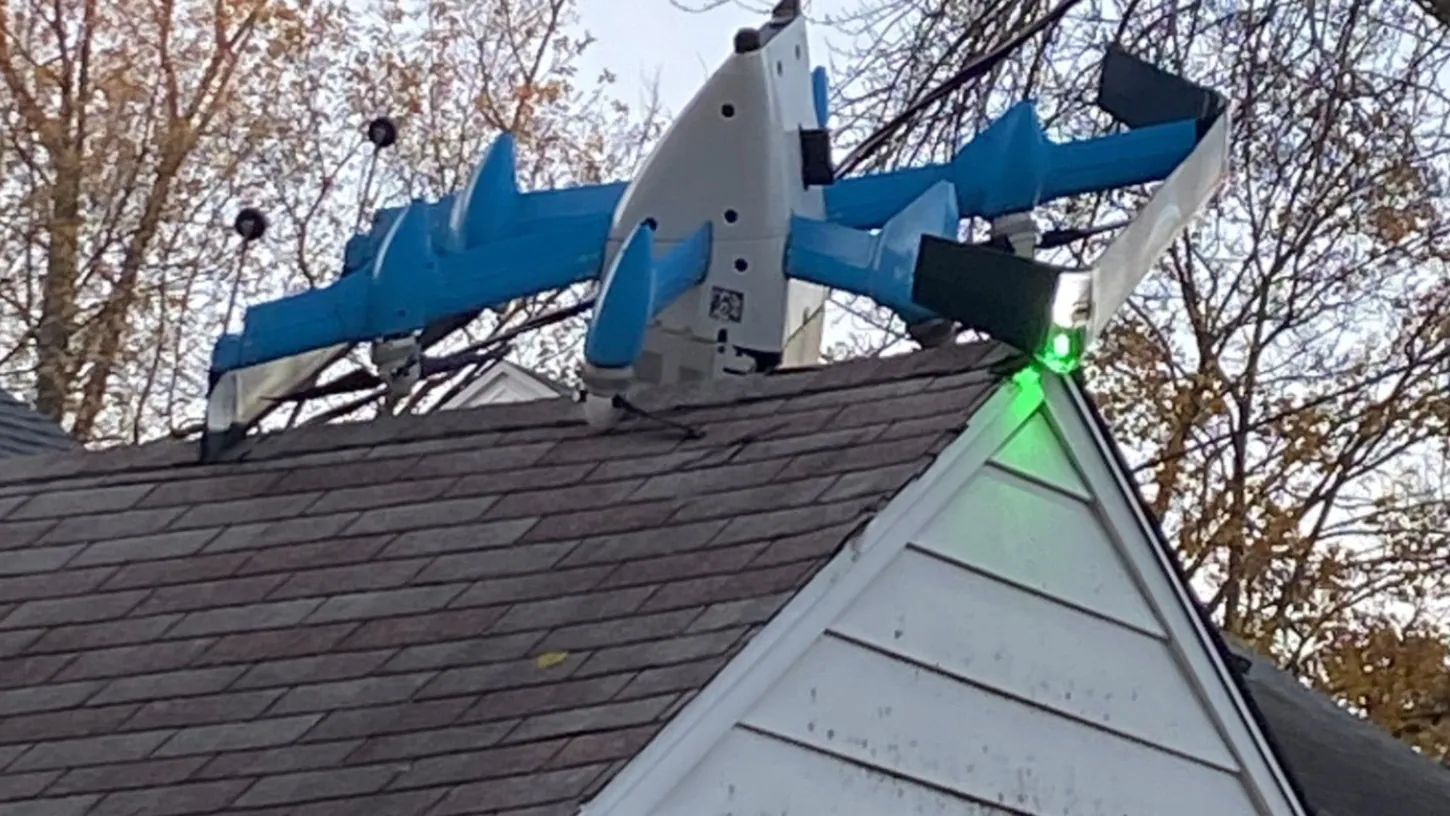
An Amazon Prime Air MK30 delivery drone ended up on the roof of a garage in Huntington Woods, Michigan, on Friday, November 20, after dropping a bottle of shampoo in the customer’s backyard next door. The customer, Jim Brennan, told Detroit’s WXYZ that the drone rose into an overhead line and lost a propeller. Amazon says it landed on a resident’s shed. Nobody was hurt. I don’t think the flight was worth the risk.
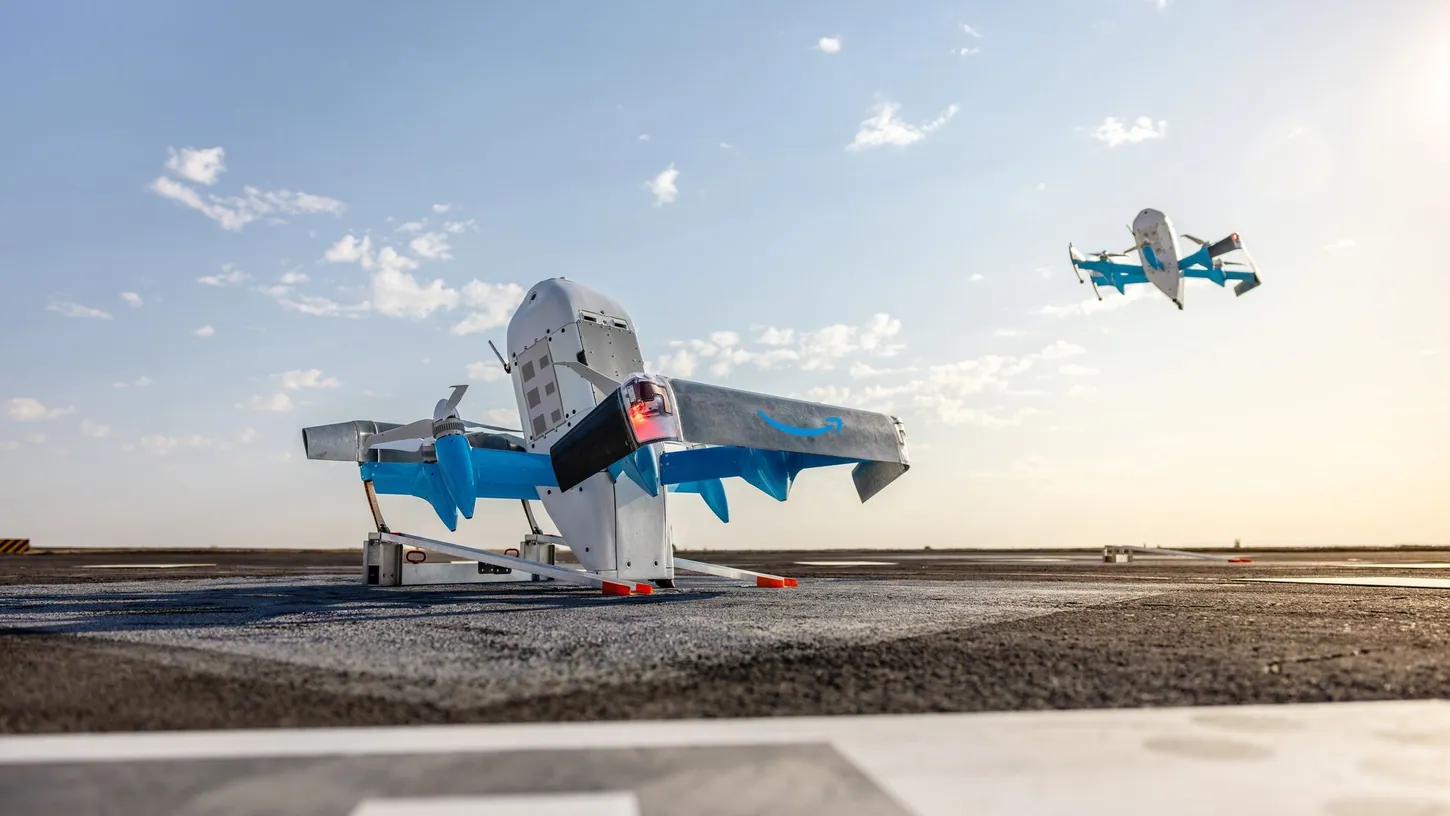
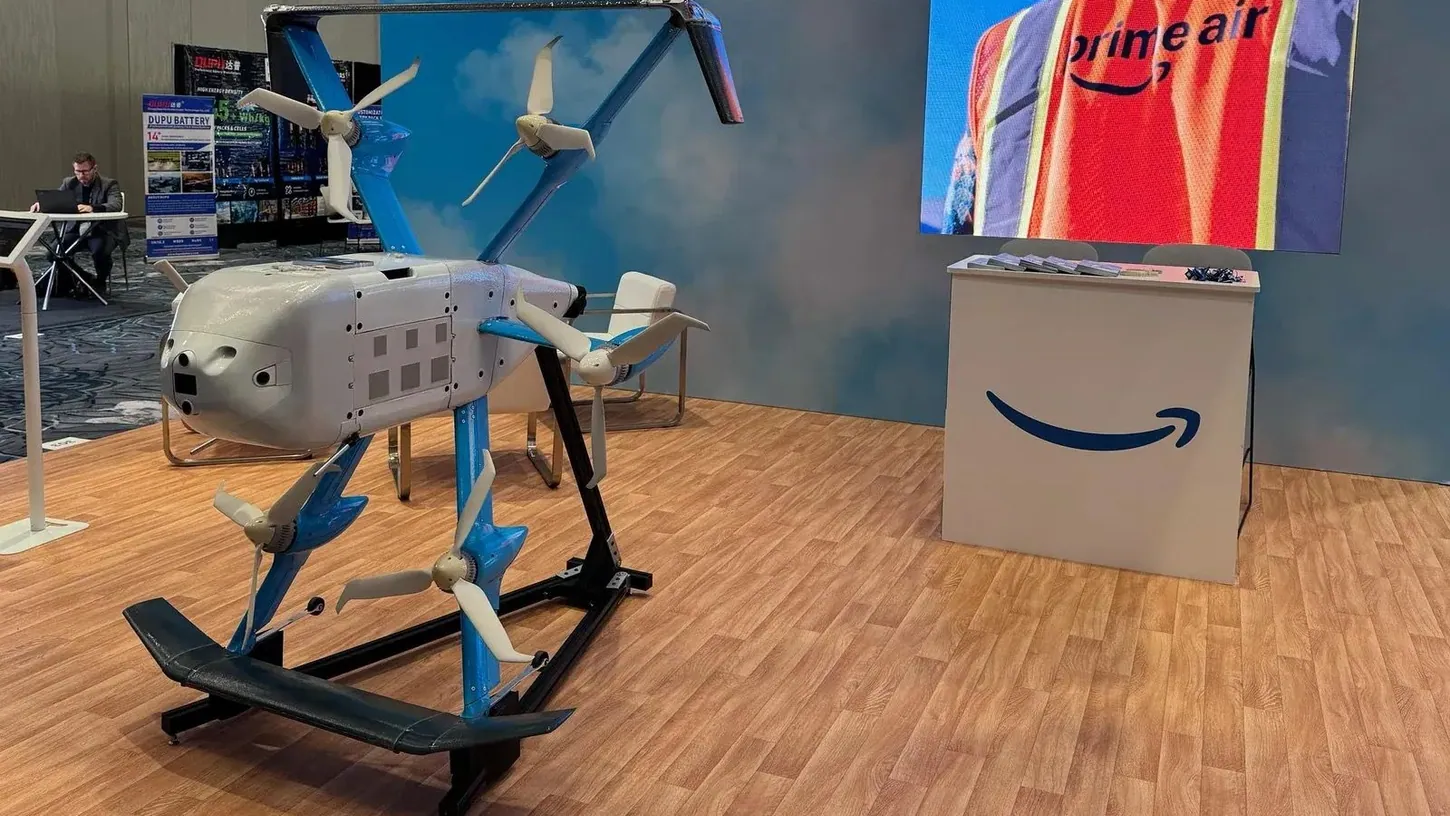
The MK30 weighs 83.2 pounds (37.7 kilograms) with a full load, is about 5 feet (1.5 meters) wide and cruises at up to 73 mph (117 km/h). It has no parachute. I stood next to one in Düsseldorf in March and again in Las Vegas in September, and on its stand it reached nearly to my shoulder. In April 2019 a drone carried a donor kidney to a hospital in Baltimore, and I’d accept far more risk for that flight than for this one.
A Kidney Justifies Risk That a Bottle of Shampoo Does Not
A drone delivered a donor kidney to the University of Maryland Medical Center on the night of April 19, 2019, for a 44-year-old woman in her eighth year of dialysis. Friday’s Amazon flight delivered shampoo, with a notification promising it in seven minutes. Both flights put an aircraft over people.
The Maryland flight is a drone delivery almost everybody supports. So is the Everdrone aircraft that brought a defibrillator to a man in cardiac arrest in Borås, Sweden, in July and was airborne 15 seconds after the alarm. Michigan itself is paying $245,000 for a pilot that will test flying donor organs to Michigan Medicine in Ann Arbor. The Maryland kidney could have gone by car in about 20 minutes, and the flight was a proof of concept, but the cargo is why people accepted it. When the Borås drone doesn’t fly, a patient pays for it.
When a shampoo flight is cancelled, the bottle comes by Amazon van. The risk on the ground is the same in both cases, because an aircraft that falls doesn’t know what it was carrying. So the less a delivery matters, the safer the aircraft has to be, and a flight that saves a trip to the store has to be very safe indeed.
The Federal Aviation Administration’s (FAA) May 2026 environmental review of Amazon’s Detroit-area hubs describes the need for the service as consumer demand for package deliveries. It says the MK30 would replace car trips to stores for “urgently needed items.” Friday’s order was shampoo.
The MK30 Flies 15.6 Pounds of Aircraft for Each Pound of Cargo
Amazon’s MK30 weighs 77.9 pounds (35.3 kilograms) empty and carries a 5-pound (2.3-kilogram) box, which works out to 15.6 pounds of aircraft for every pound delivered. Zipline’s P2 comes in at 6.9 and Wing’s two aircraft at about 5 and about 3, according to FAA filings.
DroneXL worked out those ratios from the filings for the aircraft pages of its drone delivery tracker.
| Aircraft | Takeoff weight | Payload | Aircraft per pound of cargo | How it delivers | Parachute |
|---|---|---|---|---|---|
| Amazon MK30 | 83.2 lb | 5 lb | 15.6 lb | Hovers at 13 ft and drops the box | None in any filing |
| Zipline P2 | 63 lb | 8 lb | 6.9 lb | Hovers at about 330 ft and lowers the package on a tether | Yes |
| Wing Hummingbird 7000W-B | 14 lb | 2.3 to 2.7 lb | About 5 lb | Hovers at 23 ft and lowers the package on a tether | None in filings |
| Wing Hummingbird 8000-A | 24.3 lb | 5 to 6.6 lb | About 2.7 to 3.5 lb | Hovers at 23 ft and lowers the package on a tether | None in filings |
Weight matters because of what happens after something goes wrong. The FAA’s Detroit review has the MK30 traveling at about 60 mph (97 km/h) en route, and Wing’s filings give its aircraft a cruise speed of 59 mph (95 km/h). At the same speed an 83-pound aircraft carries about six times the energy of a 14-pound one.
Amazon’s explanation, given at a press session at Commercial UAV Expo in September, is that its product inventory and its 7.5-mile (12-kilometer) delivery range, among other requirements, produced this design. Amazon also says it cut the MK30’s perceived noise by almost half compared with its earlier drones. A noise report in the FAA’s file puts the MK30 at a maximum of about 82 dBA (Lmax) from 20 feet (6 meters) during hover and takeoff, and the drone hovers at 13 feet (4 meters) over a customer’s yard to make its drop.
DroneXL Has Reported 13 Amazon Events, and Two Each for Zipline and Wing
DroneXL has reported 13 Amazon events since September 2024. They include test-range crashes, landings Amazon calls precautionary and two boxes that ended up in pools. Zipline has two, both parachute landings in Texas this year. Wing has a 2022 power line landing in Australia and a March crash in Texas.
The table uses the words the record uses, and the 13 are not all the same kind of event. Two happened at Amazon’s Oregon test range, two are deliveries where the box went wrong and the drone didn’t, and one was in England. That leaves eight in US commercial service where an MK30 hit something or came down away from its hub, against one for Wing and two for Zipline. Several of the Amazon entries are landings that Amazon says went the way the aircraft is designed to behave. No injuries were reported in any of the 17.
| Date | Operator | Place | What the record shows |
|---|---|---|---|
| Sept. 2024 | Amazon | Pendleton, Oregon (test range) | Two test drones collided in midair after operators launched them together, Bloomberg reported |
| Dec. 2024 | Amazon | Pendleton, Oregon (test range) | Two MK30s crashed in rain, and Amazon paused US deliveries in January 2025 |
| May 21, 2025 | Amazon | Tolleson, Arizona | MK30 came down inside an apartment complex, AZFamily reported. Amazon called it a precautionary safe landing |
| July 31, 2025 | Amazon | Avondale, Arizona | Propeller wash pushed a delivered package into a customer’s pool |
| Oct. 1, 2025 | Amazon | Tolleson, Arizona | Two MK30s struck the same crane boom minutes apart and came down in parking lots |
| Oct. 14, 2025 | Amazon | Goodyear, Arizona | MK30 landed on a sidewalk about 5 feet from a resident. Amazon called it a precautionary safe landing |
| Nov. 18, 2025 | Amazon | Waco, Texas | MK30 struck a wire line after a delivery, and the FAA said it was investigating. Amazon called it a safe contingent landing |
| Feb. 4, 2026 | Amazon | Richardson, Texas | MK30 hit an apartment building and fell to the sidewalk |
| July 29, 2026 | Amazon | Darlington, England | MK30 came down in a garden, and the UK’s air accident investigators opened a case. Amazon said it had touched an object on a moving vehicle and came down as designed |
| Aug. 17, 2026 | Amazon | Richmond, Texas | Package dropped from about 13 feet landed in a customer’s pool |
| Sept. 11, 2026 | Amazon | Baton Rouge, Louisiana | MK30 landed itself beside Florida Boulevard, with no visible damage |
| Sept. 2026 | Amazon | Waco, Texas | MK30 N328PA set down on dry grass at a workplace. Photos were posted September 21 |
| Nov. 20, 2026 | Amazon | Huntington Woods, Michigan | MK30 ended up on a garage roof after a shampoo delivery. The customer says it hit a line and lost a propeller. Amazon says it landed on a resident’s shed |
| Sept. 29, 2022 | Wing | Browns Plains, Australia | Drone made a precautionary landing onto a power line and burned, and about 2,000 homes lost power |
| March 1, 2026 | Wing | Kemah, Texas | Drone crashed on a return flight and burned, The Daily News reported. The cause is under review |
| July 26, 2026 | Zipline | Greenville, Texas | P2 came down under its parachute on a residential street |
| Sept. 4, 2026 | Zipline | Cypress, Texas | P2 came down under its parachute on Highway 6 |
The Kemah crash is new to DroneXL’s file. I found it while researching this piece, in a report by The Daily News of Galveston County. The paper reported that Kemah’s fire chief believed a power line collision was possible, and that Wing said the cause was under review. In September I wrote that Wing had no US incident in DroneXL’s record. That was true of the record and it missed Kemah.
This list is what DroneXL has found. DroneXL asked all three companies in September how many times their aircraft have come down away from a hub. Amazon and Wing did not answer, and Zipline answered with its mileage. Amazon’s program also crashed test drones before the MK30, including a 2021 crash in Oregon that an FAA report says set several acres on fire. A count is also not a rate. Amazon told WXYZ it has delivered hundreds of thousands of packages by drone this year and called incidents “extremely rare.” Wing says it has passed one million deliveries worldwide, and Zipline says more than 2.5 million. Nobody outside the companies can turn those figures into incidents per flight.
Zipline’s Two Entries Both Ended Under a Parachute
Both Zipline entries ended with a P2, which weighs up to 63 pounds (29 kilograms), coming down under a parachute. Zipline delivers from about 330 feet (100 meters) and lowers the package on a tether, so the aircraft stays above the wires and fences that the MK30 descends among.
Amazon’s design is the heaviest of the three and it comes lowest, to 13 feet against Wing’s 23, and neither of those two has a parachute. Three of Amazon’s entries are collisions with a fixed object: a crane boom, a wire in Waco and an apartment wall. Huntington Woods is a fourth if the customer’s account holds. In September DroneXL asked Amazon what the MK30 is designed to do after it hits something. Amazon did not answer, then or in the two rounds of questions that followed. Zipline answered some of the same questions in writing.
A parachute doesn’t settle it. One of Zipline’s came down in a traffic lane, and Zipline had not said what caused either landing when it answered DroneXL’s questions on September 16. Wing stopped using parachutes because an open canopy takes away the aircraft’s steering, and one of its drones still burned in Kemah. Amazon points to six motors and backup flight controllers, and the FAA’s Detroit review notes the MK30’s redundant safety features and its detect-and-avoid system.
DroneXL’s Survey Asks Readers Where the Line Belongs
Every town guide in DroneXL’s drone delivery tracker carries the same anonymous five-question survey. One answer says you’d use drone delivery only for medicine or urgent items. Another says a lighter aircraft with a parachute would make it acceptable. It takes about two minutes.
Readers under Amazon’s Michigan hubs can answer on the Hazel Park guide, and the full list of town guides covers the other markets. It is a count of who answered and not a scientific poll. If your town has no guide yet, the comments under this article are open, and I’d like to know where you would draw the line between a kidney and a bottle of shampoo.
Residents with a complaint can reach Amazon at 1-888-280-4331 or through its customer service chat, under “Something Else” and then “Amazon Drone Delivery.” DroneXL’s guide for residents lists the other routes, and the Amazon Prime Air tracker page keeps the incident record current.
DroneXL’s Take
I want drone delivery to work, and I’ve written for years that drones should be used for good. A kidney or a defibrillator is worth real risk, and I’d expect most people to agree. A bottle of shampoo is worth almost none. I don’t want to live in a society where getting shampoo in seven minutes is reason enough to send an 83-pound aircraft down between the power lines of a residential street.
Amazon says incidents are extremely rare, and nobody has been hurt in any of them. But Amazon said in August that it plans to reach nearly 500 cities and towns by the end of this year, and in my view a small rate multiplied by that many backyards stops being a small number. The garage’s owner told WXYZ that Friday’s flight left lifted shingles on his roof, and that Amazon offered to help with the damage and gave him a $100 gift card. Brennan told the station he still looks forward to his next drone delivery. Amazon says its drones pick a landing spot clear of people. This one ended up pinned between a garage roof and an electrical cable, by Brennan’s account, and I’d call it luck that nobody was under it.
My read is that the MK30 is the wrong aircraft for this job. Amazon should build a smaller, lighter and quieter drone that stays high and lowers the box, and it should carry a recovery system for the day the sensors miss a wire. Zipline and Wing both show that a lighter aircraft can do this work. Until Amazon has one, the MK30 should fly the deliveries that justify it, and shampoo should come by van.
Sources: WXYZ, FAA Final Environmental Assessment and FONSI/ROD, Amazon Prime Air, Detroit, MI (May 2026), FAA Technical Noise Report, Appendix E, The Daily News of Galveston County, DroneXL Drone Delivery Tracker
DroneXL uses automated tools to support research and source retrieval. All reporting and editorial perspectives are by Haye Kesteloo. Read our editorial standards.
Advertise with DroneXLYour company hereReach 200,000+ drone readers a month with a sponsored article, a banner on your beat, or a partnership.See the options →