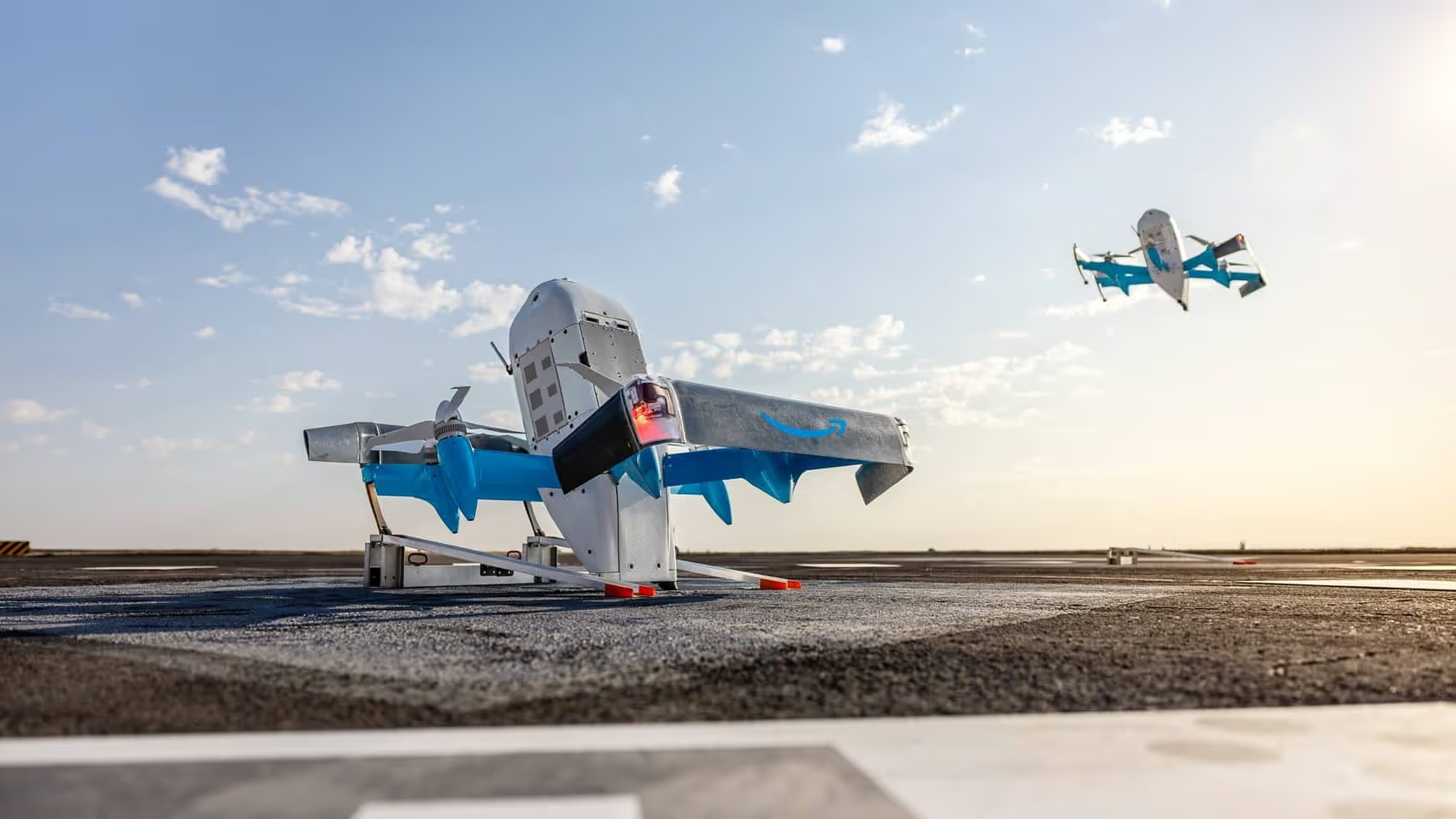
Amazon plans to offer Prime Air drone delivery in nearly 500 US cities and towns by the end of 2026, a sixfold increase over its current footprint, the company announced Wednesday. New launch sites in the Chicago, Atlanta, Cleveland, Syracuse, and Boise metro areas will join the 11 markets where Prime Air already flies across seven states.
That headline number deserves a second look before anyone pictures 500 drone ports. Each Prime Air site covers roughly 175 square miles (453 square kilometers), and Amazon counts every municipality inside that circle toward the total. Standing next to the MK30 delivery drone at XPONENTIAL Europe in Düsseldorf this April, what struck me was how much aircraft delivers how little payload. The same ratio runs through this announcement: the fleet is modest, and the arithmetic is generous.
Amazon Counts Every Town Inside Each 175-Square-Mile Circle
Prime Air currently flies from 11 sites in seven states, and each site serves an area of roughly 175 square miles (453 square kilometers). Amazon’s “nearly 500 cities and towns” tally counts every municipality those circles touch, so a handful of new metro launches multiplies the number quickly.
Work Amazon’s own multiplier backward and today’s 11 sites already count as roughly 80 cities and towns, a bit over seven municipalities per circle. Drop the same circle on the south suburbs of Chicago, where Prime Air plans to fly from fulfillment centers in Markham and Matteson, and the count climbs far faster, because 175 square miles is a circle roughly 15 miles (24 kilometers) across, and suburban Cook County packs dozens of incorporated villages into that much ground.
The five named metros put Prime Air in Georgia, Ohio, Illinois, Idaho, and New York for the first time, with what Wednesday’s announcement calls more communities to come later this year. At least one launch carries a caveat Amazon’s own team supplied: in May, Prime Air infrastructure principal Jeff Cleland told Syracuse residents that the Clay, New York operation hoped to fly this year but could slip into 2027 depending on FAA approval timelines. Syracuse still sits on today’s list.
The urgency has a name, and it’s Walmart. About 90 percent of Americans live within 10 miles (16 kilometers) of a Walmart store, and Walmart’s partner Wing is under contract to fly from more than 270 of them by 2027, an advantage DroneXL mapped in July. Amazon has to draw each circle around a warehouse instead. A sixfold jump in the municipality count is how a warehouse network answers a store map.
Prime Air Halved Its Fees And Widened The Catalog Before Scaling Up
Drone delivery is now free for Prime members on orders of $50 or more. Smaller Prime orders cost $2.99 and non-members pay $4.99. Nearly any item under 5 pounds (2.3 kilograms) that fits a large shoebox qualifies, which Amazon says covers more than 60% of frequently purchased products.
The pricing is the quiet story here. When Waco launched last November, Prime members paid $4.99 per drone delivery and everyone else paid $9.99. Nine months later the same service costs $2.99 and $4.99, with the free tier on top. Companies don’t halve fees on a product they’re winding down.

The volume figures remain Amazon’s own. “We’ve already delivered hundreds of thousands of packages to customers by drone this year,” said David Carbon, vice president of Prime Air. CNBC reported that Carbon told employees in a March all-hands that the division expects to reach 1 million deliveries in 2026, and CEO Andy Jassy’s annual shareholder letter set targets of communities with 30 million customers by year-end and half a billion packages annually by 2030. Most orders arrive around 60 minutes after checkout, with the fastest at about 30. “It’s still an experiment,” Forrester retail analyst Sucharita Kodali told the Associated Press.
The MK30’s Incident Record Travels With The Expansion
Five new metro areas will inherit an aircraft with a documented incident history: a two-month nationwide grounding in early 2025, two crane strikes in Arizona, a severed internet cable in Waco, and an apartment-building collision in Richardson, Texas. No serious injuries have occurred across any of these events.
Amazon voluntarily paused all US commercial drone operations in January 2025 after two MK30 drones crashed at its Oregon test site, where a software update had made lidar altitude sensors read light rain as the ground. The FAA approved a fix that March and flights resumed. The incidents that followed through late 2025 and early 2026 all involved stationary obstacles, a record DroneXL compiled when Amazon pitched Central New York on its 176-square-mile delivery zone.
Amazon’s answer is its Detect-and-Avoid system, which the company takes seriously enough that it quit the Commercial Drone Alliance in March over whether such systems should be mandatory across the national airspace. In more than 70,000 flights, Amazon says, the system twice steered its drones away from crewed aircraft, one of them a helicopter that wasn’t broadcasting its position. The company holds Part 135 air carrier certification, the same framework used for commercial airlines, along with FAA waivers to fly beyond visual line of sight, and its 11th market opened in Papillion, Nebraska, just three weeks ago. The drones fly suburbs, not downtowns, and steer clear of major airports.
DroneXL’s Take
The 500-city figure is a counting choice, not a construction plan. Amazon measures municipalities its delivery circles overlap, and one suburban circle can sweep in dozens. The plan is real, the growth is real, and the headline number still flatters the map more than the fleet.
Concede what’s real first: this is no longer the program that limped through 2024. Fees got cut in half, thousands of packages move daily, and the January 2025 grounding produced an FAA-approved fix instead of a quiet shutdown. Thirteen years after Jeff Bezos told 60 Minutes that drone delivery was four or five years away, packages actually arrive by air in 11 American markets. That deserves to be said plainly.
What I don’t trust is the unit of measurement. The announcement never says how many launch sites the 500-town map requires, and the site count is the number that determines capital spending, jobs, airspace load, and how many planning boards Amazon has to win over. Syracuse shows why that missing number matters: Amazon’s own infrastructure principal allowed in May that Clay could slip to 2027, yet Syracuse appears on today’s list of metros launching soon. Winter isn’t a press release variable either. The MK30 stays on the ground below 14 degrees Fahrenheit (minus 10 Celsius), which puts real holes in a Boise, Cleveland, or Central New York December, exactly the month the year-end count comes due.
My scorecard for this promise is short. Watch whether Clay and Markham actually fly before the FAA’s environmental assessments and local site-plan approvals run out of calendar, and watch the December accounting: if “nearly 500” survives it, Amazon will have earned the number the same way it defined it, one 175-square-mile circle at a time. Half a billion packages a year by 2030 works out to well over a million drone flights a day. Today’s operation flies thousands. Between those two figures sits every hard question this announcement doesn’t answer.
Sources: Amazon, CNBC, Associated Press
DroneXL uses automated tools to support research and source retrieval. All reporting and editorial perspectives are by Haye Kesteloo.