
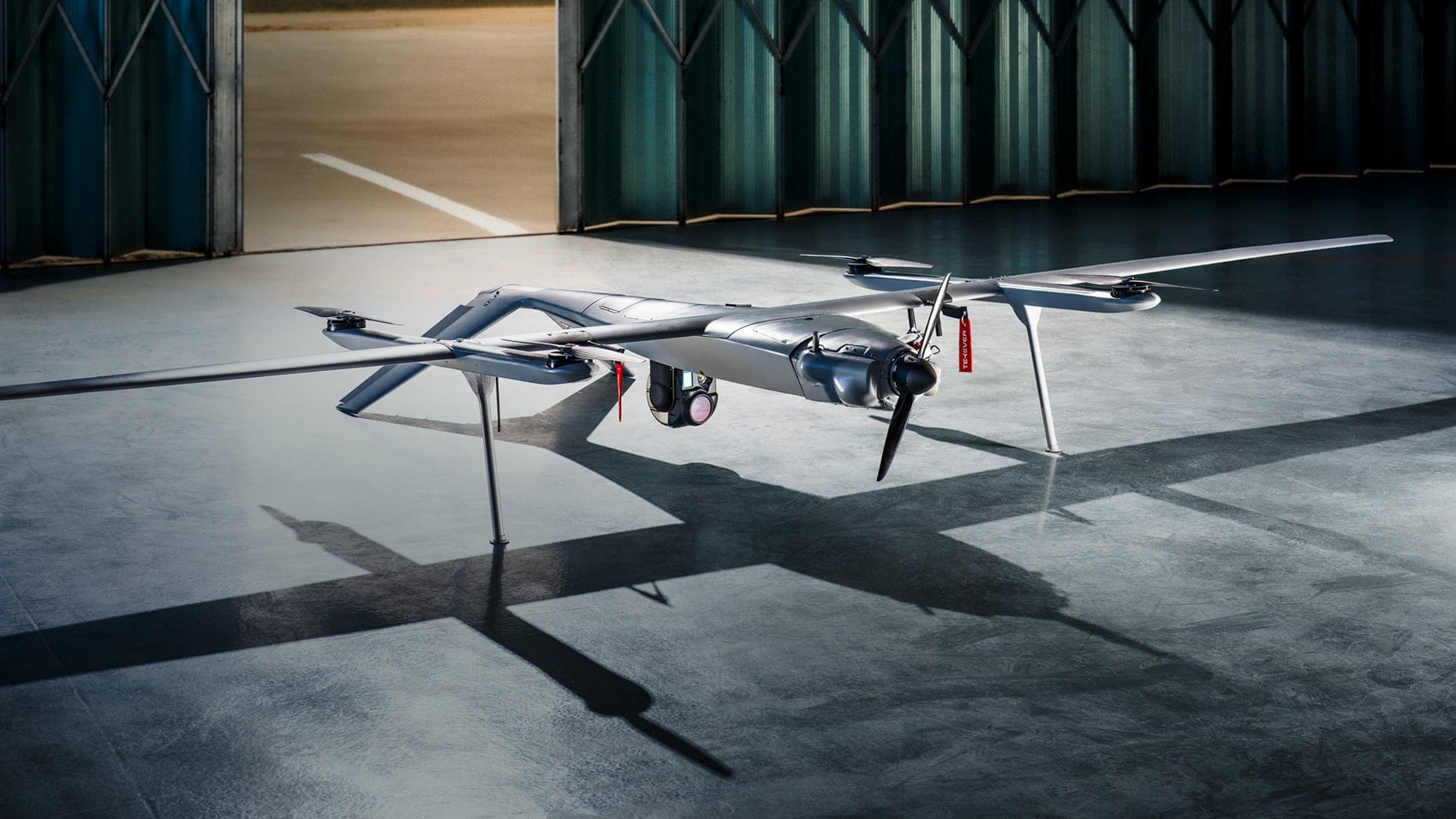
Tekever, the Portuguese-British maker of AI-driven surveillance drones, said Wednesday it has closed the first $580 million of a Series D round at a $6.4 billion valuation. The University of California’s investment office and Baillie Gifford led it. It is UC Investments’ first direct investment in Europe.
When we covered Tekever’s $74 million round in November 2024, the pitch was U.S. expansion. By May 2025 it was a unicorn, valued above £1 billion. The new valuation is more than four times that, and it lands one week after Tekever signed a contract worth up to £400 million ($530 million) to replace the British Army’s Watchkeeper drones.
Tekever lists acquisitions among the uses for the money. The day before the round was announced, it signed a memorandum of understanding with Estonian drone maker Threod Systems, which was reported to be exploring a sale last year.
Tekever Raises Money to Buy Companies, and Has Already Started
CEO Ricardo Mendes told Bloomberg Television he expects the defense technology market to consolidate heavily over the next few years, and that the round is designed to fund growth through acquisitions. Tekever made one purchase this month and signed one framework deal.
The interview was reported by The Next Web. The Series D announcement says the first close covers most of the raise, with more closings to come over the next few months.
On September 1, Tekever bought Flowcopter, the Edinburgh company whose hydraulic transmission powers Tekever’s new AR6 heavy-lift drone, which Tekever says carries at least 441 pounds (200 kg) over 311 miles (500 km). DroneXL first wrote about Flowcopter’s cargo drone in 2022.
The Threod memorandum of understanding, announced September 22, sets up a framework for “long-term cooperation” on technology and joint programs. The announcement mentions no equity stake or acquisition. Bloomberg reported in July 2025 that Threod was exploring a sale after its 2024 revenue rose 87% to €38 million.
Merlyn Advisors joins as a new investor, and its portfolio manager is former U.K. Defence Secretary Ben Wallace. “Tekever has a proven track record that shows it can do all three,” Wallace said, meaning innovate fast, scale industrially and meet operational needs. Crescent Cove, Ventura Capital and Iberis Capital put in more money.
The AR5 Takes Over From Watchkeeper, Britain’s £1.4 Billion Drone Fleet
The U.K. Ministry of Defence picked Tekever’s AR5 on July 25 to replace Watchkeeper, in service since 2014. The government announcement sets an initial order of six aircraft, up to 24 delivered by 2029, under a deal worth up to £400 million over 10 years.

Tekever signed the CORVUS contract on September 16. The AR5 carries up to 110 pounds (50 kg) of cameras and sensors, according to the MoD. Tekever says it will build the aircraft in Swindon and expects them to start entering Army service later this year. The case for it rests on Ukraine, where Tekever says its drones have flown more than 50,000 operational hours since 2022.
Watchkeeper is the benchmark CORVUS gets measured against. In 2024 we reported that the U.K. had spent £1.4 billion on 54 of them and that none were on operational deployment. Last November, Skyeton’s Ukrainian-built Raybird was reported to be under consideration as the replacement. Tekever got the job.
Mendes told Bloomberg the company now employs more than 1,500 people. Tekever opened its first U.S. office in Fayetteville, North Carolina, in May.
DroneXL’s Take
My read: most of Europe’s defense tech money has arrived ahead of battlefield results, and Tekever is the rare case where the order ran the other way. Helsing raised $1.8 billion in July after Politico reported its HX-2 hit five of 14 targets in the Donbas, a figure Helsing disputed. Stark’s strike drones missed on all four attempts in October 2025 trials with British and German forces, then raised €500 million in June. Tekever builds surveillance drones, flew them in Ukraine for years, and then got a signed contract from a customer with a £1.4 billion reason to be careful. The 50,000 hours are Tekever’s own figure. The British Army still bet its next surveillance program on that record after Watchkeeper, and that is a harder test than any pitch deck.
The part I’d watch is the shopping list. A company that raises $580 million to consolidate the market now owns a propulsion firm and has a paper relationship with a drone maker that was reportedly exploring a sale. University of California money now sits behind that shopping list, and behind a company that opened a North Carolina office in May to support U.S. partners and end users.
Sources: CNBC, Tekever, GOV.UK, The Next Web
DroneXL uses automated tools to support research and source retrieval. All reporting and editorial perspectives are by Haye Kesteloo. Read our editorial standards.


