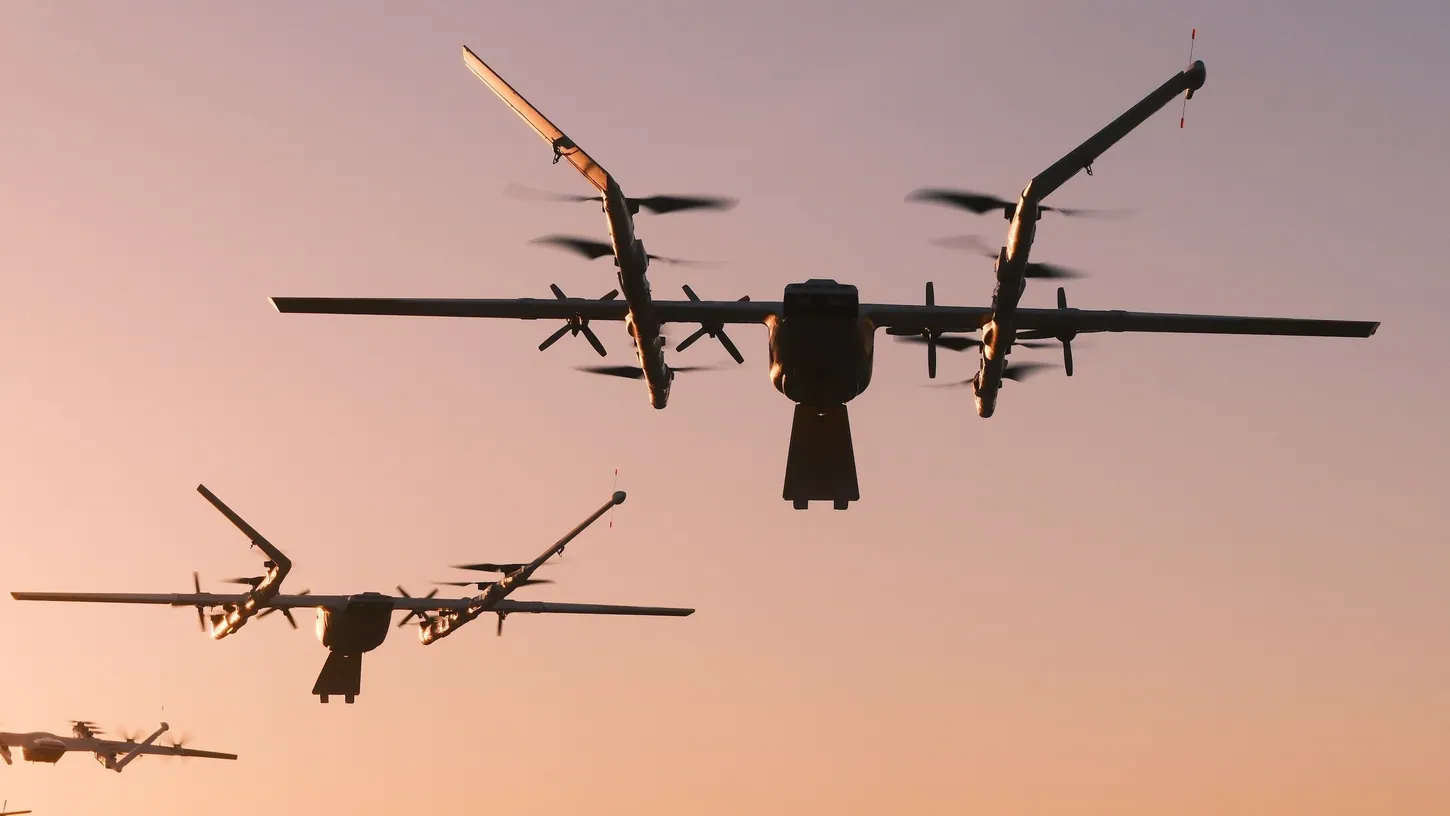
DoorDash unveiled the aircraft behind DoorDash Air on Wednesday at Dash Forward, its annual product event. The drone flies on six slow-spinning propellers and lowers orders to the ground on a winch. Pilot deliveries will start in Northern California with Chipotle Mexican Grill, Popeyes Louisiana Kitchen and a local restaurant, Momo N Curry. DoorDash gave no start date and named no city.
When DoorDash earned its FAA Part 135 air carrier certificate on July 29, I wrote that three numbers would decide what kind of aircraft it had built: span, payload and maximum takeoff weight. Today’s announcement says the drone can carry about 80% of typical DoorDash restaurant orders. It gives no payload weight.
DoorDash Built The Kitchen Handoff Before It Built The Drone
DoorDash says it designed the loading systems, packaging and kitchen handoff first and the aircraft second. Crews pack and hand off an order as usual, and a winch handles both pickup and drop-off. Failsafe systems can lower the entire aircraft to the ground in rare events, the company says.
That sequence is the pitch to merchants. Popeyes chief digital officer James Huang said the drone works “without asking our restaurant teams to change a thing.” Mohan Khatiwada, who owns Momo N Curry, said his small front-of-house staff makes every minute of order handling count. Chipotle’s chief digital officer, Arlie Sisson, said the service gives guests more choice in how they get their food.
Dispatch runs through DoorDash’s Autonomous Delivery Platform, the same software that already assigns orders to Dashers and to Dot, the company’s sidewalk robot. It weighs weather, flight range and ground traffic before sending an order by air, according to DoorDash’s announcement. Harrison Shih, head of DoorDash Air, framed the goal as “Any local business should be able to reach consumers by air.”
The partner fleets stay. DoorDash spokesman Eli Scheinholtz told FreightWaves that Wing and Flytrex keep flying for DoorDash, and that more than one drone option adds resilience to its network. Wing started flying Lowe’s orders sold through the DoorDash app in Matthews, North Carolina, only six days ago, as DroneXL reported in Lowe’s Now Flies Painter’s Tape to Charlotte Yards in 20 Minutes.
DoorDash Air’s Only Capacity Figure Is A Share Of Orders
The 80% figure is DoorDash’s estimate, drawn from U.S. restaurant deliveries of limited distance and size over a limited period, a footnote in the release says. Like DoorDash’s July post, the announcement lists no payload in pounds, no range, no cruise speed and no maximum takeoff weight.
Compare that with Wing. Lowe’s customers in Matthews are held to Wing’s limit of about 2.5 pounds (1.1 kg) per flight, a number anyone can plan an order around. A share of DoorDash’s own order history can’t be checked against anything.
The delivery-time claim has the same shape. DoorDash says initial tests averaged under five minutes from restaurant to door, footnoted as a sample of limited distance and size, with times not guaranteed. In July the company put its 2025 drone deliveries, all flown by partners, at a 25-minute average, described only as its latest estimate.
Noise gets a comparison instead of a measurement: cruising sound roughly like a passing car at delivery height, with neither the decibel level nor the height given. Co-founder Stanley Tang went further when he posted the launch video on X, calling the drones “as silent as a passing car.”
This is DoorDash Air.
- Stanley Tang (@stanleytang) September 30, 2026
Noise is already a Bay Area question for DoorDash. In August 2025 it leased a warehouse at 1960 Folsom St. in San Francisco’s Mission District to build and test aerial delivery systems. Teamsters Local 665 appealed the zoning approval over jobs, and residents quoted by Mission Local raised noise and privacy, as DroneXL covered in DoorDash’s Mission District Drone Test Faces Union Pushback.

The one hard airframe detail, six propellers mounted at the ends of the arms, also corrects my own July read. In DoorDash Just Became An Airline, I took the pointed nose in DoorDash’s launch video for a winged hybrid VTOL. DoorDash’s own photo released today shows no wing: a pointed white fuselage sits on two cross booms, each carrying three rotors. The nose I saw was real. The wing I inferred from it was not.
DroneXL’s Take
DoorDash did the hard part in the right order. Starting from the restaurant counter instead of the airframe is how drone delivery gets past pilot programs, and a Popeyes crew that never changes its routine is the version merchants will actually adopt. I want this to work.
But “80% of orders” and “a passing car” are marketing units. The people who will live under these flights need a payload weight, a maximum takeoff weight and a decibel figure at a stated height, and DoorDash has now had two announcements to publish them. DroneXL sent 30 written safety questions to Wing, Zipline and Amazon when it launched its Drone Delivery Tracker. DoorDash is now an airline with its own aircraft, and it belongs on that list. Until it publishes those numbers, Northern California neighbors are being asked to accept a drone overhead on the strength of a comparison.
Sources: DoorDash (Business Wire), DoorDash, July 29, 2026, FreightWaves, Stanley Tang on X
DroneXL uses automated tools to support research and source retrieval. All reporting and editorial perspectives are by Haye Kesteloo. Read our editorial standards.