
The Federal Aviation Administration has rewritten the internal order that decides what drone pilots get back from FAADroneZone. Order JO 7200.23E, Processing of Unmanned Aircraft Systems Requests, is listed on the FAA’s orders page with an October 1 issue date and takes effect October 31. It cancels the April 2023 version and runs to 36 listed policy changes.
The one most Part 107 pilots will feel first: a drone inspecting a cell tower or high-rise inside controlled airspace can now be authorized above the LAANC grid ceiling without any coordination with the control tower. The same order writes down, for the first time, how the FAA handles requests inside the Class E surface area around smaller airports, and it takes multi-day approvals at grid altitude away from everyone except first responders. Every Part 91 drone approval now carries a see-and-avoid waiver.
The order’s own change list says the Class E surface rule exists because “this type of request was not addressed in previous versions of the order.” Those surface areas already carry UAS Facility Map grids on the FAA’s public map.
Tower Inspectors Get 100 Feet Above the Structure With No ATC Coordination
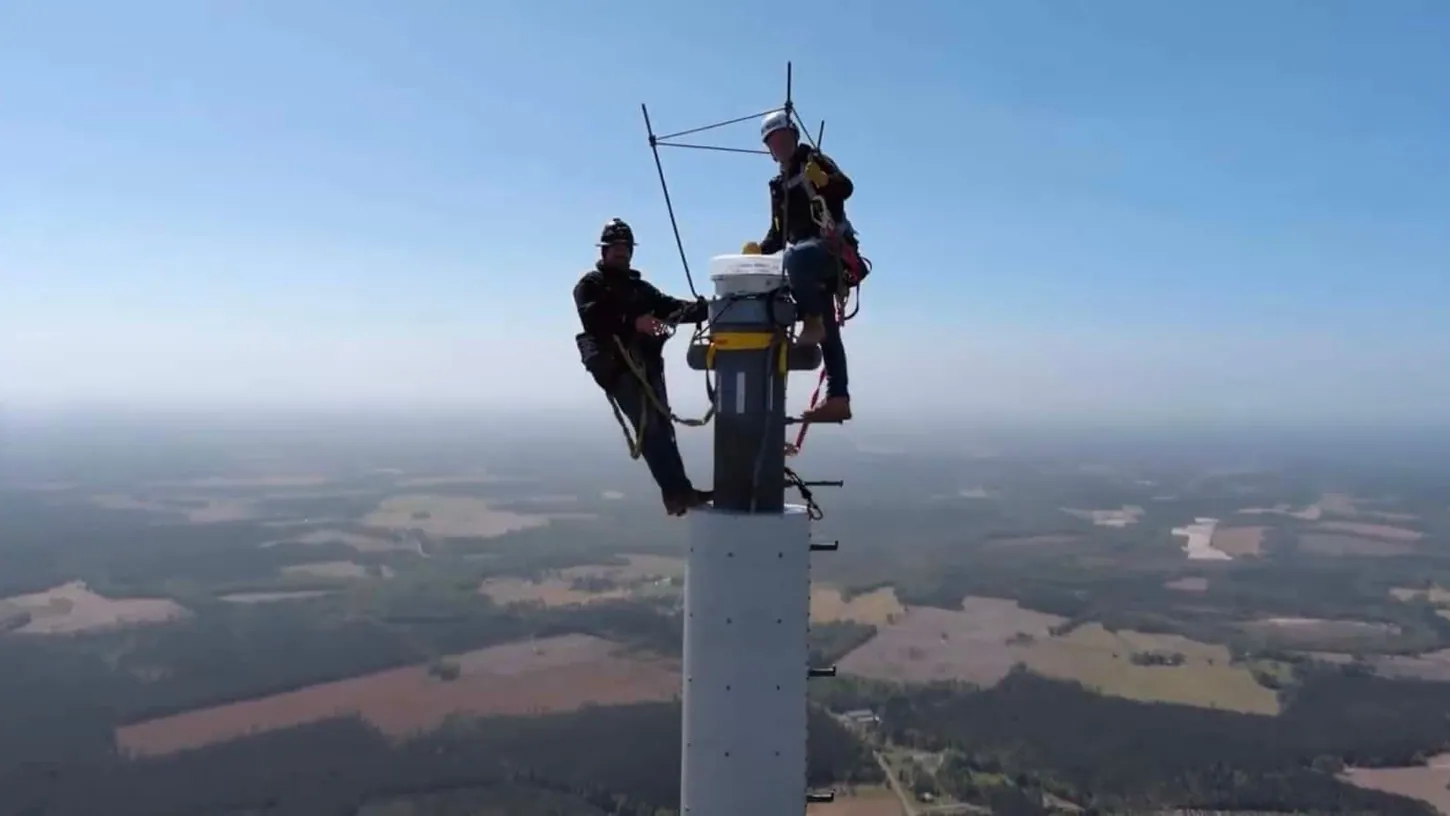
Paragraph 3-5 of the new order says air traffic facility coordination “is not required” above the facility map altitude for a Part 107 line-of-sight inspection of a vertical structure. The pilot stays within a 100-foot (30-meter) radius of the structure and no more than 100 feet above its top.
The drone also stays at least 2 nautical miles (3.7 kilometers) from any runway, heliport, seaplane base or vertiport unless a separate authorization covers it, keeps 500 feet (152 meters) below and 2,000 feet (610 meters) horizontally from clouds, and the pilot needs 3 statute miles (4.8 kilometers) of visibility from the control station. Bridges and power lines do not qualify. The order names cell towers, communications towers and high-rise buildings as examples and excludes “vertical structures with horizontal spans.”
The authorization can be written for a specific site or for the whole country. The order says a Service Center can “write a nationwide authorization for companies that make such a request,” with coordination among the FAA’s Service Centers left to the processing team manager. Tower inspection authorizations under this paragraph can run 24 months, against a single day for an ordinary request at a LAANC-enabled airport.
Requests still go through FAADroneZone, even at LAANC airports, and the order excludes airspace delegated to the Department of War. For a specific-area authorization, paragraph 4-5 says the Service Center is not required to verify that the operator meets the criteria, only that it “can do a cursory check.” The order puts compliance on the pilot: “It is the proponent’s responsibility to ensure they comply with the AA requirements.”
Class E Surface Areas Get a Formula the Order Says Nobody Wrote Down Before
Paragraph 3-3 covers the Class E surface area designated for an airport. On a sectional it is the dashed magenta ring around a field with no tower. The FAA says the facility map grids came from a national safety risk management panel using concentric circles from the airport reference point.
The circles are now policy. Inside 2 nautical miles (3.7 kilometers) of the reference point, a Part 107 pilot gets nothing without prior coordination and approval from the air traffic facility. From 2 to 3 nautical miles the ceiling is 100 feet (30 meters). From 3 to 4 it is 200 feet (61 meters), and beyond 4 nautical miles it is 400 feet (122 meters). Every authorization also requires a 1,000-foot (305-meter) cloud ceiling, a condition the standard facility map grid never carried.
Recreational flyers under Section 44809 get the same rings with a harder edge. Inside 2 nautical miles, requests “are not authorized” at all. Where a facility has built its own map that does not follow the circles, the facility’s map wins.
The order also closes a door on hobbyists. Individuals asking for a fixed flying site under Section 44809 are to be denied with the line “Individuals will not be granted approval for fixed sites,” and fixed sites and aviation events are reserved for community-based organizations. The FAA will issue those as airspace authorizations instead of letters of agreement.
Multi-Day Approvals at Grid Altitude Now Go to First Responders Only
The one-day rule survives for ordinary pilots. A request in airspace managed by a LAANC-enabled facility, at or below the grid altitude, is issued for a single day. Ask for a week and the Service Center issues the first day. It then tells the pilot to use LAANC next time.
The 2023 order let any operator with a defined project, a construction job for example, get a multi-day authorization at grid altitude. The new one reserves that at-grid option for first responders, and only when the approval saves the agency or the FAA paperwork. Above the grid, the rules the 2023 order already carried stay: a multi-day approval needs the facility manager’s sign-off and a project with a start and end date, and first responders get relief from the single-day policy. The one addition there is a buffer of up to 14 days “to address potential flight cancellations or delays due to weather,” with the air traffic facility’s approval.
The public safety demand is on the record. DroneXL reported in August that a FOIA release showed the FAA had cleared more than 1,000 agencies for drone first responder flights in ten months, and departments like Warwick, Rhode Island, which is waiting on zero-foot grids at T.F. Green to fly its Flock drones, are the operators the at-grid exception now serves.
Part 107 operational waivers now move through the FAA’s Aviation Safety Hub instead of FAADroneZone, and the order adds the moving-vehicle waiver under 107.145 to the list, which it says “was missing” from the 2023 version. COA extensions are capped at 60 days and barred once a COA has expired.
Every Part 91 Drone Approval Now Carries a See-and-Avoid Waiver
Chapter 5 was rebuilt around one sentence: all drone operations under Part 91, “whether within VLOS or beyond visual line of sight,” require relief from 14 CFR 91.113(b), the rule that requires a pilot to see and avoid other aircraft. The 2023 order attached that waiver to BVLOS flights only.
The new one attaches it to every Part 91 approval, because a drone has no pilot on board to see anything. The FAA split the work between two offices. A September 3, 2025 memorandum of agreement delegated line-of-sight 91.113(b) waivers to the Air Traffic Organization’s Service Centers, which process them with the COA itself and must list 91.113 on the FAA Form 7711-1. BVLOS waivers moved out of the headquarters UAS policy team, which ran a multi-office technical review and had applicants present their case to a panel, and into Flight Standards office AFS-750, which takes a concept of operations by email and issues the waiver before the pilot applies for airspace in CAPS. Applications and renewals are due 60 business days ahead, and a COA still expires at 24 months.
The 2023 order’s Tactical BVLOS section for first responders is gone from the main text. The FAA’s own public safety FAQ says the expedited public safety COA it introduced in April 2025 replaced the Tactical BVLOS approval, which DroneXL first covered in June 2023. The new order does not list the removal among its 36 changes.
The order also drops a numerical error. The agency agreements that let NASA, the Interior Department, the Forest Service and Customs and Border Protection fly small drones in Class G without a COA cap those flights at 1,199 feet (365 meters) above ground, and the 2023 text had said 1,200. The whole document now refers to the Pentagon as the Department of War, and a new chapter formalizes how the FAA and NAV CANADA handle six border airports, including Bellingham and Sault Ste. Marie, where one country’s controllers manage the other’s airspace.
Trade group NATA posted a short note on the order on October 6, the only coverage DroneXL has found. The order’s PDF carries a September 22 date in its filename, nine days before the issue date on the FAA’s listing.
DroneXL’s Take
I read the tower paragraph twice because it is the most useful thing the FAA has written for working Part 107 pilots in a while. A pilot inspecting a monopole inside Class D used to choose between a grid ceiling that stopped below the antennas and a bespoke authorization that took weeks and a tower’s goodwill.
Now the FAA has said, in its own order, that a drone hugging a tower is not a conflict for the pattern. The facility maps should have carried that rule from the start, and it took until 2026 to say it.
The Class E circles are harder to cheer. The FAA is admitting that the grids around its non-towered Class E airports came from a panel formula rather than from anyone who knows the field, and the fix is to make the formula official, with a cloud ceiling requirement the rest of the map system does not have. A pilot 2.5 nautical miles from a quiet Class E airport gets 100 feet, and a pilot at a busy Class D airport with a tower that bothered to draw its map can get 400 feet. My read is that the circles are a placeholder the FAA never expected to publish, and the order publishing them is the first chance anyone outside the agency has had to argue with them.
The bigger signal is in Chapter 5. The FAA has now put in writing that no drone under Part 91 can comply with see-and-avoid, line of sight or not, and that every approval needs a waiver to say so. It is the same question that stalled Part 108 over who yields in the sky, and the agency answered it for Part 91 with a form field while the civil rule sits at the White House. Watch what the AFS-750 email queue does to BVLOS waiver times between October 31 and whenever Part 108 publishes, because every Part 91 BVLOS request now runs through it.
Sources: FAA Order JO 7200.23E, FAA Order JO 7200.23D, NATA.
DroneXL uses automated tools to support research and source retrieval. All reporting and editorial perspectives are by Haye Kesteloo. Read our editorial standards.


