
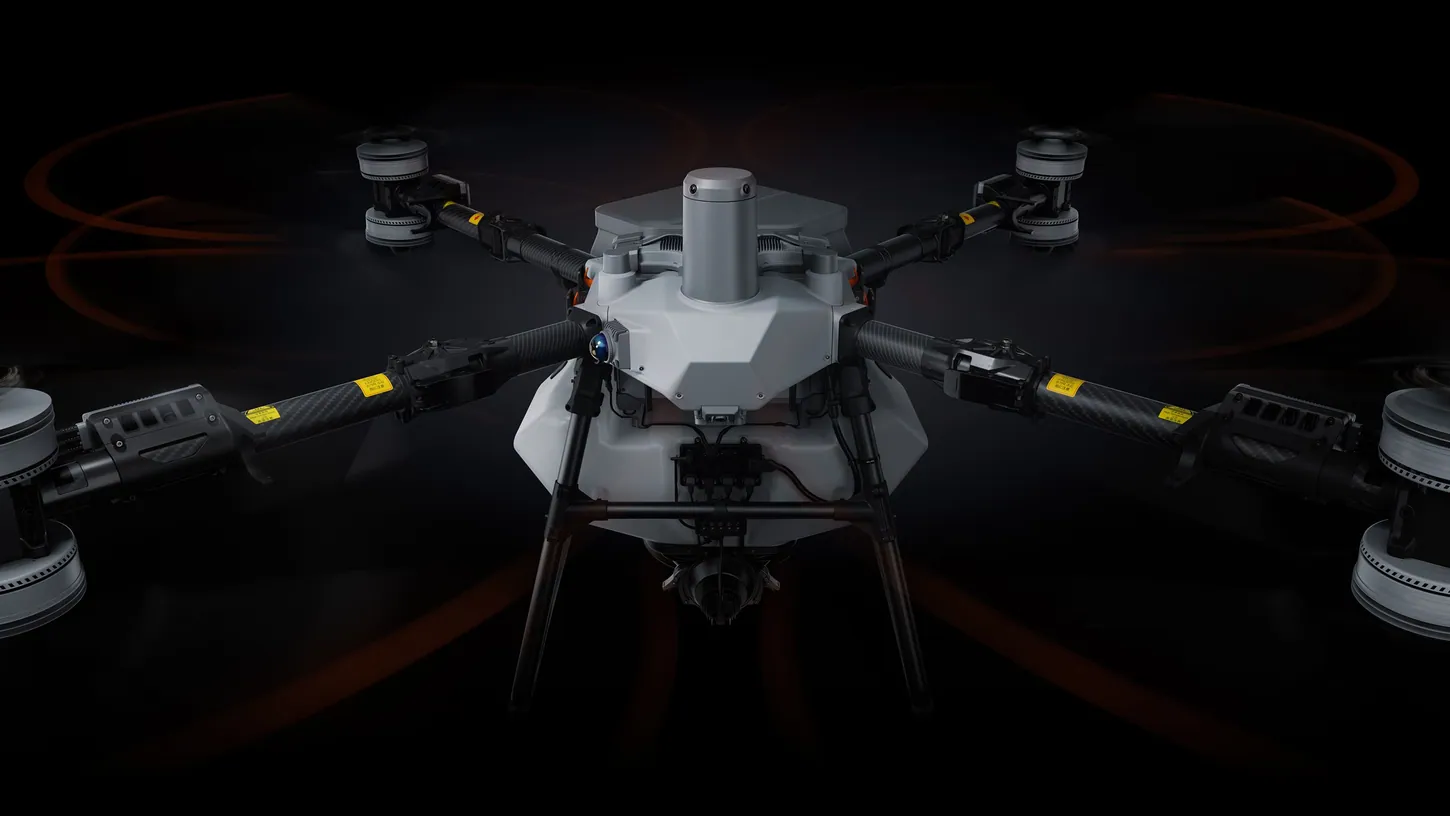
China will require export licenses for heavy-lift drone motors, their speed controllers and large carbon-fiber propellers starting November 18. The Ministry of Commerce published the revised list on Monday, October 19, together with the General Administration of Customs and the Central Military Commission’s Equipment Development Department. Drone autopilots, long-endurance drones that fly beyond visual line of sight, and the software and technology behind them are on it too.
Tunnel boring machines and dredger parts got their own notices the same day. A fourth notice, in force immediately, sets deadlines for Chinese customs queries on suspected dual-use exports and extends the procedure to cross-border e-commerce parcels, mail, express packages and passenger luggage.
The ministry calls the drone change an “optimization” and says some once-advanced drones are now mass consumer products. A Shenzhen drone industry official says common agricultural spraying drones generally fall below the new lines. DJI’s own spec sheet puts the Agras T100 sprayer’s 100-liter tank over one of them.
China’s Parts List Targets 48-Volt Motors and Big Carbon Props
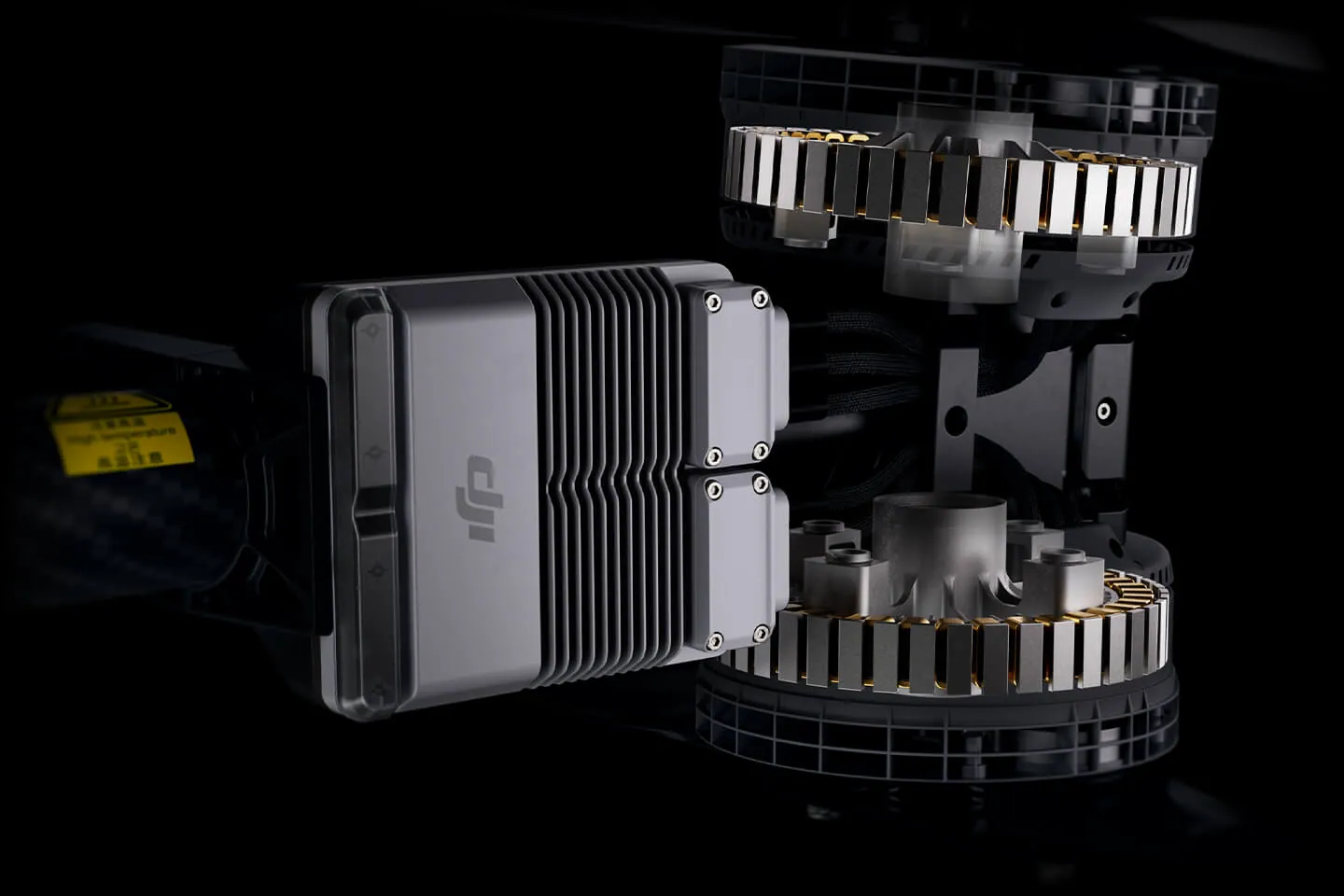
The new 9A901 entry covers brushless drone motors rated at 48 volts or more, 3 kilowatts or more, at least 3 kilowatts per kilogram and no faster than 3,000 rpm. Matching speed controllers need licenses too, as do large carbon-fiber propeller blades and variable-pitch blades of any length.
The blade test has two versions. A blade that passes through the center of rotation is covered at 30 inches (762 millimeters) from that center, and a folding blade at 25.5 inches (648 millimeters) from its root. These thresholds sit well above FPV hardware. Reaching 48 volts takes a 13S or larger battery, more than double the 6S packs most FPV quads fly on, and a 3-kilowatt motor rated under 3,000 rpm turns a big, slow propeller.
DJI’s Agras T100 shows how close the line runs. DJI’s spec page lists 52-volt flight batteries and a 60 rpm-per-volt motor rating, which works out to about 3,120 rpm with no load on that pack. It does not publish rated power or power density, the other two motor tests, or the blade length behind its 62-inch carbon propellers. The 100-liter spray tank is clearer. A separate entry, 9A112, covers autonomous or beyond-line-of-sight drones built to carry aerosol dispensing systems larger than 80 liters, plus any drone with a range of 186 miles (300 kilometers). Hobby and competition model aircraft are exempt.
Xiang Zheng, deputy secretary-general of the Shenzhen Drone Industry Association, wrote in the 21st Century Business Herald that thresholds for low-sensitivity civil drones went up while motors, speed controllers and propellers got tighter controls. He says common models for spraying, power-line inspection, delivery and filmmaking generally sit below the lines, and that companies get a one-month transition to adjust their customs paperwork.
China Measures Whole Drones by Endurance and a 25-Knot Gust Test
Complete drones need a license under entry 9A012.a if an operator can control them beyond natural line of sight and they either fly 3 hours or longer, or fly between 30 minutes and 3 hours while taking off and holding stable flight in gusts of 25 knots (46.3 km/h).
That wording follows the Wassenaar Arrangement’s 9A012 entry, the multilateral control list behind US and EU export rules, where the first tier ends at one hour instead of three. The US moved the other way this year. Commerce’s Bureau of Industry and Security dropped the license requirement for 9A012.a.1 drones headed to most Wassenaar members in January, as DroneXL reported.
The gust test does the sorting. DJI rates the Matrice 4 for winds of 12 m/s (about 23 knots) during takeoff and landing on its enterprise spec page, with a 49-minute maximum flight time. Drones that do land in the 30-minute tier get the lightest treatment in the notice: the exporter registers each shipment for an export certificate and ships without a license. Radios built for these drones need a license if their airborne output reaches 30 dBm or one ground station can fly more than 10 aircraft. Exporters with a working compliance program, an export record and steady end users may apply for general licenses.
Bloomberg reported that the list adds new types of drones. The notice itself does not say which entries are new and which carried over from the 2024 list. A ministry spokesperson said in a Q&A that China briefed the countries and regions it holds export-control dialogues with before publishing.
Chinese Customs Queries Now Reach Parcels and Passenger Luggage
Notice No. 52, in force since Monday, sets deadlines for an existing customs procedure. When an exporter can’t show a Commerce Ministry license and customs has evidence the goods may be dual-use, customs holds the shipment and issues a query. The exporter has 7 working days to answer with documents.
Those documents include contracts, invoices, transport records and technical data. Customs gets 15 working days to decide or refer the case to the ministry, which has another 15. The notice applies the same procedure to cross-border e-commerce, passenger, postal and express channels, the routes a parts order from a Shenzhen seller travels. The drone notice adds a paperwork rule on top: a motor or propeller that comes close to the thresholds without crossing them must still be declared with its specs and marked “not subject to export control.”
US-Bound Drone Items Get Case-by-Case Review and No Fast Lane
None of Notice 49’s facilitation measures reach American buyers. Since August 5, drones, components and technology on China’s dual-use list headed to the United States get “rigorous case-by-case review” and no license facilitation, Xinhua reported. The registration route and general licenses both sit under that heading.
My reading of the August rule is that motors, speed controllers and propellers crossing the new lines go into that review from November 18, while a qualifying exporter may apply for a general license to ship the same 48-volt motor to Germany. DroneXL covered the August restriction as Washington pushed on the same supply chain from its side. The Section 232 proclamation put tariffs of up to 100% on drones and critical components, as DroneXL broke down in August.
DroneXL’s Take
I think “China curbs more drones” gets this backwards for most pilots. The airframe test is borrowed from a Wassenaar entry the US itself just loosened, and the Matrice 4’s wind rating sits under the gust line. The tightening is in the parts list, and it lands on the American builders who are supposed to replace DJI. The Section 232 proclamation concedes that most US-built commercial drones use foreign parts, and as DroneXL noted in August, the motors and speed controllers among them still come mostly from Chinese suppliers. After the 2024 round of Chinese controls, US-bound infrared parts fell 60% in volume and cost 3.5 times as much within eight months, per Nikkei’s read of Chinese customs data that DroneXL covered last year. Beijing is using export licenses as a trade weapon, and Washington is taxing its own builders for buying the only parts on offer. If you build heavy-lift or spray drones in the US, check your motor and ESC spec sheets against 48 volts and 3 kilowatts before November 18.
Sources: Ministry of Commerce Announcement No. 49 of 2026 (via Xinhua), Ministry of Commerce spokesperson Q&A, Bloomberg (Josh Xiao), 21st Century Business Herald, Xinhua, DJI
DroneXL uses automated tools to support research and source retrieval. All reporting and editorial perspectives are by Haye Kesteloo. Read our editorial standards.


