China’s export licenses for heavy drone motors take effect in three weeks, and the spec sheets of the two biggest Chinese suppliers show the rule lands in a different place than the trade coverage says. Read from a single row of test data, the four motor tests catch neither Hobbywing’s X15 nor T-Motor’s U15 II, the largest multirotor motors either company publishes full test tables for. The propeller entry is the one that bites. The 64 to 73 inch blade options on Hobbywing’s P-series and the 62-inch carbon-fiber blades on DJI’s Agras T100 run past the lengths Announcement No. 49 lists.
DroneXL reported the thresholds when the Ministry of Commerce published them on October 19: a brushless motor needs a license from November 18 if it meets all four of rated voltage of 48 volts or more, rated power of 3 kilowatts or more, rated power density of 3 kilowatts per kilogram or more, and rated speed of 3,000 rpm or less. Hobbywing labels two of those on its sheets, rated voltage and rated power. Neither company publishes a rated speed or a rated power density, and T-Motor labels nothing “rated” at all. It publishes a full-throttle test row and a “maximum continuous power” figure a quarter the size, and which of the two counts decides whether its flagship needs a license.
Hobbywing’s Spray Motors Miss the Density Test, Its Big Blades Hit the Length Test
Hobbywing’s X11 Plus runs at 54 volts, is rated at 2,130 watts and turns 3,414 rpm at full throttle, and fails three of China’s four motor tests. The X15 runs at 69 volts and a rated 4,400 watts, but its motor weighs 2,850 grams with wire, 1.5 kilowatts per kilogram.
Both sets of figures come from Hobbywing’s own X11 Plus and X15 product pages. The density test is what does the sorting. A motor that crosses it must deliver 3 kilowatts from a kilogram of motor, and Hobbywing’s agricultural motors are built heavy for cooling and duty cycle. The company’s P-series is a different animal: its product page lists the P50M at 280 to 450 volts and 6 kilowatts rated output, the P65M at 8.8 kilowatts and the P115M at 18.3 kilowatts. Hobbywing publishes neither the bare motor weight nor a rated speed for any of them, so the two tests that would decide the P-series cannot be run from the public sheet.
Those model numbers are also where a chunk of the trade coverage went wrong. Army Recognition reported on Monday that Hobbywing’s “50 V and 65 V motor lines” sit above the 48-volt floor, and TechTimes wrote a week earlier that the P50M is rated at 50 volts and the P65M at 65. The 50 and the 65 are kilograms of rated thrust per rotor. The P50M’s input range starts at 280 volts.
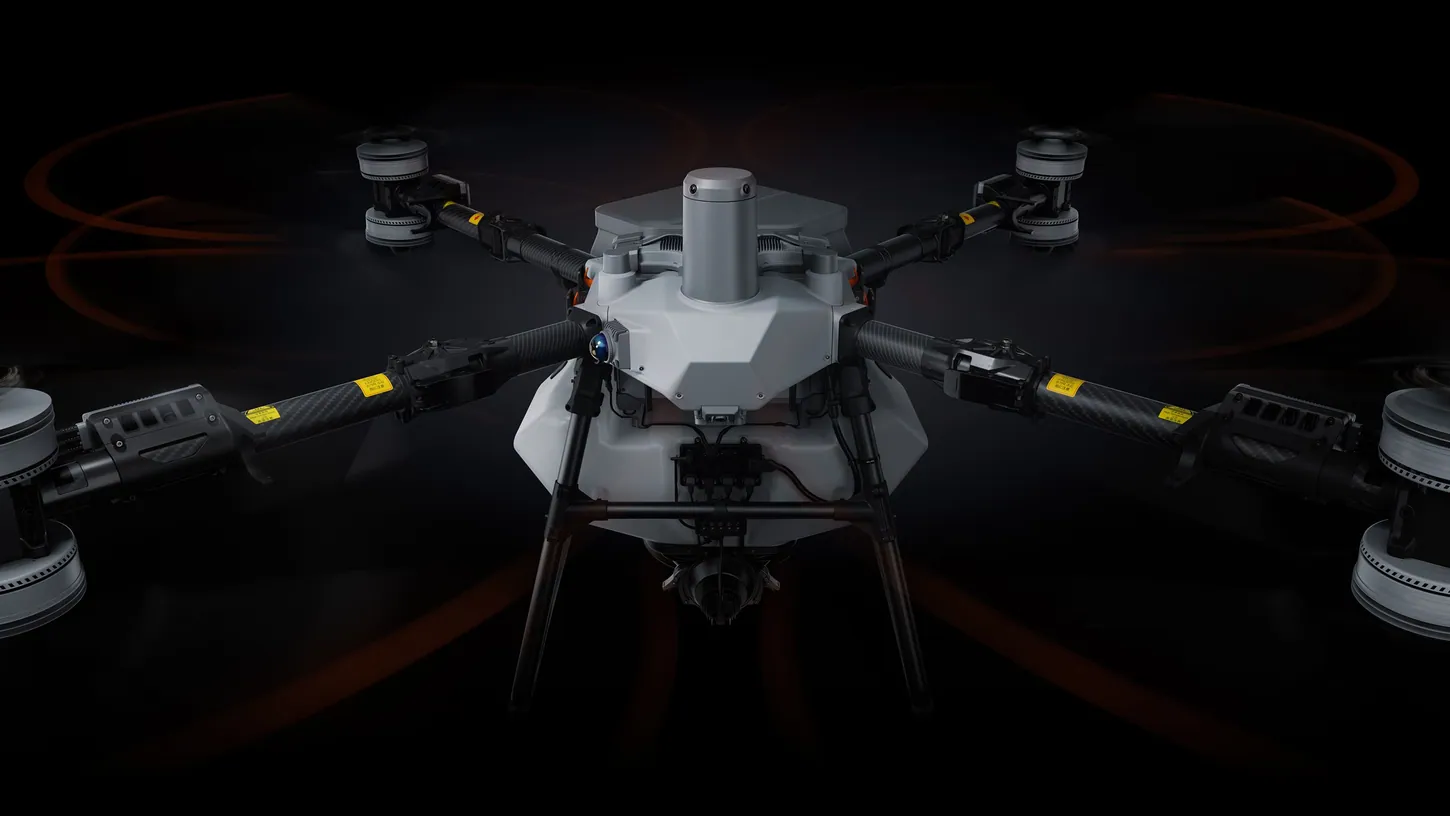
The blades are simpler. Entry 9A901.c covers a carbon-fiber composite blade that passes through the center of rotation when it measures 30 inches (762 millimeters) from center to tip, a blade that does not pass through the center, such as one bolted to a hub, at 25.5 inches (648 millimeters) from root to tip, and any blade with a variable-pitch root, no length given. The P-series flies 54 to 73 inch propellers, and the three largest options put each blade past the longer line. DJI’s T100 spec page lists 62-inch carbon-fiber composite propellers that fold, so each blade is a separate part on a hub, about 4 inches past the shorter line by my arithmetic. Hobbywing sells the X15’s 63-inch propeller as two 400-gram blades and describes them as carbon-fiber-reinforced nylon. Whether that counts as the notice’s “carbon fiber composite” is a classification question Hobbywing will have to put to the ministry.
T-Motor’s U15 II Is Controlled Only if Customs Mixes Two Rows of Its Own Table
T-Motor’s U15 II KV80 lists a maximum continuous power of 1,932 watts, which is under the 3-kilowatt floor. At full throttle on 60 volts the motor pulls 8,580 watts and lifts 36.5 kilograms, but turns 3,546 rpm, over the 3,000 rpm ceiling. Read from one row, it is not controlled.
The 1,932-watt figure is the 55% throttle point at 60 volts on the company’s store page, where the motor turns 2,316 rpm. At 1,740 grams with cables, that row is 1.1 kilowatts per kilogram, so the continuous reading fails the power test and the density test together. The full-throttle row is 4.9 kilowatts per kilogram and T-Motor’s note says the test ran for one minute, which is where the speed test fails instead. The only reading that catches the U15 II takes its power and density from the full-throttle row and its speed from the continuous one, and nothing in the notice says a customs officer cannot do that.
The Shanghai law firm Allbright’s reading of the notice tells exporters to build a parameter database for every model and request a formal classification ruling where a number is in doubt. T-Motor also sells the U15 II in a custom 40 KV winding for 24-cell, 100-volt packs, which it markets for freight transport and manned aircraft programs. A lower KV motor turns slower per volt, and that version is the one the entry reads as written for. The 40-inch propeller T-Motor pairs with the stock motor sits 10 inches under the blade line.
T-Motor is the brand of Nanchang Sanrui Intelligence Technology, which Caixin reports booked 1.075 billion yuan (about $161 million) in 2025 revenue, 48.8% of it overseas, and grew first-half 2026 revenue 68.8% to 735 million yuan. Caixin puts Hobbywing’s overseas share at 21.9% of core revenue in the first half of 2025, down from 30.1% in 2022, with Europe and the United States its main foreign markets. Neither company has posted anything about Announcement No. 49 on its news pages.
Exporters Have Three Weeks to Produce Numbers Their Spec Sheets Do Not Carry
Announcement No. 49 makes exporters declare an item’s indicators to customs and mark the form “subject to export control” when the item is listed. A part that comes close to a threshold gets the same declaration, marked “not subject to export control.” If customs doubts the numbers, the goods wait.
The companion Announcement No. 52 sets the clock on that wait: the exporter gets 7 working days to answer a query, customs 15 to decide, and the ministry another 15. A T-Motor shipment to a German cargo-drone builder, or a Hobbywing X15 order for an Australian spray fleet, therefore needs a rated speed and a rated power density on paper before November 18, whether or not the motor crosses the line.
Liu Xinyu, a partner at King & Wood Mallesons, wrote in The Paper on October 20 that the new notice also removes the drone-specific catch-all clause from the 2024 rules, while the general catch-all in Article 12 of the Export Control Law still applies to anything an exporter knows or should know is headed for military use. Companies with a working internal compliance program, an export record and stable end users may apply for general licenses.
Shipments to the United States get none of that. Since August 5, listed drone items bound for the US sit under case-by-case review with no facilitation, per Xinhua, and the new motor and blade entries join that queue on November 18.
Ukraine’s Direct Chinese Drone-Part Imports Fell From 90% to 28% Before the Rule Lands
Nearly 90% of Ukraine’s imported drone parts came directly from China in early 2024. In the first eight months of 2026 the share was 28%, according to Ukrainian customs data the AP reported on October 17. Analysts say much of the Polish and Czech volume was built in China.
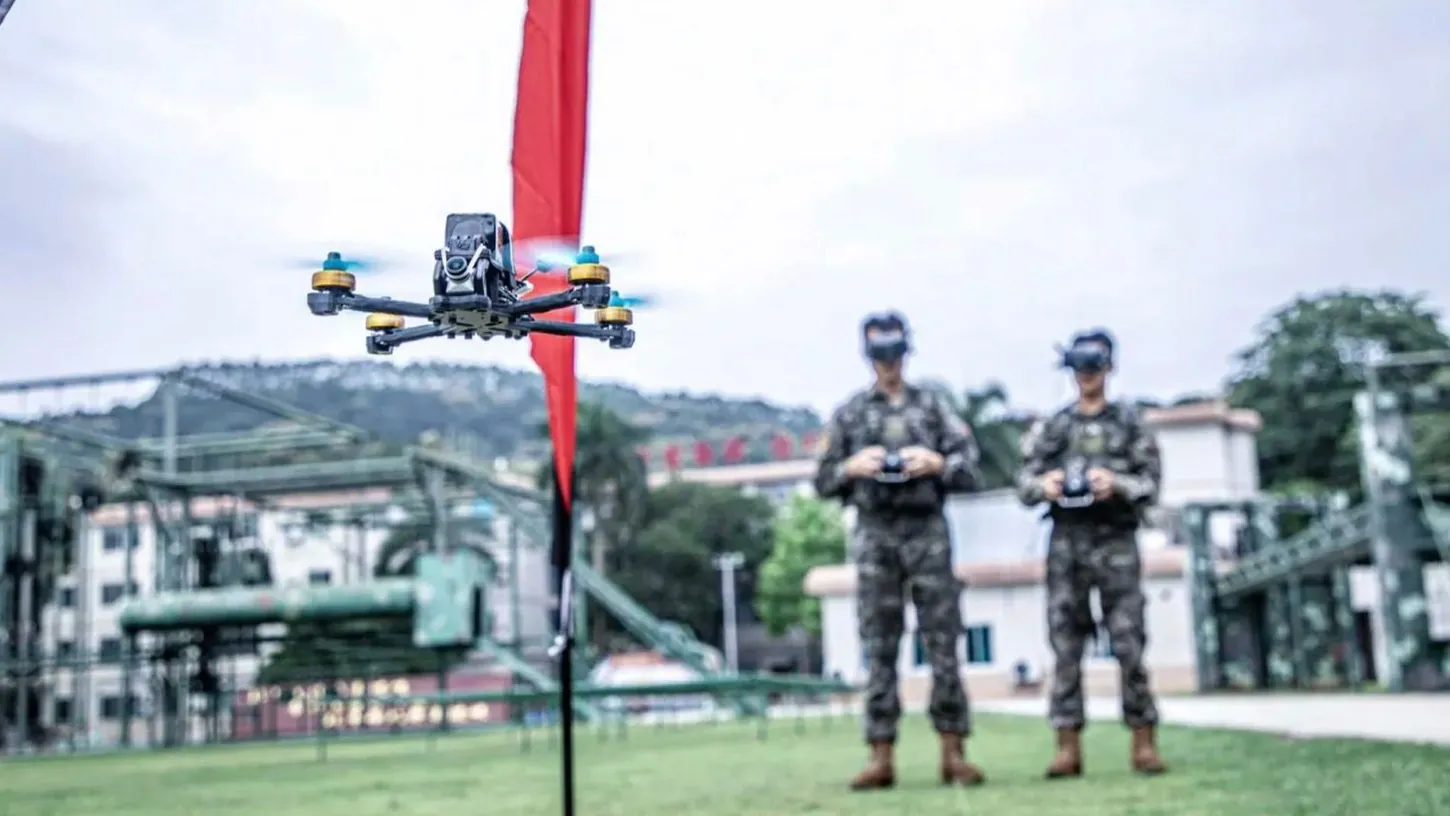
The parts Ukraine burns through at scale are the ones the rule skips. A 5-inch or 7-inch FPV drone runs a 6-cell pack at about 22 volts and a motor under 100 grams, nowhere near 48 volts or 3 kilowatts, and Motor-G alone ships 200,000 of those motors a month from inside Ukraine. Oleksandr Yakovenko of TAF Industries told the AP that switching entirely to Western parts could raise costs by as much as 60% and cut production by a similar amount. The exposed Ukrainian hardware is the heavy-lift bomber class and the long-range strike drones, the aircraft that fly U15-class motors and blades past 60 inches.
Washington Is Banning the Same Chinese Motors From Its Own Side
The Pentagon’s Drone Dominance program barred Chinese-origin motors and batteries from its second round in August, and Tobyhanna Army Depot opened a motor line on June 30 that officials say can build “upwards of 500,000 motors annually.” Those are motors for small drones, not the 3-kilowatt class Beijing is licensing.
The Section 232 proclamation put tariffs of up to 100% on imported drones and components, as DroneXL broke down in August. November 18 is also the first day of the APEC leaders’ meeting in Shenzhen, the city Hobbywing calls home. The Shenzhen government lists the meeting for November 18 and 19, and the Asia Society’s account of the September White House summit says both Trump and Xi intend to attend. The trade truce the two sides extended in September runs to January 10.
DroneXL’s Take
I think the motor entry is narrower than the headlines said, and the propeller entry is the one American and European heavy-lift builders should be reading. A motor that holds 3 kilowatts per kilogram under 3,000 rpm at a continuous rating is a cargo-drone and manned-aircraft part, and the biggest off-the-shelf multirotor motors from Shenzhen and Nanchang miss it on their own test tables. A 62-inch carbon blade is on every 100-liter sprayer, and the blade test has no density escape hatch. If you build with the P-series or anything turning a propeller over 60 inches, the fix is a second blade supplier, not a lawyer.
The bigger problem is the word “rated.” T-Motor’s flagship is uncontrolled if customs reads its continuous row and uncontrolled if it reads the full-throttle row, and controlled only if it takes the power from one and the speed from the other. Nothing in the notice says which row counts, so every number customs sees on November 18 will have been chosen by the exporter in the previous three weeks, and every hold will be argued over a definition. My read is that this is the point: the ministry does not need to refuse a U15 II shipment to Munich, it only needs the right to hold it for 37 working days while it asks what “rated speed” means. Washington banned the same motors from its own procurement in August. Between the two capitals, a heavy-lift builder in Ohio has a motor it may not be able to buy from China and cannot buy from the Army at all.
Sources: Ministry of Commerce Announcement No. 49 of 2026 (via Xinhua), Hobbywing X11 Plus, Hobbywing X15, Hobbywing P-series, T-Motor U15 II KV80, DJI Agras T100, Caixin Global, Allbright Law Offices, The Paper, Xinhua, AP via Taipei Times, Army Recognition, Tobyhanna Army Depot, Shenzhen government, Asia Society Policy Institute, Nikkei Asia
DroneXL uses automated tools to support research and source retrieval. All reporting and editorial perspectives are by Haye Kesteloo. Read our editorial standards.