
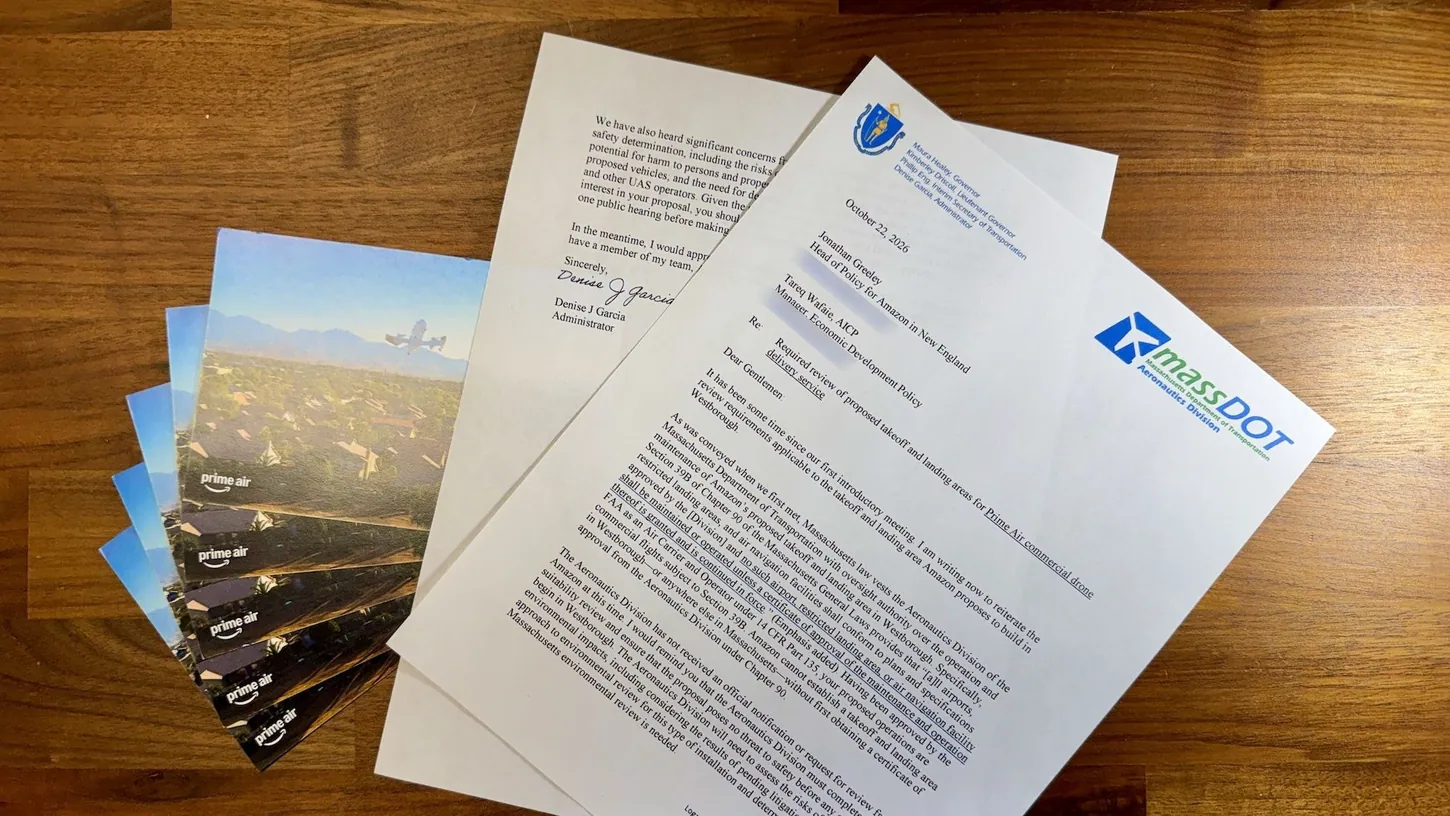
The Massachusetts Department of Transportation told Amazon on Thursday, October 22, that it cannot open a Prime Air drone takeoff and landing area in Westborough, or anywhere else in Massachusetts, without a certificate of approval from MassDOT’s Aeronautics Division. The division also says it has not received an official notification or request for review from Amazon. Its letter refers to an earlier introductory meeting at which, it says, the division had already explained that oversight role.
Aeronautics Division Administrator Denise Garcia wrote that Amazon should expect at least one public hearing before any decision on the certificate. MassDOT’s communications office sent DroneXL the two-page letter, addressed to Jonathan Greeley, Amazon’s head of policy in New England, and Tareq Wafaie, its economic development policy manager, along with a statement from Interim Transportation Secretary Phillip Eng.
Wafaie told a Westborough audience on September 23 that Amazon planned to launch there possibly by the end of October, and that it did not yet have its remaining approvals, including a MassDOT Aeronautics inspection and registration of the landing area, as DroneXL reported from that meeting. Massachusetts rules want a landing-area application on file at least 90 days before the site is first used.
Massachusetts’ 90-Day Filing Rule Puts Amazon’s Westborough Pad Into 2027
As I read 702 CMR 5.03, an application filed on the day of Garcia’s letter would meet the rule’s 90-day lead time no earlier than January 20, 2027 (October 22 plus 90 days). That holds only if a certificate had issued by then.
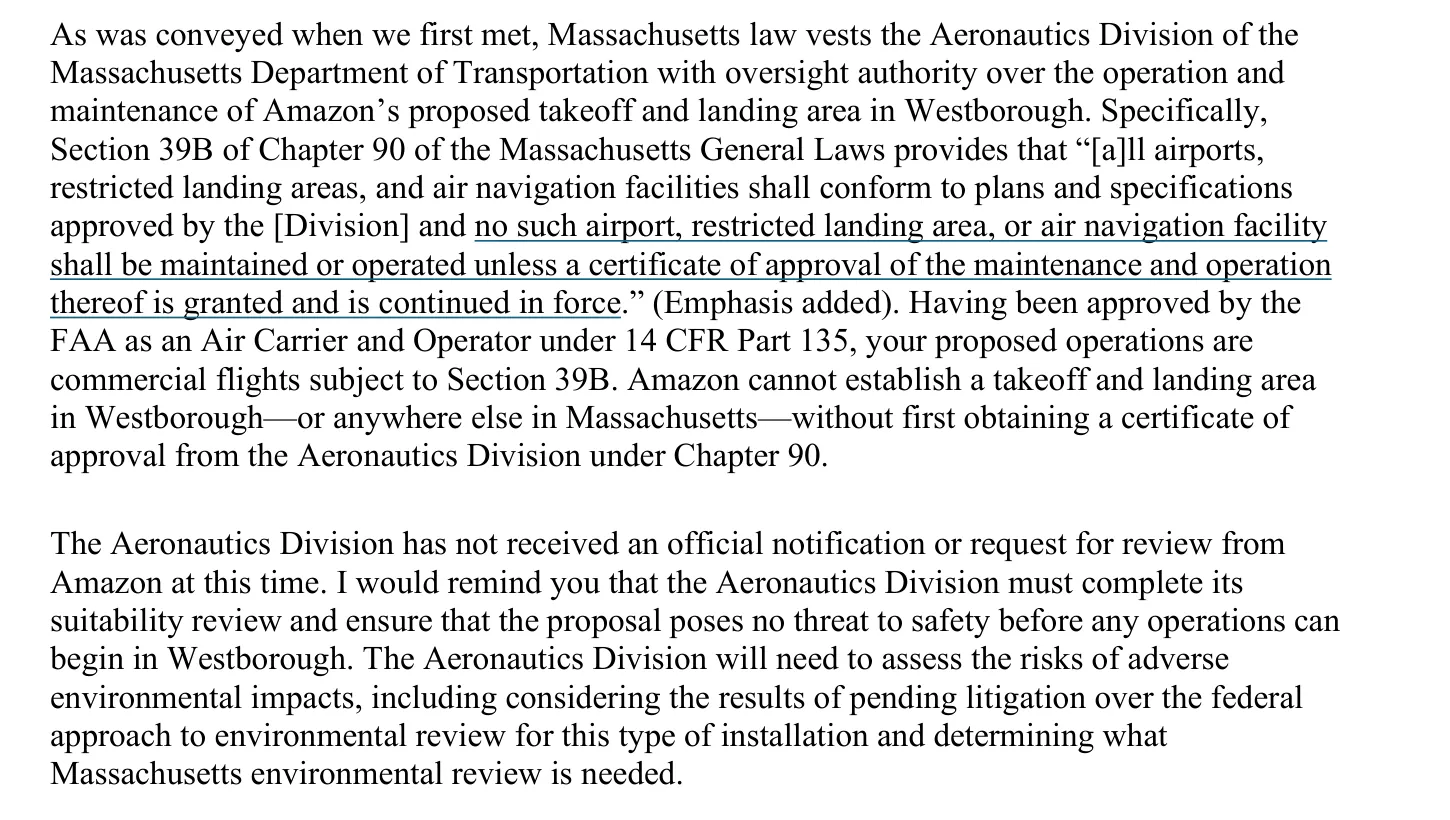
January 20 is a floor rather than a forecast, because the certificate has to come first, after the inspection and the public hearing in the town that the same rule requires. DroneXL’s article earlier today read M.G.L. c. 90, § 39B and 702 CMR 5.01 as the rules behind the state certificate, because the 16 legislators who asked Governor Maura Healey for a freeze cited no statute. Garcia’s letter cites § 39B directly. She writes that Amazon’s FAA approval as an air carrier and operator under Part 135 makes its proposed operations commercial flights subject to that section. DroneXL removed the two Amazon employees’ email addresses from the copy linked here.
The legislators had asked the state to stop accepting or processing certificate applications from drone delivery operators, and Garcia’s letter shows Amazon has not reached that step. She closed by asking Amazon for an update on its plans and the project’s status.
Eng’s statement puts the burden on Amazon. “We will carefully scrutinize their plans,” he said, adding that Amazon will need to show its operations will not pose a risk to public safety and will minimize safety impacts on surrounding neighborhoods and the environment.
MassDOT Ties Its Safety Review to Low Flights and the Aircraft’s Weight
Garcia lists the community concerns that could bear on the division’s safety determination: flights over private property at very low altitudes, the potential for harm to people and property given the size and weight of Amazon’s vehicles, and deconfliction with public safety agencies and other drone operators.
The division must complete its suitability review and ensure “that the proposal poses no threat to safety before any operations can begin,” she writes. The letter does not name the aircraft or mention a parachute. Amazon’s MK30 has an 83.2-pound (37.8-kilogram) maximum takeoff weight under an FAA re-evaluation of Prime Air’s Pendleton, Oregon test site, and it carries packages of up to 5 pounds (2.3 kilograms) with no parachute on board.
The division will also assess the risk of adverse environmental impacts. Garcia says that includes considering the results of pending litigation over the federal approach to environmental review for this type of installation, and deciding what Massachusetts environmental review the pad needs. The letter does not name the case. The Worcester Telegram & Gazette identified it as the suit Massachusetts joined with other states, which DroneXL covered when 15 states sued the FAA on September 28.
Amazon did not immediately respond to requests for comment from the Telegram & Gazette or the Boston Globe, both outlets reported.
The same state office also has a say over Westborough’s 510-to-13 bylaw banning commercial drone pads, passed October 19. It takes effect only after the attorney general approves it or lets 90 days pass without acting, and the warrant says MassDOT’s Aeronautics Division must approve it too. Locally, the Zoning Board of Appeals hears the residents’ appeal on November 2, and the Planning Board resumes Amazon’s site-plan hearing November 10.
The Drone Delivery Tracker lists the Westborough hub as in review, and DroneXL’s guide for residents covers what a town can still do once a hub is proposed. Residents can call Amazon at 1-888-280-4331 and say it is about drone delivery, or open the customer-service chat and pick “Something Else,” then “Amazon Drone Delivery.”
DroneXL’s Take
MassDOT’s letter does more for Westborough than the freeze the 16 legislators asked for, in my view, because it moves the decision to a state hearing where the aircraft’s size and weight are already part of the record. As I read the clause about pending litigation, it also leaves the division room to wait on the states’ case against the FAA before it rules.
The reasoning isn’t aimed at Amazon alone either. Garcia’s test is Part 135 status, and DoorDash holds a Part 135 certificate of its own, so any drone delivery operator that wants a Massachusetts pad needs the same certificate from the same division, with a public hearing in the town under 702 CMR 5.03. That settles the equal-treatment worry I raised earlier today better than a moratorium could. Drone delivery that carries medication or a defibrillator can make its case at that hearing. An 83-pound aircraft with no parachute carrying five-pound consumer orders low over Westborough’s backyards will have a harder time, I suspect, and it should.
Sources: MassDOT Aeronautics Division letter to Amazon, October 22, 2026 (PDF, email addresses redacted by DroneXL), statement from Interim Transportation Secretary Phillip Eng provided to DroneXL by MassDOT, The Boston Globe, Worcester Telegram & Gazette, 702 CMR 5.03, M.G.L. c. 90, § 39B.
DroneXL uses automated tools to support research and source retrieval. All reporting and editorial perspectives are by Haye Kesteloo. Read our editorial standards.


