
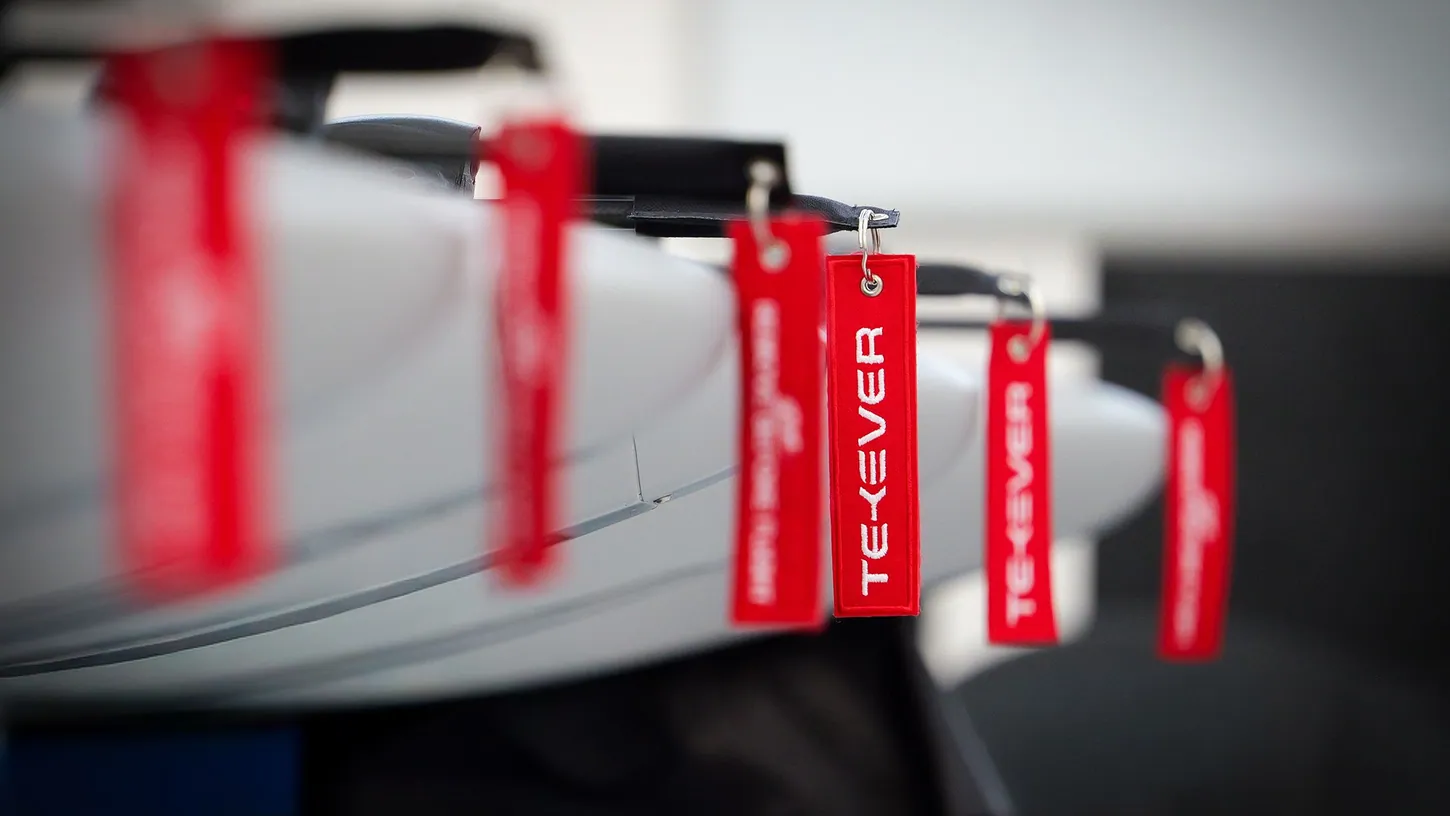
Tekever, the Portuguese-British maker of AI-driven surveillance drones, said Monday that U.S. Special Operations Command (USSOCOM) has bought its uncrewed aircraft systems. The purchase followed validation and acceptance testing, with flights at several locations.
The customer is the only detail Tekever named. Its announcement says the number, model and configuration of the aircraft are not being disclosed, and it gives no contract value. It is datelined Fayetteville, North Carolina, home of Tekever’s U.S. office.
Nineteen months ago, Tekever put an aircraft through an exercise with SOCOM in California, and that time it named the model.
Tekever Ran Its AR3 Through a SOCOM Exercise at Camp Roberts in 2025
The only Tekever drone named in the company’s announcements of work with SOCOM is the AR3. Tekever said in March 2025 that it had completed an operational exercise with the command at Camp Roberts, California, with the AR3 at the center and operating in a contested electronic warfare environment.
That March 2025 release pitched the AR3 on vertical takeoff and landing, which removes the need for separate launch or recovery equipment, and on a low acoustic and visual signature. Its swappable payloads included electro-optical and infrared cameras, radar and signals intelligence sensors.

The current version, the AR3 EVO, weighs up to 55 pounds (25 kg) at takeoff, or 66 pounds (30 kg) in its VTOL setup. Tekever’s product page lists up to 22 hours of endurance as a pure fixed-wing and 14 as a VTOL, a 13-pound (6 kg) payload, a 46-knot cruise and a datalink range of up to 143 miles (230 km). It lands in a 16-by-16-foot (5 by 5 meter) space.
Monday’s USSOCOM announcement describes a “highly deployable” intelligence, surveillance and reconnaissance system with a modular mix of aircraft, payloads, communications and AI mission software. Tekever uses the same modular language for the larger AR5, the aircraft behind the British Army’s new surveillance program. The AR5 needs an airstrip, even an unprepared one, so “highly deployable” fits the VTOL AR3 better. Tekever has not said which model SOCOM bought.
Tekever Opened Its Fayetteville Office Five Months Before the Announcement
Tekever opened its first U.S. office in Fayetteville on May 18, the first day of SOF Week in Tampa, where it was due to exhibit at the NATO DIANA booth. Fayetteville sits next to Fort Bragg, home of U.S. Army Special Operations Command, and the office supports U.S. end users.
When DroneXL covered Tekever’s $74 million round in November 2024, U.S. expansion was the pitch. SOCOM is now the fourth government customer Tekever has announced since August. The Portuguese Air Force ordered AR5s on August 11, and Tekever signed the British Army’s CORVUS contract, worth up to £400 million ($530 million), on September 16. On October 13 it said the Bundeswehr had taken delivery of its first Tekever system, a heavy-lift aircraft, as it opened a German headquarters in Munich.
In between, Tekever announced the first close of a $580 million Series D at a $6.4 billion valuation, led by the University of California’s investment office and Baillie Gifford. CEO Ricardo Mendes called the SOCOM buy “an important milestone in a relationship that has been built over time.”
DroneXL’s Take
Washington now holds two opinions about drones like Tekever’s. SOCOM tested the company’s aircraft and bought them. The FCC put every foreign-made drone on its Covered List in December, with Chairman Brendan Carr saying they “pose an unacceptable national security risk,” and in July it proposed banning imports and sales of foreign drones it calls military-grade to any buyer outside the federal government. Thermal imaging puts a drone in that category, and the AR3’s payloads include infrared cameras. The proposal carves out imports for federal use, so SOCOM’s purchase is untouched. A U.S. pipeline operator or a county sheriff who wanted the same aircraft would need an exemption, such as a Blue UAS listing or a Conditional Approval from the Department of War. My read is that the risk lives in the airframe and its supply chain, not in the buyer’s letterhead. If the Department of War trusts Tekever’s drones with special operations surveillance, it should tell the FCC whether a civilian buyer can trust them too.
Sources: Tekever, Tekever (Camp Roberts exercise), Tekever (North Carolina office), Tekever (Germany), Resilience Media
DroneXL uses automated tools to support research and source retrieval. All reporting and editorial perspectives are by Haye Kesteloo. Read our editorial standards.


