
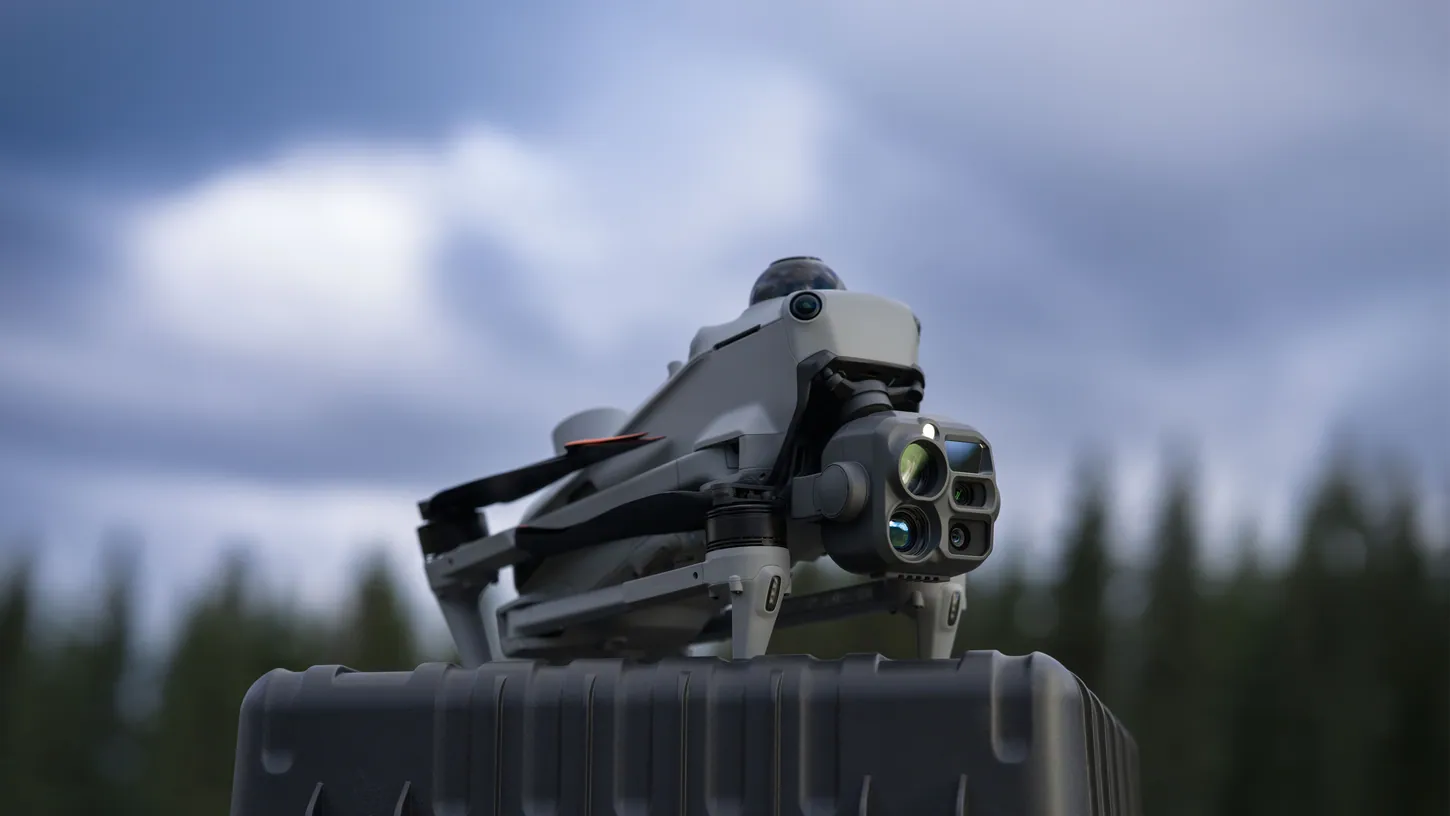
DJI Enterprise launched the Matrice 5T on November 5, 2026, a folding enterprise drone built around the native 1280 by 1024 thermal camera, rotating LiDAR and mmWave radar it introduced three weeks ago on the dock-only Matrice 5TD. DJI puts flight time at 59 minutes, rates the airframe IP55, and says the aircraft is available from its enterprise dealers today. UK dealer Heliguy opened pre-orders at about $8,655 before VAT, with the first batch expected the week of November 23. DJI itself published no price.
The spec sheet gives transmission range and transmitter power for Canada, the European Union, China and Japan. The FCC appears nowhere on it. The Matrice 4T, the drone the 5T succeeds, lists the FCC on every band of its sheet.
The Matrice 5T Carries the 5TD’s Sensors on Folding Arms, 1,020 g Heavier Than the 4T
The Matrice 5T weighs 2,239 g (4.9 lb) with its battery and folds to 335 by 155 by 203 mm. That is 1,020 g more than the 1,219 g Matrice 4T and 361 g less than the dock-bound 5TD. Payload doubles to 400 g across three E-Ports.
The gimbal is the one DroneXL matched window for window to the 5TD’s in DJI’s October 29 teaser. Its thermal camera is an uncooled 1280 by 1024 detector on an 8 μm pitch behind a 53 mm equivalent f/0.85 lens, with a 2560 by 2048 upscaled mode DJI calls UHR. The Matrice 4T has a 640 by 512 detector on a 12 μm pitch and reaches 1280 by 1024 only as a Super Resolution output. The telephoto grows from 168 mm to a 252 mm equivalent f/2.8 lens on a 1/1.5-inch sensor, for 176x hybrid zoom, and DJI says it reads license plates at 400 meters (1,312 feet). The wide camera’s 1/0.98-inch sensor and f/1.8 lens produce color video down to 0.01 lux, a figure from DJI’s own testing. The laser rangefinder reaches 3,000 meters (1.9 miles).
The dome on the top deck that leaker Igor Bogdanov’s July photos showed is a rotating LiDAR with a 360-degree horizontal field, a 110-meter (361-foot) range and obstacle avoidance from 0.5 to 32 meters (1.6 to 105 feet). DJI says it picks out power lines at night at that 32-meter limit. Three mmWave radars face forward, up and down, with the forward unit detecting small obstacles at 40 meters (131 feet), and six fisheye cameras hold position in 0.5 lux. DJI’s sheet notes that the mmWave radar “may be unavailable or restricted in some countries or regions.” The 10,073 mAh battery weighs 768 g and lifts the no-wind flight time from the 4T’s 49 minutes to 59. The aircraft flies at up to 23 m/s (51 mph) and operates from -4°F to 122°F (-20°C to 50°C).
DJI’s 40 km Range Claim Compares Canada’s Rating With the 4T’s FCC Number
DJI’s launch release says the Matrice 5T transmits up to 40 km (25 miles), “up from the previous generation’s 25 km”. The 40 km is the 5T’s Canadian IC rating. The 25 km is the Matrice 4T’s FCC rating. Under European CE rules they read 20 km and 12 km.
The Matrice 5T specifications list five bands for the O4 Enterprise link, and the 902 to 928 MHz band that American unlicensed radios share is rated for Canada and Japan only. Two DJI Cellular Dongle 2 modules are built in, one on an eSIM and one on a nano-SIM, and four relay modes let one aircraft or two pass the link on to the drone doing the work. Heliguy’s launch guide says the relay modes need 5 GHz support in the operator’s country.
No band on the sheet carries an FCC figure. The FCC put foreign-made drones on its Covered List on December 22, 2025, and no new DJI model has received an FCC grant since. Dock 4 and the Matrice 5TD launched on October 14 with the same four-regulator sheet, and the 5T now makes it two new DJI enterprise aircraft in three weeks. DJI’s release names no market and sends buyers to “authorized DJI Enterprise dealers.” On launch morning, a search for the Matrice 5T at Advexure returned four unrelated products, and the same search at Drone Nerds returned none. Heliguy, in the UK, was taking pre-orders.
The release, which DJI datelined Shenzhen and put out over PR Newswire’s US wire at 7:40 AM ET, still carries the line that “US-based users no longer have the option to sync their flight logs with DJI servers,” a sentence the data-security section of the October 14 Dock 4 release did not carry. The threat to the hardware US departments can still buy sits in the FCC’s Docket 26-189 proposal, which would bar the import and sale of foreign drones with any of seven capabilities. Thermal imaging and LiDAR are two of them, and the Matrice 4T has the first. DJI asked the bureaus to withdraw the proposal on September 2, and the FCC has not finalized it.
The RC Plus 3 Enterprise Is in the Box, and Nothing From the Matrice 4 Carries Over
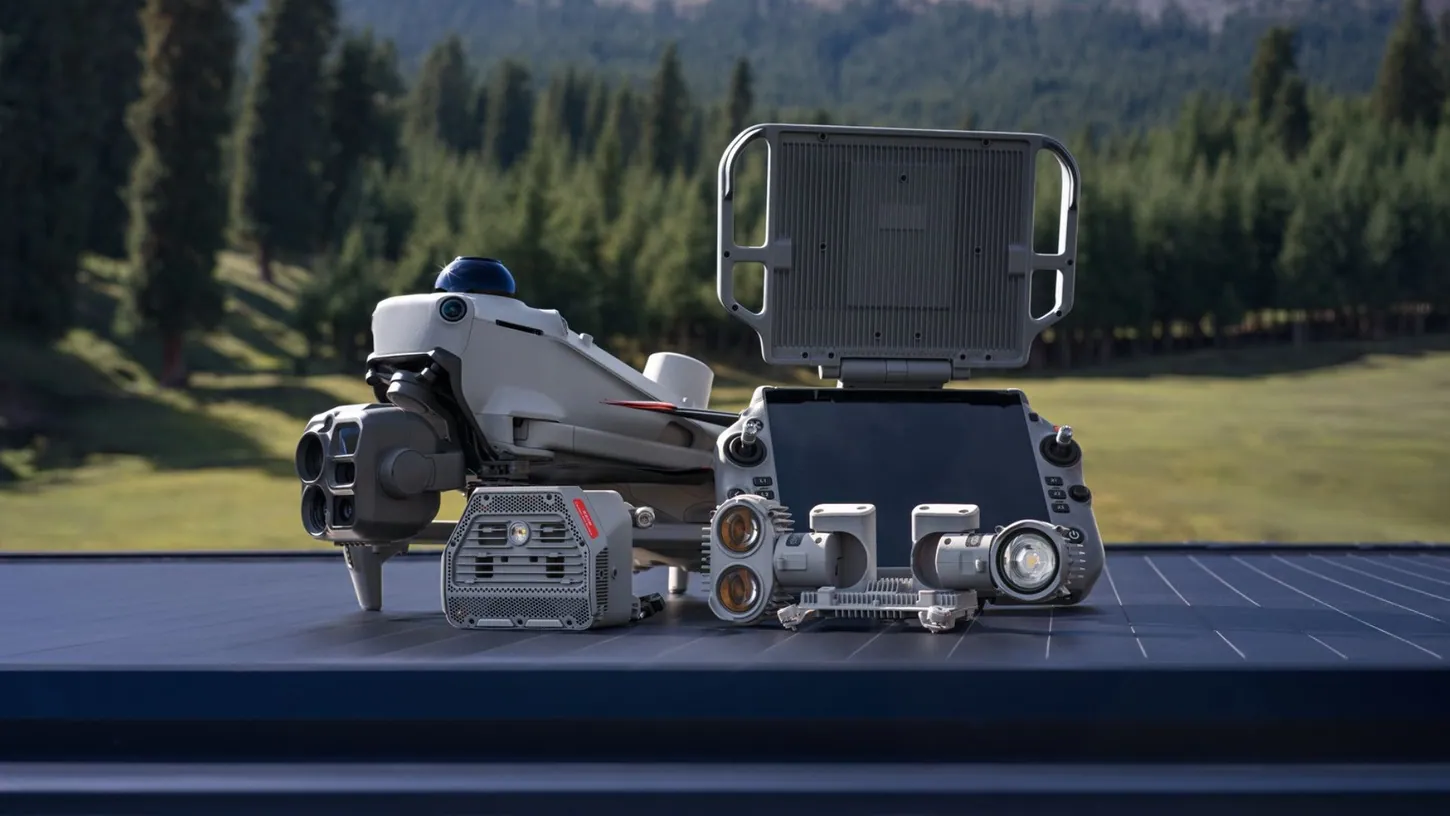
The Matrice 5T ships with the new DJI RC Plus 3 Enterprise, a 1,240 g (2.7 lb) controller with a 7.44-inch, 2,000-nit screen running Android 16. DJI’s FAQ says 5T accessories do not fit the Matrice 4 series. Heliguy’s pre-order includes the controller and hub, with the battery sold separately.
The AL2 spotlight weighs 175 g and draws 60 W, and the AS2 speaker weighs 194 g and puts out 120 dB at one meter, which DJI rates for 400 meters (1,312 feet) of broadcast. The 515 W hub charges three batteries in sequence. On board, DJI’s models detect more than 20 target types from the thermal and visible feeds at once, the computer accepts third-party models, and operators on FlightHub 2 can search the feed with text and image prompts. The remote controller builds a rough 3D model from a single flight and processes 200 photos in eight minutes, by DJI’s count.
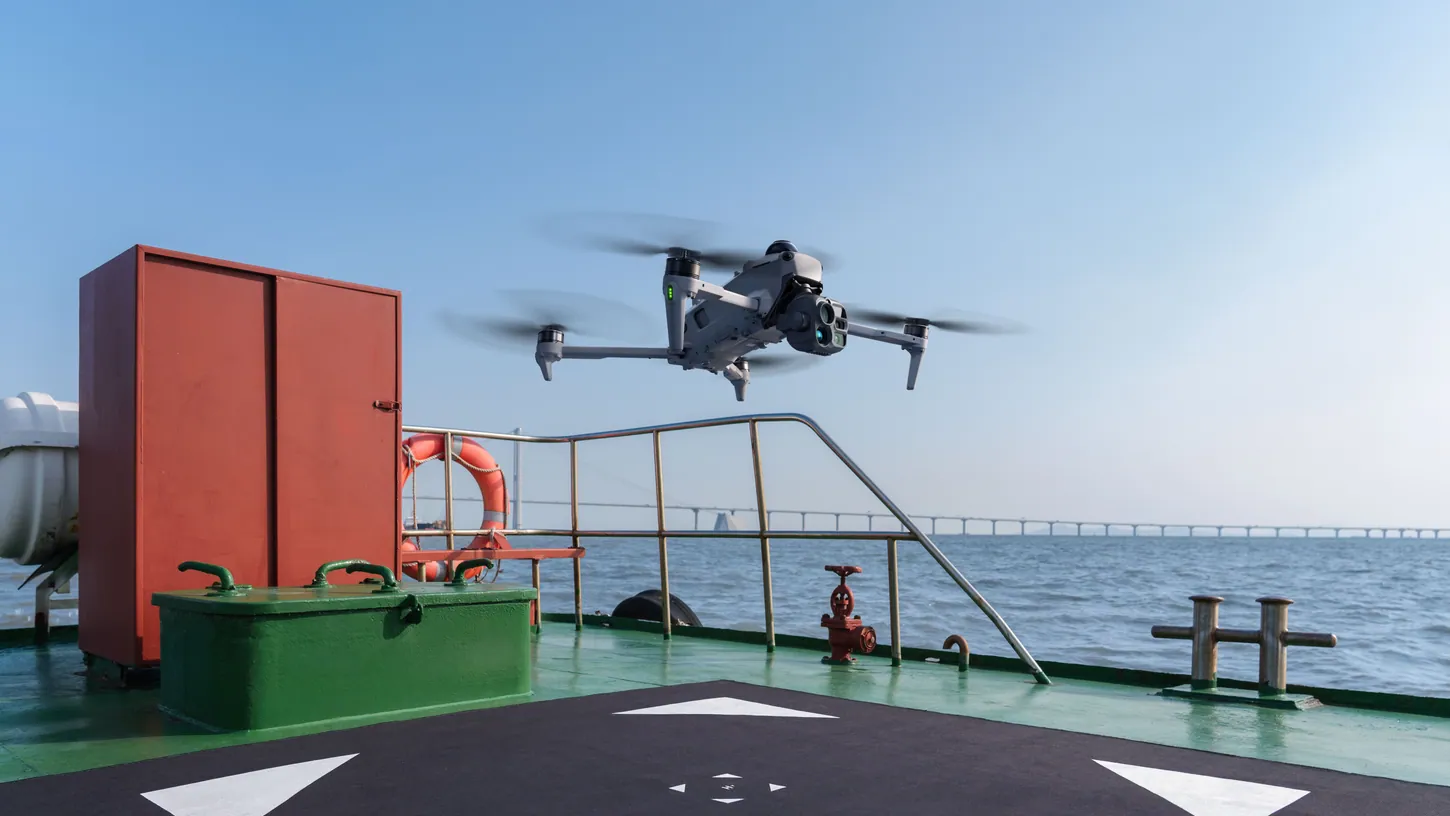
The 5T takes off from a moving vessel and reads a deck pattern to land on it, and its LiDAR locks onto a power line for a lateral flight along it. Heliguy lists the 5T as C2 and C6 certified for Europe, and DJI’s release says its Flight Termination System module, which stops the propellers on command or at a geocage boundary, is what C6 requires.
The same dealer sells the Matrice 4T, battery included, at about $6,759 before VAT, so the 5T costs about $1,900 more before its battery. US dealer listings in October put the 4T, the DJI thermal drone American departments can still buy, at about $7,100 to $7,700.
DroneXL’s Take
This is the drone every US police unit with a Matrice 4T in the trunk has been waiting for, and it is the second aircraft in three weeks that DJI shipped with the FCC missing from the spec sheet. The 5TD needs a dock on a roof, so it was never going to matter to the patrol-car units that make up most of American public safety drone flying. The 5T is built for exactly those units, with four times the thermal pixels and ten more minutes in the air than the 4T, for about $1,900 more at the same dealer. A sergeant in Windsor, Ontario, can put one on order today. Across the river in Detroit the choice is the 4T, or nothing at all if the FCC adopts its Docket 26-189 definition.
I don’t read the four-regulator sheet as DJI giving up on America. The release still talks to US users about their flight logs, and the Blue UAS exemptions that let the Pentagon’s approved drones through expire on January 1, 2027, so the FCC has a decision coming either way. I think DJI prints the approvals it has and leaves the gap on the page for American buyers to notice. They will, every time a Canadian department posts its first 5T thermal clip.
Sources: DJI press release on PR Newswire, DJI media center, DJI Matrice 5T specifications, DJI Matrice 4 Series specifications, Heliguy
DroneXL uses automated tools to support research and source retrieval. All reporting and editorial perspectives are by Haye Kesteloo. Read our editorial standards.


