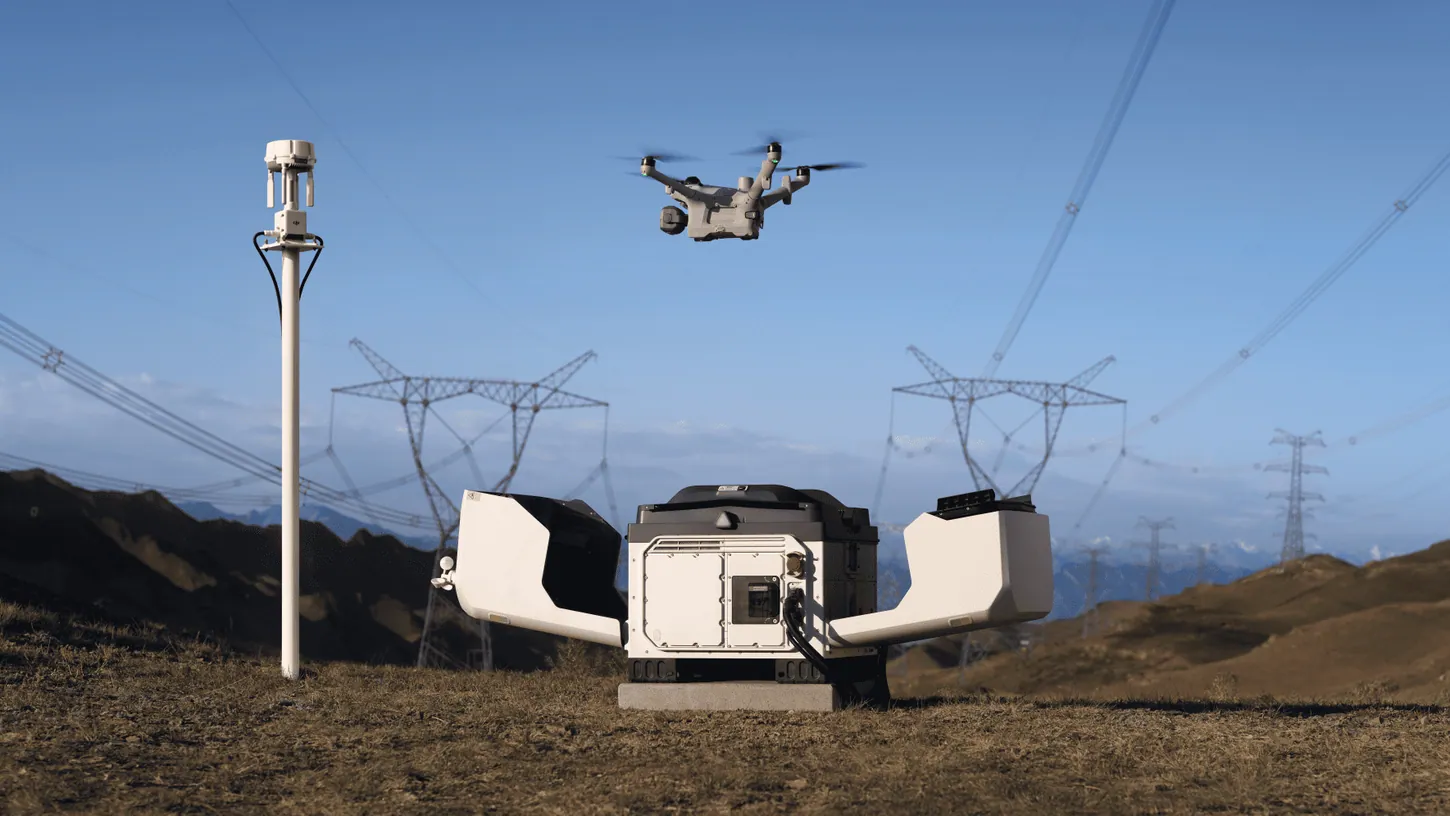
DJI Enterprise launched Dock 4 and the Matrice 5TD on October 14, 2026, and the dock is the first DJI has built that swaps the aircraft’s battery automatically. Every earlier DJI dock could only charge the pack inside the landed drone. DJI puts the swap at 25 seconds once the lid closes and the full turnaround, landing to takeoff, at 45 seconds. The Matrice 5TD flies up to 59 minutes on a pack, and DJI is selling the pair as a dock-as-first-responder (DFR) system for police, emergency crews, utilities and overnight security.
The launch confirms the Dock 4 name from a September leak and the Matrice 5TD’s registry weights, both in DroneXL’s October 8 teaser report. DJI published no price and says the dock is sold through its enterprise dealers.
Dock 4’s spec sheet lists transmitter power for Canada, the European Union, China and Japan. Dock 3’s sheet lists the same figures for the FCC.
Dock 4 Holds Three Spare Batteries and Charges Two at Once
Dock 4 has four battery compartments but holds no more than three packs, because the swap mechanism needs one empty slot. It charges two at a time, each from 15% to 95% in 27 minutes. A returning Matrice 5TD gets a fresh pack automatically when it lands below 79%.
The Dock 4 FAQ also corrects the count in our teaser coverage: the render looked like a carousel of five or more bays, and the production dock has four. The packs also double as the dock’s backup power. Each one runs the dock for about 4.5 hours after a grid outage, and the dock can keep swapping on battery power as long as at least two packs are loaded. It cannot charge the aircraft until power returns.
Each pack is 260 Wh, against 149.9 Wh for the Matrice 4TD battery that Dock 3 charges in place. Dock 4 works only with the Matrice 5TD, so a 4TD fleet cannot move into the new dock. The new dock uses the same 400 by 400 mm (15.7 by 15.7 inch) mounting pattern as Dock 3, though, and it needs the DJI O4 Ground Station, an optional add-on for Dock 3 that now carries Dock 4’s video link, RTK base station and network connection. The dock weighs 66 kg (146 lb) without batteries and runs from -40°F to 122°F (-40°C to 50°C).
The Matrice 5TD Builds LiDAR and Radar Into the Airframe
The Matrice 5TD specifications list 2,600 g (5.7 lb) and 3,050 g (6.7 lb) at takeoff, matching the China registry entry DroneXL reported on September 27. The 750 g gain covers a heavier battery plus the rotating LiDAR and mmWave radar the 4TD lacks.
Three 50 MP cameras (wide, 70 mm and 252 mm) share the gimbal with a 1280 by 1024 thermal camera and a laser rangefinder that reaches 3,000 m (1.9 miles). The drone carries up to 450 g (1 lb) of accessories on three mounts, including a new speaker, spotlight and parachute. The spotlight has a catch in the spec notes: switching it on turns off the visual obstacle sensors and leaves only radar and LiDAR. The aircraft cannot be flown with a remote controller at all.
DJI’s press release says the drone reaches a scene at up to 21 m/s (47 mph). The spec sheet limits that speed to FlyTo tasks and caps every other mode at 15 m/s (34 mph). The 59-minute flight time was measured at 15 m/s with no payload, and the Matrice 4TD’s 54 minutes was measured at 12 m/s.
Dock 4’s Radio Specs Name Canada, Europe, China and Japan, Not the US
Dock 4 and the Matrice 5TD have no path to US sale. They launched after the FCC put foreign-made drones on its Covered List on December 22, 2025, and no new DJI model has received FCC authorization since. Dock 3, authorized before that date, lists the FCC on every band.
The Covered List action blocks new grants for as long as the designation stands, which is why Dock 4’s sheet gives transmitter power for Canada’s IC, Europe’s CE, China’s SRRC and Japan’s MIC and nothing for the FCC. DJI’s release names no market, and its product page tells buyers to contact a local dealer. The aircraft’s new sub-2 GHz video link includes 902 to 928 MHz, the same band American unlicensed radios use, and the sheet lists that band for Canada and Japan only.
The bigger threat for the US is a proposal that also reaches hardware already on sale. The July 21 notice two FCC bureaus issued in Docket 26-189 defines “military-grade” drones by seven capabilities and proposes barring the import and sale of foreign models that have them. Thermal imaging, LiDAR and a docking station are three of the seven. Dock 4 with the Matrice 5TD has all three, and the Dock 3 and 4TD that US departments can still buy already have two. DJI asked the bureaus to rescind the notice in comments filed September 2, the day the comment period closed, and the proposal has not been finalized.
DroneXL’s Take
I think the swap carousel fixes the weak spot in every DJI dock so far, a box that answers one call and then charges for half an hour. DJI built Dock 4 for the DFR work American police buy docks for, and they can’t buy it.
Canada is on Dock 4’s spec sheet, so a department there running Dock 3 can unbolt the old dock and set a Dock 4 on the same mounting holes. A US department on the same roof keeps its 2025 hardware, and if the FCC adopts the Docket 26-189 definition, it may not be able to buy another Dock 3 either. El Paso’s 22-dock program, the case study DJI still sells to US police, applied this spring for federal money to replace its DJI fleet. The FCC’s case against this hardware rests on where it was made, not on anything a rooftop dock has been shown to do. My read is that provenance alone is a thin reason to leave American departments a generation behind the rest of the DFR world.
Sources: DJI press release, DJI Dock 4 specifications, DJI Dock 4 FAQ, DJI Dock 3 specifications
DroneXL uses automated tools to support research and source retrieval. All reporting and editorial perspectives are by Haye Kesteloo. Read our editorial standards.