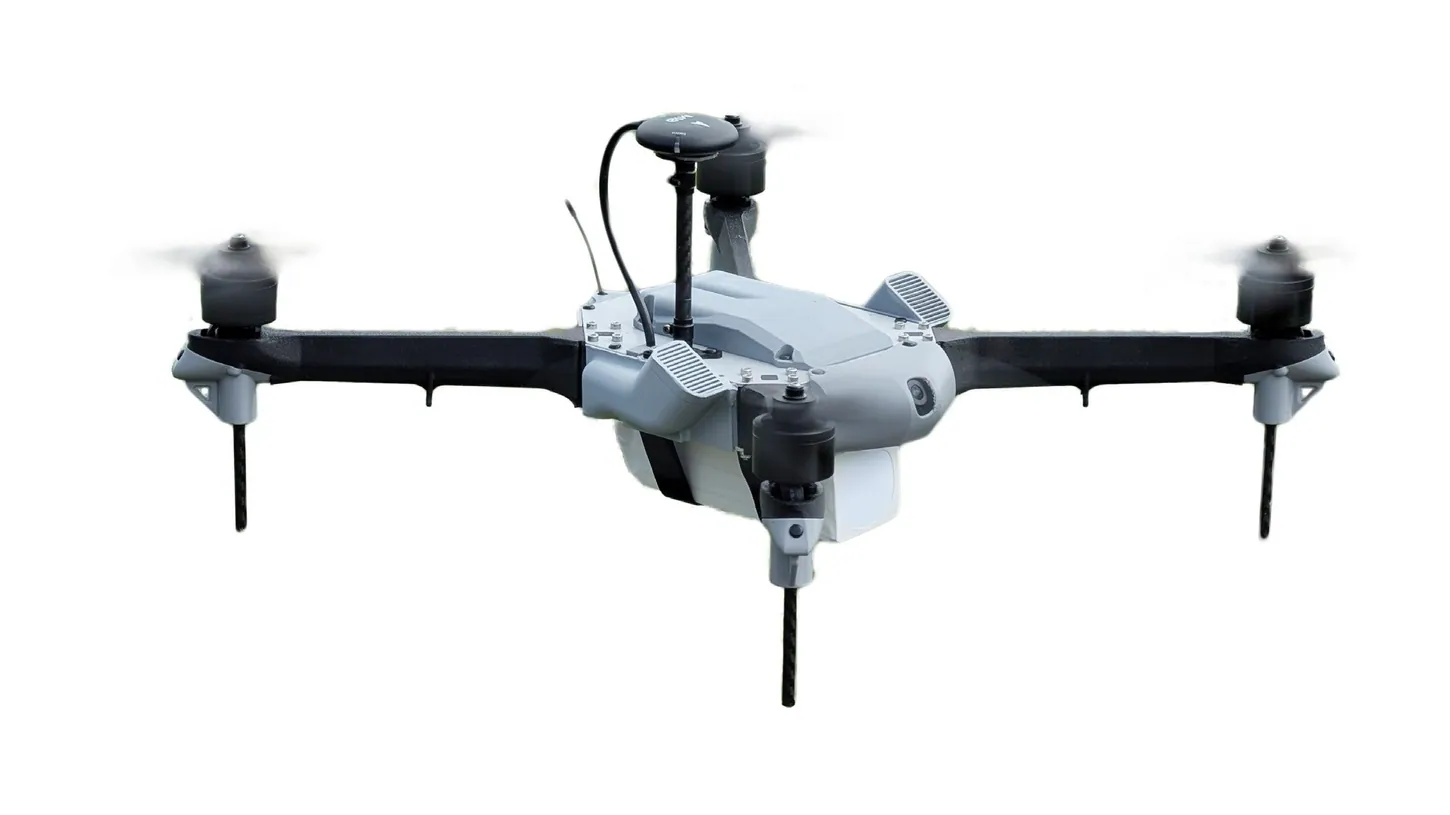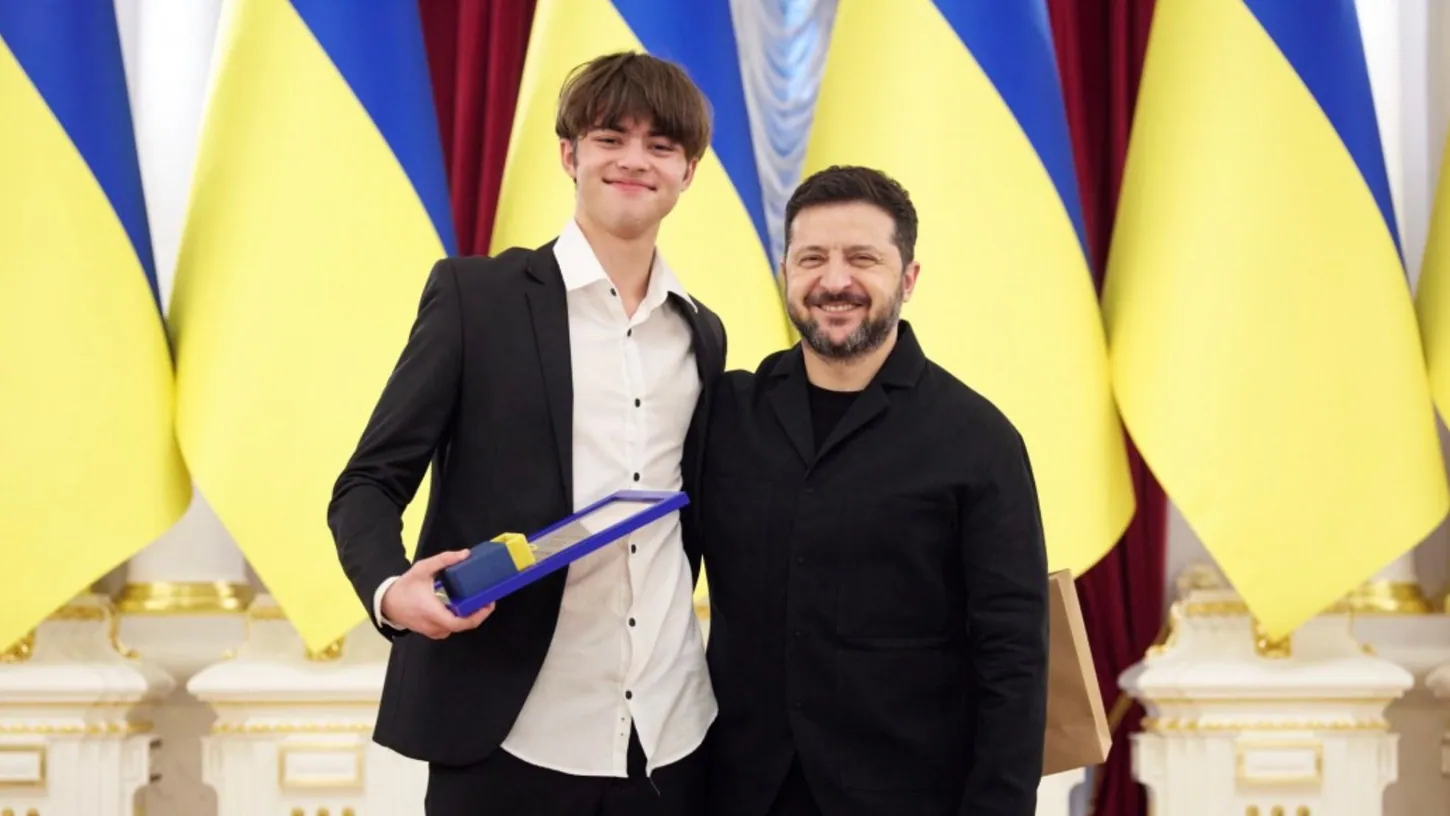
President Volodymyr Zelenskyy gave Yaroslav Sheiko, an 11th-grader at Lyceum No. 33 in Poltava, the presidential “Future of Ukraine” award on November 20, Ukraine’s Children’s Day. Sheiko was honored for drone autopilot and optical stabilization systems, and TechRadar has since described his work as AI-powered navigation that guides drones without GPS.
Sheiko’s own project video describes a GPS-free autopilot that costs less than $35 to build and lists artificial intelligence as a future step. It reports a guided flight of nearly a kilometer, and it gives no figure for how close the drone came to its target.
Sheiko’s Autopilot Runs on a $15 Raspberry Pi and a Classic Tracking Method
The autopilot is a Raspberry Pi, which Sheiko prices at about $15, wired to the drone’s existing camera and flight controller. His algorithm combines optical odometry with inertial sensors and sends the flight controller attitude commands. Once the operator points at a target, the Lucas-Kanade method locks onto it.
Lucas-Kanade is an optical-flow technique published in 1981, and nothing in the video describes a trained model. The AI comes at the end, as a plan: “integrating AI will enable the drone to identify objects autonomously,” Sheiko says, instead of tracking a target the operator picked. The award citation, as UNN reported it from the Office of the President, credits him with autopilot and stabilization systems using AI, and a Poltavawave profile built on the regional Junior Academy of Sciences’ information ties the AI to his separate stabilization project.
Sheiko’s Video Reports a Near-Kilometer Flight but No Miss Distance
In the video’s final test, Sheiko says the system guided a drone to its target from nearly a kilometer (about 0.6 miles) away at more than 43 mph (70 km/h), correcting for crosswind. The drone holds altitude most of the way, then descends on a parabola near the target.
He says professional optical navigation systems cost over $1,000, and that even $30,000 is not the ceiling. His costs less than $35, and he says no other system matched its mix of accuracy, low cost and ease of manufacturing. The video also says the system tracks moving targets and works day and night. It does not say how close the drone got to the target, what it flew on, or how often it missed. He names adapting the system to fixed-wing drones as the next step, and he holds a multirotor in the video’s closing frame. His failsafe paper, below, used a fixed-wing plane. A QR code in the video leads to test footage, which DroneXL has not reviewed.
TechRadar’s November 25 story said details on “operational testing, navigation accuracy, maximum range” had not been disclosed. The video, embedded on Sheiko’s INOVA 2025 exhibit listing, answers the range question. The project won gold in Zagreb, as did all 15 students Ukraine’s Junior Academy of Sciences sent to INOVA 2025, an event with teams from 25 countries, Nova Ukrainska Shkola reported.
Sheiko’s Radio Failsafe Is the Part He Published With Flight Data
The video says the autopilot takes over when the drone loses its operator link. It points to his published paper. That April 2025 paper adds a new failsafe action to ArduPlane, the fixed-wing version of the open-source ArduPilot firmware, so an onboard computer takes over when the radio drops.
He wrote it, under the spelling Sheyko, with Nataliia Kryvko, his math and informatics teacher, and Oleksandr Shefer, who heads the automation, electronics and telecommunications department at Yuri Kondratyuk Poltava Polytechnic National University. Electronics and Control Systems, a National Aviation University journal, published it on April 8, 2025. A new MAVLink message, FBWAG_NOTICE, tells the companion computer the radio is gone. The two sides confirm each other’s messages, and if the companion computer stays silent after three tries, the aircraft falls back to Return to Launch.
The test aircraft was a fixed-wing drone with a SpeedyBee F405 V4 flight controller running a modified ArduPlane 4.5.7, a Raspberry Pi Zero 2W as the companion computer and a RadioMaster TX16S transmitter. Sheiko flew four scenarios, five flights each. Manual control worked every time. With the plane at 328 feet (100 meters) and the transmitter switched off, the Pi took over on all five flights. With half the MAVLink packets deliberately dropped, it took over on four, and on the fifth flight the plane returned to launch. With the Pi shut down as well, the plane returned to launch on all five.
The tests ran on an open-field range with low radio interference, not under jamming. The example companion-computer code leaves out the flight-control commands, and the authors call it “not ready for the full cycle of air testing.” The paper’s timing figures don’t agree either: the same test reports a 0.2 to 0.3 second switch and a 0.8 second average from radio loss to takeover. ArduPilot’s published parameter list for Plane has no such failsafe option, so pilots running stock ArduPlane don’t have it.
DroneXL’s Take
Sheiko’s $35 price matters more than the AI label the coverage gave him. Vermeer’s founder put the cost of his camera navigation kit at roughly $20,000 per aircraft. A Raspberry Pi running a 1981 tracking method and inertial math is a different class of product, and if it works, it is cheap enough to bolt onto drones that are built to be lost. I’d want a number before I believed it, though. The Orqa drones that flew for Green Berets were judged on completing missions with GPS and radio both jammed, and Sheiko’s guidance has no published miss distance and no test under jamming. His failsafe paper shows he can write up 20 flights honestly, including the one that didn’t go to plan. He should do the same for the guidance, and send the failsafe change to ArduPilot, where people who fly ArduPlane every day would review it.
Sources: Yaroslav Sheiko’s INOVA 2025 project video, Electronics and Control Systems (Sheyko, Kryvko and Shefer, 2025), INOVA 2025 exhibit listing, TechRadar, UNN, Poltavawave, Nova Ukrainska Shkola.
DroneXL uses automated tools to support research and source retrieval. All reporting and editorial perspectives are by Haye Kesteloo. Read our editorial standards.
Advertise with DroneXLYour company hereReach 200,000+ drone readers a month with a sponsored article, a banner on your beat, or a partnership.See the options →