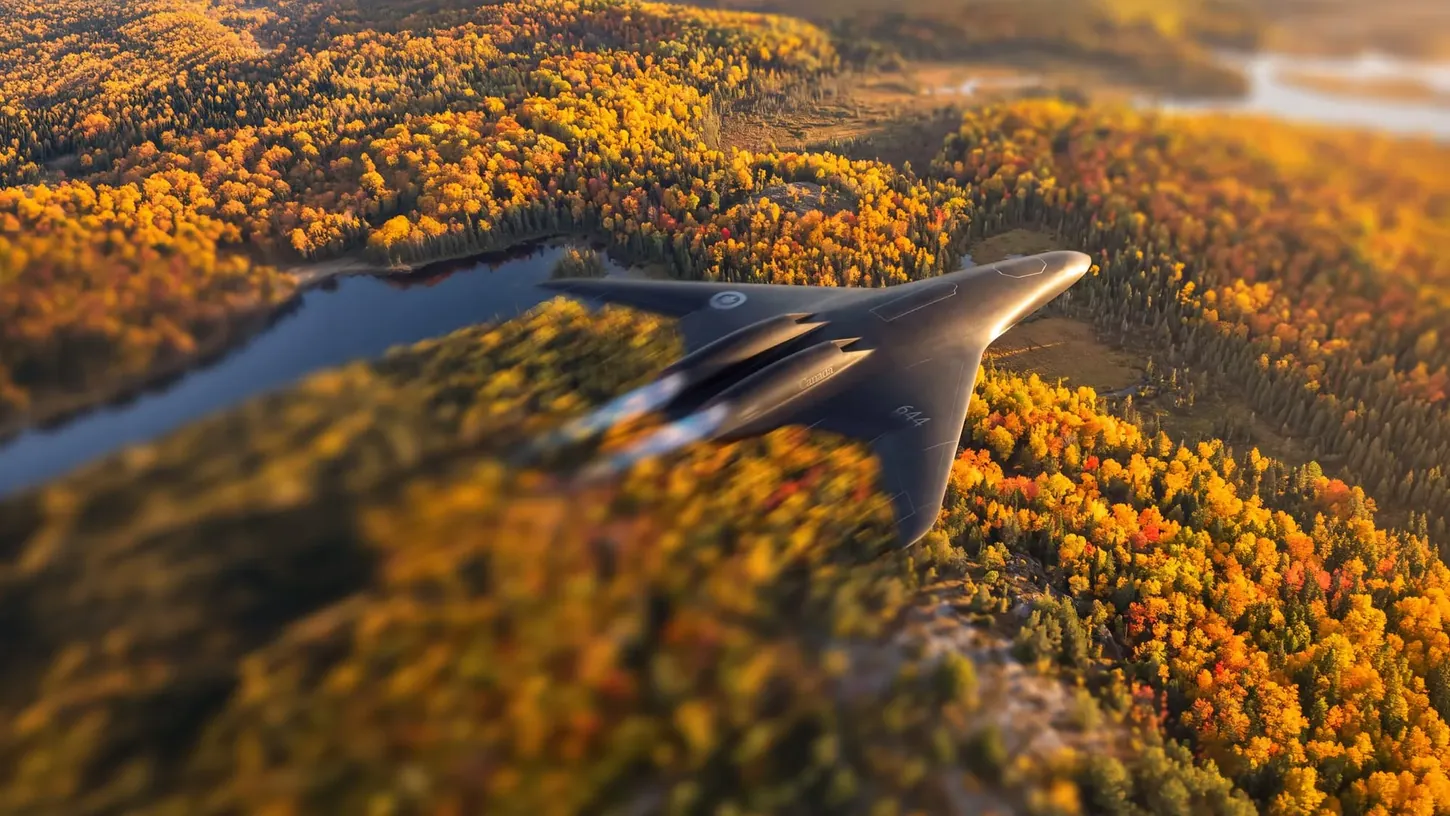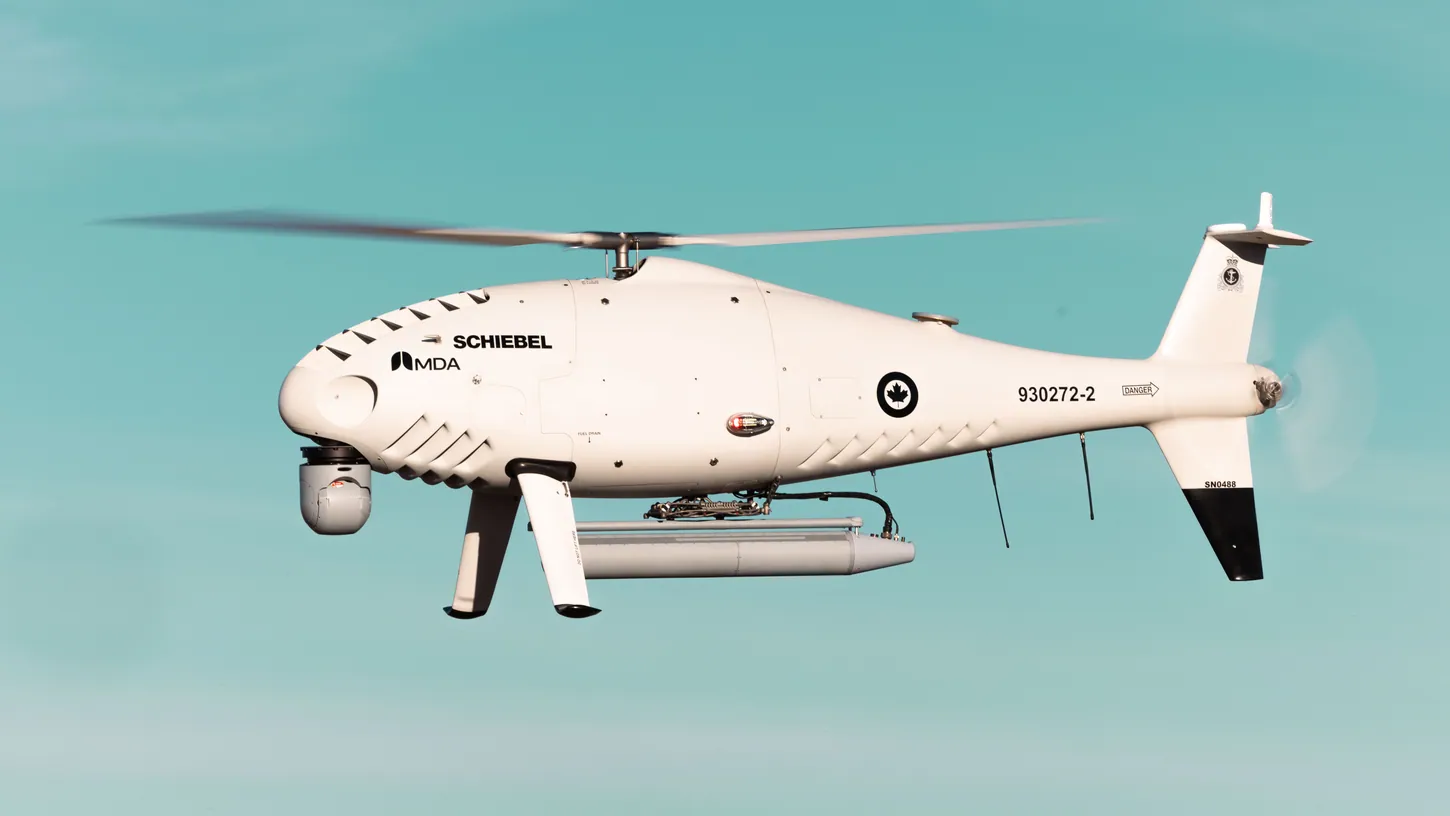
The Royal Canadian Navy’s first drone helicopter, the CU179 Peregrine, flew test sorties off Nanoose Bay, British Columbia, on Thursday and Friday, November 26 and 27, and anyone with a flight-tracking website could follow along. The aircraft broadcast its position over ADS-B (Automatic Dependent Surveillance-Broadcast) under the callsign NOMAD01, and Vancouver tech journalist Peter Vogel spotted it on both days.
The Peregrine is the navy’s version of the Schiebel Camcopter S-100, the Austrian helicopter drone Canada chose in 2025 for its Halifax-class frigates. It made its first flight on September 1 at the same test range on Vancouver Island. Its first launch from a frigate is not planned until 2027.
NOMAD01 Broadcast a Military Drone Tag and an 11-Knot Loiter
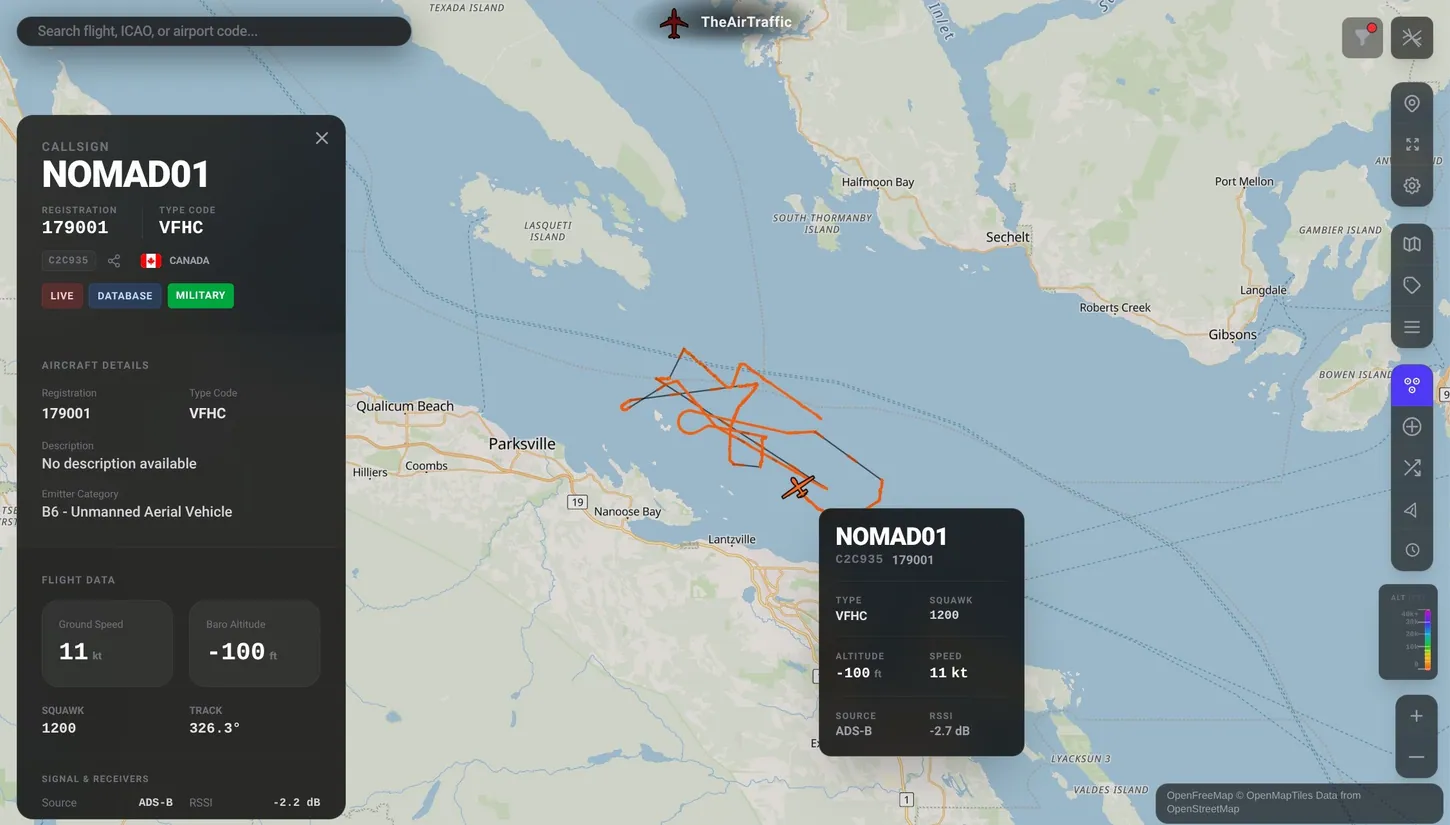
Vogel’s Friday screenshot from the TheAirTraffic tracker shows NOMAD01 with registration 179001, ICAO code C2C935, a Canadian military tag and the emitter category “Unmanned Aerial Vehicle.” The aircraft was flying a tangle of loops over the Strait of Georgia between Nanoose Bay and Lasqueti Island at 11 knots (13 mph).
The registration matches the CU179 designation, and the location is the navy’s own test range. Vogel first flagged the aircraft on Thursday, over the Salish Sea north of Nanaimo at 200 feet (61 meters) and 7 knots. In his Friday post he named the type and described its job as over-the-horizon intelligence gathering. “As a helicopter-type UAV it flies low and slowly,” he wrote.
The same Friday screenshot gives a barometric altitude of minus 100 feet. That figure comes from air pressure rather than a measurement of height above the water, and Thursday’s 200 feet is the more believable number. Defence Blog reported the Friday track on Saturday from Vogel’s post and the navy’s published record.
Canada Awarded About C$39 Million for Its First Two Peregrines
Ottawa awarded MDA Space two contracts on August 5, 2025, according to National Defence. The first, worth about C$39 million, buys two aircraft with options for four more. The second covers five years of support for about C$27 million and can be extended to 20 years.
Schiebel confirmed in September 2025 that it supplies the aircraft to MDA, and says the S-100 gives a ship real-time surveillance out to 100 nautical miles (115 miles). National Defence says the Canadian aircraft carries wide-area surveillance payloads and long-range radar. The 2025 release frames the job as long-range surveillance and targeting for the frigates. The Royal Navy, which is now testing the much larger Proteus helicopter drone, already flies its own S-100 under the same Peregrine name.
The Navy Will Fly the Peregrine From Other Platforms Before a Frigate in 2027
The navy told Shephard in October that the Peregrine will first launch and recover from other maritime platforms, for testing, training and writing shipboard procedures. The first launch from a Halifax-class frigate is planned for 2027, with initial operational capability in the first quarter of 2028.
Navy spokesperson Lt. Cdr. Michaël X Déry gave that timeline in the Shephard report. Full operational capability was set for 2032 when the contracts were awarded. Integration with the River-class destroyers, the ships the Peregrine moves to after the frigates, has not been worked out yet, Shephard reported.
The navy’s Advanced Naval Capabilities Unit flies the aircraft at the Canadian Forces Maritime Experimental and Test Ranges near Nanaimo, National Defence said. For the first flight campaign, from August 24 to September 4, the navy flew beyond visual line of sight with a ground-based radar watching the airspace. Canadian UAVs, which supplied its Sparrowhawk detect-and-avoid system, says its radar spotted a range incursion on September 1 and the Peregrine was held on its helipad until the airspace cleared. It also caught a low-flying general aviation aircraft crossing the restricted area without transmitting ADS-B, a plane no ADS-B tracker would have shown.
DroneXL’s Take
Canada is taking seven years to bring a drone helicopter that other navies already fly to full capability. The contract was signed in August 2025 and full capability is due in 2032, with a first operational step in early 2028, for an aircraft National Defence itself calls internationally proven. Some of that time is honest work: this is the first drone of its class the navy will operate, and its sailors still have to write the procedures for flying one off a frigate deck. But two aircraft and a deck trial in 2027 is a slow pace for a government that announced more than C$900 million for drone and aerospace programs this year. I’d watch the options for four more aircraft. Until Ottawa exercises them, the Peregrine is a two-aircraft test program, and the best public view of it is a flight tracker.
Sources: Peter Vogel on X, National Defence, Shephard, Schiebel, Canadian UAVs, Defence Blog
DroneXL uses automated tools to support research and source retrieval. All reporting and editorial perspectives are by Haye Kesteloo. Read our editorial standards.
Advertise with DroneXLYour company hereReach 200,000+ drone readers a month with a sponsored article, a banner on your beat, or a partnership.See the options →