
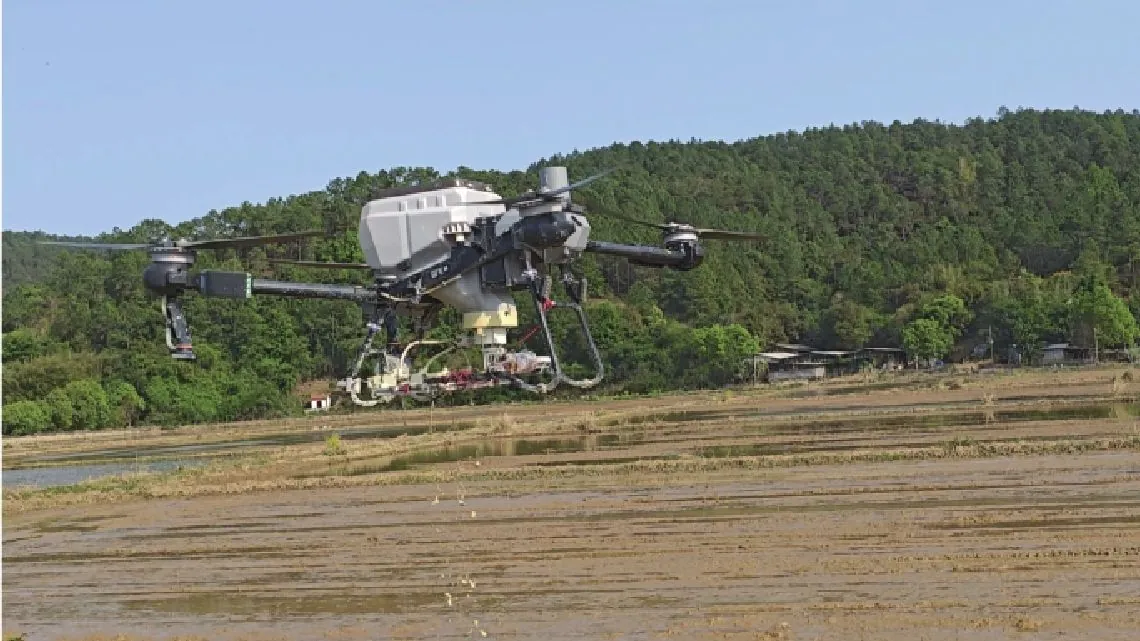
Researchers at South China Agricultural University in Guangzhou have built a drone seeding system that shoots germinated rice into a paddy in rows instead of scattering it. In a field trial harvested in November 2025, plots seeded this way yielded 6,731 kg per hectare (about 6,000 pounds per acre), against 6,040 kg for plots seeded by a conventional broadcasting drone. That is an 11% gain.
The six-person team, with professor Zhou Zhiyan as corresponding author, published the design last month. The drone flew at 4.5 mph (2 m/s), 6.6 feet (2 meters) above the mud, and hit its rows more tightly than the same rig running a store-bought pump.
A 3-Inch Impeller Pump Fires Germinated Rice Past the Rotor Wash
Broadcast drone seeding lets seed fall through the rotor downwash, which pushes it off course. The SCAU team’s fix is speed: a pump pressurizes a seed slurry and fires it out in 10 Hz pulses, fast enough to limit how far the downwash pushes seeds off line.
The slurry is soaked, sprouted rice mixed with cellulose powder, bentonite clay and water. Pumping it is the hard part, because a pump built for liquids clogs, cracks seeds or loses pressure. The team compared an axial-flow pump, a helical impeller pump and a semi-open impeller pump, and the semi-open design scored 0.985 on their weighted index against 0.464 and 0.231.
Simulation and bench tests then settled on four blades, a 76 mm (3-inch) impeller and a 22 mm blade width. That pump moved 1.12 kg of slurry per second and cracked 0.74% of seeds, under the 0.8% ceiling China’s national standard sets for drone rice seeding. The commercial benchmark is still broadcasting, the method XAG brought to rice in 2020 with a granule spreader that blows seed from the air.
The Prototype Held Tighter Rows Than a Store-Bought Pump
The prototype seeded a test site in Zengcheng district on August 9, 2025. Its seed clusters landed with a standard deviation of 2.0 cm (0.8 inches) from the target line, against 2.9 cm (1.1 inches) for a commercial Seaflo DC pump on the same rig.
The coefficient of variation in spacing between clusters was 13.2%, against 18.6% with the commercial pump, which the team had used in earlier trials.
Those figures come from three sampling frames per pump, ten seed clusters each, and they are the strongest numbers in the paper. Row placement is what separates this from the spinner spreaders Ohio State was testing in 2024.
The 11% Yield Gain Rests on Three Square Meters per Method
The yield comparison is thinner. The team harvested three 1-square-meter (10.8 square feet) plots per seeding method on November 22, 2025, at one site in one season. Pulsed-jet plots ranged from 6,430 to 7,028 kg per hectare, broadcast plots from 5,798 to 6,337. Every pulsed-jet plot out-yielded every broadcast plot.
The authors list two problems of their own. The pump draws a lot of power at its working voltage. And the team cannot yet control precisely how deep the seed goes into the mud, which depends on exit speed in ways it has not worked out.
The study is in Transactions of the Chinese Society of Agricultural Engineering, volume 42, issue 19.
DroneXL’s Take
I’d look past the 11% to the 2.0 cm. Every pulsed-jet plot beat every broadcast plot, but three square meters per method from one field is a promising sign. It isn’t a yield trial. Row accuracy is the real advance, because an orderly crop is what transplanting machines exist to produce, and drones that can do it skip the nursery and the tractor in fields too small or wet for either. This is drones-for-good work, done by a university lab with a provincial grant. American rice growers are unlikely to see the Chinese hardware that eventually carries it: the FCC’s December 2025 Covered List decision froze new foreign drone models out of US authorization, and as we noted in January, US farmers have no domestic spray drone at DJI’s scale to turn to.
Source: Yang Yu et al., Transactions of the Chinese Society of Agricultural Engineering, South China Morning Post, XAG
DroneXL uses automated tools to support research and source retrieval. All reporting and editorial perspectives are by Haye Kesteloo. Read our editorial standards.


